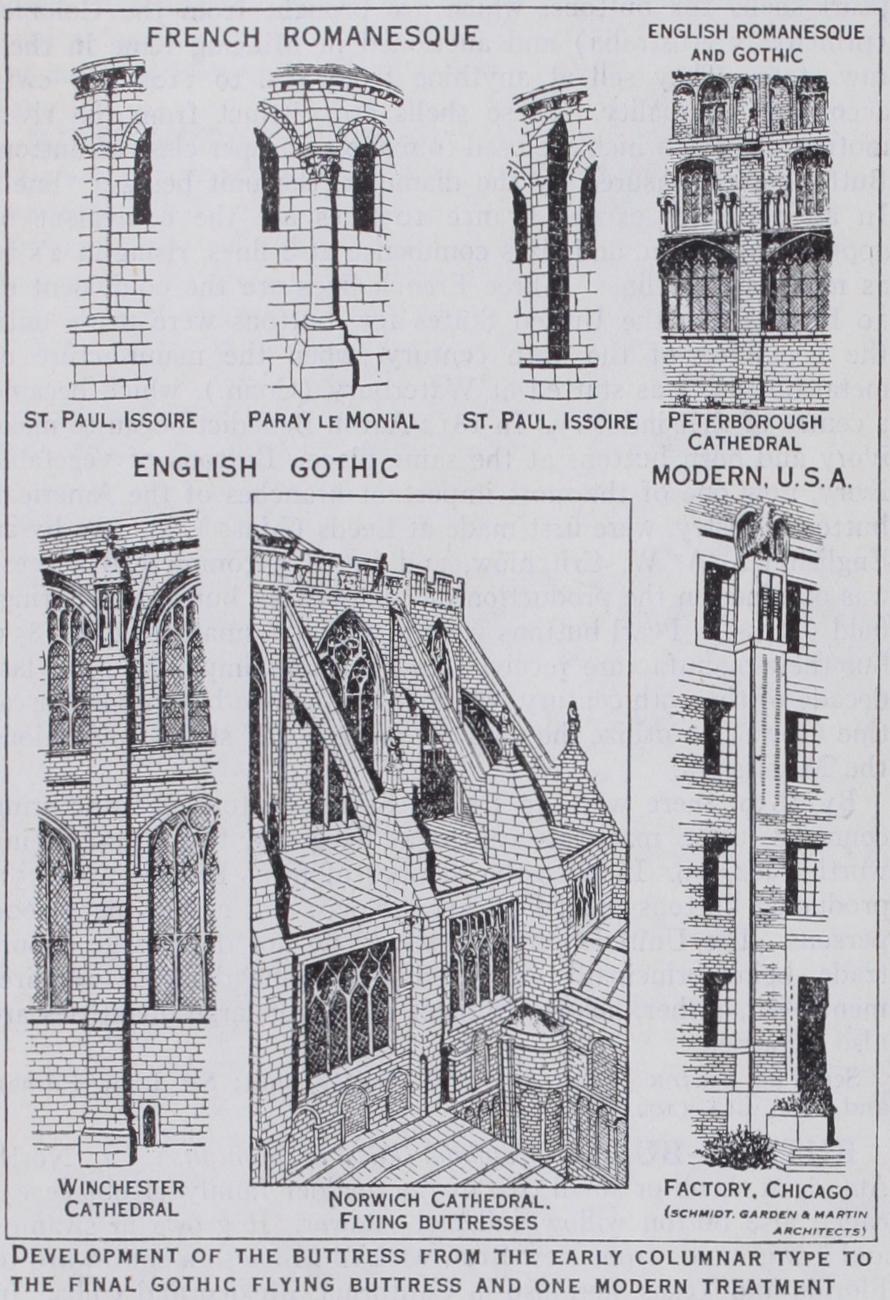
BUTTRESS, a mass of masonry projecting from the face of a wall, either to strengthen the wall or to resist the side thrust of an arch, roof or vault abutting against that wall (see ABUTMENT). Until the extensive development of vaulting there was little need for buttresses, and therefore they are not found prior to the Roman period. In such buildings, however, as the great thermae of the Roman empire, the enormous vaults rendered careful buttressing a necessity. The Romans always attempted to com bine their buttresses with necessary cross walls in the plan. Even when this could not be done and the buttresses showed externally (as in portions of the villa of Hadrian at Tivoli and the baths of Diocletian at Rome) no special architectural treatment was de veloped for them. Byzantine buttresses follow Roman precedent. In early Romanesque work buttresses occasionally occur as mere pilaster strips used largely for decorative purposes, and it was only with the rapid development of the vaulting of churches, in the 12th century, that buttresses of large size became necessary. Employed first around the apses of French churches these but tresses took form originally as engaged columns, complete with capital and base, and sometimes topped with a cone ; then, as projecting masses of masonry with a steep slope at the top to shed the water. When naves came generally to be vaulted with ribbed and groined vaults, the tremendous concentration of thrusts at each bay rendered necessary an entirely new study of the buttress problem. The solution was only reached satisfactorily in the Gothic period. The Gothic builders seized upon this struc tural necessity and transformed it into one of their greatest op portunities for achieving architectural effect. The flying buttress (q.v.), the pinnacles which by weighting a buttress at its top increased its efficiency, the gables, and the moulded offsets all helped the buttress to function. In the later period of French Gothic, sculpture was frequently added; in the late Gothic styles in all countries the tendency was towards over-elaboration and thinness. In modern work, due to the almost universal abandon ment of structural vaults, buttresses are used only to strengthen thin walls as in retaining walls and the like, and are usually treated in the simplest manner possible. (T. F. H.)