
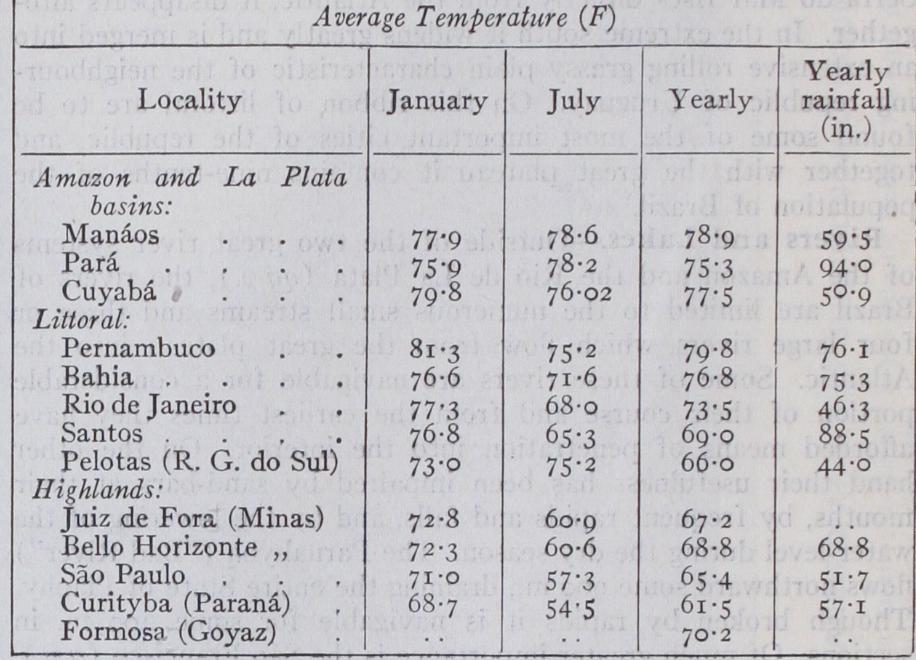
CLIMATE General Considerations.—Brazil lies almost entirely within the torrid zone, less than one-twelfth of its area extending south of the tropic of Capricorn. It is often assumed, therefore, that the climate is predominantly tropical. But happily for Brazil the effects of latitude are modified by a number of other factors, such as altitude, prevailing winds, rainfall and distance from the sea. As a consequence there are considerable variations of cli mate, ranging from tropical in the Amazon valley and along the coastal belt as far south as Santos, to subtropical and temperate throughout large parts of the great Brazilian plateau and the three southern States of the republic.
The accompanying table, based largely on the data in Delgado de Carvalho, Meteorologie du Bresil (1917), indicates the tempera ture and rainfall at various points in the republic.
This fact is due in part at least to the higher infant mortality among the negro elements. The increase of the proportions of whites has also been greatly accelerated during the last four decades by the large influx of European immigrants. The Brazilian population is apparently undergoing a transformation by which the mulatto element is increasing in relation to the pure negroes, while falling behind in relation to the pure whites. This process, called by the Brazilians the "arianization" of the race, will result, in the opinion of some authorities, in the disappearance of the pure negro element by the end of another century.
Immigration, which in 1913 amounted to 192,684, almost entirely ceased during the World War. The flow was resumed dur ing the twenties, rising to a figure of 121,596 in 1926. But thereafter it generally declined until 1931 when just 31,410 newcomers entered the country. During the next so years Brazil could advantageously absorb 1 oo,000 immigrants annually with out adversely affecting the homogeneity of its population, pro vided these additions were more evenly distributed than has been the case in the past.
ment tutelage until they become economically independent, or have been placed on the large plantations, chiefly coffee, under formal contract. The total number of immigrants registered from 1820 to 1931 was 4,549,869. Of this total almost one-third, namely, 1,492,879, were Italians; next came the Portuguese with 1,350,027, while the third largest group were Spaniards, who fur nished a total of 588,511. Thus the three Latin countries of According to the Retrospecto Commercial of the Jornal do Commercio for 1926 the population of Brazil on Dec. 31, 1926 was 36,870,972.
Organization of the Government.—The overthrow of the monarchy on Nov. 15, 1889 resulted in the creation of a Federal republic under the name of the United States of Brazil (Estados Unidos do Brasil). The present Constitution, promulgated Feb. 24, 1891, and amended Sept. 3, 1926, follows in the main the constitution of the United States of America. The republic consists of 20 States, the Federal district, and the territory of Acre. The relations between the national and State Governments are carefully defined. The former has the exclusive right to direct the foreign affairs of the republic, to maintain an army and navy, to levy import duties, to regulate foreign commerce, to issue money, and to maintain the postal and telegraph service. To the States are left all those faculties not expressly denied them by the Federal Constitution. Chief among these are the right of self-government, the right to levy export taxes, the exclusive control of the public lands, mines and industries. They are charged with the support of primary education, the maintenance of order and the support of a system of State courts. According to the Constitution as originally adopted the National Govern ment is forbidden to interfere in the States except to repel in vasion, to maintain a republican form of government, to enforce the execution of Federal laws, and to re-establish order at the request of the States themselves. The amendments of 1926 con siderably expanded this right of interference. The Federal Govern ment may intervene for instance "to reorganize the finances of any State whose inability to lead an autonomous life shall have been demonstrated by the discontinuance for more than two years of payment of its funded debt." (Art. 6, par. 4.) The Executive Power.—The Constitution clearly recognizes the principle of the separation of powers : "The organs of the national sovereignty are the legislative, the executive, and the judicial power, harmonious with and independent of each other." The executive power is vested in a president, elected for a term of four years by a direct vote of the electors. He must be a native of Brazil, over 35 years of age. He is ineligible for the succeeding term. A vice-president is elected at the same time and under the same conditions. He succeeds to the presidency in case the office becomes vacant during the last two years of the presidential term. If the vacancy occurs during the first two years a new election must be held. The president receives a salary of 120,000 milreis and 265,000 milreis for expenses of his residence, the equivalent of about £io,000 in all. The ministry contains seven portfolios, viz., foreign affairs; finance; agricul ture, industry and commerce; traffic and public works; justice and internal affairs; war; marine. The ministers are responsible to the president, who appoints or removes them with absolute discretion. The president sanctions or vetoes laws passed by congress, is in supreme command of the army and navy and possesses wide appointive power. (One of the amendments adopted in 1926 authorizes him to expel from Brazil any foreign subject dangerous to the public order.) The powers of Federal intervention and declaration of a state of siege, though subject to the control of congress, are in reality largely exercised by the president. Both constitutionally and politically the Brazilian executive is stronger than the president of the United States.
The Judicial Power.—The judicial system consists of a su preme Federal tribunal of 15 judges in the national capital and a district court in each of the 21 units of the federation. One mem ber of the supreme tribunal holds the position of solicitor-general of the republic. The judges and solicitor-general are appointed for life by the president with the approval of the senate. The supreme tribunal has original and appellate jurisdiction and like the Supreme Court of the United States has power to pass on the constitutionality of Federal and State laws. The district Federal courts have original jurisdiction in Federal causes. Brazil has Federal codes covering the domain of civil, criminal and com mercial law.
State and Local Government.—In the main the Govern ments of the 20 States are similar to that of the Union. The separation of powers is observed, at least in theory. In practice the governmental functions of the various States reveal wide diver gences due to differences in population and resources. In popu lous and progressive States like Sao Paulo and Minas Geraes a genuinely democratic regime prevails and public opinion finds full expression. In some of the thinly populated States, where condi tions are backward, political power is concentrated in the hands of a few large landholders, sometimes even in a single family. The Brazilians themselves describe them as "feudal States." Munici palities, of which in 192o there were 1,300, in theory enjoy a large amount of self-government, with an elective council and a pre fect. In practice, save in the case of the larger cities, the munici palities are subject to the political control of the State administra tion. The prefect of the Federal district is appointed by the president of the republic.
Though marked progress has been made in recent years, the educational system in Brazil is still unsatisfactory. According to the census of 192o illiteracy ranged from 38% in the Federal district to 88% in the State of Piauhy. For the entire republic the figures are 75.5%, or 64.9% of the population over 15 years of age. There is no ministry of public instruction in Brazil but only a national department of education within the ministry of justice and internal affairs. With the assistance of the national council of education this department exercises supervision over primary education in the Federal district and the Acre territory and secondary and higher education throughout the republic. A law passed in 1924 authorizes the Federal Government to grant aid to the States for the maintenance of rural schools in the immigrant settlements.
Primary Education.—Primary education is free but not com pulsory save in the States of Ceara, Maranhao, Alagoas, Matto Grosso, Minas Geraes, Sao Paulo and Santa Catharina. Except as noted above, it is under the control of the States and munici palities. In 1925 approximately £1,500,000 was expended by the States for elementary education and £400,000 by the Federal Government. The returns for 1920 show 1,249,449 pupils enrolled in 12,748 elementary schools, the great majority of which have a course of only four years.
Secondary Education.—Secondary education is provided by the Federal Government, by the States and by private agencies. The courses in the Government schools, known as collegios, gym nasios, lyceus, were fixed in 1925 at six years. The Collegio Dom Pedro II., located in the capital, is the only Federal secondary school in Brazil. It is regarded as a model for all other schools of its kind. In 1924 there were 56 secondary schools under Govern ment control or supervision. In addition there were a large num ber under private auspices, many of them maintained by the Catholic Church and by Protestant churches in Great Britain and the United States. Some of these schools have collegiate depart ments. Among the best of these institutions founded or main tained under Protestant auspices are Mackenzie college in Sao Paulo and Collegio Bennett in Rio de Janeiro. Normal schools, in some cases combined with secondary schools, are to be found in the State capitals and in Rio de Janeiro. In recent years their standards have risen noticeably. The normal school at Sao Paulo is one of the best in South America.
Higher Education.—Higher education, wholly of a profes sional character, was given in a number of independent faculties until 192o, when the University of Rio de Janeiro was created by the amalgamation of the faculties of law, medicine and en gineering. In 1924 there were in Brazil ten law faculties, six schools of medicine, six schools of engineering, besides a number of schools of pharmacy and dentistry. The Federal Government also supports four military schools, a naval academy and several schools of agriculture. Finally there are a number of professional, technical, commercial and trade schools under Federal or State control. The State School of Mines at Ouro Preto in Minas Geraes should be singled out for special mention.
Museums, Art Galleries and Libraries.—Several museums of note are to be found in Rio de Janeiro. The former palace of Dom Pedro II. at the Quinta da Boa Vista has been transformed into a museum of geology and natural history. An excellent his torical museum, especially rich in mementos of the imperial epoch, dates from the centenary of Brazilian independence (1922). The National school of art contains collections of the old masters as well as many works of Brazilian artists, notably those of Pedro Americo de Figueiredo. The National library, whose foundation goes back to 1807, contains over half a million volumes and a wealth of manuscript material. In the suburbs of Sao Paulo, on the site of the proclamation of Brazilian independence in 1822, is the Paulista museum, containing one of the best natural history collections in South America.
Learned Societies.—Of the many learned societies in Brazil but two call for mention. The Brazilian Academy of Letters, founded in 1889, is modelled upon the French Academy. Its 40 members include many of the names famous in Brazilian litera ture. The Brazilian Historical and Geographical Institute (Insti tute Historico e Geographico Brasileiro) is the oldest South American historical society now in existence. It dates from 1838 and its quarterly review is a vast repository of material on Brazilian history and geography.
Under the empire the Roman Catholic Church had been recog nized and supported by the State, but with the advent of the republic (1889) Church and State were entirely separated. Civil marriage, the civil registration of births and deaths, and the secu larization of cemeteries followed. Yet the overwhelming majority of the Brazilians are at least nominally Catholic, as is also true of the bulk of the immigrants. Ecclesiastically Brazil is divided into 20 dioceses under the archbishop of Rio de Janeiro, who was raised to the dignity of a cardinal in 1905. Complete religious toleration has long prevailed in Brazil and Protestantism has made some progress, especially in the domain of education. In 1923 there were 120 evangelical centres and 700 organized churches, most of the latter being small. The Lutheran Church, whose pastors are largely recruited from Germany, claimed 342 congregations, 195,700 members, and 200 parochial schools.
Religion and charity have always been closely associated in Brazil. Hospitals and asylums have been established by the Catholic Church throughout the country. A Misericordia hospital and a recolhimento, or asylum for orphan girls, are to be found in all the larger cities and towns. In 1922 the income of the hospitals in Rio alone amounted to 5,634 contos (some £136,000). In recent years the more progressive cities have expended large sums for public health and public assistance in general. These activities, which are closely co-ordinated with those of the Church, are in the capital under the general supervision of the Depart mento Municipal de Assistencia Publica. Athletics, especially foot ball and baseball, arouse great interest in Brazil. They have been encouraged by the public authorities and by the well-organized Young Men's Christian Associations.
Public Revenues and Expenditures.—The national revenue is derived in considerable part from duties on imports, the duties on exports having been surrendered to the States when the repub lic was organized. Since 1899 a varying percentage of the import duties—amounting to 6o% by the budget law of 1923—has been paid in gold in order to supply the Government with specie needed for its foreign remittances. In all official reports the reve nues and expenditures have therefore been calculated in gold and currency together, to the complete mystification not only of the foreigner but even of the average Brazilian. The gold milreis, which is never seen in circulation, has a value of approximately 27d. The value of the paper milreis varies according to the rate of exchange. One thousand milreis constitute a conto de reis. The following table gives in contos the revenue and expenditure for the years 1922-27, the figures for the last three years being estimates derived from the president's messages.
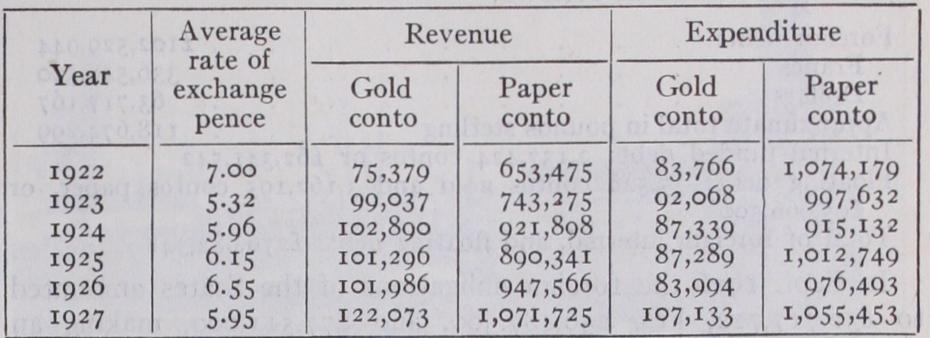
The figures for the budgetary estimates for 1927 converted into pounds sterling (at 6d. exchange) reveal a revenue of f47,300,000, with an expenditure of f44,900,000, leaving a surplus of £2,400, 000. But from this surplus must be deducted £2,200,000 bonus to public officials, leaving a net surplus of £200,000. If this estimate proves correct the year 1927 should mark a turning point in the financial history of Brazil. For the first time in many years the budget will have been balanced. Deficits were not uncommon during the empire but under the republic they have been the rule. For instance, the aggregate deficits for the years 1891-1904 were the equivalent of 143,240,000 and more recent years have revealed little improvement.
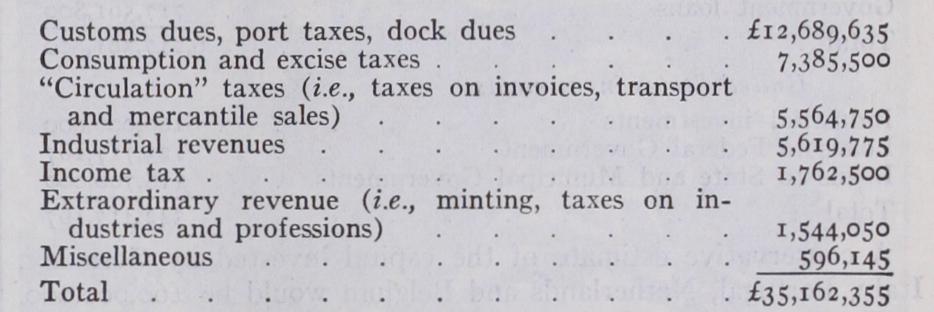
Revenues of the Federal Government.—The most impor tant sources of revenue, as revealed in the budget proposals for 1926, are as follows (conversion at 6d. exchange) : From this table it will be seen that a large proportion of the national revenue comes from indirect taxation, customs dues alone accounting for more than one-third of the total income. The in come tax, which first appears in the budgetary estimates for 1924, has proved difficult to collect, and represents barely 5% of the entire revenue of the Federal Government.
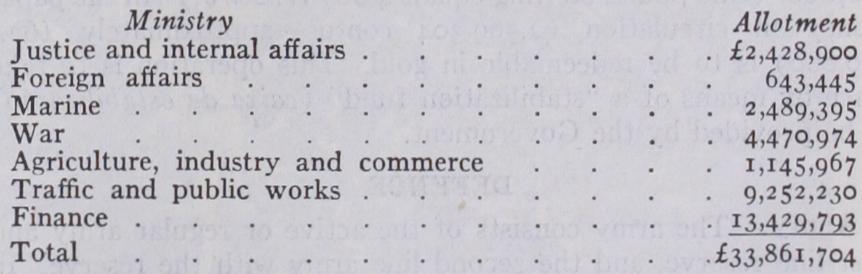
Expenditures of the Federal Government.—These may be made clear by the following table, likewise taken from the bud getary estimates for 1926: It should be noted that the expenditures of the Ministry of Finance, which include the service of the foreign and internal debt of the republic, amount to about 4o% of the total. The Government-owned railways make the heaviest draft on the budget of the ministry of traffic and public works. The funds expended by the ministry of justice and internal affairs are for the most part devoted to education and public health, those ex pended by the ministry of agriculture to colonization and the support of agricultural schools.
Foreign and Domestic Debts and Investments.—Brazil's foreign debt is partly a legacy of the empire. When the republic was established in 1889 it amounted approximately to f30,000,000. Since then the debt has been greatly increased and on two different occasions, the Government was forced to recur to funding loans with a temporary suspension of the sinking fund. Prior to 1908 all the loans were floated in London, from 1908 to 1916 consider able loans were raised in France and since 1921 heavy borrowing has been made in the United States. The Federal Government has never repudiated its foreign obligations. On Dec. 31, 1925, Brazil's, national debt stood as follows : Foreign debt: . . . . . . . . . Francs . . . . . . . . . Dollars . . . . . . . . . 63, 717,16 7 Approximate total in pounds sterling . . . 118,674,299 Internal funded debt: 2,13 7,424 contos or £62,341,542 Floating debt: 35,526 contos gold and 3,162,195 contos paper, or I95,666,500 Total of foreign, internal, and floating debt: £276,682,341 In Sept. 1926 the foreign obligations of the States amounted to £32,717,722, Frs. 256,487,500, and making an approximate total in pounds sterling of 50,776,975. At the same date the outstanding foreign indebtedness of the Brazilian munici palities amounted to L10,777,508, Frs. 373,665,00o, and 000, the equivalent in pounds sterling of 16,912,414. There are no reliable statistics available regarding the internal indebtedness of the States and municipalities.
Naturally, complete accuracy in regard to foreign investments is impossible, but the following figures, brought up to June 30, 1924, are believed to be approximately correct : British investments Industrial enterprises . . . . . . . Loans to Federal Government . . 102,633,294 Loans to State and Municipal Governments . . 60,636,430 Total . 284,275,268 French Investments Frs.
Industrial enterprises . . . . . . 1,500,000,000 Government loans . . . . . . . 717,561,800 Total . . 6,217,561,800 United States investments Industrial investments . . . . . . $100,000,000 Loans to Federal Government . . . . . 123,717,167 Loans to State and Municipal Governments . . 118,700,000 Total . . A conservative estimate of the capital invested by Germany, Italy, Portugal, Netherlands and Belgium would be £60,000,000.
The Brazilians are alive to the disadvantage of a fluctuating currency and the Government is taking steps towards putting the national finances on a gold basis. In 1923 the Federal Government transferred to the Bank of Brazil for a period of 5o years the sole right to issue currency; late in 1926 and early in 1927 legisla tion was enacted providing for the stabilization of the milreis. Henceforth the milreis is to be regarded as the gold equivalent to 200 milligrams of gold fine (equal to 6d.) and a new unit of currency called the cruzeiro, having a value of 1 o milreis, is to be adopted. (One pound sterling equals 4.067 cruzeiro.) All the paper money in circulation (2,569,304 contos—approximately £62, 000,000) is to be redeemable in gold. This operation is to take place by means of a "stabilization fund" (caixa de estabilizacdo) to be provided by the Government.
Army.—The army consists of the active or regular army and first line reserve, and the second line army with the reserve. In 1925 the nominal strength of the active army was 4,969 officers, 622 sergeants and instructors, and 42,393 privates. Its organization includes 7o battalions of infantry and 13 machine-gun companies, 19 regiments of cavalry of four squadrons each, 18 regiments of field artillery, and seven battalions of engineers. Military service, under the law of 1923, is in theory obligatory on all Brazilians from 21 to 44 years of age. Service in the active army consists of one to two years' training in the ranks, eight years in the reserve, and 14 years in the second line army (seven in the National Guard and seven in the National Guard reserve). It is estimated that mobilization would put ioo,000 men in the field. The requisite effectives are recruited by voluntary enlistment without bonus, and if this does not supply the necessary number, by compulsory service based on the drawing of lots. Military instruction is given in the Realengo Military academy at Rio. The military organiza tion is provided with an elaborate code and a system of 12 military courts which culminates in a supreme military tribunal. (P. A. M.) Navy.—In the year 1905 the Brazilian Navy lost its prin cipal unit by the destruction of the armoured turret ship "Aquibadan" by a magazine explosion in the Bay of Jacarepagua near Rio de Janeiro; but a naval programme was introduced in that same year, making provision for an appreciable modern fleet, and the principal units of the Brazilian navy are still the ships completed in the year 1909 under that programme. These in clude the two "dreadnought type" battleships "Minas Geraes" and "Sao Paulo" of 19,20o tons, armed with twelve i2in. and twenty-two 4.7in. guns, mounted similarly to those in the original British "Dreadnought"; two cruisers, the "Bahia" and the "Rio Grande do Sul" of 3,150 tons, armed with ten 4.7in. guns. An old coast defence ship and an obsolete cruiser complete the heavy ships of the Brazilian navy. There are eleven destroyers, all dating from 1908 to 1910, except one, formerly H.M.S. "Porpoise," 1914; and four submarines, three launched at Spezzia in 1914, and one more modern, the "Humayta," also built in Italy and completed in 1927. The remainder of the fleet is made up of small auxiliary vessels and river gunboats. The main naval base and naval school are situated at Rio de Janeiro. There are smaller arsenals at Para, Pernambuco, Sao Salvador and Ladario. (E. A.) Air Services.—During recent years growing attention has been devoted to the Air Force as an element of national defence. The military flying school, located in the suburbs of the capital, gives the necessary training to air pilots, observers, mechanics and expert artificers. A company of engineers is attached to the school. Among the special troops are listed 12 Air Force flights. The navy also maintains a well-equipped school. It is located on Gobernador island in the harbour of Rio de Janeiro.
Agriculture.—"Taking Brazil as a whole, no country in the world, owned by a European race, possesses so large a proportion of land available for the support of human life and productive industry." Thus does Lord Bryce (South America, Observations and Impressions, p. 404) bear witness to the enormous wealth, for the greater part still unexploited, locked up in Brazil's boundless extent of fertile land. Though Brazil is essentially an agricultural country, only 20% of its 2,000,000,00o ac. is occupied as farm lands, and of these lands barely 20%-an area equal to twice the size of England—is actually cultivated, the remainder being pasture and forest land. Between one-half and two-thirds of the cultivated area is to be found in the three States of Sao Paulo, Minas Geraes and Rio Grande do Sul.
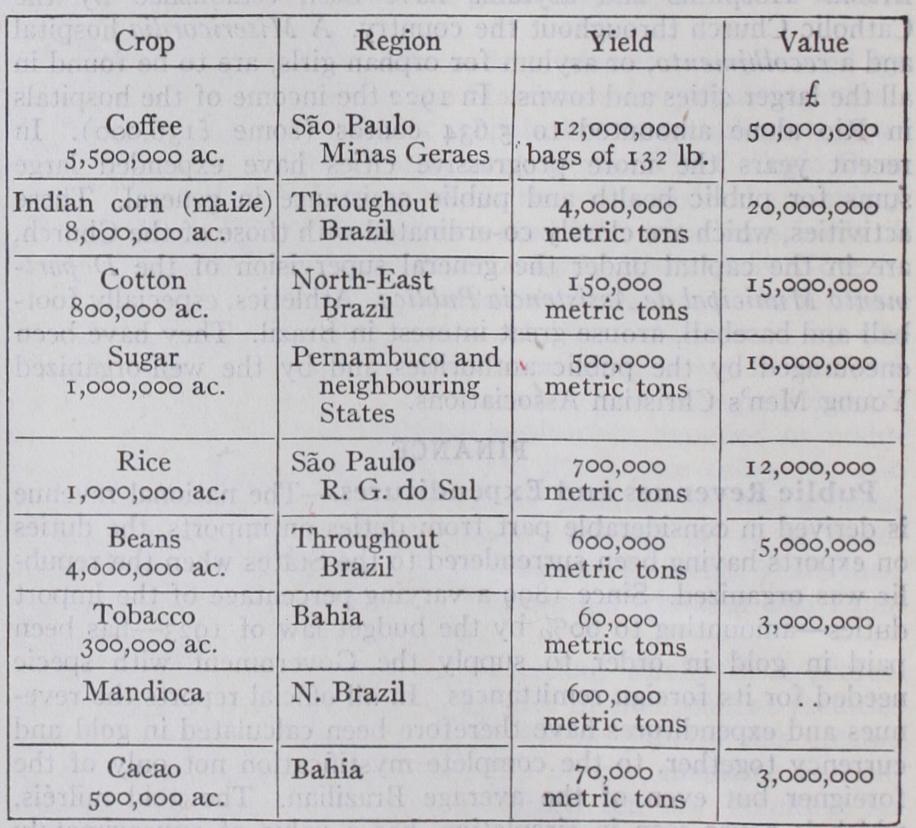
The accompanying table shows the most important crops, the areas planted, the region in which they are grown, the average yield and value. In most cases the figures are only approximate. Ac cording to the Retrospecto Commercial the total estimated value of the principal Brazilian crops for 1924-25 was 7,843,932 contos (approximately f i 88,o0o,o0o) .
Of these various crops the most important is coffee. From two thirds to three-fourths of the coffee production of the world is furnished by Brazil. Seventy per cent of this coffee is grown in the State of Sao Paulo, and one-half of the total crop is marketed in the United States.
Pastoral Industries.—During the past quarter century pas toral industries have made enormous strides in Brazil. By the census of 1920 there were in Brazil 34,271,324 beeves, 5,253,699 horses, 1,865,259 mules and asses, 7,933,437 sheep, goats, 16,168,549 hogs. Both the National Government and the more progressive States have done much to improve the quality of the cattle stock. The establishment during the World War of modern slaughtering and meat-packing plants gave the industry an immense stimulus. In 1928 there were in of these plants, largely owned by American and British capital. From 1917 to 1921 the exports of frozen and chilled meats averaged over 6o,000 metric tons a year. There is still a large demand for xarque or jerked beef and some 7o plants, supplying some 5o,000 metric tons, are devoted to the salting and drying of this meat. With the immense areas in central and southern Brazil adapted to cattle raising, Brazil seems destined eventually to outstrip Argentina, the United States and Australia as the greatest pur veyor of the world's meat supplies.
Fisheries.—Brazil is provided with an astounding variety of fishes, nearly an eighth of the approximately 20,000 known spe cies being found along her coast and in her rivers. Though a con siderable fishing population is to be found along the Atlantic seaboard and in the Amazon basin the fishing industry has never assumed a major importance, and cured fish, especially cod, continues to be a staple import. That there are considerable possibilities is obvious.
Forest Industries.—Here the chief items are rubber, mate or Paraguayan tea, Brazil nuts, vegetable wax, palm fibre, cabinet and other woods and the products of medicinal plants. Rubber is the chief product of the Amazon basin. In 1905 it represented 32% of the value of Brazil's exports, but fell in 1925 to less than 5%, due to the successful competition of the plantation-grown rubber of the East. The dried leaves of mate or Paraguayan tea, which grows extensively in the temperate regions of Brazil, finds a ready market in the Plate republics. The export of cabinet woods is small, due to the cost of transporting timber to the coast. In recent years the pine forests in temperate Brazil, espe cially in Parana, have been extensively exploited. But the forest industry is still in its infancy and we have the curious spectacle of the country with the greatest timber resources in the western hemisphere, if not in the world, exporting only 133,293 metric tons of lumber in 1925.
Mineral Wealth.—The yield from Brazil's mineral resources lags in value far behind the products of her plantations, pastures and forests. The annual gold output, which reached large pro portions during the i8th century, now amounts to some £600,000. It comes from two very deep British-owned mines in Minas Geraes. Diamonds are found in Minas Geraes and Bahia. The most valuable are probably the carbonados or black diamonds, chiefly used in drills for cutting purposes. The value of the average annual yield is probably less than 1300,000. Manganese, a metal indispensable in the making of steel, is found in large quantities in Minas Geraes. By all odds the most important of the potential mineral resources of Brazil is iron. The deposits in Minas Geraes are of almost fabulous extent. According to conservative estimates they contain over 12,000,000,000 tons of high grade ore. Unfortunately Brazil contains none of the coking coal necessary for smelting, while electric smelting is too expen sive to be practicable. Bituminous coal of poor quality (2o to 55% ash content) is found in Rio Grande do Sul and Santa Catharina. Some 400,000 metric tons were mined in 1925, as against 1,619,687 metric tons imported from England and the United States. Thus far no petroleum in paying quantities has been found in Brazil.
Manufactures.—Since the establishment of the republic it has been the avowed policy of the Government to encourage manufacturing industries by means of a high protective tariff. According to the census of 1920 there were 19,735 factories em ploying some 350,000 operatives. The capital employed exceeded f ioo,000,000. By 1925 the value of the yearly output had risen to approximately L200,000,000, an increase of nearly l00% over the figures for 1915. Textiles easily take the lead. At the begin ning of 1926 Brazil had 257 cotton mills equipped with spindles and 70,565 looms, and employing 114,065 operatives. The largest and most progressive of the factories are located in and about the cities of Rio de Janeiro and Sao Paulo. In a score of manufacturing lines, including shoes, hats, tobacco, matches, Brazil is virtually independent of imports. Other important manu factures are silk, clothing, dairy products, furniture, canned fruit and vegetables and paper.
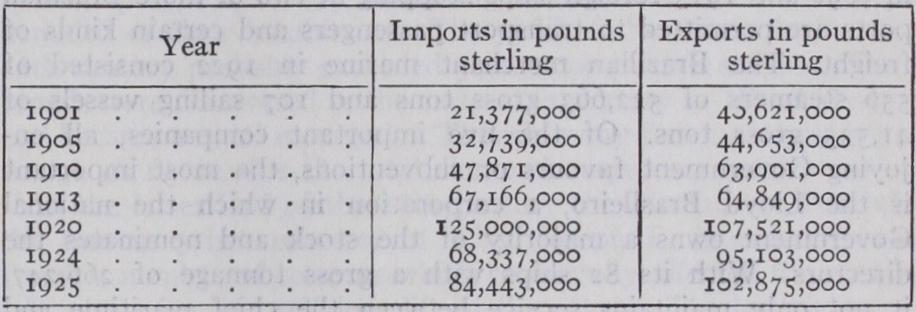
Similar data regarding exports for 1925 are as follows :—coffee, 74,020; rubber, 5,058; cotton, 3,307; mate, 2,857; cacao, 2,626; tobacco, 2,342; chilled and frozen meat, 1,716.
Statistics for the chief countries of origin of imports for 1925 are as follows:—United States, 20,772; Great Britain, 18,770; Germany, 11,774; Argentina, 9,837; France, 4,904; Italy, 3,073; Belgium, 2,836. Similar data regarding Brazil's principal markets for the same year :—United States, 46,468; France, 12,947; Ger many, 6,876; Italy, 6,563; Netherlands, 6,279; Argentina, 5,572; Great Britain, 5,182.

For over a quarter of a century following Vespucci's voyage interest in Brazil all but ceased. No precious metals were dis covered and the energies of the Portuguese were increasingly ab sorbed by the establishment of a great empire in the East. Portu gal's enemies and rivals, especially the French, were quick to take advantage of this neglect. Swift corsairs from Honfleur and Dieppe loaded their ships with the valuable Brazil-wood and even attacked Portuguese vessels returning from the Indies. Brazil be came a sort of no man's land over which the Portuguese crown wielded only a shadowy control. This apathy came to an end, however, with the accession of John III. (1521-1557) and the centre of gravity in colonial affairs began gradually to shift from Asia to America.
The first systematic effort to establish an organized government in Brazil was made in 1532. Brazil was divided into 15 hereditary captaincies or fiefs, extending So leagues along the coast and an indefinite distance inland. These grants were distributed to fa voured persons, chiefly courtiers, who took the name of donatarios. Their rights and privileges were extensive. They were authorized to found cities, issue land grants, levy internal taxes, and appoint municipal officers. To the crown was reserved the right to im pose export taxes and the monopoly of Brazil-wood and spices. The captaincy system failed to realize the hopes of the crown. Only Io of the fiefs were occupied by their owners and of these only two were really successful. The most flourishing of the set tlements was that of Sao Vicente, south of the present city of Santos. This had been granted to Martim Affonso de Souza, who in 1530 had explored the coast as far south as the La Plata es tuary and had penetrated for some distance into the interior. By the middle of the century the captaincy had a population of some 5,000, including the growing port of Santos and the town of Sao Paulo, over the edge of the Serra do Mar, on the fertile plateau of Piratininga. In northern Brazil Duerto Coelho had converted the captaincy of Pernambuco into a great sugar-producing region. But the remaining captaincies were for the most part tragic fail ures. The donatarios were generally incompetent and tyrannical and the struggling settlements were powerless against attacks of hostile Indians or the depredations of French corsairs.
Royal Control.--At length fully alive to these perils King John determined to substitute for the inefficient rule of the dona tarios a unified, centralized administration. Brazil was brought directly under royal control through the appointment of a gover nor-general. The first to hold this office was Thome de Souza, a Portuguese noble who had gained wide experience in India. In he took up his new duties at Bahia, which remained the capital of Brazil for the next 200 years. The governor-general was granted wide powers in civil and criminal affairs. The donatarios were obliged to surrender their political and judicial rights, though they were allowed to keep possession of their fiefs until they were acquired by the crown. Local officials, responsible to the gover nor-general, were placed over the captaincies, and strategic points along the coast were fortified. In the cities municipal organiza tions, similar to those in Portugal, were established. Brazil now began to attract bettlors in increasing numbers. By 1600 Bahia and Pernambuco each had a population of 2,000 whites, with over twice as many negro slaves and converted Indians.
A factor of great importance in the progress of the colony was the labour of the Jesuits. At the instance of John III. several fathers accompanied the first governor-general, Thome de Souza, to Bahia. Among them was Manuel Nobrega, the first of a long line of missionaries who devoted their lives to the protection and conversion of the Indians and to the raising of the moral level of the colonists. At the site of the present city of Sao Paulo, No brega established a school for the training of missionaries. Here he was joined by Jose de Anchieta, whose heroic labours among the Indians won for him the title of the "Apostle of Brazil." As rapidly as the Indians were converted they were settled in villages or "aldeas," similar to the missions in Spanish America. The ac tivities of the Jesuits soon aroused the antagonism of the colon ists, particularly the "Paulistas," the name given to the hardy and tough-fibred settlers of Sao Paulo. The colonists demanded an abundant labour supply and as white labourers were lacking they proceeded to enslave the Indians and to f orce them to work on their plantations. Both the Jesuits and colonists appealed to the crown; the former won a partial victory by the decree of which granted to the Jesuits full control over the Indians in the "aldeas" while permitting the colonists to enslave Indians cap tured in legitimate warfare. In the north the storm centre of a somewhat similar conflict was Father Antonio Vieira, who in the 17th century established a chain of missions in the Amazon valley. Naturally the restrictions on Indian labour stimulated the intro duction of negro slaves, a movement which steadily gathered mo mentum after the middle of the 16th century.
Dutch and French Aggression..--Brazil had hardly been brought under royal authority before a determined effort was made by the French to establish a permanent colony. The prime mover in this enterprise was a French adventurer and soldier of fortune named Nicholas de Villegagnon, who contrived to enlist the support of Admiral Coligny and even Calvin by the assurance that the future colony would be an asylum for Huguenots and other Protestants. King Henry II. lent his sanction and in the French took possession of the beautiful harbour of Rio de Janeiro, which the Portuguese had strangely neglected to occupy. But Villegagnon failed to rise to his opportunities. He showed little skill as a colonist. His promise of religious toleration was broken. Attempts at forceful conversion to Catholicism alienated the support of the Protestants. Rumours of these dissensions reached Europe and checked what might have become a great migration from France and Geneva. Meanwhile the Portuguese had come to realize the extent of the French menace. A large force under Men de Si, the governor-general, blockaded the en trance to the harbour and forced the French garrison to surrender. To ward off future attacks Men de Sa in 1567 founded the city of Rio de Janeiro. Although subsequent attempts were made by the French to gain a foothold in Brazil—notably by Duclerc and Ad miral Duguay Trouin in 1710 and 1711—the hope of establishing "Antarctic France" as a pendant to the French colonies in North America was never realized.
From 158o to 1640 Portugal was united to Spain, and as a part of the Spanish colonial empire Brazil was naturally exposed to attacks by Spain's enemies. Among these were the Dutch, who had just succeeded in establishing their independence. In 163o a fleet sent out by the Dutch East India Company captured Per nambuco, the metropolis of the rich sugar growing district in the north. As governor of its new possession the company chose Count Maurice of Nassau-Siegen, a prince of the House of Orange, and perhaps the ablest man in the Netherlands. His statesmanlike programme included the creation of a great colonial empire, rec onciliation between Dutch and Portuguese, the grant of religious toleration, and the limited participation of the colonists in the government. Imposing public works were erected in the capital, rechristened Moritzstadt. Distinguished artists and scientists were invited to make known to Europe the resources and beauties of Brazil. But the directors of the company, intent on a policy of greed and gain, refused to support their enlightened governor and he resigned in 1644. A rebellion launched by a wealthy plantation owner, Joao Fernandes Vieira, proved beyond the power of Maurice's incompetent successors to crush and in 1661 the Dutch renounced all claim to Brazil.
Expansion and Reforms.—Reference has already been made to the "Paulistas," as the inhabitants of the captaincy of Sao Paulo were called. Of part Indian blood, the Paulistas comprised the most enterprising element in colonial Brazil. With the object of securing Indian slaves and discovering mines and precious metals they organized great expeditions into- the interior, known as bandeiras. At times these expeditions were veritable treks or migrations, in which entire families took part and which lasted for a period of years. Though some of the most remote portions of Brazil were explored by the bandeiras, it was not until 1693 that gold deposits were discovered in what is now the State of Minas Geraes. The stampede or gold rush which took place an ticipated in many ways the days of '49 in California or those of '51 in Australia. In the hitherto unbroken wilderness towns sprang up as if by magic, while large sections of the littoral were denuded of their inhabitants. The yield of the mines during the i8th century probably exceeded 50,000,000 pounds sterling. Dia monds were discovered in the early i8th century in Minas Geraes and became a royal monopoly. Though many famous stones were found, no figures for the total diamond output are available.
In the latter half of the i8th century the Marquis of Pombal, the famous prime minister of King Joseph I., introduced into Brazil a number of reforms which profoundly affected the social, administrative, and religious life of the colony. The last rights of the donatarios were absorbed by the Crown, the capital was trans ferred from Bahia to Rio de Janeiro, the Indians were placed on a legal equality with the whites, immigration from the Azores and Madeira was encouraged, two privileged companies were created, a monopoly of the diamond fields was established. The act for which Pombal is best known was the expulsion of the Jesuits from Brazil in 1760. Through their protection of the Indians and their various commercial ventures they had stirred up widespread re sentment, and when they attempted to thwart some of Pombal's reforms the all-powerful minister banished them from both Portu gal and Brazil with brutal thoroughness. The value of many of Pombal's reforms is more than questionable but it can hardly be denied that they tended on the whole towards the development of the capabilities and resources of Brazil.