
GREAT BRITAIN'S TRADE WITH THE BRITISH EMPIRE Total Exports.—Great Britain's exports to all countries ex panded by 82% between the decades beginning in 187o and 1925. Exports to the empire expanded in the same period by 152%. This is shown in Table I below in which post-war export values have been scaled down to 1913 prices. The extent to which the empire's share of British exports has increased is shown in fig. 6.
Total exports of British produce and manufactures and exports to the empire in ten yearly averages 187o-19o9, four years' average 1910 1913, and the years 1922 to 1926.
Note I.-The Irish Free State which was part of the United King dom until 2923 has been omitted from the above figures.
Note figures given in brackets in the "empire" column show the purchases of the empire as it was in 1913 ; i.e., exports to countries such as Palestine, `Iraq, etc., which were outside the empire in 1913 have been excluded.
Note 3.—In view of the considerable rise in prices, the post-war figures have for comparative purposes been adjusted to 1913 price levels. No very accurate figures can be given because of the change in the composition of the exports.
The recorded values of Great Britain's total exports and ex ports to the empire in the ten years 1926-1935 are given in Table II, which also shows the way in which the relative impor tance of the empire as a market for Great Britain fell away in the years leading up to and during the economic depression of 1929 onwards, and then increased until the empire again takes just short of half Britain's total exports.
Exports from Great Britain to all countries and to empire countries, 1926-1936, and percentage to empire countries.
ble for over a quarter of the world's food supply. Its economic resources are the greatest that have ever come under the control of any single political system. The exports and imports of its several constituents totalled £2,430 millions in 1935 and formed 3o% of the world's total international trade. This proportion may be compared with the 1o•8% of the United States, the 3-8% for France and its empire, the 8.6% for Germany and the 4.6% for the Netherlands and its empire in the same year. In of the total trade of the British empire was inter-Imperial.
The first group comprises the three Southern Dominions— Australia, New Zealand and South Africa. Maintaining very close trading connections with the mother country and capable of almost unlimited development, these three countries together constitute Great Britain's largest empire market, and it will be noted that the relative importance of the group has also markedly increased. South Africa's prosperity benefited greatly from the rise in the value of its gold exports subsequently to 1931, and it became the second largest customer in the world for British goods. Third place is taken by Australia.
The Indian group comprises India, Ceylon, Malaya and the Straits Settlements. India takes more goods from Great Britain than any other country in the world. British export trade to the Straits Settlements, British Malaya and Ceylon has increased considerably in recent years.
The American group, of which Canada is by far the most im portant member, includes Newfoundland, the West Indies and British Guiana. Owing to the immense economic influence of the United States of America upon neighbouring countries, this group is somewhat less affected by the imperial aspect of trade than the other groups in the empire. Canada is, however, an important market for Great Britain, buying per head of population eleven times the value of British goods purchased by her larger neigh bour.
The West African colonies base their trade upon the native agriculturist. In East Africa production has so far developed on the basis of the large estate worked by native and Indian labour. Though British East Africa covers a larger area than West Africa, the development of this group of colonies has not pro ceeded so far, and the volume of exports from Great Britain is only a third of that of West Africa.
Table IV shows the value of imports from the empire 187o 1926.
Imports of produce and manufactures into the United Kingdom in ten yearly averages 1870-1909, four years' average 1910-13 and the years 1922-26.
Table V. gives the recorded values of total imports into Great Britain and imports from the empire in the years 1926-1936, and the percentage from empire countries.
From the middle of the last century, manufacturing activity became the distinguishing mark of the economic life of a con stantly growing number of nations. During and since the World War the output from the world's factories has been tremendously increased and Great Britain is meeting increasingly serious com petition in all the markets of the world. As a result, those coun tries which are today taking Great Britain's manufactures and sending in exchange raw materials for her industries and food stuffs for her urban population are essential to her welfare. Thus a most important aspect of empire trade is its complementary nature as opposed to the competitive trade which characterizes the interchange between Great Britain and those countries which are her industrial rivals.
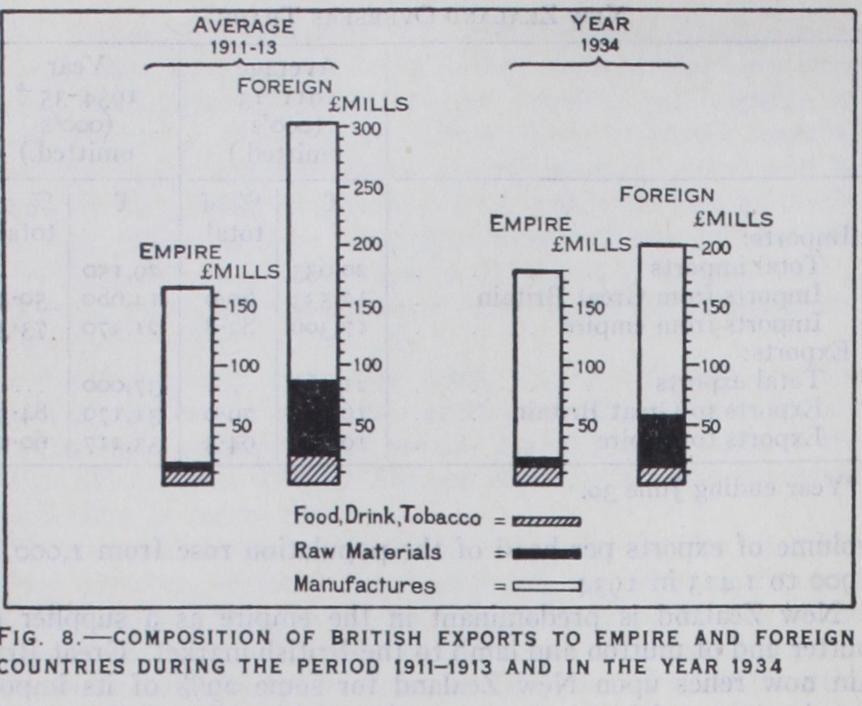
Composition of British Exports to the Empire.—The Board of Trade classifies British external trade under three main heads:— 0) Food, drink and tobacco.
(2) Raw materials and articles mainly unmanufactured.
(3) Articles wholly or mainly manufactured.
Great Britain, as a predominantly manufacturing nation, with most of her skill and capital locked up in highly specialized in dustries, must be especially interested in the extent of markets overseas for the third of these classes. From the standpoint of national social welfare, it is the output of highly manufactured goods requiring the employment of the highest degree of national skill which should be encouraged.
In 1934 the empire was responsible for only 13% of the total export of coal from Great Britain. Of manufactured goods, how ever, in this year L156.6 millions, or 51%, were exported to the empire. The export trade pillars given in fig. 8 show the value of exports in each of the three classes to empire countries and to foreign countries in 1911-13 and Composition of British Imports from the Empire.—Figure 9 gives the value and proportion of each class of imports supplied by the empire and foreign countries in 1911-13 and in It should be pointed out that a considerable proportion of the empire imports classed as manufactured consists of semi-manu factured metals, the raw materials of many British industries.
The relative importance of empire supplies of certain industrial foodstuffs and raw materials is shown in the following figures: The Southern Group : Australia.—Australia, among the three dominions of the Southern group, maintains the largest volume of imports and exports. The following table shows the extent of Australian trade with empire countries: volume of exports per head of the population rose from 1,000 in 1900 to 1,423 in New Zealand is predominant in the empire as a supplier of butter and of mutton and lamb to the British market. Great Brit ain now relies upon New Zealand for some 29% of its import requirements of butter in comparison with only 5.6% pre-war, and of the total imports into Great Britain of mutton and lamb New Zealand holds 56.4%. A large proportion of New Zealand's inter-empire trade is conducted with Australia. Export figures are available since 1905 showing the increasing predominance of prod ucts derived from the grasslands of the dominion. In 1905 69.8% of the exports of New Zealand were pastoral in origin and in 1934 this proportion had risen to 92.7%. Although wool is the chief export, yet the development of dairying has been mainly responsible for the marked rise in this percentage.
Australia takes a somewhat smaller percentage of its imports from Great Britain and from the empire as a whole than before the war. This decline is partly attributable to a post-war increase of non-competitive imports into Australia from the United States such as petrol. The proportion of Australia's exports to Great Britain showed a striking increase in the years after 1929. In 1924-26 the proportion was only 41.o%; in 1935 it was 56.3%. The decline of foreign markets, especially in Europe, for Aus tralia's primary exports caused an increasing volume to be di rected to the British market.
The chief Australian exports are wool, wheat, dairy products, meat, fruit and non-ferrous metals.
Figures published by the New Zealand Government show that New Zealand's export trade has grown very considerably in vol ume since the beginning of the century. Taking 1900 as the base year at 1,000, the value of exports in 1913 was 1,341, in 1925 it was 1,830 and in 2,750. The index number of South Africa's chief exports are gold, wool, diamonds and fruit. The South African gold output amounts to over one-third of the world's present total output.
The extremely close trading connection between India and the home country is thrown into relief if Great Britain's share of the imports of another eastern market—China—is noted. In Great Britain's share of Chinese imports amounted to only 10.6% of the total as compared with 39.9% for India. Indian exports to empire countries other than Great Britain are marked by a considerable trade in jute goods to Australia and New Zea land and by a more general trade, of which cotton piece goods form a large proportion, to Mauritius and the Straits Settlements.

Australia, in years when there is a failure in the Indian wheat crop, sends consignments of wheat to India.
Canadian trade with the Empire during the last few years has been the considerable growth in the exports to and imports from Australia. A trade treaty between the two Dominions, providing for tariff preferences, was negotiated in September 1925.
West Indies.—The trade between Canada and the West Indies is an important inter-empire development. In June 1920, a recip rocal arrangement was entered into with the West Indies and, in 1925, this agreement was enlarged. It seems probable that the mutual tariff advantages so arranged will lead to Canada be coming an increasingly important source of supply of manufac tures and foodstuffs to the West Indies and a valuable market for their tropical products, chiefly sugar and bananas.
Newfoundland.—The import trade of Newfoundland, simi larly to that of Canada, is greatly affected by the United States of America.
The share of the mother country in Newfoundland's imports in 1934 was 23%, and in its exports 38%. Empire supplies (largely from Canada) accounted in 1934 for 66% of the total, and exports to the empire accounted for 43.6% of the total. New foundland exports a limited range of products of which the most important are dried fish, cod liver oil and paper pulp.
West African Group.—The West African group is comprised of the following colonies and protectorates : Gambia, Sierra Leone, Gold Coast (which includes British Togoland) and Ni geria (which includes British Cameroons).
Territorial alterations after the war make any general com parison with pre-war years difficult, but the direction of Nigerian trade is indicative of the trade of the other West African colonies.
Malaya.—One of the most dramatic episodes in the develop ment of empire trade has been the growth of the wealth of Ma laya through the introduction (via Kew Gardens) of the Para rubber tree from Brazil, and the increase of the exports of tin. Per head of its population Malaya is now one of the largest exporting countries in the world. Great Britain shares in the im port trade of British Malaya to the extent of 16% and the empire as a whole to the extent of 33%.
The American Group: Canada.—The growth of Canada's export trade between 1911-13 and 1935, as shown by the table below, is an unmistakable index of the rapid development of that country. Canada has become the premier wheat exporting country of the world, and the number of motor-cars that it ex ports is second only to the exports of the United States of America.
The United States is naturally Canada's chief source of supply. It is, however, of interest to note that Great Britain holds three times as large a share of the Canadian market as it does of the market provided by the United States of America. A feature of The inter-Imperial trade of West Africa, apart from that with Great Britain, mainly consists of trade between the several West African colonies. India, however, takes some 5% of Nigeria's exports, and the same West African country sends 34% of its ex ports to European industrial countries, and 9% to the United States of America.
The typical West African exports are oilseed and palm oil. Practically 50% of the total value of Nigeria's consignments abroad are accounted for by these two staple articles of export. Tin ore is also important. During the post-war years there has been an important development of the cocoa industry, especially on the Gold Coast.
East African Group.—Kenya and Uganda, representing the bulk of British East African trade, provide the best basis for comparison between pre-war and post-war years. Since 1917, these two colonies have been amalgamated in one customs union and for the purposes of foreign trade are treated as a single unit. The trade figures for 1911-13 are given on the same basis.
Though close trading connections exist between Great Britain and East Africa, eastern markets have a considerable influence. A 'significant feature of the post-war trade is the immense in crease of exports to India. The Indian share of the exports of Kenya and Uganda in 1911-13 was 4.2% and in 1935 it had risen to 41%. Imports from India had increased from a pre-war share of less than 2% to a share of 5.6% in 1935. Imports from Japan in 1934 formed 15.2% of the total.
Uganda is becoming of considerable importance to the empire as a supplier of cotton. The exports of cotton from Kenya and Uganda increased from 285,000 quintals in 1926-30 to 523,00o quintals in (I quintal = 220 lbs.) . This was 6o% greater than the exports of cotton from the Sudan. In 1935 British East African coffee represented 44% of the total supplies sent to Great Britain.