
CORONEL, BATTLE OF. This action was fought (Nov. I, 1914) between a British squadron under Rear Admiral Sir Christopher Cradock and a German squadron under Vice Admiral Graf von Spee. Actually it took place in a position 41m. to the west of Coronel in Chile. The result was a severe defeat of the British forces, the flagship "Good Hope" and the cruiser "Mon mouth" being sunk; while the two remaining ships escaped in the dark. The German ships were comparatively little damaged.
The causes which led up to the British defeat can be directly traced to a faulty appreciation by the Admiralty of the whole situation of Cradock vis-ŕ-vis von Spee. In consequence of this Cradock had not been reinforced by a powerful modern cruiser for which he had urgently applied, while the instructions sent him were ambiguous, although their general tone was such that he could not have done otherwise than set out in search of an enemy which proved to be superior in every respect to his fighting strength. It has been argued that, having found the enemy, he should have avoided action, but he had specific orders "to be pre pared to meet them" and "to protect trade." It has also been argued that he would have been safe if he had not pressed on without the old battleship "Canopus" and that he had been speci fically warned by the Admiralty that " `Canopus' should accom pany `Glasgow,' `Monmouth' and `Otranto'." To these latter in structions Admiral Cradock had, not unnaturally, replied that it was impossible to find and destroy the enemy's fast squadron with a ship of such slow speed as the "Canopus" in company. More over, the idea that this ship, because she was classed as a battle ship, was something in the nature of an impregnable fortress, under whose shelter he could not come to any harm, was based on a complete fallacy as to her fighting efficiency. Her four old z tin. guns could have been out-ranged by the more modern Sin. guns of the German "Gneisenau" and "Scharnhorst." Her armoured belt was no thicker than that of the "Good Hope," while her crew was very largely untrained, whereas von Spee's two principal ships were the crack gunnery ships of the German Fleet in the eastern waters. There can be very little doubt that had the "Canopus" been present in the battle she would have been sunk as surely as were the "Good Hope" and "Monmouth." Events Leading Up to the Action.—On Oct. 2 2 Admiral Cradock left Port Stanley in the Falkland islands by the route round the Horn. The "Canopus," which had just arrived at the Falklands, was told to follow immediately and meet him on the other side of the Straits of Magellan. He had sent instructions for the armoured cruiser "Defence" to join him, but these were cancelled by the Admiralty, who informed him that she was to remain on the east coast of South America under Admiral Stoddart's orders. The "Glasgow" and "Monmouth" were already in the South Pacific, working from a secret base in the Chonos archipelago (lat. 45 ° 24' S., long. 74°18' W.), where the "Good Hope" joined them on Oct. 26th. Here, too, was the armed mer chant cruiser "Otranto." At this time, Cradock had no very definite intelligence of the enemy on which to act. He therefore, on Oct. 27, despatched the "Glasgow" to Coronel to pick up what news she could and to cable to the Admiralty his dispositions and intention to move northward. These, his last messages, were duly despatched on Oct. 31 and reached the Admiralty just after Lord Fisher had been installed as the new first sea lord. The latter at once per ceived the grave danger in which Cradock might find himself. He reversed the previous decision and gave immediate orders for the "Defence" to join him, while Cradock was instructed to keep his squadron concentrated and to effect a junction with the "De fence" at the earliest possible moment, but unhappily these orders never reached him. Meanwhile the "Glasgow" had reported wireless indications of the close proximity of German warships. On Oct. 3o, theref ore, Cradock set out from his base, leaving the "Canopus" behind to make good engine defects. His squad ron consisted of the "Good Hope," "Monmouth" and "Otranto." The "Glasgow" met him at i :30 P.M. on Nov 1.' Von Spee, coming from the Far East, had crossed the Pacific and his last port of call had been Mas-a-Fuera. On Oct. 3o he had sent an armed merchantman, the "Prinz Eitel Friedrich," into Valparaiso and was cruising with the remainder of his squadron just out of sight of land. From this ship he learnt of the "Glas gow's" visit on Oct. 31. He therefore stood south with the object of finding her.
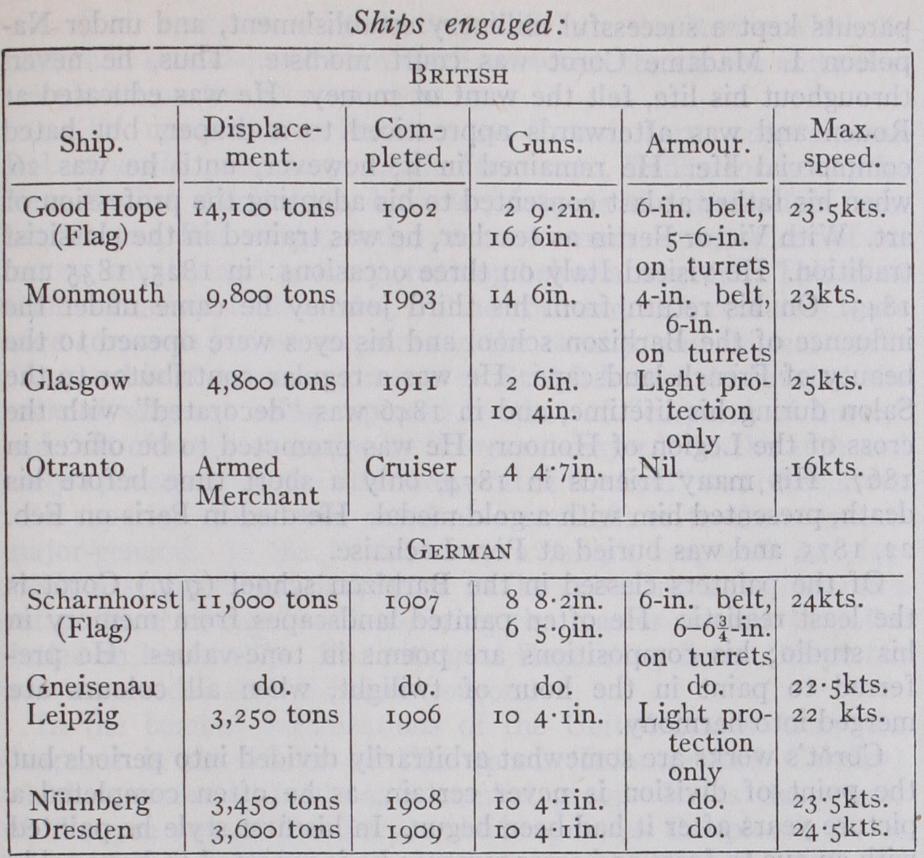
Meanwhile Cradock had ordered his ships to spread 15m. apart on a line of bearing north-east by east in the order "Good Hope," "Monmouth," "Otranto," "Glasgow" ; "Good Hope" being to the westward, while a course was set north-west by north in the direc tion in which he expected to find the enemy. Before the ships could get into their stations, the "Glasgow" and "Otranto" sighted the smoke of von Spee's squadron, and by 4:Io P.M. the former ship sighted and reported the "Scharnhorst," "Gneisenau," and a light cruiser. The British ships at once closed on the "Good Hope." Three hundred miles to the southward the "Can opus" had just left harbour and was plodding along, escorting her colliers. Von Spee, on sighting the "Glasgow" to the west ward, turned and worked his squadron up to full speed. It was blowing hard from the southward and there was a heavy sea run ning. Under such conditions it would have been impossible for 'Chilean time. 5 hours slow on Greenwich.
the main deck guns of the "Good Hope" and "Monmouth" to have been fought, and the combined broadside of these ships was therefore reduced from two 9.2in. and 15 6in. to two 9.2in. and seven 6in. The 12 Bin. guns, which formed the combined broad side of the two German armoured cruisers, were mounted on the upper deck, thus securing them an additional advantage in such weather.
By 5:2o P.M. the British squadron_was on an easterly course, the "Good Hope" leading, followed by "Monmouth," Glasgow" and "Otranto," and heading direct for the enemy. About 5:25 Cradock altered to the southward, which brought him on a con verging course to that of von Spee, who was then about I'm. on his bow, steering to the south-west. The British admiral was evi dently determined to fight, and desired to close the range and to take full advantage of the sun while it was high enough to dazzle the enemy. But von Spee was no less determined not to be rushed and to fight under his own conditions. He therefore turned away when Cradock attempted to close. At 6 : 20, however, the sun having begun to dip below the horizon, he decided that his time had come. The British ships stood out, silhouetted against the red glow, while those of the German squadron were becoming more and more difficult to see against the approaching darkness to the eastward. A few minutes later the "Scharnhorst" opened fire at just over ii,000 yards. The third salvo hit the "Good Hope" between the conning tower and her fore-turret, starting a fire. Now the rest of the German ships joined in, the "Gneisenau" tak ing on the "Monmouth," the "Leipzig" the "Glasgow," and the "Dresden" the "Otranto." The "Good Hope" replied, but under the difficult conditions of light it is evident that her fire was very ineffective.
Cradock determined to close still further, and by 6 :53 the range was down to 6,600 yards. The "Monmouth" was firing furiously, but the heavier German shells were finding their mark, and by 7 o'clock both the British ships were in great distress. The "Mon mouth's" fore-turret, having been struck by a shell, caught fire and exploded, the gun-house being blown overboard. The "Good Hope" was badly hit and on fire. A quarter of an hour later, with the range down to only 5,000yd., she was rapidly losing speed, and about 7 :2o a shell struck her amidships and a moment later a huge column of fire shot up. Firing a few last desperate shots, she disappeared, having been practically blown in two and gutted. At 7:20 the "Monmouth" ceased fire and proceeded to try and get her fires under, but already she was badly down by the bows and had a heavy list. She made vain efforts to work to the westward and get her stern to the sea. The "Glasgow" did what was possible to support her, but could only have offered a useless sacrifice by remaining. The "Otranto," wisely, had already made off.
By the light of the moon the "Nurnberg," which had been mak ing great efforts to catch up and join in the fight, sighted the now almost completely crippled "Monmouth." She attacked her with a torpedo, but missed, and then opened fire with her guns at only 800yd. range. At 8:58 P.M. the "Monmouth," heeling over more and more, went down with her ensign still flying. Not a soul was saved from either her or the "Good Hope." The "Glasgow" even tually joined up with the "Canopus" and worked back to the Falkland islands via the Magellan straits, the "Otranto" taking the passage round the Horn.
The effect of the defeat at Coronel was for the time being most disconcerting to British trade and interests in South Ameri can waters. But von Spee, in the midst of the rejoicing by the German community at Valparaiso, had no illusions as to his ulti mate fate and in fact retribution swift and complete was al ready being organized, and there was something of poetic justice in the selection of Rear Admiral Sturdee, the chief of the Naval staff at the time of the Coronel disaster, for the command of the squadron which was to avenge Cradock in the battle of the Falk lands. (E. A.)