
COLOGNE (Ger. Koln), a fortified town, archiepiscopal see and third city of the German Reich, in the Prussian Rhine province. Pop. (1933), 75o,i9o. It lies in the form of a vast semicircle on the left bank of the Rhine, 44 m. by rail north-east from Aachen, 24 south-east from Dusseldorf and 57 north-north west from Coblenz.
Its situation (I) as an important port on the Rhine (2) at the Rhine crossing of the great natural highway from Paris via the valleys of the Oise, Sambre and Meuse along the north-western margin of the Ardennes and (3) at the emergence of roads along the Rhine from the incised section of that river has made it one of the chief cities in western Europe. The value of the site on the Rhine frontier was realized by the Romans and very little altera tion in the town plan had taken place by the days of Archbishop Hildebold in the 9th century. The city was still contained within the rectangle formed by its Roman walls. Trading facilities during the Ilth century caused a great increase in the size of the town and early in the 12th century the suburbs of Oversburg, Niederich and St. Aposteln were included. These were later enclosed by a rampart, fortified by walls and gates, some of which survived until the 19th century. Within the crescent formed by these fortifi cations flourished the mediaeval city—a capital of a third of the Hanseatic league. This mediaeval section of the city still has its tortuous, narrow and dark streets. The long Hohe-Strasse of this section is the city's chief business centre. The mediaeval walls and ditches were dismantled between 1881 and 1885, and the site of the old fortifications, bought from the government by the munici pality, were converted into a fine boulevard, the Ring, nearly 4 m. long.
Beyond the Ring, about m. farther out, a new line of fortifi cations was built and I,000 acres, now occupied by handsome streets, squares and two public parks, were thus added concen trically to the inner town. Still later extensions have been in the form of "spurs" forming suburbs projecting as it were from the central core. Among the most important suburbs are Bayenthal, Lindenthal, Ehrenfeld, Nippes, Siilz, Bickendorf, Merheim, Niehl, and those on the opposite bank of the Rhine. Cologne is connected with Deutz by bridges. Mulheim, Meiheim and Worringen were incorporated in the city in 1914. Of the former city gates four have been retained, restored and converted into museums : the Severin gate, on the south, contains the geological section of the natural history museum ; the Hahnen gate, on the west, is fitted as the historical and antiquarian museum of the city; and the Eigelstein gate; on the north, accommodates the zoological section of the natural history museum.
The most important squares are the Domhof, the Heumarkt, Neumarkt, Alte Markt and Waidmarkt in the old inner, and the Hansa-platz in the new inner town.
The Gurzenich was a former meeting-place of the diets of the Holy Roman empire and built between 1441 and 1447. The ground floor was in 1875 converted into a stock exchange, and the upper hall utilized for public festivities. The Rathaus (I 3th century) has beautiful Gobelin tapestries. The Tempelhaus, the seat of the patrician family of Overstolzens, is a building of the 13th century, now the chamber of commerce. There is also the Wallraf-Richartz museum, with a collection of paintings by Italian and Dutch masters ; the Zeughaus, built on Roman foundations ; and the municipal library and archives. The Wolkenburg, a Gothic house of the 15th century, was restored in 1874. Near the cathedral is a museum of church antiquities. Cologne has numer ous educational institutions including a new high school for music, on university lines, subsidised by the municipality, the province and the Prussian state. The number of students is limited to 500. The municipal theatre (Stadttheater) is famed for its operatic productions.
Commercially, Cologne is the retail town for the industrial cities of Rhineland and Westphalia, and has a very important trade in corn, wine, mineral ores, coals, drugs, dyes, manufactured wares, groceries, leather and hides, timber, porcelain and many other commodities. The docks are to the south of the city. Cologne manufactures sugar, chocolate, tobacco and cigars ; the most famous product is the perfume known as eau de Cologne (q.v.) (Kolnisches Wasser, i.e., Cologne-water).
Cologne occupies the site of Oppidum Ubiorum, the chief town of the Ubii, and here in A.D. 5o a Roman colony, Colonia, was planted by the emperor Claudius, at the request of his wife Agrippina, who was born in the place. After her it was named Colonia Agrippina or Agrippinensis. Cologne rose to be the chief town of Germania Secunda and had the privilege of the Jus Italicum. About 33o the city was taken by the Franks but was not permanently occupied by them till the 5th century, becoming in 475 the residence of the Frankish king Childeric. Counts of Cologne are mentioned in the 9th century.
The succession of bishops in Cologne is traceable, except for a gap covering the 5th century, from A.D. 313, when the see was founded. It was made the metropolitan see for the bishoprics of the Lower Rhine and part of Westphalia by Charlemagne, the first archbishop being Hildebold, who occupied the see from 785 to his death in 819. Of his successors one of the most illustrious was Bruno (q.v.), archbishop from 953 to 965, who was the first of the archbishops to exercise temporal jurisdiction, and was also "archduke" of Lorraine. The territorial power of the archbishops was already great when, in 118o, on the partition of the Saxon duchy, the duchy of Westphalia was assigned to them. In the century they became ex-officio arch-chancellors of Italy (see ARCH-CHANCELLOR), and by the Golden Bull of 1356 they were finally created electors of the empire. With Cologne itself, a free imperial city, the archbishop-electors were at perpetual feud; in 1262 the archiepiscopal see was transferred to Briihl and in 1273 to Bonn; and the quarrel was not finally adjusted until 1671. The archbishopric was secularized in 18o1, all its territories on the left bank of the Rhine being annexed to France ; in 1803 those on the right bank were divided up among various German states, and in 1815, by the congress of Vienna, the whole was assigned to Prussia. The last archbishop-elector, Maximilian of Austria, died in 18o1.
The municipal history of Cologne follows in general the same lines as that of other cities of Lower Germany and the Nether lands. At first the bishop ruled through his burgrave, advocate, and nominated jurats. Then, as the trading classes grew in wealth, his jurisdiction began to be disputed. Peculiar to Cologne, how ever, was the Richerzeche (rigirzegheide), a corporation of all the wealthy patricians, which gradually absorbed in its hands the direction of the city's government. In the 13th century the arch bishops made repeated efforts to reassert their authority, and in 1259 Archbishop Conrad of Hochstaden, by appealing to the democratic element of the population, succeeded in overthrowing the Richerzeche and driving its members into exile. His succes sor, Engelbert II., however, attempted to overthrow the demo cratic constitution, with the result that in 1262 the brotherhoods combined with the patricians against the archbishop, and the Richerzeche returned to share its authority with the elected "great council." As yet, however, none of the trade or craft gilds, as such, had a share in the government, which continued in the hands of the patrician families, until long after the battle of Worringen (1288) had secured for the city full self-government, and the archbishops had ceased to reside within its walls. In the i4th century a narrow patrician council selected from the Richer zeche, with two burgomasters, was supreme; but in 1396, the rule of the patricians having been weakened by internal dis sensions, a bloodless. revolution established a comparatively dem ocratic constitution, based on the organization of the trade and craft gilds, which lasted until the French Revolution.
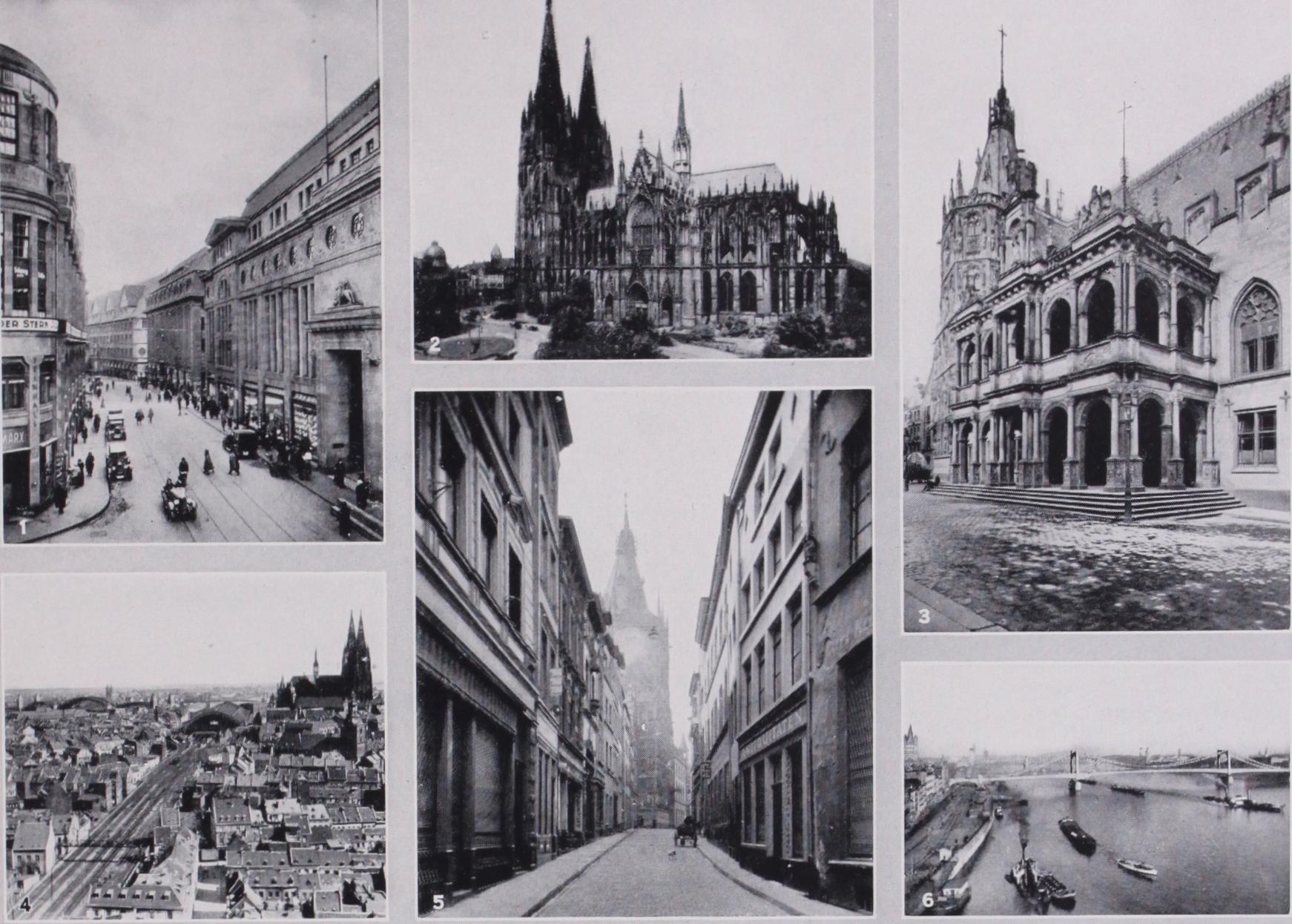
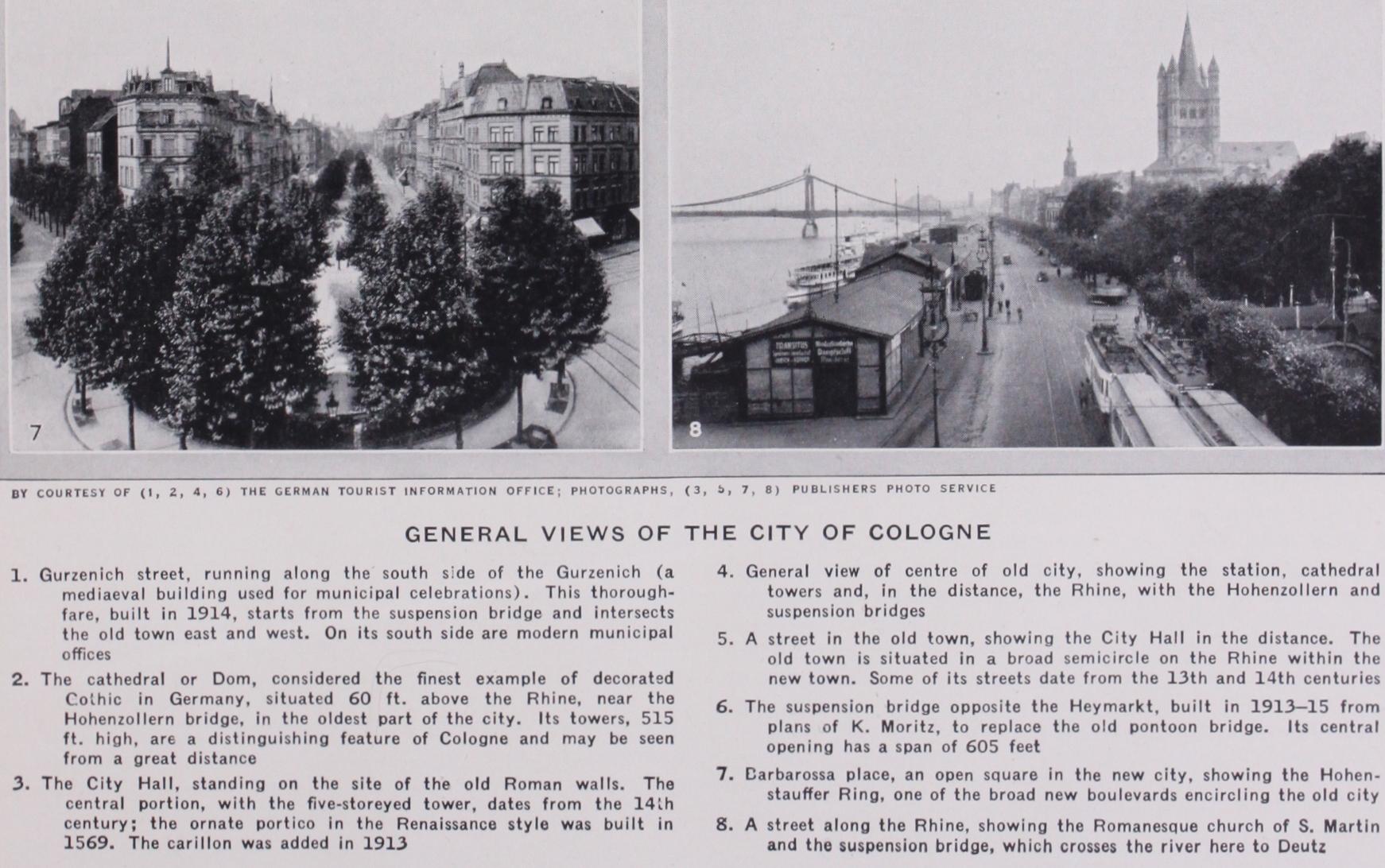
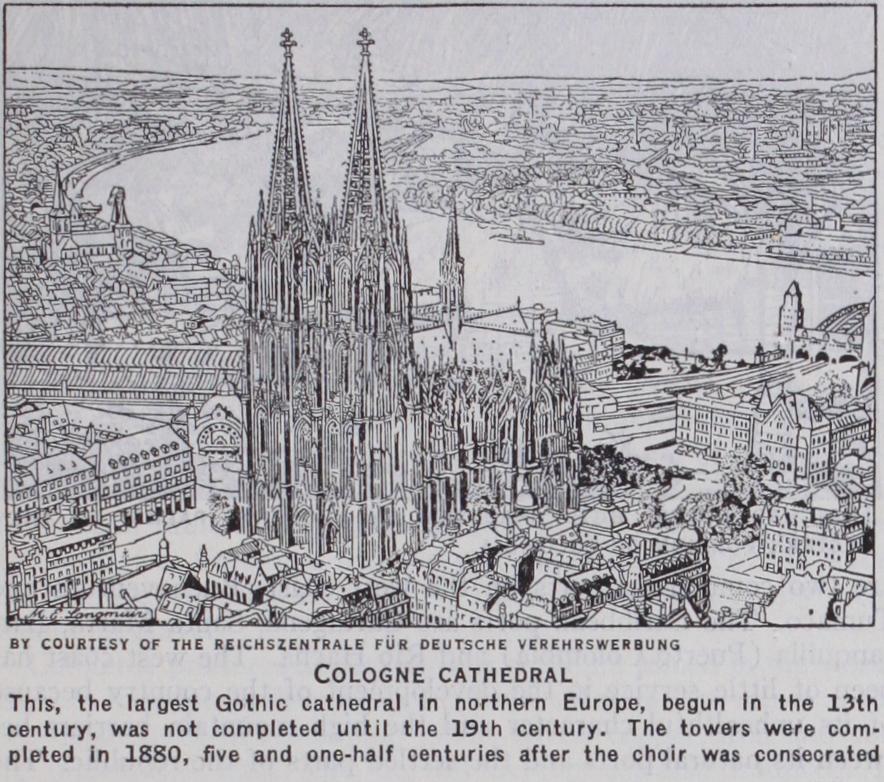
The greatness of Cologne was founded on her trade. Wine and herrings were the chief articles of her commerce; but her gold smiths, armourers, and weavers were famous and exports of cloth were large. So early as the th century her merchants were settled in London, their colony forming the nucleus of the Steelyard. When, in 1201, the city joined the Hanseatic League (q.v.) its power and repute were so great that it was made the chief place of a third of the confederation.
The expulsion of the Jews in 1414, and still more the exclusion of Protestants from the citizenship and magistracy, deeply affected the prosperity of Cologne. New trade routes, the decay of the gilds and many prolonged periods of warfare further contributed to its decay; and when, in 1794, Cologne was occupied by the French it was a poor city of some 4o,000 inhabitants, of whom only 6,000 possessed civic rights. Incorporated in France in 18o1 it was not then important enough to be more than the chief town of an arrondissement. On the death of the last elector in i8o1 the archiepiscopal see was left vacant. With the assign ment of the city to Prussia by the congress of Vienna in 1815 a new era of prosperity began. Cologne university, indeed, was definitively established at Bonn, but the archbishopric was re stored 0820 as part of the new ecclesiastical organization of Prussia, and the city became the seat of the president of a gov ernmental district. Its prosperity rapidly increased; when rail ways were introduced it became the meeting-place of several lines, and in 1881 its growth necessitated the pushing outward of the circle of fortifications.
Cologne, together with. a bridge head of i8sq.m., was occupied in Dec. 1918 by the Allies under the terms of the Armistice. It was made the head-quarters of the British army of occupation and was not evacuated until Jan. 3o, 1926.
BIBLIOGRAPHY.-L. Ennen, Gesch. der Stadt Kan (Cologne, 1863– Bibliography.-L. Ennen, Gesch. der Stadt Kan (Cologne, 1863– 8o) to 1648, and Frankreich und der Niederrhein (ib., 1855, 1856), a history of the city and electorate of Cologne since the Thirty Years' War ; L. Korth, KOln im Mittelalter (Cologne, 189o) ; K. Hegel, Stiidte und Gilden der germanischen Volker im Mittelalter (Leipzig, 1891) ; R. Schultze and C. Steuernagel, CoIonia Agrippinensis (Bonn, 1895) ; F. Lau, Entwickelung der kommunalen Verfassung der Stadt 'Coln bis zum Jahre .1-396 (Bonn, 1898) ; K. Heldmann, Der Kolngau und die Civitas KOln (Halle, 19oo) ; W. Behnke, Aus KOins Franzosenzeit (Cologne, i9o1) ; Helmken, KOln und seine Sehenswiirdigkeiten (2oth ed., Cologne, 1903) ; H. Keussen, Historische Topographie der Stadt Kan im Mittelalter (Bonn, 1906). For sources see L. Ennen and G. Eckertz, Quellen zur Geschichte der Stadt Kan (186o-79) ; U. Cheva lier, Repertoire des sources hist. Topo-bibliographie (Montbeliard, 1894-99), s.v. Cologne, which gives a full bibliography ; Dahlmann Waitz, Quellenkunde (Leipzig, 1906), p. 17, Nos. 252, 253. For the archdiocese and electorate of Cologne see Binterim and Mooren, Die Erzdiozese Kan bis zur franzosischen Staatsumwiilzung, new ed. by A. Mooren (Dusseldorf, 1892, 1893).