
COLOMBIA is a republic occupying the north-western angle of South America. It is bounded on the north by the Caribbean sea and Venezuela, on the east by Venezuela and Brazil, on the south by Brazil, Peru and Ecuador, and on the west by Ecuador, the Pacific ocean, Panama and the Caribbean sea. The republic has an extreme length from north to south of 1,050m. and an extreme width of 86o miles. The area is estimated as sq.m., but owing to boundary disputes this figure should be con sidered as approximate only.
The Western Cordillera roughly follows the line of the Pacific coast, and the Central Cordillera lies between the other two, sep arated from them by the valleys of the Cauca river (west) and the Magdalena river (east). The Western Cordillera is covered with vegetation, and its Pacific slopes are precipitous and humid. It terminates in low wooded hills in the southern part of Bolivar department. The highest elevation in the Western Cordillera is i 1,85o feet.
The Central Cordillera has a series of lofty volcanoes, some of them perpetually snow-capped. It terminates in low hills in the Magdalena valley. The highest elevation in this range is Tolima, 18,432 feet. The elevations of the Eastern Cordillera are inferior to those of the Central, and it has few summits rising above the line of perpetual snow. In this range the highest eleva tion is 7 0o feet.
The Eastern Cordillera is the region of densest population and is distinguished by its large area of plateau and elevated valley lying within the limits of the vertical temperate zone. The "sa bana" of Bogota (8,563ft.) is a good illustration of the higher of these plateaux. It has an area of 2,000 square miles. It has a mild temperature, is fertile and its varied production is of the temperate zone. On the lower valleys, plateaux and mountain slopes of the Cordilleras the great coffee crop of Colombia is produced in altitudes ranging from 3,00o to 6,000ft. above sea level.
The Pacific coast line, omitting minor convolutions, has a length of about loom.; that of the Caribbean is about 70o miles. There are two commercial ports on the west coast, Buenaventura and Tumaco. The Caribbean ports are Cartagena, Santa Marta, Bar ranquilla (Puerto Colombia) and Rio Hacha. The west coast has been of little service in the development of the country because of its unhealthful character and the high mountain barriers be tween its natural ports and the settled parts of the republic. The Caribbean coast plain is hot and low with the exception of the north-western section of Magdalena department, where the sur face is elevated in the Sierra Nevada de Santa Marta with lofty snow-covered peaks, the highest of which is said by some authori ties to be 17,389 feet.
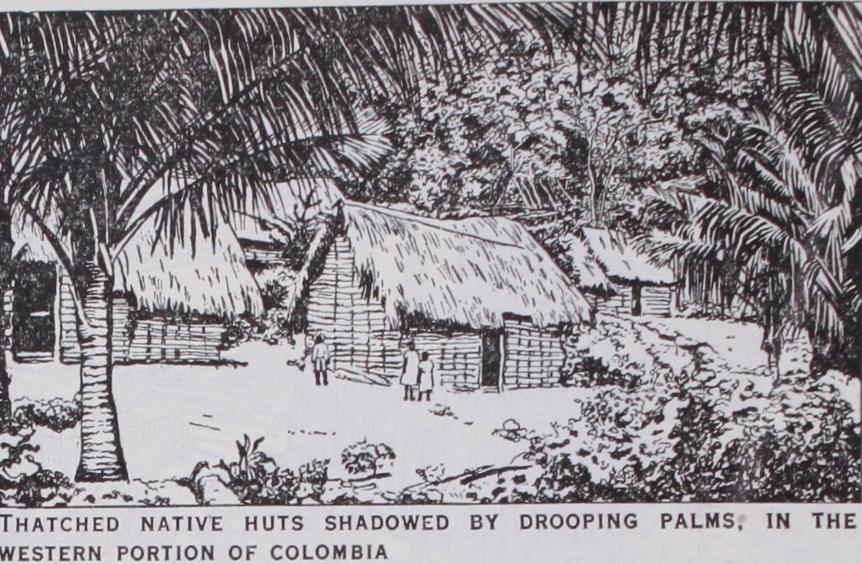
The rivers of the Pacific coast are numerous. They have short, precipitous courses with comparatively short navigable channels. The waters of the rivers of the great eastern plains pass to the Atlantic through the Orinoco and Amazon rivers. Some of them are navigable, which fact may be of great importance to the fu ture development of this region, as yet only partially explored.
(R. U. L. ) Geology.—The Andes reach their northern end in Colombia, where they are divided into three principal ranges, of which the central one is the highest. This range, the Cordillera Central, which is separated from the western one by the valley of the Cauca and from the eastern one by the valley of the Magdalena, includes peaks that rise to heights of more than 18,00o feet. The highest of these, Tolima (18,347 ft.) and Huila (18,115 ft.), are volcanic. The cores of all the ranges consist of old granite, gneiss and schist, which are generally overlain, on the east and west flanks, by folded and contorted beds of sandstone, shale, slate and limestone of Cretaceous age, with which are interbedded sheets and masses of volcanic rock, chiefly porphyry and porphyrite. The western chain, the Cordillera Occidental, extends northward from Ecuador nearly to the Caribbean sea. In its southern part it is flanked on its west side by steeply tilted Palaeozoic beds ; in its northern part on both sides by Mesozoic beds. The eastern An dean range, known as the Cordillera Oriental, or the Cordillera of Bogota, is composed mainly of folded Cretaceous beds. The Cor dillera Central, which is the continuation of the Cordillera Oriental of Ecuador, consists chiefly of beds of Cretaceous sandstone and porphyritic rocks. The axes of folding in all these ranges conform in direction with the trend of the ranges. Along the Pacific coast of Colombia there is a lower range, composed mainly of Tertiary volcanic rocks, which are covered in places with soft Quaternary sandstones and marls containing the remains of species of marine animals such as inhabit the neighbouring ocean. The Magdalena valley is a structural trough 600 m. long and 9 to 45 m. wide, outlined by faults and filled with Tertiary clay and sandstone, which unconformably overlie Cretaceous beds. The Cucuta basin, which is a south-westward continuation of the Maracaibo basin of Venezuela, is occupied by Cretaceous and Tertiary formations re lated to those in the Maracaibo basin. The beds in these basins are wrinkled by small folds that trend north-north-east. The foot hills east of the Cordillera Oriental are composed of marine Cre taceous and marine and fresh-water Tertiary beds, which are folded and faulted along lines parallel to the trend of the Andes. In the part of Colombia that lies east and south-east of the Andes the surface deposits are mainly Tertiary and Quaternary sand, loam and gravel.
Colombia produces about half the platinum mined in the world. Gold is found in both lodes and placers. Most of the mines are in the department of Antioquia. Some silver, copper, iron and coal are mined. Oil, nitre, lead, tin and mercury are also produced. In 1926 the output of oil was 6,444,00o bbl. and in 1927 14,600,000.
(G. McL. Wo.) Climate.—Colombia lies almost entirely in the north torrid zone. The heat of the tropics is, however, modified throughout a large part of the area by the elevation of the surface and the action of winds and ocean current. In general, torrid heat pre vails within the lower areas, including the coastal plains and the valleys of the larger rivers. These regions are characterized by excessive moisture and dense forests and are in general unhealthy. Above the tropical zone in the mountainous area are found all gradations of cooler climate. The subtropical districts comprise the valleys and slopes lying between 1,5oo and 7,5ooft. of eleva tion. Some of them are among the most fertile and productive areas of the country. The temperate zone lies between 7,50o and 1 o,000f t. of elevation and the cold, bleak paramos at from 10,000 to 15,000. Above these are wastes of ice and snow. The princi pal cities are situated in the vertical temperate zone.
In general, the year is divided into a wet season (called invierno, or winter) and a dry season (called verano, or summer). In some sections there are two wet and two dry seasons. The time when these seasons occur and their duration vary greatly, however, in the different regions and even vary from year to year in the same location.
The condor inhabits the higher Cordilleras. Others of this order are the eagle, osprey, buzzard, kite and hawk. Parrots and parakeets are numerous everywhere in tropical and subtropical regions, also the macaw and toucan. A vast number of water fowl throng the shallow lagoons and river beaches at certain seasons. These are largely migratory and include the crane, heron, egret, roseate spoonbill, stork, bittern and many species of duck. There is an infinite variety of insect life in Colombia and the coun try is considered one of the best fields for students and collec tors. The varieties include butterflies, spiders, beetles and ants. Practically all the low country swarms with mosquitoes and other insect pests, but there are no mosquitoes on the high plateaux.
As the surface of the land rises the character of the vegetation changes. From 1,5ooft. to 4,5ooft. there is a great variety of semi-tropical fruits. The temperate zone commences at 6,000ft. and is the finest agricultural region. Here practically all the cereals, vegetables and fruits commonly found in the United States are produced. Above io,000ft. are the paramos with stunted vegetation. Farther up only Alpine species are found. Colombia is especially rich in fine woods, but very little use has been made of this resource so far. The varieties include mahog any, lignum vitae, Brazil-wood, pine, walnut, cedar, oak and many others. One of the most useful trees of the temperate zone today is the eucalyptus introduced from Australia.
Of the aboriginal or Indian inhabitants there remain some scattered tribes in a savage state. Their number is estimated at about r6o,000, and they are found principally on the eastern plains, also in the Rio Hacha, Upar and Santa Marta districts and in the Atrato river basin. There are also civilized Indian communities which to some extent retain their own language and customs. According to one authority nearly Ioo native languages are spoken in Colombia, but these belong principally to small and isolated communities, and the traveller in the country hears noth ing but Spanish along the ordinary routes of travel. Bogota, the capital of the republic, has a present population estimated at 200,000 ; Medellin, 100,000; Barranquilla, 70,000 ; Cartagena, Manizales and Cali, 5o,000 each.
In general, the higher altitudes are healthy. There the chief dangers to the public health lie in the lack of modern sanitation in the cities. Many of the Colombian cities are lacking in proper water supply, sewage disposal, street pav ing, etc., but everywhere the desire for improvement exists. The Governments are installing improvements as fast as possible. The ports are free from yellow fever and similar diseases.
The legislative power is vested in Congress, consisting of the senate and the house of representatives. The senate is composed of 35 members elected for four years by electoral councils ap pointed by the departmental assemblies. The house of representa tives consists of 92 members elected directly by the people for a period of two years. Congress meets every year in Bogota on July 20 for a period of 90 days. It can of its own volition extend the session 3o days and after that the session can be extended by the president indefinitely. All citizens who know how to read and write or who have an income of $300 or real estate worth $1,000 can vote for president and for the members of the house of representatives.
The judicial power is vested in the supreme court of nine mem bers at Bogota and a superior court in each judicial district. The supreme court has appellate jurisdiction in judicial matters and original jurisdiction in impeachment trials and in matters in volving constitutional interpretation. There are various inferior courts.
In 1924 there were 7,110 primary schools, of which were were public and 555 private, with a total of 428,024 pupils. The entire expenditure for these schools amounted to $3,6o4,945 (Colombian pesos). There were 400 secondary institutions with 28,630 stu dents, and 17 normal schools. Industrial training was given to 2,169 pupils. There are two universities of the national Govern ment, the University of Bogota, founded in 1572, and the School of Mines in Medellin. The other universities are departmental. They are the universities of Antioquia at Medellin (founded in 1822), of Cartagena, of Popayan and of Pasto. The national universities have faculties of law, medicine, political and natural science, mathematics and engineering. The Government maintains a conservatory of music and a school of fine arts in Bogota.
The principal sources of ordinary revenue and the proportion of the total that each contributed in 1925 are shown by the fol lowing percentages: customs, port dues, etc., 62.33%; national railroads, 11.54%; salt monopolY, 5'48%; posts and telegraphs, 5.15%; stamp tax, 2.36%; income tax, 1•57%; sundry items, 11•57%. Customs tariffs alone produced $26,3o5,729 in 1925. This is the largest single item of revenue, and there is no other approaching it in importance. It is practically all derived from import tariffs. The administration expenses of the government have been kept well in hand, so that for some years past it has been possible to devote important amounts from general revenues to the constructions of public works. The year 1924 showed a surplus of total revenues over expenditures of $2,187,528, and 1925 showed a surplus of $3,133,876, to be carried over to the fol lowing year. In addition, during these years the national debt was being steadily reduced by amortization.
The aggregate revenues of the departments increased from $13,9o7,46o in 1922 to $19,975,123 in 1925. These figures do not include receipts from the departmental railroads, which in 1925 showed a net gain over operating expenses of $1,937,119. Prac tically all the departments participated in this growth of revenue.
During the 19th century the national Government, on account of civil wars and currency depreciation, was repeatedly unable to meet the requirements of its external debt, which was placed in London. A settlement was reached with the bondholders in 1896 providing for a consolidation loan to fund outstanding issues and arrears of interest. In 19oo Colombia again went into default. In 19°5 the agreement of 1896 was renewed; under the renewal, in terest payments were to be resumed on July 1, 19o5, and the sinking-fund payments in 191o. All the provisions of the set tlement were complied with, and since 19o5 all the obligations of the Government in connection with the public debt have been exactly fulfilled. In 1922 the total internal and external debt amounted to $48,236,221, which by the middle of 1926 had been reduced to $24,047,818. The improved economic situation of Colombia and its regular compliance with its engagements since 19o5 have materially improved the credit of the national Govern ment. In Sept. 1927 it was able to place a 6% loan for $25,000, 000 on very favourable terms in New York. Several of the de partments and cities and three mortgage banks of Colombia have placed loans in the United States.
The Banco de la Republica was established in 1923 with the sole right to issue notes, which are convertible into gold, on a minimum gold reserve of 6o% of its circulation and deposits. A portion of the profits of the bank is devoted to the retirement of the old inconvertible paper currency. Since the establishment of the Banco de la Republica the currency has been very strong and has been quoted in foreign currencies at very near its par value and at times above par. On June 3o, 1926, the note circulation of the bank amounted to $36,923,549. Its total demand obligations, including the circulation, amounted to $44,803,115, against which it held a gold stock of $37,468,792, or 85%. All local and foreign banks are under the control of a national banking superintendent. During 1925 a national agricultural mortgage bank was established to aid the agricultural development of the country.
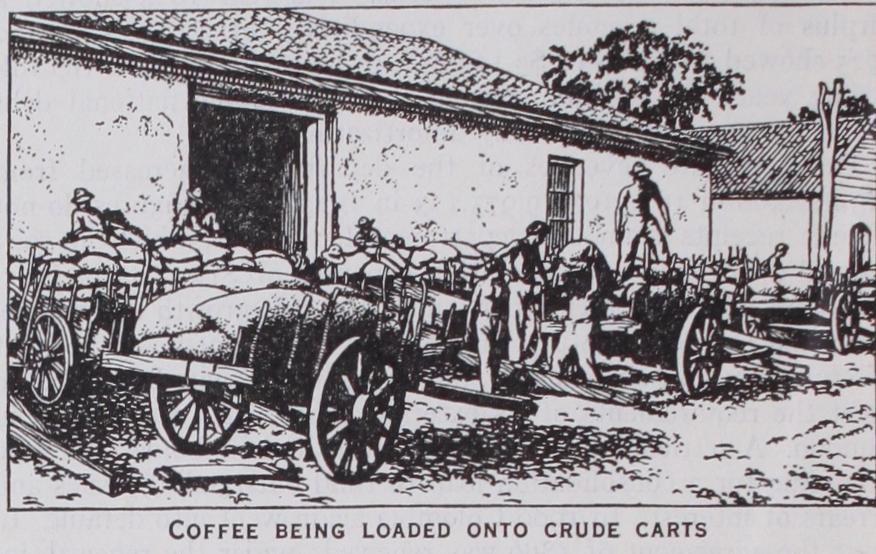
Coffee is grown principally in the zone between 3,000 and 6,000ft. in elevation. The Colombian crop in 1925 was 2,000,000 bags (132 lb. per bag). Over a five-year period the annual average production was 1,600,000 bags. Colombia is second only to Brazil in the size of its coffee production and produces about one tenth of the world's consumption. Colombian coffee is known in the world's markets as mild, and is blended with stronger grades. It is grown under shade-trees and a large part of the crop is grown on mountain slopes. Antioquia, Caldas and Cundinamarca, named in order of their relative quantity production, are the principal coffee producers, but coffee is produced in nearly all the depart ments. It is packed in sacks of from 6o to 65kg. and is for the most part exported by way of the Magdalena river. Eighty-five per cent of the coffee exported goes to the United States. The average annual value of coffee exported in the five years ending with 1925 was $51,399,578. There is no export duty on coffee.
Bananas grow- extensively in nearly all regions of the torrid and temperate zones in a great number of varieties and are one of the principal foods of the people. The production for export is practically all in the region about Santa Marta on the Caribbean coast. Other agricultural products exported are cotton, rubber, tobacco and tagua. Their export value, however, is insignificant. Other agricultural production is mainly food for home consump tion. The torrid zone produces rubber, coconuts, tobacco, bananas, sugar-cane, corn, cotton, cocoa, beans, rice, etc. The subtropical zone, in addition to coffee, produces a great variety of fruits such as banana, pineapple, mango, papaya, alligator-pear and citrus fruits. The temperate zone is the most favourable for agriculture and produces wheat, barley, potatoes, oats, corn and practically all the fruits and vegetables known in the United States.
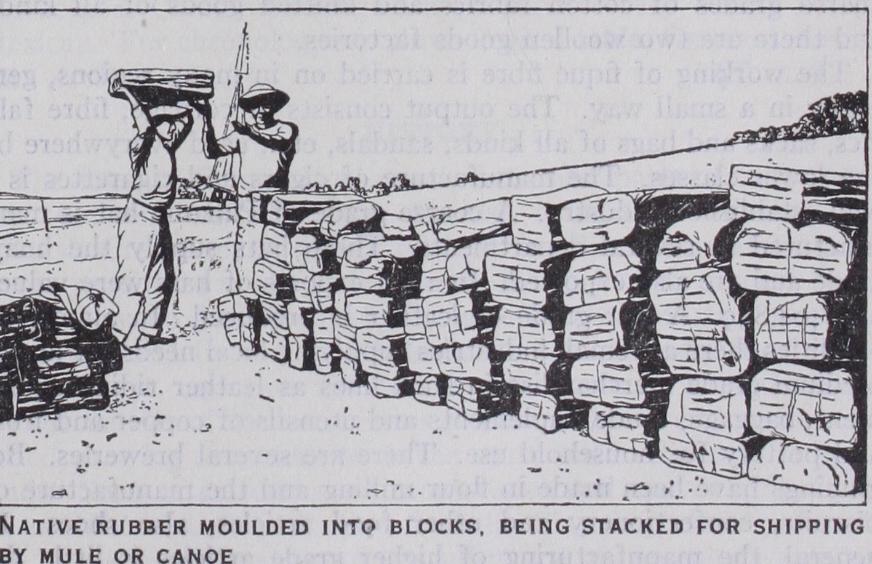
There are no statistics of gold production. Exports of gold in 1924 were $2,078,739. Colombia at the present time is the prin cipal producer of platinum and emeralds. The value of the an nual platinum production is between $3,000.00o and $4,000,000. The emerald production is a Government monopoly, and the out put is sold under contract in Paris. The revenue from this sale was officially stated as $659,334 in 1923 and $257,50o in 1924. Salt production is also a Government monopoly. The value of the output of the maritime salt works for 1925 was $1,161,244, and of the salt mines, $1,389,183. There are no statistics of the silver production, which is entirely consumed within the country. There are abundant resources of coal. This mineral is mined in many localities enough to supply the needs of the country, but there are no statistics of production. A number of other minerals are known to exist, but are not exploited on a commercial basis.
The working of fique fibre is carried on in many regions, gen erally in a small way. The output consists of cordage, fibre fab rics, sacks and bags of all kinds, sandals, etc., used everywhere by the lower classes. The manufacture of cigars and cigarettes is a well-established industry. A coarse grade of Panama hat is man ufactured in several departments. These hats supply the home trade and are also exported. In 1924 exports of hats were valued at $404,859• A fair grade of leather is produced. In almost all localities there are small industries supplying local needs for low or medium grade merchandise in such lines as leather riding equip ment, baggage, crude implements and utensils of copper and iron, and pottery for household use. There are several breweries. Be ginnings have been made in flour milling and the manufacture of biscuits, confectionery and other food articles, also shoes. In general, the manufacturing of higher grade articles is little de veloped and this branch should offer possibilities.
Navigation of the Magdalena is possible only to steamers of small draught. At best it is slow and difficult and at times, when the dry season is on along the upper waters, it becomes impossible and traffic is held up. There is a span in about the middle of its course that is impassable to steamers, and all freight and pas sengers have to be transferred by railroad between La Dorada and Honda, a distance of 38 miles. Barranquilla is the principal port, but ocean ships have to be unloaded at Puerto Colombia and merchandise transferred by a railroad 17m. long to Barranquilla, where it is loaded on the river steamers. Import merchandise for the capital has been transferred six times in Colombia when it finally reaches the merchants' warehouses in Bogota.
The epoch of prosperity that Colombia has enjoyed in recent years has resulted in increased imports and exports, and the ad ditional burden put on the existing transportation facilities has re sulted at times in a serious congestion of merchandise in the principal ocean and river ports. Permanent and full relief can be afforded only by the completion of railroad trunk lines connect ing the interior with the coast. The Government has embarked on an extensive programme of railroad and highway construction, which includes the completion of trunk lines traversing the pop ulated sections of the east and of the west.
Communications.—At the beginning of the year 1926 there were 1,127m. of railroad in operation, of which 564m. were owned by the national Government, 238m. by the departments and 325m. by private companies. There is an aerial cable line 45m. long for handling merchandise, in service between Mariquita, near the Magdalena, and the city of Manizales. Two other aerial cable lines are now under construction.
The United Fruit Company operates a regular weekly steam ship service between Colombia and New York and touches at Cartagena, Puerto Colombia and Santa Marta. The Colombian Steamship Company has a regular weekly service between New York and Puerto Colombia and Cartagena. The Grace Steamship line and the Panama Mail Steamship Company have services at longer intervals. Several European steamship lines call at the Colombian ports.
There is a regular service of hydroplanes between Barran quilla and Girardot, the river port for Bogota, with service several times weekly in each direction. There is also air service between the following points : Puerto Wilches and Bucaramanga ; Girardot and Neiva; Barranquilla and Buenaventura. This service is main tained by a German company and carries passengers and mail.
Little progress was made in road building until the last decade. Formerly the roads of the country were principally bridle-paths and were passable to vehicles only in a comparatively limited number of populous districts. The national and departmental Gov ernments are making every effort to push road construction, and the last few years have shown considerable progress. Not much reliance is to be placed on available road statistics, especially as to the length of roads passable for automobiles. In 1924 the length of roads paved with crushed stone or gravel and sand was given as 76o miles. There is a very good automobile road connecting Bogota with Tunja and points beyond, which will eventually be passable for vehicles all the way to Cucuta near the Venezuelan frontier. There are other good roads connecting Bogota with neighbouring towns.
Mail from the coast to Bogota and the interior is carried by the river steamers and the service is slow and at times delayed. The air mail is quick and regular, and much safer than the Govern ment mails. The Colombian Air Mail service has agencies in the more important cities of America and Europe.
The telegraph system is owned by the Government. In July 1926 it comprised 1 5,5 2 5m. of line and service was given in 752 offices. The Government also operates wireless telegraph service in some parts of the republic. There is cable communication with foreign countries through the ports of Buenaventura and Carta gena. The larger cities have local telephone service owned by pri vate companies or the municipalities. The national Government owns long-distance telephone lines connecting most of the larger cities. (R. U. L.) From the archaeological point of view the large expanse of territory represented to-day by the Republic of Colombia must be considered separately. But investigation is so incomplete that only the main lines of the prevailing culture can be indicated. The fine technique of the pottery and gold-work of certain regions, and also the traditional history of a few tribes, bring the area into relation with the more organized cultural developments both to the north and south. Large portions of the country were peopled by tribes living under primitive conditions, and the manifestations of higher culture are confined, so far as is known, to the Cauca Valley and the plateau of Bogota.
Historical tradition, as preserved, relates principally to the tribes of the Bogota plateau, where, at the time of the Spanish invasion, political conditions seem to have been much the same as those of central Peru at the beginning of the rise of the Inca. The expansion of tribes of kindred culture, ruled by paramount chiefs, led inevitably to collision, and the Chibcha people had established a supremacy over their neighbours, which, given time for development, might well have resulted in an "empire" on Inca lines. Far less is known from traditional sources of the people of the Cauca Valley, among whom the Quimbaya tribe stand pre eminent as potters and gold-workers. Existing evidence would place culture of the more advanced peoples of Colombia in exactly that position which their geographical situation suggests. There is undoubtedly a close connection with Panama, and remoter Pe ruvian and Mexican influence. Influence from the south is a natural assumption, but, owing to the difficulties of travel by land, due to the forested area of eastern Panama, sparsely peopled by tribes of low culture, the very close relationship between the Colombians and the Talamancans appears at first sight surprising. But clearly there was a regular "port-to-port" trade down the western coast, which was so continuous that Vasco Nunez de Balboa received from the Panamanian chief, Tumaco, an itinerary by sea to Peru, as yet undiscovered, together with a description of the llama.
Like the Talamancans, the inhabitants of Colombia did not practise stone-building, with one notable exception. This is the prehistoric site of San Augustin, on the upper Magdalena, where sculptures have been found in a style obviously connected with the art of the Peruvian Chimu. The pottery, especially in orna mentation by means of the "lost-colour" process (the reservation of designs in the ground-colour by means of wax or resin painting before the second slip was applied) shows a close relationship with Talamancan technique, while the forms and paste display near relationship to the ware of the Ecuadorian highlands. The gold work, produced by the cire-perdue process of casting, with soldered details, or by hammering is, as far as the province of Antioquia (the Quimbaya area) is concerned, almost indistinguishable from the Talamancan. But the Chibcha produced castings, of very inferior quality, in a peculiar style of their own, which is easily recognizable. Gold was common in the Colombian region, and was employed for divine offerings, either in the form of dust or of manufactured articles. At certain ceremonies, practised in com mon by the tribes of the Bogota plateau, rich offerings of this metal were thrown into certain sacred lakes (especially lake Guatabita) or deposited on the banks. The particular rite of investiture of the ruler of Guatabita, in accordance with which, plastered with gold-dust, he plunged into the lake, gave rise to the many stories of "El Dorado" found in the pages of the early chroniclers. Religion, so far as can be ascertained, was expressed in the worship of various powers of nature, the sun, moon, rain and lakes. Creator-gods and culture-heroes were also included in the pantheon. In outline, religion seems to have corresponded to that of the early Peruvian tribes, but much of the ritual shows a very close correspondence with that of the later Mexicans, especially in the extent, and methods, of human sacrifice. Nahuatl influence extended into the Talamancan area, and certain features of Nahuatl ritual may have been introduced into Colombia together with Talamancan methods of pottery decoration and gold-tech nique. Human sacrifice, if it existed under the Inca regime in Peru, was rare, and was only practised on special occasions. In this respect Colombian religion approximates very closely to the Mexican. For chronology see chronological table, CENTRAL AMER ICA : Archaeology.
The coast of Colombia was one of the first parts of the Ameri can continent visited by the Spanish navigators. In 1508 the Spanish Crown made grants of land in this region and settle ments were soon made on the coast. In April 1536 an expedition under Gonzalo Jimenez de Quesada left Santa Marta and made its way inland by the Magdalena. Quesada founded Bogota on Aug. 6, 1538, and gave the country the name of New Granada. By the middle of the i6th century there were several well-estab lished, growing communities on the coast and in the interior high lands. Soon after settlement monasteries and convents began to be established and the Roman Catholic Church grew very power ful. A considerable share of the substance of the colony went to the maintenance of the religious communities and the construc tion and enriching of churches. The power of the Spanish Crown was delegated throughout most of the colonial period to a viceroy who governed not only the territory which is at present Colombia but also that of Panama, Ecuador and Venezuela. Under the Spaniards little economic progress was made. The Crown took considerable wealth out of the country but the colonists lived in poverty.
In 1811 insurrection against Spanish domination was formally commenced, and almost incessant warfare was carried on with the mother country until 1824. Simon Bolivar, the great national hero, headed the struggle. In 1831 the republic of New Granada was founded, which included the territory at present known as Colom bia and Panama, and a Constitution was promulgated. From then up to 1903 the country was carrying on intermittent civil war. Under President Tomas de Mosquera in 1861 the power of the Church was reduced and its property appropriated by the nation. In 1861 the name The United States of Colombia was adopted.
Through the many years of strife the conciliation of warring factors was effected, the unity of the country consolidated, and the way laid for permanent peace. There was, however, a con stant drain on the manhood and resources of the country, and the intervals of peace were too short to permit of the development of the natural resources or progress in transportation. Colombia en tered the loth century as a country in which the principal centres of population were scattered over a vast territory more or less isolated from each other. A life of considerable comfort and culture developed in the various cities, but the country as a whole remained in a backward state. In 1903 peace was attained, which has proved to be lasting.
Perhaps the most important event of the loth century has been the loss of Panama, which seceded in 1903 (see PANAMA) . The differences between Colombia and the United States over the secession of Panama were adjusted by the Thompson-Urrutia Treaty, which was finally ratified by the Colombian senate in Dec. 1921. Among other conditions this provided for the pay ment of $25,000,000 indemnity to Colombia for the loss of Panama in five yearly payments, Colombia engaging to recognize the independence of Panama.
Under Gen. Pedro Nel Ospina who became president in Aug. 1922, an impetus was given to the construction of public works, especially roads and railroads. For this purpose loans to the amount of $25,000,000 in July, 1927, and $34,000,000 in March, 1928, were concluded in New York; particular projects involved included a railway giving Bogota direct connection with the Pacific and another extending from Bogota northward to connect with the existing line in the lower Magdalena valley. In 1926 Dr. Miguel Abadia Mendez was elected to the presidency for a four year term. A treaty with Nicaragua signed March 24, 1928, settled several century-old territorial disputes between the two countries by awarding the Mousquito Coast and the Great and Little Corn Islands to Nicaragua and islands of the Andres Archipelago to Colombia. In Feb. 1930, Dr. Olaya Herrara was elected president, the first Liberal in several decades. The financial crisis forced the Conservative majority in Congress to provide checks on the export of gold, regulation of exports and imports, a virtual suspension of debt payments, a system of agricultural credits, and appropriations for public works. The Conservatives sought by voting war preparations to magnify a minor Peruvian invasion of Leticia, Sept. 1931, into a major issue ; only the friendly agency of Brazil, the U.S.A., and the League of Nations secured the interposition of a League Commission to administer the province while a Protocol favorable to Colombia was negoti ated; Conservative opposition delayed ratification until Meanwhile the Liberals captured control over Congress and re opened their attack on the favoured position of the Catholic Church. In the presidential election of boycotted by the Conservatives, Dr. Alfonso Lopez, advocate of a "New Deal," easily won over his Communist rival. An eight-hour day law, re newed fiscal controls, an issue of scrip and appropriations for public works roused opponents early in 1935 to form a Patriotic National Economy Group to fight Dr. Lopez. The advantageous operation of the commercial treaty negotiated with the U.S.A. off set the hostility of that country's bondholders due to the absorp tion of private mortgage companies into two government controlled banks. Assurance of peace with Peru and an improving market for coffee brought further encouragement in 1935.