
COLON, the second city of the Republic of Panama, and the northern gateway to the Panama canal. The American town of Cristobal, which is within the Canal Zone, adjoins Colon and is virtually a part of it. The great port works and docks built by the American Government at Cristobal make Colon one of the most important ports of the Caribbean sea, a considerable portion of the freight for neighbouring coastal points in Central America and northern South America being transhipped there and other goods being unloaded for storage in the large bonded warehouses within the Canal Zone. Colon has a population of about 33,000, not including the residents of the Canal Zone. It is the northern terminus of the Panama railroad, 48m. from the city of Panama. It is the capital of the province of Colon, the seat of a Panaman custom-house and of consuls of various countries.
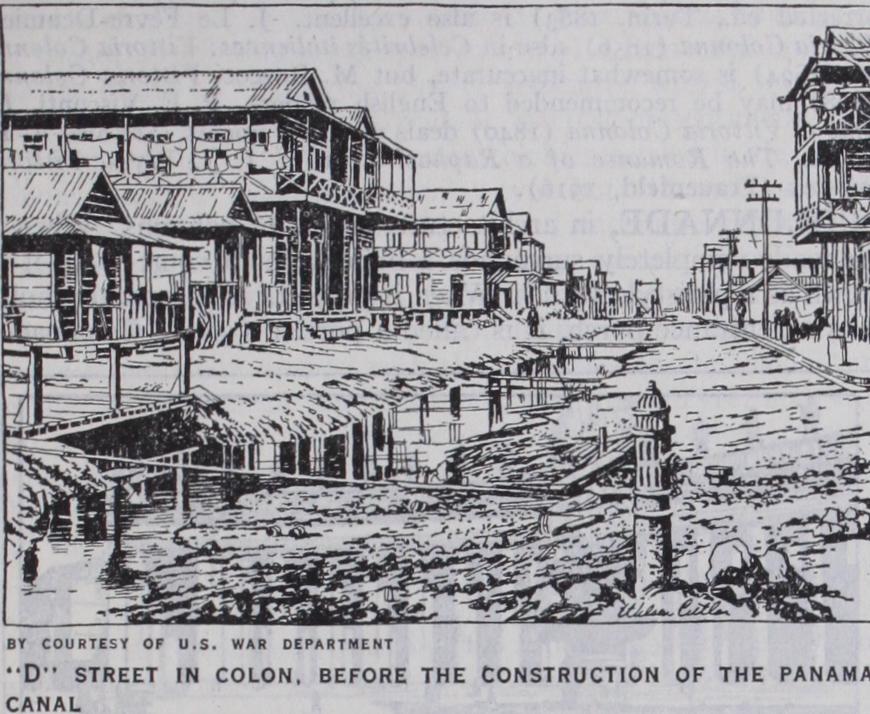
Colon is now one of the busiest tourist centres in the world, its streets lined with shops owned by natives of every land under the sun, and selling the varied products of the world. The native pop ulation is largely negro, chiefly descendants of labourers imported from the British West Indies during the various periods of con struction on the Panama canal, and the rule of the road is to keep to the left, one of the few cities of importance in Latin America following the British custom. The town was founded in 185o, at the Atlantic terminus of the original Panama railway, and was first called Aspinwall, after William H. Aspinwall (18o7-75), one of the builders of the railway. The present name, Colon, is the Spanish form of Columbus, as the twin city of Cristobal is the Spanish of his Christian name. On the completion of the railway in 1855, Colon attained outstanding importance as compared with the older Caribbean ports of Panama, and with the first plans for the isthmian canal, took on additional prestige. Prior to the begin ning of work on the American canal, in 19°3, Colon was notor iously unhealthy, and one of the provisions of the Canal Treaty of 19°3, giving the United States full sanitary control over the cities of Panama, was to enable it to clean up Colon before the work of construction was begun. Much of the work of Gen. Gorgas (q.v.), the sanitary genius of the canal construction, was done in and about Colon, which was given a new system of water works and sewerage as well as a complete drainage of the sur rounding swamps in the triumphant fight against yellow f ever and malaria. Colon is now one of the most healthful tropical cities in the world. The Hotel Washington, operated by the United States Government, is the popular resort of the Canal Zone.
(W. THo.)