
CORINTH, a city of Greece, situated 12 m. south of the isthmus (see CORINTH, ISTHMUS OF) which connects Pelopon nesus and central Greece, and separates the Saronic and the Co rinthian gulfs. The citadel, or Acro-Corinthus, rises precipitously on the south to a height of 1,886 ft. and commands all routes into Peloponnese. The territory of Corinth was small and un fertile ; but its position made it a commercial centre, and ships were hauled across the isthmus. With its western port of Lechaeum it was connected by two continuous walls, with Cen chreae and Schoenus on the east by forts.
Modern Town.—The modern town of New Corinth, the head of a district in the province of Corinth, is situated on the west ern side of the Isthmus, 31 m. north-east from the ancient city. It was founded in 1858, when Old Corinth was destroyed by earthquake, and was almost wholly destroyed by earthquake in 1928. It is connected by railway with Athens (S7 m.), with Patras (8o m.) and with Nauplia (4o m.), the capital of Argolis. Com munication by sea with Athens, Patras, the Ionian Islands and the Ambracian Gulf is frequent since the opening of the ship canal, in 1893. But it has few local resources. Its chief exports are currants (which have their name from the town), olive-oil, silk and cereals from north-east Peloponnese. Old Corinth, being a considerable town, after the War of Liberation was suggested as the capital of the new kingdom. Since the earthquake of 1858, it is a poor village, mostly Albanian.
Archaeology.—The ancient city spreads out over two terraces, one about ioo ft. above the other; both are ancient shore-lines: the present coast of the Gulf is about 1 m. distant. Here at the nearest point to the city was laid its western harbour, Lechaeum, excavated far into the shore and joined with the city by long walls. The heart of the ancient city was in an indenta tion about the middle of the upper terrace. At its lower end is the modern public square, shaded by a gigantic plane tree. On the terrace to the west is a venerable temple ruin, and, directly up the hollow, Acro-Corinthus rises over 1,5oo ft. above the vil lage. Even from the village, the view over the gulf includes Parnassus on the north, Cyllene on the west, and Geraneia on the north-east. From Acro-Corinthus the view is still finer.
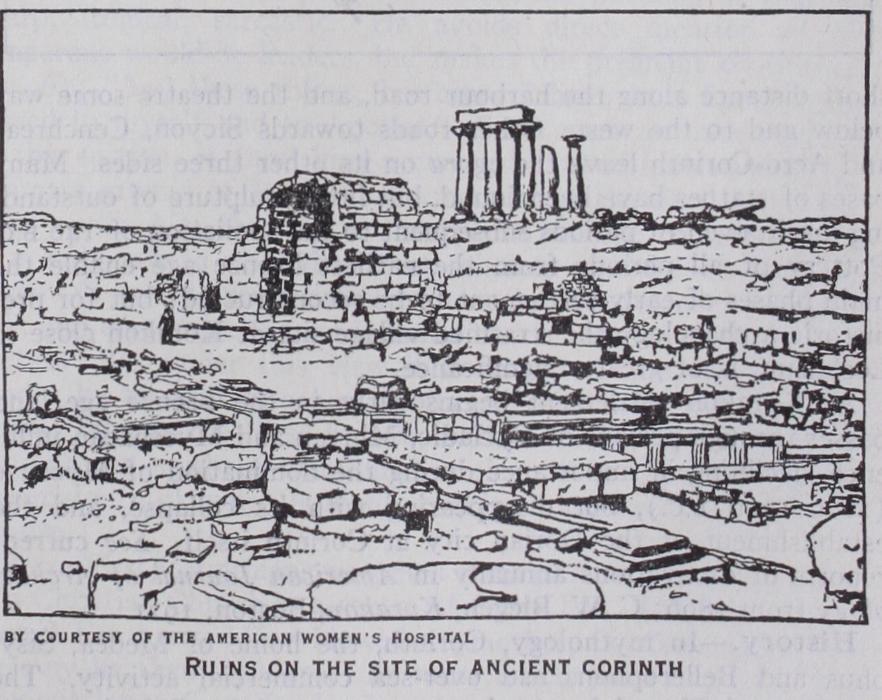
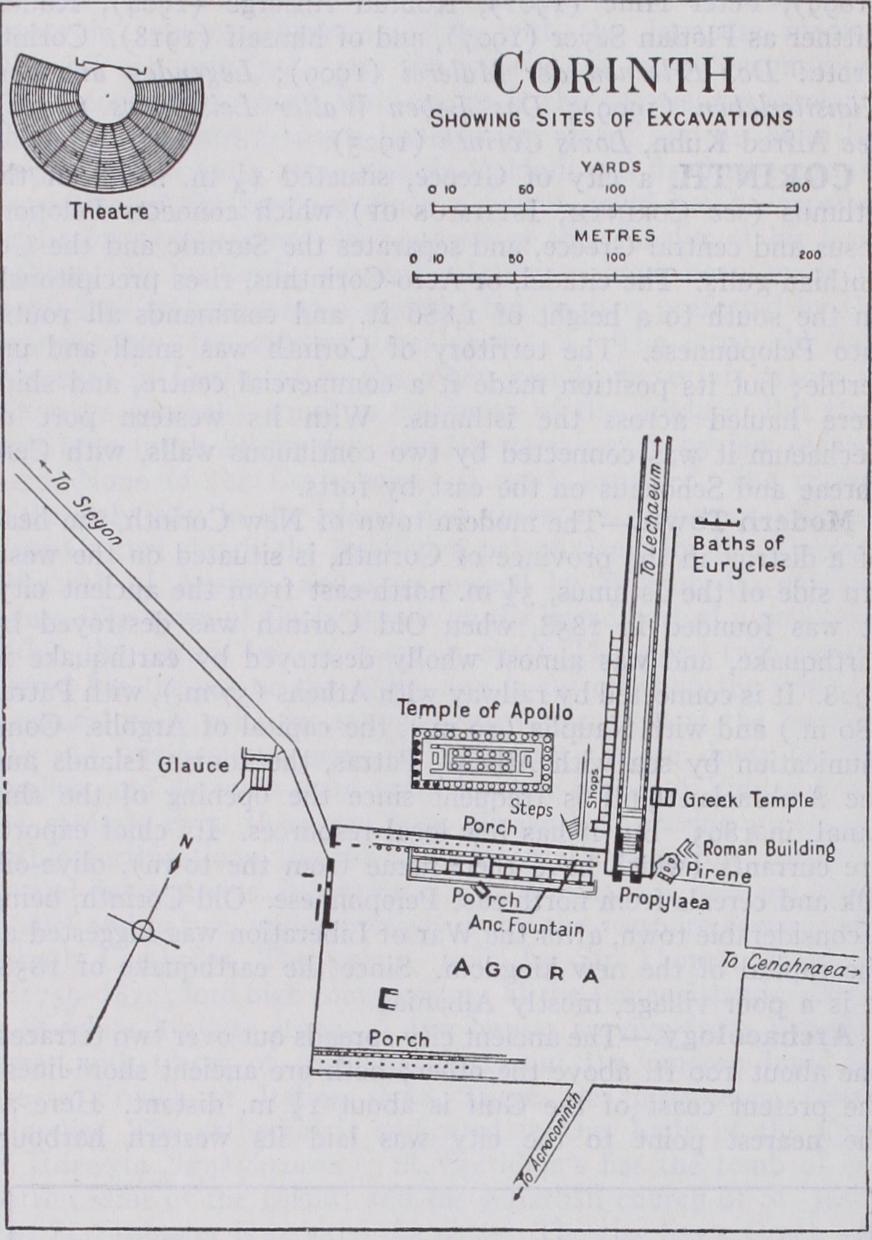
Excavations begun in 1896 by the American School of Classical Studies at Athens, and still in progress, have brought to light important monuments of the ancient city, both Greek and Roman. Principal discoveries are the ancient market-place (agora), on the terrace south of the ancient temple, surrounded with colonnades and monuments ; the harbour road which enters the agora up the hollow east of the temple, through a stately gateway; the famous fountain of Pirene, east of this gateway ; large public baths a short distance along the harbour road, and the theatre some way below and to the west. Other roads towards Sicyon, Cenchreae and Acro-Corinth leave the agora on its other three sides. Many bases of statues have been found, but little sculpture of outstand ing merit, even of periods subsequent to the spoliation of I46 B.C. Pottery of all periods from the earliest bronze age enable the main phases of early settlement to be reconstructed; but for pre historic archaeology the stratified village-site at Korakon close to Lechaeum is of greater significance.
At Korakon settlement begins early in the bronze age, and passes through periods of Cycladic, Minyan and Mycenaean influ ence, declining in importance during the domination of Mycenae (1600-12oo B.c.), but disappearing with its collapse, and the establishment of the Dorian city at Corinth itself. See current reports of excavations annually in American Journal of Archae ology from 1896; C. W. Blegen, Korakon, Boston, 1921.
Corinth's real prosperity dates from the time of the tyranny (657-581 B.c.), established by Cypselus (q.v.) and continued under his son Periander (q.v.). Under these remarkable men the city rapidly developed. She extended her sphere of influence throughout the coast-lands of the western gulf ; she controlled the Italian and Adriatic trade-routes and secured a large share of the commerce with the western Greeks. Connexions grew up with Miletus, Lydia, Phrygia, Cyprus, and Egypt. As an industrial centre, Corinth achieved pre-eminence in pottery, metal-work, and :lecorative handicraft ; her bronze and her pot tery were widely exported over the Mediterranean.
The tyranny was succeeded by an oligarchy which pursued a commercial policy to the neglect of military efficiency. Late in the 6th century, Corinth joined the Peloponnesian league under Sparta, in which her financial resources and strategic position secured her an unusual degree of independence. The city be friended the Athenians against Cleomenes I. (q.v.) and supported them against Aegina, their common commercial rival. In the great Persian war of 48o B.C., Corinth served as the Greek head quarters; her army took part at Thermopylae and Plataea (q.v.) and her navy at Salamis and Mycale. Later the develop ment of Athenian trade and naval power became a serious menace. In 459 B.C. the Corinthians, with the Aeginetans, made war upon Athens, but lost both by sea and land. The Athenians extended their rivalry even into the Corinthian gulf. Syracuse remained friendly, but the disaffection of Corcyra hampered the Italian trade. The alliance of Corcyra with Athens led the Corinthians to incite Sparta to war with Athens in 432 B.C. In the war Corinth displayed great activity, and gave valuable support to Syracuse (see PELOPONNESIAN WAR).
In 395 B.C., the domineering attitude of Sparta impelled the Corinthians to conclude an alliance with Argos, Thebes and Athens. Later Corinth rejoined Sparta and after Leuctra (q.v.) opposed the Thebans. In 344 B.C. a political struggle ended in the tyranny of Timophanes, who was put to death by his brother Timoleon (q.v.).
After Chaeroneia (q.v.), Philip II. of Macedon summoned a Greek congress at Corinth and left a garrison on the citadel. This citadel, one of the "fetters of Greece," after Alexander's death fell to Antigonus Gonatas. In 243 B.c. Corinth was freed by Aratus and incorporated into the Achaean league (q.v.), but was again surrendered to Macedonia. T. Quintius Flamininus, after proclaiming the liberty of Greece at the Isthmus, restored Corinth to the league (ig6 B.c.). With the revival of its political and commercial importance the city became the centre of resistance against Rome. After the war of 146 B.c. the Romans despoiled Corinth of its art treasures and destroyed the entire settlement.
In 46 B.C. Julius Caesar repeopled Corinth with Italian freed men and dispossessed Greeks; it rapidly recovered its commercial prosperity. Augustus made it the capital of Achaea; Hadrian enriched it with public works. Its prosperity is attested by the New Testament, by Strabo, and by Pausanias.