
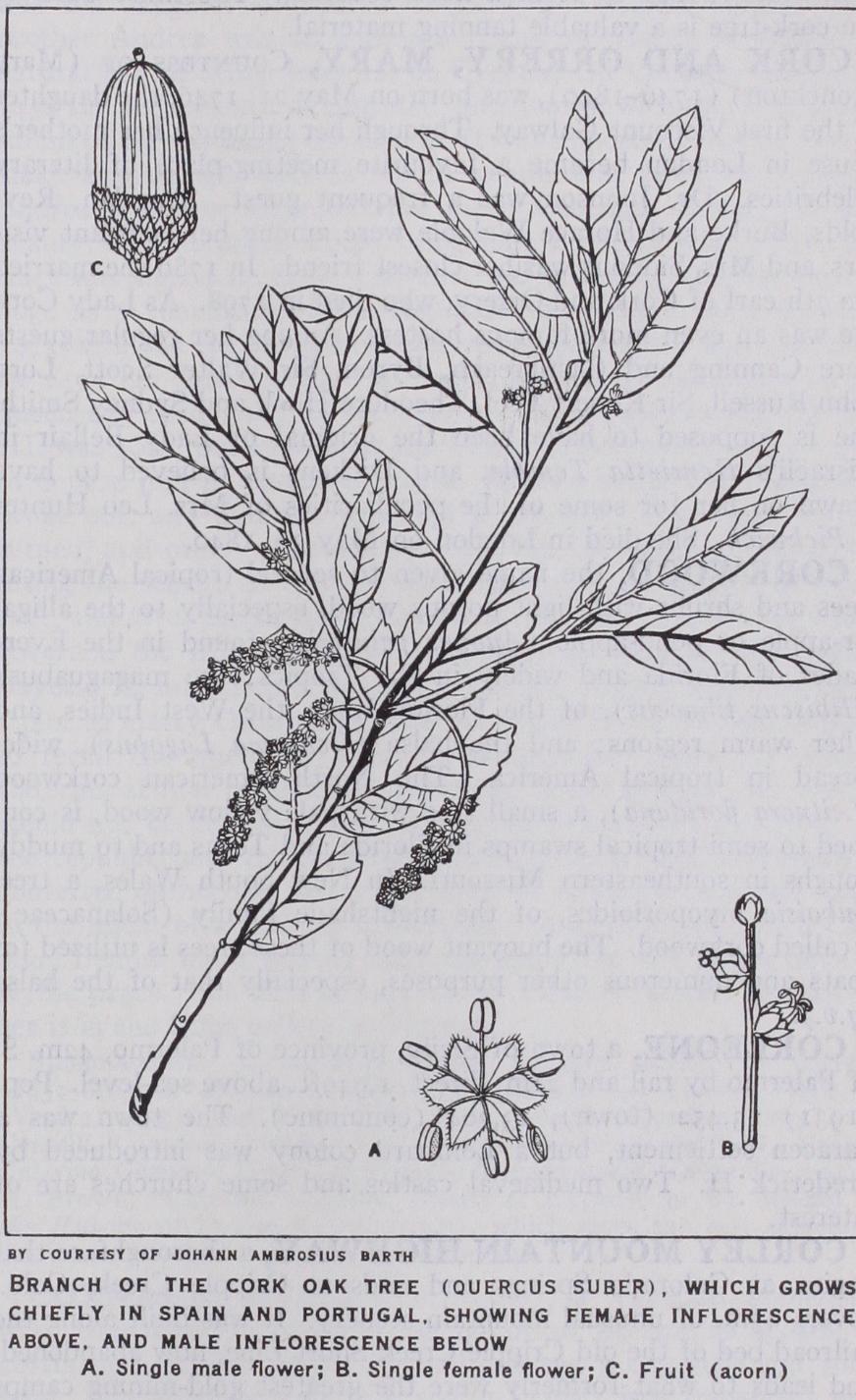
CORK, the outer layer of the bark of an evergreen oak (Quercus sober). The tree reaches the height of about Soft., .growing in the south of Europe and on the North African coasts generally; but it is principally cultivated in Spain and Portugal. The outer layer of bark in the cork oak by annual additions from within gradually becomes a thick soft homogeneous mass, pos sessing those compressible and elastic properties upon which the economic value of the material chiefly depends. The first strip ping of cork from young trees takes place when they are from 15 to 20 years of age. The yield, which is rough, unequal and woody in texture, is called virgin cork, and is useful only as a tanning substance, or for forming rustic work in ferneries, con servatories, and so forth. Subsequently the bark is removed every eight or ten years, the quality of the cork improving with each successive stripping; and the trees continue to live and thrive under the operation for 15o years and upwards. The produce of the second barking is still so coarse in texture that it is only fit for making floats for nets and for similar applications. The operation of stripping the trees takes place during July and August. Two cuts are made round the stem—one a little above the ground, and the other immediately under the spring of the main branches.
Between these three or four longitudinal incisions are then made, the utmost care being taken not to injure the inner bark. The cork is thereafter removed in the sections into which it has been cut, by inserting under it the wedge-shaped handle of the imple ment used in making the incisions.
Though specially developed in the cork-oak, cork is an almost universal product in the stems (and roots) of woody plants which increase in diameter year by year. Generally towards the end of the first year the original thin protective layer of a stem or branch is replaced by a thin layer of "cork," that is a layer of cells the living contents of which have disappeared while the walls have become thickened and toughened as the result of the formation in them of a substance known as suberin. Fresh cork is formed each season by an active formative layer below the layer developed last season, which generally peels off. Where the for mation is extensive and persistent as in the cork-oak, a thick cover ing of cork is formed. In some cases, as on young shoots of the cork-elm, the development is irregular and wing-like outgrowths of cork are formed. In northern Russia a similar method to that used for obtaining cork from the cork-oak is employed with the birch.
Cork possesses a combination of properties which peculiarly fits it for many and diverse uses, for some of which it alone is found applicable. The leading purpose for which it is used is for forming bungs and stoppers for bottles and other vessels con taining liquids. Its compressibility, elasticity and practical im perviousness to both air and water so fit it for this purpose that the term cork is even more applicable to the function than to the substance. Its specific lightness, combined with strength and dura bility, recommend it for forming life-buoys, belts and jackets, and in the construction of life-boats and other apparatus for saving from drowning. On account of its lightness, softness and non conducting properties it is used for hat-linings and the soles of shoes, the latter being a very ancient application. It is also used in making artificial limbs, for lining entomological cases, for pommels in leather-dressing, and as a medium for making archi tectural models. Chips and cuttings are ground up and mixed with india-rubber to form a floor covering. The inner bark of the cork-tree is a valuable tanning material.