
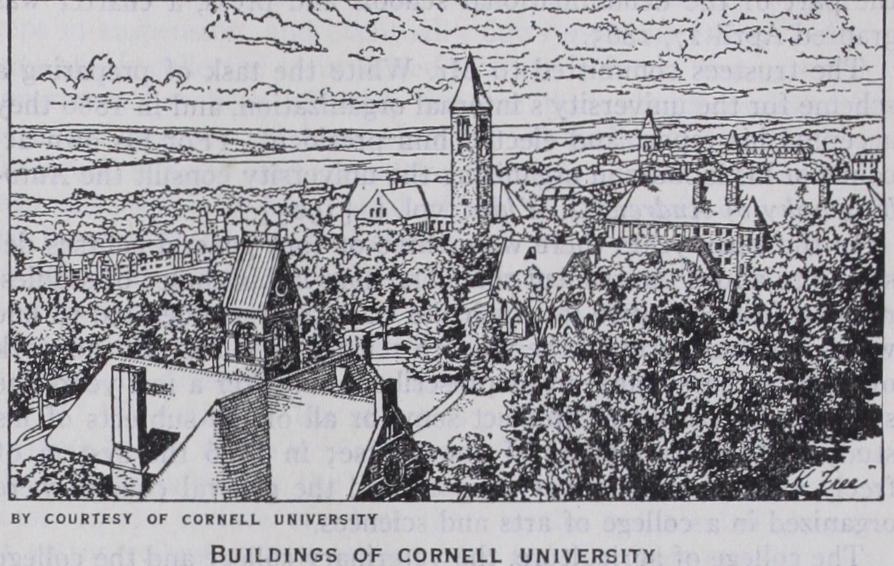
CORNELL UNIVERSITY, an American institution of higher education, situated at Ithaca, New York. Its campus has a fine situation on a hill 800ft. above sea level and 400ft. above Cayuga lake, between deep gorges cut by two creeks, and com mands a wide view of the lake and the town. The university was founded in 1865 and was named in honour of Ezra Cornell, its principal benefactor. It was organized by Andrew D. White, its first president, and was opened in 1868. It is co-educational (since 1872) and comprises the graduate school, with 63o stu dents in 1927; the college of arts and sciences (1,898 students) ; the law school (175 students), established in 1887; the medical college (263 students), a graduate college established in 1898 by the gift of Oliver Hazard Payne, situated in New York city but maintaining a division in Ithaca; the New York State veterinary college ( o7 students), established by the State legislature in 1894; the New York State college of agriculture (664 students), maintained by the State since i9o4 and closely related to two experiment stations, the one at Ithaca supported by the Federal Government and the other at Geneva, 4om. away, maintained by the State Government ; the State college of home economics (451 students), established by the State legislature in 1925; the col lege of architecture (182 students) ; and the college of engineering, comprising three schools: civil engineering (328 students), me chanical engineering (431 students) and electrical engineering (3o9 students). The total enrolment was 5,438 students, including 1,271 women. In addition, 2,o53 students were enrolled in the 1927 summer session and 79 in the short winter courses in agri culture. Nearly all the States and territories of the United States and 35 foreign countries were represented.
The government is vested in a board of trustees consisting of 15 persons co-opted, ten elected by the graduates and five ap pointed by the governor of New York, these 3o persons for terms of five years; the president of the university, the governor and lieutenant governor of New York, the speaker of the assembly, the State commissioners of education and agriculture, the presi dent of the State agricultural society and the librarian of the Cornell library in the town of Ithaca, each of these eight persons ex officio ; the eldest male descendant of Ezra Cornell for the term of his natural life, and a representative of the State Grange elected annually. The university faculty elects three delegates who sit with the board and have the usual powers of trustees except the right to vote. The group of State colleges, the graduate school and the medical college are each governed by the board through a council composed of trustees and members of the faculty. The presidents have been Andrew Dickson White, 1866-85; Charles Kendall Adams, 1885-92; Jacob Gould Schurman, 1892-192o, and Livingston Farrand, inaugurated in 1921.
The university libraries contain about 75o,000 vols., most of them in the general library building, which, with an endowment (1891) of $3oo,000 for the purchase of books and periodicals, was the gift of Henry Williams Sage (1814-97), who had suc ceeded Ezra Cornell as chairman of the board of trustees; in 1906 the general library received an additional endowment fund of about $5oo,000 by the bequest of Willard Fiske, who gave it also four rich collections; viz., the Dante (8,000 vols.), Petrarch (4,000 vols.), Rhaeto-Romanic (1,3oo vols.) and Icelandic ( 15, 000 vols.). It includes the President White historical library, 23, 000 vols. and pamphlets, given by President White, especially rich in the primary sources of history and containing useful col lections on the period of the Reformation, on the English and French revolutions, on the American Civil War and on the history of superstition. Other special collections are the classical li brary of Charles Anthon, the philological library of Franz Bopp, the Goldwin Smith library (1869), the White architectural library, the Spinoza collection presented by President White (1894), the library of Jared Sparks, the Samuel J. May collection of works on the history of slavery, the Zarncke library of Germanic philology and literature, the Eugene Schuyler collection of Slavic folk-lore, literature and history, the Wordsworth collection made by Mrs. Cynthia Morgan St. John, the Charles W. Wason collection of works relating to China and the Chinese, the James Verner Scaife collection of books relating to the American Civil War and the Emil Kuichling library of hydraulic and sanitary engineering. The law library (6o,000 vols.) includes complete collections of the reports of the Federal courts and the several American State jurisdictions and of the English, Scotch, Irish and English colonial reports. The Flower veterinary library has 6,000 vols. and an en dowment of $io,000. The general library has published catalogues of the Dante, Petrarch and Icelandic collections given by Willard Fiske; it issues Islandica, an annual relating to Iceland and to the Icelandic collection.
In common with many of the State universities, Cornell univer sity was founded on the Morrill Act of 1862, by which the Federal Government apportioned to the several States 9,5oo,000ac. of the public lands, from the proceeds of the sale of which each State was to endow at least one college "where the leading object shall be . . . to teach such branches of learning as are related to agri culture and the mechanic arts." But it was Ezra Cornell (q.v.) who established the foundations, and Andrew D. White who deter mined the form of the new university. They were members of the New York legislature that in 1863-65 considered what disposition should be made of this State's share of the Federal grant. In 1864 Cornell, at White's suggestion, determined to found a university of a new type, "an institution"—as he expressed his own ideal— "where any person can find instruction in any study." He offered to give it $5oo,000 and 2ooac. of land if the State would agree to endow it with all the proceeds of New York's portion of the Federal grant. The proposed charter provided that, besides those branches of learning which the Morrill Act had specified, "such other branches of science and knowledge may be embraced in the plan of instruction and investigation pertaining to the university as the trustees may deem useful and proper"; the university was to be made non-sectarian by a provision that a majority of the board of trustees should never be of one religious sect or of no religious sect and that persons of every religious denomination or of no religious denomination should be equally eligible to all offices and appointments. Despite bitter opposition, especially on the part of the denominational schools and press, a charter was granted April 27, 1865.
The trustees committed to Mr. White the task of preparing a scheme for the university's internal organization, and in 1866 they accepted his report and elected him president. (For his own ac count of his labours in organizing the university consult the Auto biography of Andrew D. White, vol. i. [19o5].) In the early years there were three or four general courses designed to afford the student some freedom in his choice of studies, ranging from a course in which the classics preponderated to one which was built around the modern sciences. At first all the work of each of these courses was prescribed, but after a few years the student was permitted to elect some or all of the subjects of his study in the latter years of the course; in 1896 the system of freely elective studies was adopted and the general courses were organized in a college of arts and sciences.
The college of agriculture, the veterinary college and the college of home economics, with the State agricultural experiment sta tion, form a group unique in their organization, being maintained by the State but administered by the trustees as units of the uni versity, a privately endowed institution. The college of agricul ture, established on a foundation of courses given since 1868 and with a Federal experiment station founded in 1879, was organized in 1890 and made a State college in 1904 with Prof. L. H. Bailey (b. 1858) as director. The present director is Prof. A. R. Mann (b. 188o). The veterinary college was organized by Prof. James Law (1838-1921), F.R.C.V.S., and is now under the direction of Prof.
V. A. Moore (b. 1859). This group of colleges has steadily en larged its resources both for instruction and for scientific re search; the State government has given it buildings and equipment costing more than $3,000,000; and through its experiment stations and departments of extension it renders constant service to agri cultural enterprise and rural interests throughout the State.
The school of mechanical engineering owes its foundation to Hiram Sibley (1807-88), a banker of Rochester, N.Y., who gave $18o,000 for its endowment and equipment and whose son Hiram W. Sibley has helped to maintain it ; it was built up under Prof. R. H. Thurston (1839-1903 ), its director in 1885-1903 ; in 1921 it was combined with the college of civil engineering and the school of electrical engineering in a single college under the direc tion of Prof. D. S. Kimball (b. 1865). The college occupies the Sibley group of laboratories and shops, Lincoln, Franklin and Rand halls and the Fuertes observatory, and possesses a hydraulic laboratory built so as to use a 7oft. fall of water in the gorge of Fall Creek; it maintains various museums and laboratories of research and publishes a Bulletin of its engineering experiment station. The college of architecture gives courses leading to degrees in architecture, landscape architecture and fine arts. The law school became a graduate school in 192 5 ; it publishes the Cornell Law Quarterly, established in 1915.
The medical college after its foundation in 1898 occupied a building extending from 27th to 28th street in First avenue oppo site Bellevue hospital, in New York, and enjoyed relations with New York hospital and Bellevue hospital by which they admitted its students to their wards for instruction and research. In 1927 the university entered into an agreement with New York hospital by which that hospital and the college are permanently affiliated and are to occupy for their joint operation a new building to be erected at 68th street and Avenue A, near the Rockefeller Insti tute for Medical Research. To aid in carrying out this project the general education board appropriated $7,500,000; large legacies to both the hospital and the college were contained in the will of Payne Whitney, the vice president of the hospital, who had devoted himself for several years to the perfecting of the project. The college is affiliated with the Memorial hospital for the study and treatment of cancer and with the John E. Berwind maternity clinic ; it operates a pay clinic whose attendance has averaged 335 patients daily.
A group of dormitories for men was begun in 1914. For under graduate women, in addition to Sage college (1874) and Prudence Risley hall 0913), a group of new halls was provided for by a gift of $1,65o,00o received in 1928. There were 64 fraternities, most of them chapters of national "Greek-letter" societies, in 1927, and 14 similar organizations of student women, housing and boarding their members.
The regular annual tuition fees in 1927 ranged from $Soo in the medical college to $20o in the State colleges, which, however, re ceive residents of New York State free of tuition in their under graduate courses.
For athletic recreation the trustees in 1902 appropriated to the students 55ac. of the campus, 35ac. of which are always open for games; the athletic association uses the remainder, having a football field, a baseball field, two quarter-mile cinder tracks and appropriate stands and buildings. The association owns and oper ates two boat-houses and their equipment of racing boats and motor launches on the main inlet of Cayuga lake, and, in the win ter, provides conveniences for skaters on Beebe lake, above the dam of the hydraulic laboratory, where it conducts a clubhouse and restaurant. During their first two years all undergraduate students are required to receive physical training, which for the men takes the form of military training under officers detailed by the War department ; the university's unit of the reserve offi cers' training corps of the army occupies the New York State drill hall (1913), the floor of which is 2ac. in area. A staff of medical advisers safeguards the students' health by means of periodical consultations or examinations; weekly lectures on hygiene and preventive medicine are prescribed for all first year undergraduate students.
In the years 1869-1927 the university conferred 29,532 degrees, including 3,375 advanced degrees. The graduates are organized in many local associations and clubs, and in the Cornell alumni corporation, which meets at Ithaca every June with the primary duty of canvassing the postal ballot for alumni members of the board of trustees. Through the Cornellian council, which they organized in 1908, former students have contributed more than $1,500,00o to the university; they publish the Cornell Alumni News, a i6-page weekly newspaper. An undergraduate board publishes the Cornell Daily Sun, founded in 188o, and under graduate boards with faculty advisers publish the Sibley Journal of Engineering, the Cornell Civil Engineer, and (in the college of agriculture) the Cornell Countryman. (W. P.)