
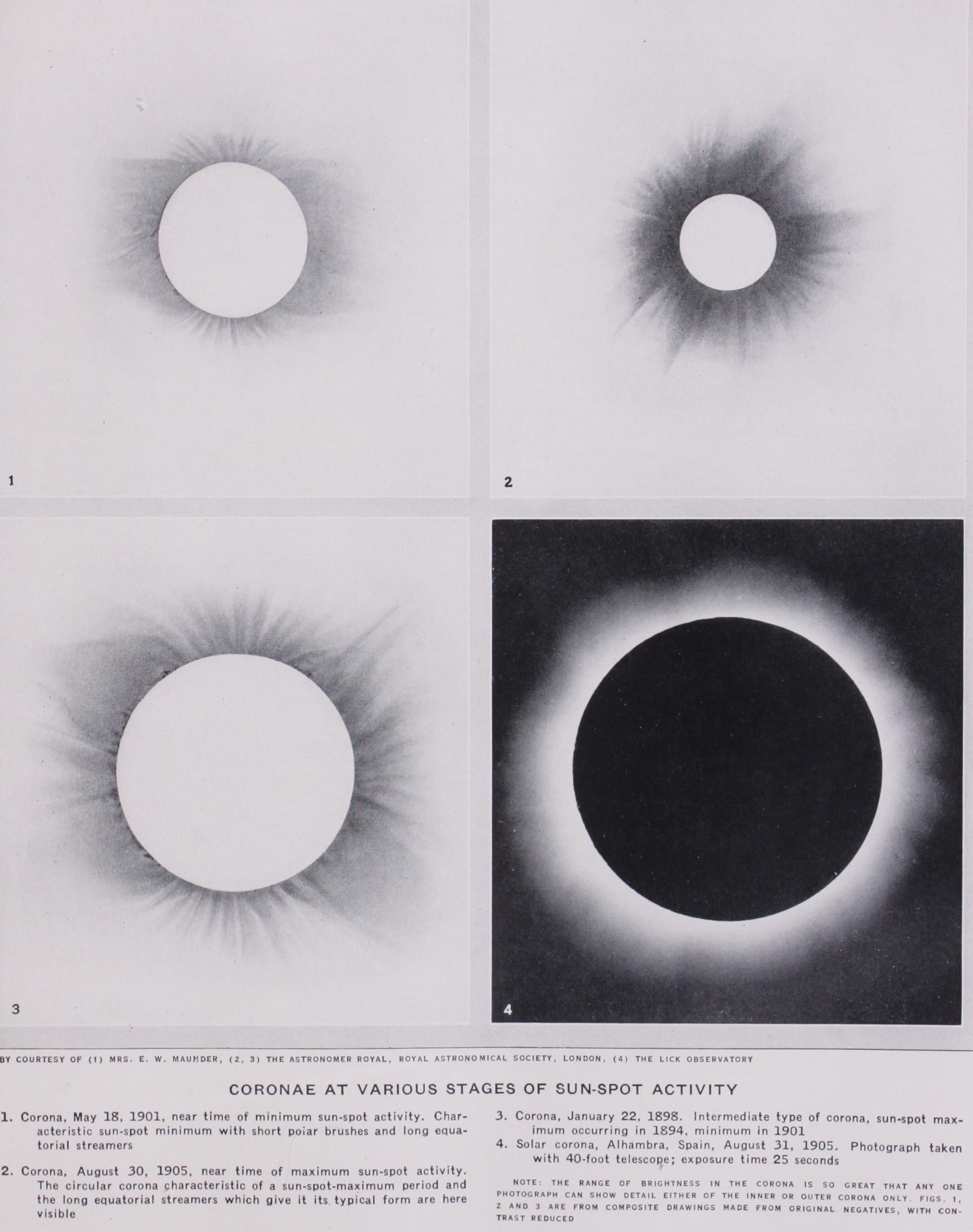
CORONA. During the period of totality of an eclipse of the sun there is seen surrounding it a halo, pearly-white in colour, of irregular shape, but roughly circular in form, about twice the size of the sun, with faint streamers extending several diameters from the limb of the sun. This is termed the Solar Corona. It was long uncertain whether the corona belonged to the sun or to the moon, or if it arose in the earth's atmosphere. It cannot originate in the atmosphere since it presents the same appearance when seen from widely separated positions on the earth's surface, and photographs show that the dark moon moves across the back ground formed by the corona, so that it cannot belong to the moon. It will be obvious that many of the phenomena that will now be described are inconsistent with any but a solar origin.
Coronae near sun-spot maximum are found to differ more than those occurring near a sun-spot minimum. It is definitely estab lished that changes occur and that the broad features may be correlated with sun-spot activity. It remains at present undecided whether any changes occur during the short periods of time for which the corona can be observed at any one eclipse. Certainly no changes have been found during the time of totality at any one station, which is necessarily less than about seven and a half minutes. The interval of time between totality at different points of the earth's surface lying within the zone of totality may, how ever, be several hours, and it is of interest to compare observa tions of the corona made at widely separated stations. The evi dence is on the whole in favour of changes taking place. In 1905 plates taken in Egypt and in Spain with an interval of 7omin. showed no movement, but in 1918 stations 26min. apart showed changes in the coronal arches, indicating that they were receding from the sun with a velocity of about i6km. per sec., and Prof. Horn d'Arturo, comparing photographs of the corona of Jan. 14, 1926, taken in East Africa and in Sumatra, with an interval of I5omin., finds considerable changes and velocities of recession of the coronal material of the order of 'km. per sec. Of course, rapid motions along the lines of the streamers might exist and escape detection.
The Distribution of Intensity. The older measurements are quite inconsistent. More recent measurements agree more or less with the law found by Bergstrand in 1914. He found that the in tensities near the solar equator differ greatly from those near the poles at the same distance from the centre of the sun. The equa torial rays are three times as intense as the polar rays. He sug gested that we regard the corona as the superposition of an interior corona existing only in the equatorial zone, and a general outer corona. In both the intensity decreases as the inverse square of the distance from the edge of the sun, but the intensity of the equatorial corona is double that of the outer corona. However, on account of the complex detailed structure of the corona, any attempt to derive a law of intensity distribution of the kind just examined, which ignores variation round the sun and treats the corona as if it were a disc whose brightness varies only along a radius, is foredoomed to failure if regarded as anything but a rough approximation.
The Total Radiation from the Corona. In view of the great un certainty of the older measurements and the paucity of modern ones, caution must be used in giving any figures for the total radiation, but it seems fairly clear that the total energy radiated is from about a quarter to a half that received by us from the full moon, and that it is not constant but varies from one eclipse to another, the measures indicating, for example, that it was 40% greater in 1926 than in 1925.
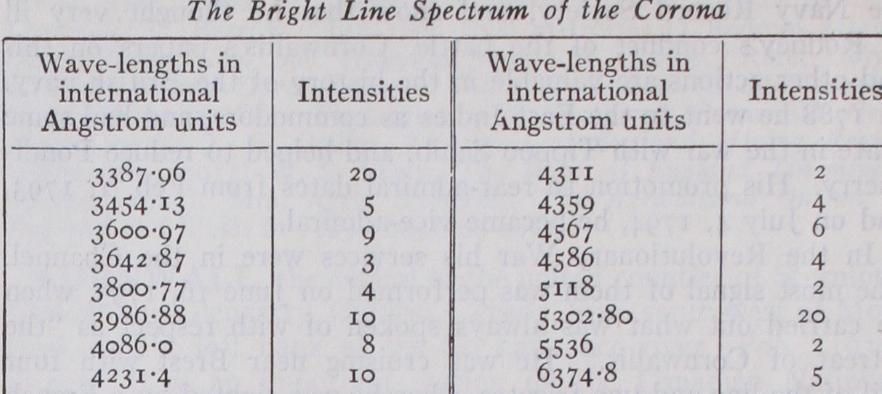
Of these lines 4231 and 4586 are near strong lines due to ionized iron, and 5536 is near a strong iron line and near a strong line due to ionized strontium. These lines are, however, possibly coronal in origin. Three lines in the far ultra-violet (3164, 317o and have been observed by Deslandres once only, and are probably of chromospheric origin due to TiII. A few other very doubtful lines are 3461, 4398, 4533 and 4567. See C. R. Davidson and F. J. M. Stratton, Mem. Roy. Ast. Soc., 64, 142 (1927).
The distribution of intensity of the lines across the corona groups these same pairs together, and also 3388 and 3987; the line appears to belong to the 3601 group and 6374 resembles and 3987 but not very closely.
A remarkable relation between the wave-lengths of certain coronal lines discovered in 1911 by J. W. Nicholson (resembling the relation between nebular lines also discovered by him), and accounted for in terms of a dynamical theory of a hypothetical atom, seems not to have stood the test of time. He found that most of the lines then classed as coronal lines could be fitted to a formula of the typeX where n is an integer. Increas ing accuracy of measurement has not improved the fit of this formula, moreover some of the lines used by him are of very doubtful coronal origin or even existence, and some have been identified as chromospheric lines due to ionized iron or titanium.
Probably the view to take at the present time is something like this. We have a satisfactory theory of the chromosphere, whereby it turns out to be a gaseous atmosphere consisting largely of elec trons and ionized atoms supported by radiation pressure (the competent force lacking in older theories). At the top of the chromosphere the density is very low, pressure is of the order of 10-12 atmospheres, and since we can scarcely suppose the density to increase outwards from the sun, there is no difficulty in fitting on to it a tenuous coronal envelope. The mechanism of the radia tion pressure supporting the atoms is that of line absorption, which is very different from that of pressure on small particles. In par ticular it is selective in its action. Only those atoms are capable of existing in such an atmosphere that are ionized to the appro priate degree under the existing conditions of temperature and pressure, so that they can absorb the requisite amount of radia tion from the supply provided, which last is determined by the surface temperature of the sun. This is quite welcome, however, for since we have to account for the coronal lines we must sup pose them due to some atoms, and since there are not many of them only a few atoms should be concerned in their production. The coronal region must consist of gases in a rather higher degree of ionization than in the chromosphere, since the pressure is so much lower, and though there may not be possible a static equi librium for such an atmosphere, yet, owing to recombination of ions (allowing suitably powerful absorption to occur from time to time) there may be a dynamical equilibrium. We do not re quire to suppose the corona quiescent. If we regard coronal ma terial as shot up from below, owing to excessive radiation pres sure, we have a good reason for the observed connection be tween coronal arches and streamers and prominences, since, near prominences and sun-spots, locally superheated regions of the solar surface are found to occur ; moreover the connection with sun-spot activity is no longer mysterious. There will be present a considerable proportion of free electrons ; these can scatter light and, it turns out, would do so in the right kind of way, so far as observation is possible ; and the scattering by atoms present is not inconsistent with observation.
Finally with regard to the origin of the coronal lines, it seems most likely that they are to be explained in the same way as the nebular lines, i.e., as due to known atoms in circumstances which cannot so far be imitated in the laboratory ; so that transitions can occur sufficiently often under the conditions of low density (i.e., long undisturbed life of the individual atoms) and appro priate stimulation, so as to produce "forbidden" lines of appre ciable intensity and to suppress the ordinary lines. The atoms involved would presumably be those capable of existing (possibly at a lower stage of ionization) in the high chromosphere, and in deed doubly ionized calcium has been suggested as the source of these lines, with some plausibility, but so far it is not more than a suggestion; ionized titanium seems also very likely to be involved.