
DARAS, a fortified Roman city on the Mesopotamian frontier about 12 miles N.W. of Nisibis, founded A.D. 504 by Anastasius to replace Nisibis, ceded to the Persians A.D. 363. It was built near the head of, and almost completely blocking, a narrow valley running north-north-east and south-south-west. It flanked the road to Mardin.
Belisarius, aged 24, appointed General of the East by Justinian in 529, was stationed here in June, 53o, when Pezozes arrived at Nisibis with a Persian army of 40,000 horse and foot, to invade the Roman empire. Reinforcements from Lebanon raised Beli sarius' army to 25,000 undisciplined troops, discouraged by recent defeats. Daras was dominated on three sides by high ground. This, and the low spirits of the troops, made it unwise to stand a siege. Belisarius caused a ditch to be dug across the valley, the flanks protected by the high ground unsuited to cavalry. Open ings allowed the Romans to counter-attack. In the centre a rec tangular projection, like an entrenched camp, gave flanking fire across the front and protected the front and exposed flanks of two bodies of 600 Hunnish light cavalry, placed on either side of this bastion. Infantry manned the centre, and cavalry was posted on the flanks. Ii! concealment, on the high ground beyond the Roman left (east) flank, was posted a squadron of 300 light horse, under Pharas. Belisarius kept a reserve under his own hand. The city walls gave the protection of overhead fire from the bows of the inhabitants of Daras and, probably, artillery engines.
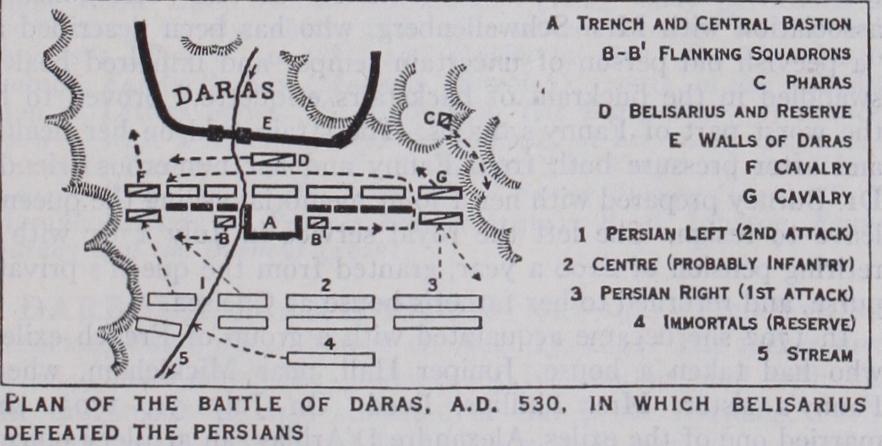
Pezozes arrayed his host in two lines. He kept the "Immortals" in reserve. The first day the Persians looked over the situation 'It is erroneous to suppose that every shepherd called Daphnis in pastoral poetry and romance is this Daphnis.
and skirmished, but did not attack. Only a short time before, a Persian force had ridden to disaster into a similar ditch dug for them by the Ephthalite Huns. Pezozes did not like the unusual steadiness in the Roman ranks any more than he liked the ditch. Also a stream, whose bed was four feet deep, probably interfered with his power to manoeuvre. The next day reinforcements brought the Persian strength to a total said to be 50,00o men. The Persians advanced about noon. Pezozes relieved the front line with the second to keep up a continuous fire of archery; but the wind favoured the Roman bowmen. Both sides suffered heavy losses in this missile fight. The Persian horse charged the Roman left. The Roman cavalry gave way. Then the squadron of Pharas, moving along the high ground, fell on the Persian rear, and the 600 Hunnish cavalry from the left (east) angle of the central bastion, took the enemy in flank. The Persian horse was routed with heavy loss.
Belisarius noted a movement of the Persians, including the "Immortals," toward his right. He ordered the victorious Huns from the left flank to reinforce the similar detachment on the right, and added troops from his reserve. The Persian attack drove in the Roman cavalry on their front, but the Huns, charg ing from the west angle of the trench, penetrated between the two Persian lines and created disorder. The reinforcements sent by Belisarius charged also, and the defeated Roman cavalry rallied and counter-attacked. Surprised and almost surrounded, the Per sians broke. The Roman lines now advanced across the ditch, and the victorious cavalry rolled up the Persian flank. Belisarius called an early halt to the pursuit lest his undisciplined troops might get out of hand and fall into an ambush.
This victory restored the prestige of Roman arms, raised morale and discipline, and established the reputation of Belisarius. The use of the ditch afforded security to the weakest part of the line. By its location, it protected the front, flanks and rear. It econo mized force by making use of the walls of Daras and the citizens to cover a possible retirement. It left the cavalry the greatest freedom of manoeuvre. Finally, it permitted a counter-attack.
2. Primary accounts: Malalas, Chronographia (in Migne. Patr. Gr. V. 97, 186o) ; Procopius, Histories (1914-1924; Greek and English on opposite pages) .
3. For topography and maps: Chapot, La Frontiere de l'Euphrate (1907) ; Sachau, Reise in Syrien and Mesopotamien (1883). (J. M. Sc.)