
DEAD SEA, the lake in southern Palestine in which the river Jordan terminates. It is bounded on the north by the Jordan valley—at that point broad, arid and forbidding, on the east by the escarpment of the Moabite plateau, on the south by the desert of the Arabah, and on the west by the mountains of Judaea. It has a length of 47 m. and a breadth of Io m., a superficial area of 36o sq.m. and a mean depth of 1,08o feet. Its surface level, which has a seasonal variation of Io to 15 ft., lies about 1,300 ft. below that of the Mediterranean, and is the lowest sheet of water on the earth's crust. The Jordan alone pours into the Dead sea on a daily average a volume of water estimated at 6 million tons, and in the winter season torrents—very few of which are perennial—from the hills to the east and west add their contribu tion. The rainfall in the Dead sea valley seldom exceeds 5 in. in the year. There is, of course, no effluent. The heavy inflow is carried off by evaporation (estimated at 131 mm. per day), visible in strange looking blue-white clouds which float half formed and ethereal above the waters. An interesting feature is the peninsula, called from its shape the Lisan (tongue) which projects from the east shore. The sea to the south of this penin sula is shallow, showing a depth of from 3 to 3o ft., whilst north of it, towards the eastern shore, is the point of greatest depth (1,310 feet).
Geology.—The Dead sea occupies the lowest point of the Jordan rift-valley or trough-fault, caused by the slipping down of the strip of earth's crust confined by the two parallel fractures visible in the rock walls on either side of the valley. In the Jurassic and Cretaceous periods an extended Mediterranean cov ered Syria and Palestine, but during the Tertiary period an exten sive upheaval of the sea-bed produced land. The earth movement was uneven, creating wrinkles (the Lebanons and the hills of western Palestine) and causing the fractures which resulted in the Jordan-Dead sea depression. There seems reason to suppose that prior to the Pluvial period, which later followed, the climate of this region was similar to that now prevailing, and that the Dead sea was approximately the same size as at present. During the Pluvial period the surface of the Dead sea gradually rose until it reached a height of 1,400 ft. above present level, and conse quently higher than the Mediterranean. At this stage it was a vast inland sea stretching zoo m. from Huleh in the north to a point 4o m. beyond its present southern limit. Its waters were capable of supporting life, and remains of its fauna have been found in its marginal deposits.
A dry period supervened during which evaporation prevailed over precipitation causing a gradual shrinkage, until after a long interval only a remnant of the great sea remained, leaving in its wake deposits of marl, gypsum and salt, and clearly-defined beaches to bear silent witness to the uneven course of desiccation. The formation of the Lisan and of Jebel Usdum, a hill on the south-west shore, must have occurred subsequent to this period of contraction, since both are composed entirely of these lacus trine deposits. The strata of the Lisan dip to the east showing that there has been an upheaval of the floor of the Ghor. It is per missible to conjecture that the crustal movements, due probably to continued faulting, which forced up the Lisan and Jebel Usdum, forming a southern escarpment of varying elevation and irregular base line, depressed at the same time the sea-bed to the north of the Lisan, where its deepest part is known to be. With the sea confined to the north of this barrier, what is now the shallow end of the Dead sea would be dry land. At no very distant date the sea broke this barrier at its western side, aided, it may be, by another tremor, or by merely overflowing, as its level rose, at a point where the barrier was low. That the level of the Dead sea is now rising, and has seemingly been rising for centuries, is well established. Since Kitchener's survey in 1883-84 it has risen nearly 20 feet. Since 1goo it has not risen more than 6 to 8 ft., however. The chief contributing factors to this rise of level are the encroachment on the sea of the Jordan delta, the gradual raising of the sea-bed through fresh layers of precipitate and climate that seems to be growing more moist.
Salinity.—The water of the Dead sea is intensely saline. Whilst ocean water has a salinity of 4-6%, Dead sea water con tains 23-25% of salts. Exhaustive analyses of water taken from different parts and at different depths have been made. The fol lowing selection from the analyses made by Terreil will suffice. A is surface water at the north end, B 120 metres deep 5 m. E. of Kas el-Feshkha, C 30o metres deep at the same point. T= Trace.
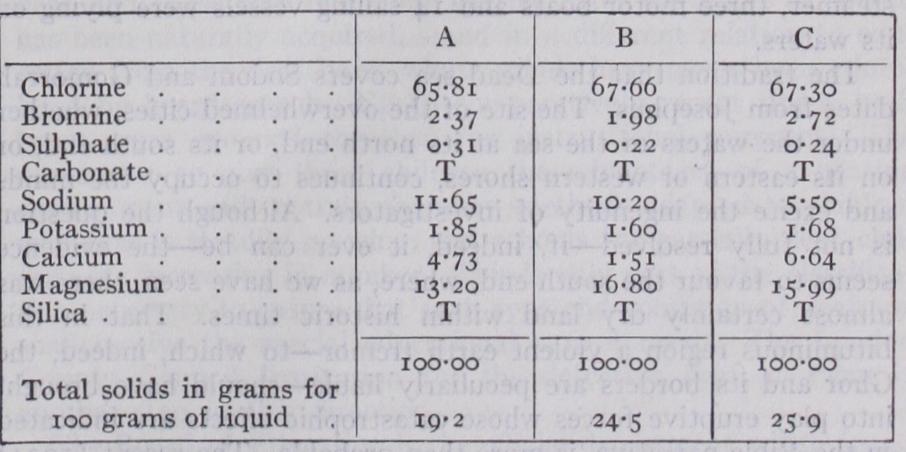
Magnesium, sodium, calcium and potassium are present as chlorides. The chloride of magnesium, largely held in solution, gives the water its nauseous taste, and chloride of calcium its smooth, oily feeling. The brine, as can be seen, is a commodity of great 'economic and commercial value, and applications have recently (1926) been invited by the Government of Palestine for the monopoly right for developing the mineral resources of the Dead sea. The density of the water is roughly 1 • 16o, increasing from north to south and with the depth. At the southern end the density is 1.2 53. In consequence the wader in the Dead sea finds that when the water reaches his armpits he is swept off his feet, and in swimming the shoulders are all the time out of the water. When the water is permitted to dry on hands or clothing the resulting stickiness is distinctly disagreeable. No animal life can exist in its waters. Fish brought down by the Jordan die and furnish food for the sea-birds. From the salt pools on the north shore and from the Jebel Usdum the Badouin have been in the habit of retrieving salt to smuggle. Salt was a Government monopoly under the Turks and continues to be so under the new Palestine regime.
Recent investigation has shown that the river Jordan carries an unusually high percentage of salts, especially sodium chloride and magnesium chloride. In the Dead sea the sodium chloride crystallizes out, but the magnesium chloride remains in solu tion. With magnesium as a permanent and increasing element in Dead sea water, its rate of entry and the cubical content of the sea calculable, the age of the Dead sea becomes a matter of simple arithmetic. From the data available to him Irwin puts the figure at 5o,000 years—obviously much too low.
Bitumen, or more exactly, asphalt, floats ashore on occasion. It is collected and used as a protection against worms and grubs in vineyards. According to Arab writers, it had many medicinal virtues. Search is now being made for petroleum in the Dead sea area.
History.—No other sea has had such a variety of names. The term "dead sea" was first introduced by late Greek writers, and is used by Pausanias, Galen, Justin and Eusebius. To the He brews it was "the sea," "the salt sea," "the sea of the Arabah," "the eastern sea." To Josephus it was "the asphalt sea," "the Sodomitish sea," whilst to Arab writers it was "the sea of Za'rah (Zoar)," "the stinking sea," "the sea of overwhelming," "the dead sea" and "the sea of Lot." This last is its modern designation. Historically, interest in the Dead sea centres in the biblical narratives of Abraham and Lot, and the destruction of Sodom and Gomorrah. At En-Gedi, on its western shore, David took refuge. To the south of En Gedi lies the fortress of Masada (Sebbah), built by Jonathan Maccabeus, the refuge of Herod and Mariamne when the Parthians took Jerusalem (42 B.c.), and the scene of the last stand and self-destruction of Eleazor and his devoted band of zealots after the fall of Jerusalem (A.D. 7o) this last a grim tale of Roman determination and Jewish heroism.
In early times the sea was navigated, as Tacitus and Josephus bear witness, and under the crusaders the new navigation dues formed part of the revenues of the lords of Kerak. The Turkish sultans of more recent times regarded the sea as their private possession, and sold to individuals the exclusive right of putting boats on it. The Turks, with German assistance, put a flotilla of motor boats on the sea during the World War, and in 1922 one steamer, three motor boats and 14 sailing vessels were plying on its waters.
The tradition that the Dead sea covers Sodom and Gomorrah dates from Josephus. The site of the overwhelmed cities, whether under the waters of the sea at its north end, or its south end, or on its eastern or western shores, continues to occupy the minds and excite the ingenuity of investigators. Although the question is not fully resolved—if, indeed, it ever can be—the evidence seems to favour the south end, where, as we have seen, there was almost certainly dry land within historic times. That in this bituminous region a violent earth tremor—to which, indeed, the Ghor and its borders are peculiarly liable—should have brought into play eruptive forces whose catastrophic effects are indicated in the Bible narrative, is more than probable. The recent (1924) joint expedition of the Xenia seminary and the American School of Oriental Research sent out to locate the Cities of the Plain are convinced that three of them, Sodom, Gomorrah and Zoar, stood in the south-east corner of the Dead sea, on the lower courses of the only perennial streams in that region, the Numeirah, the 'Esal and the Kurahi respectively, but now of course beneath the sea. Kyle and Albright would assign but one town to each watercourse, and think that Admah and Zeboim must be sought elsewhere. Yet if they would but think of these perennial streams meandering over the plain to meet the sea west of the Lisan, the vision pictured is of an oasis like Damascus, a veritable "garden of the Lord," where there would be room for Admah and Zeboim and, indeed, many others.
The dismal associations of its name are not borne out by the sea itself. The wild tales of mediaeval travellers that in its poison ous air no plant could live, that over its dread waters no bird could fly and that no waves ever disturbed its gloomy surface, are figments of the imagination. The doom of Sodom and Gomor rah must needs be writ large on the waters that hid them. "To think of this lake as sombre is quite an illusion ; its intense colour ing, its varied effects of light, its scarped overhanging slopes, broken by deep gorges, produce a picture of wild and sublime beauty." Its winter climate, with a temperature of 75° F by day and 6o to 65 ° by night, is probably the finest in the world. The possibility of the development of some oases on its south-east shore as winter resorts has been suggested. Here is the testimony of the Xenia seminary expedition, which spent part of the winter there in 1924: "With proper irrigation three large oases, total ling perhaps Io,000 ac., could be made into a veritable tropical garden. The atmosphere was pure and refreshing and there was as little swamp smell as may be found anywhere along the shores of salt water. The scenery is beautiful, sublime and romantic far beyond that of many of the winter resorts of the world. Under proper irrigation, with the establishment of a motor boat and automobile line to Jericho and Jerusalem, this plain may soon vie with Luxor as a winter health resort." The future of this, the most interesting of all seas, will be watched with interest whilst modern enterprise takes a hesitating step towards the fulfilment of Ezekiel's prophetic vision.