
DELAWARE, popularly called the "Diamond State," is one of the 13 original States of the United States of America. It is situated in the eastern part of the peninsula formed by Chesa peake bay and the estuary of the Delaware river, between 38° 27' and 39° 5o' N. lat. and between 75° 2' and 75° 47' W. long. The State has a length of about mom. and an average width of a little more than 2om.; its total area being 2,37o sq.m., of which 405 sq.m. are water surface. Excepting Rhode Island, it is the smallest State in the Union. Delaware is bounded north and north-west by Pennsylvania, east by the Delaware river and Dela ware bay, which separate it from New Jersey, and by the Atlantic ocean; south and west by Maryland (for map see MARYLAND) .
Physical Features.—Delaware lies on the Atlantic coastal plain, and is for the most part level and low, its average elevation above the sea being about 6o feet. Topographically, the State is two unequal areas, divided by a line following the general course of White Clay and Christiana creeks. Northward of this line the country is rolling, with )old hills, moderately deep valleys and rapid streams. Southward, the country is level or gently undulat ing. West of Wilmington there rises a ridge which crosses the State in a north-westerly direction and forms a watershed be tween Christiana and Brandywine creeks, its highest elevation above sea level being 44oft. at Centerville. South of the Christiana there begins another elevation, sandy and marshy, which extends almost the entire length of the State from north-west to south east and forms a second water-parting. The streams that drain the State are small and insignificant. Those of the north flow into Brandywine and Christiana rivers, whose estuary into Delaware river forms Wilmington harbour; those of the south-west have a common outlet in the Nanticoke river of Maryland; those of the east empty into Delaware bay and the Atlantic ocean. The princi pal harbours are those of Wilmington, New Castle and Lewes. The shore of the bay is marshy, that of the Atlantic is sandy. In Kent county there are more than 6o,000ac. of tidal marshland, some of which has been reclaimed by means of dykes; Cypress swamp, in the extreme south, has an area of so,000 acres. Horn blende, feldspar, granite of the Brandywine region and kaolin are found in the north. The prevailing soils of the region are clays, sometimes mixed with loam. Next, to the southward, come the Cretaceous formations and clays suitable for terra cotta manu facture. The soils of this region are mainly loams. The remainder of the State has a sandy soil resting on Tertiary white and blue clays.
Minerals of economic value are found only in the north part of the State. Kaolin, mined chiefly in the vicinity of Hockessin, New Castle county; granite, used for road-making and rough con struction work, found near Wilmington; and brick and tile clays are the products of greatest importance.
The proximity of the Delaware and Chesapeake bays helps to give Delaware a mild climate. The mean annual temperature is approximately 55° F, ranging from 52° in the S. to 56° in the N., and the extremes of heat and cold reported by the U.S. weather bureau are i o7 ° in the summer and — 12 ° in the winter. The an nual rainfall, greater on the coast than inland, ranges from 4o to 45 inches.
Representation in the legislature is according to districts, there being ten districts in each county for the election of members in the lower house for two years; and five senatorial districts in each county for the election of members in the upper house for four years; in addition, the city of Wilmington, which is in New Castle county, has five representative districts and two senato rial districts. In Nov. 1906, the people of the State voted (17,248 for; 2,162 against) in favour of the provision of a system of advisory initiative and advisory referendum; and in March, 1907, the general assembly passed an act providing initiative and referendum in the municipal affairs in the city of Wilmington. The organization of the judiciary is similar to that under the old English system. Six judges (a chancellor, a chief justice and four associate justices) of whom there shall be at least one resident in each of the three counties, and not more than three shall be long to the same political party, are appointed by the governor, with the consent of the senate, for a term of 12 years. Certain of the judges hold courts of chancery, general sessions, oyer and terminer, and orphans' courts; the six together constitute the supreme court, but the judge from whose decision appeal is made may not hear the appealed case unless the appeal is made at his own instance.
Corporations cannot be created by a special act of the legislature, and no corporation may issue stock except for an equivalent value of money, labour or property. In order to at tract capital to the State, the legislature in 1899 passed a general corporation act which reduced the taxes on corporations, forbade the repeal of charters and gave permission for the organ ization of corporations with both the power and the name of trust companies. A liberal policy is still pursued in respect to mergers and consolidations of corporations organized under the laws of the State, but all corporations using the word "trust" in their titles are under the supervision of the insurance commissioner and are compelled by law to make at least two reports each year to the commissioner.
Legislative divorces are forbidden by the Constitution, and a statute of 1901 subjects wife-beaters to corporal punishment. Al though punishment by whipping and by standing in the pillory was prohibited by an act of Congress in 1839, in so far as the Federal Government had jurisdiction, both these forms of punishment were retained in Delaware, and standing in the pillory was pre scribed by statute as a punishment for a number of offences, in cluding highway robbery, various kinds of larceny and forgery, and even pretending "to exercise the art of witchcraft, fortune telling or dealing with spirits." In 1905, by a law approved on March 20, the pillory was abolished. The whipping-post is still maintained in Delaware, and whipping continues to be prescribed as a punishment for a variety of offences, although in 1889 a law was passed which prescribed that "hereafter no female con victed of any crime in this State shall be whipped or made to stand in the pillory," and a law passed in 1883 prescribed that "in case of conviction of larceny, when the prisoner is of tender years, or is charged for the first time (being shown to have be fore had a good character), the court may in its discretion omit from the sentence the infliction of lashes." An old law sill on the statute books prescribes that "the punishment of whipping shall be inflicted publicly by strokes on the bare back, well laid on." In 1929 the death penalty for first-degree arson was abolished.
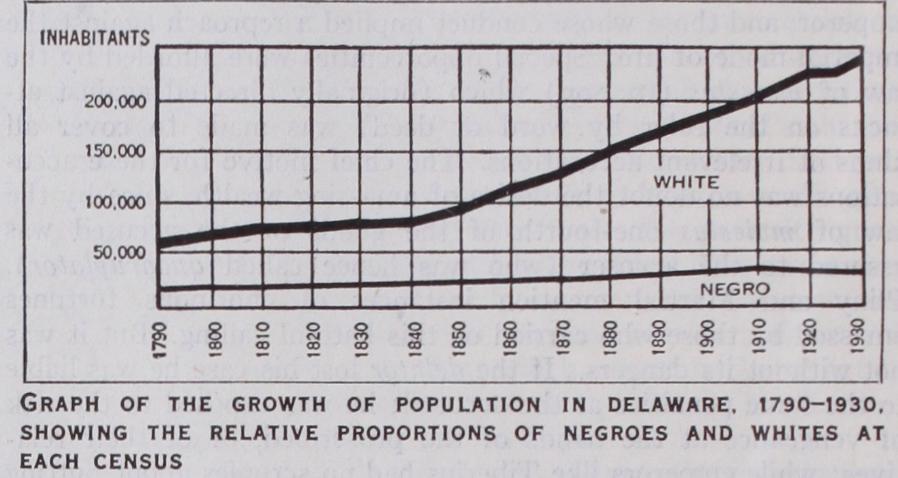
The unit of local government is the "hundred," which corre sponds to the township of Pennsylvania. The employment of chil dren under 14 years of age in factories is forbidden by statute. The marriages of whites with negroes and of insane persons are null ; but the children of the married insane are legitimate.
There was settled by decision of the United States Supreme Court in 1934 the boundary dispute between Delaware and New Jersey which had almost led to another "oyster war." The court upheld Delaware's claim to territory as far as the low-water mark on the New Jersey shore within a twelve-mile radius of New Castle. Farther down the Delaware river, however, it decreed that the boundary should follow the centre of the ship channel and not, as Delaware had contended, the geographic middle of the river. New Jersey thus succeeded in establishing its right to certain oyster beds.
After 1910 a distinct advance was made in the field of educa tion. Better facilities for the training of teachers were developed, and new school buildings erected in many parts of the State. In 1932 the enrolment in public elementary and secondary schools was or 76.5% of the total population 5-17 years of age, in clusive. In 1932, 7,890 pupils were enrolled in private and paro chial schools. The average day attendance per year per pupil en rolled had increased from 109.8 in 190o to 160.3 in 1932. The enrolment in elementary and secondary schools was : whites 37,615, coloured 6,907 ; the percentage of population enrolled : whites coloured 85.3%. Separate schools are maintained for col oured pupils throughout the whole educational system. The total, expenditure for education in 1932 was $6,355,000; it had increased $3,152,000 over that expended in 1924; the per capita of popula tion 5-17, inclusive, was $109.19 as compared with $S9.69 in 1924. The schools are supported in part. from the State school fund and in part from local taxation. Prior to 1913 the State's participa tion in higher education was confined to Delaware college, at Newark, founded in 1833 as Newark college, but rechartered, after suspension from 1859 to 1870, as a State institution. The college receives financial support from the United States land grant of 1862 and the supplementary appropriation of 1890. In 1913 the Women's college was founded and affiliated with Delaware college, with the same faculty, but entirely separate in buildings, classes and student organizations. In 1921 the two colleges were incor porated as the University of Delaware. The internal relations between the colleges, however, were left as before. The faculty in numbered 97. The value of the university property in was $4,488,511; the income for the fiscal year 1934-35 was $650,117; the total attendance in 1934-35 was 468 men and 283 women. The agricultural experiment station also affiliated with the university, was established in 1888 under the Hatch act of 1887. Under the Purnell act, increased Federal appropriations to the agricultural experiment station made possible greater expan sion of education in improved agricultural methods. An outstand ing phase of educational development was the erection of school buildings in various parts of the State, made possible by gifts ap proximating $4,000,000 by Mr. Pierre S. du Pont to an organiza tion of citizens known as the Service Citizens of Delaware. The legislature appropriated some $3,000,000 for public school con struction in 1931 so as to furnish work for the state's unemployed.
The development of manufacturing in Delaware has not been so extensive as the situation of the State, its facilities for water and railway transportation, and the proximity of the coal and iron fields of Pennsylvania would seem to warrant ; the intense indus trial activity of the World War period, however, influenced Delaware greatly, especially Wilmington and its environs. New Castle county, in which Wilmington is situated, in 192o reported 88.7% of the total wage-earners and 92.2% of the total value of products. The peak year for manufacturing in Delaware was 1919, when 32,972 wage-earners were engaged and gross production amounted to $165,073,009. In 1933 Delaware had 15,825 wage earners engaged in manufacturing (under the factory system) ; the total paid in wages was 5,000 ; the gross value of products was $106,397,0oo• Important industries were: pulp goods, cars and general shop construction and repairs by steam railway com panies, iron and steel, canning and preserving of fruits and vegeta bles, paper and wood pulp, slaughtering and meat packing, and foundry and machine shop products. The U. S. Bureau of Mines estimated the total mineral products in 1924 to be worth $512,1o5, but by 1933 their value had dwindled to $135,000. Of these sand and gravel, kaolin and clay products were most important. The forests, which once afforded excellent timber, including white oak for shipbuilding, have been greatly reduced by constant cutting ; in 1919 it was estimated that 2 2 2,65 9ac. were in woodland, of which 46,187ac. were merchantable timber. The lumber produc tion in that year was 27 million board feet, but in 1924 the pro duction had decreased to 14 million board feet, in 1929 to io million board feet, and in 1933 to only one million board feet.
The fisheries, chiefly oyster, crab, clam, menhaden and alewife, employed 862 fishermen in 1933; the catch totalled 36,526,634 lbs. valued at $209,186.
Delaware has good facilities for transport. Its railway mile age in 1933 was 3 2 5 ; the Pennsylvania, the Baltimore and Ohio and the Reading systems cross the northern part of the State, while the Pennsylvania system runs the length of the State be low Wilmington ; the Maryland, Delaware and Virginia line con nects Lewes, Del., with Love Point, Md., on Chesapeake bay.
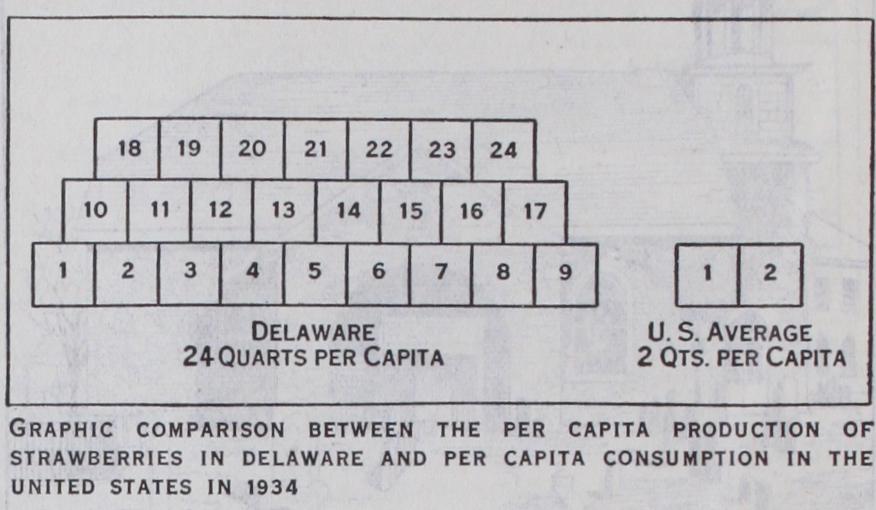
In 1933 Delaware had 1,142m. of improved roads in the State highway system, and during that year $4,138,000 were expended on rural highways. In 1934 the registration of motor vehicles was 54,240.
The Delaware and Chesapeake canal (about 132m. long), which crosses the northern part of the Delaware-Maryland peninsula from the Delaware river to Chesapeake bay, has in recent years been widened and deepened by the war department, thus affording a shorter passageway for larger ships from Philadelphia to Balti more and improving an important link of the proposed inland waterway for commerce. Wilmington is the centre of a customs district in which New Castle and Lewes are included, and although much of the trade is coastwise, it is expected that the recently constructed marine terminal at Wilmington, near the mouth of the Christiana river, will afford adequate facilities to attract increasing ocean-going trade. Imports at Wilmington and Clay mont amounted to 412,166 cargo tons in 1933; exports in the same year totalled 3,285 cargo tons.
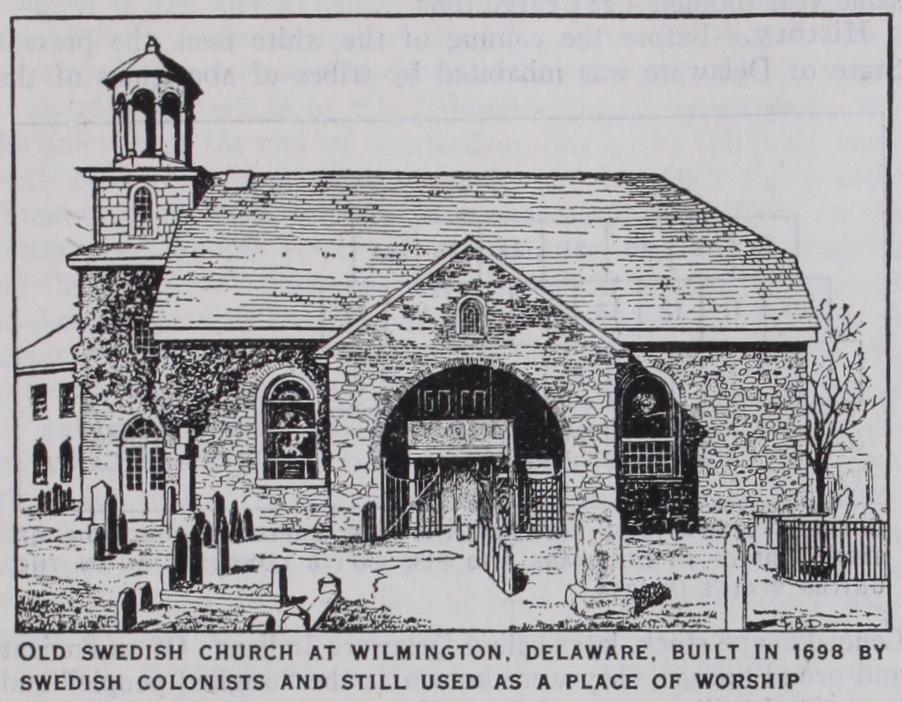
In 1638 Peter Minuit on behalf of this company established a settlement at what is now Wilmington, naming it, in honour of the child queen Christina, "Christinaham," and naming the entire ter ritory, bought by Minuit from the Minquas Indians and extending indefinitely westward from the Delaware river between Bombay hook and the mouth of the Schuylkill river, "New Sweden." This territory was subsequently considerably enlarged. In 1642 mature plans for colonization were adopted. A new company, officially known as the West India, American or New Sweden company, but also popularly known as the South company, was chartered, and a governor, Johan Printz (c. 1600-63) was sent out by the crown. He arrived early in 1643 and subsequently established settlements, including one on the island of Tinicum, near the present Chester, Pa. ; another at the mouth of Salem creek, N. J. ; and another near the mouth of the Schuylkill river. Friction soon arose with New Netherland, although the Swedes and the Dutch, owing to their common dislike of the English, and the common interests of Swe den and Holland in the Thirty Years' War, had maintained a formal friendship. In 1651, Peter Stuyvesant, governor of New Netherland, and more aggressive than his predecessors, built Ft. Casimir, near what is now New Castle. In 1654 Printz's successor, Johan Claudius Rising, who had arrived from Sweden with a large number of colonists, expelled the Dutch from Ft. Casimir. In re taliation, Stuyvesant, in 1655, with seven vessels and as many hundred men, recaptured the fort and also captured Ft. Christina (Wilmington). New Sweden thus passed into Dutch control and became a dependency of New Netherland. In 1656, however, the Dutch West India company sold part of what had been New Sweden to the city of Amsterdam, which in the following year established a settlement called "New Amstel" at Ft. Casimir (New Castle). This settlement, badly administered, made little progress.