
DENTISTRY, a special department of medicine, dealing with diseases of the teeth and their treatment. (For anatomy see TEETH.) Until well into the Igth century apprenticeship afforded the only means of acquiring a knowledge of dentistry, but in Nov. 184o was established the Baltimore College of Dental Surgery, the first college in the world for the systematic education of dentists. This, combined with the refusal of the medical schools to furnish the desired facilities for dental instruction, placed dentistry for the time being upon a footing entirely separate from general medicine. The British medical schools later revised their policy and special courses of instruction are arranged to meet the demands of the various examining bodies. Recently an official dental register corresponding to the medical register has been instituted in Great Britain.
The most important dental research of modern times is that carried out by W. D. Miller of Berlin (1884) upon the cause of caries of the teeth, a disease said to affect the human race more extensively than any other. Miller demonstrated that, as pre vious observers had suspected, caries is of bacterial origin, and that acids play an important role in the process. This work has been given greater precision by McIntosh, James and P. Lazarus Barlow who isolated a group of bacilli (B. acidopliilus odontolyti cus) from carious teeth which was capable of producing the characteristic changes under experimental conditions. Dental caries and septic conditions of the gums bear highly important relations to more remote or systemic diseases, furnishing avenues of entrance for pathogenic bacteria, notably those of actinomyco sis and pyaemia.
The dental engine in its several forms is the outgrowth of the simple drill worked by the hand of the operator. It is used in 'The filling of teeth with gold foil is recorded in the oldest known book on dentistry, Artzney Buchlein, published anonymously in 153o, in which the operation is quoted from Mesue (A.D. 857), physician to the caliph Haroun al-Raschid.
removing decayed structure, and for shaping the cavity for in serting the filling. The rubber dam invented by S. C. Barnum of New York (1864) provided a means for protecting the field of operations from the oral fluids, and extended the scope of operations even to the entire restoration of tooth-crowns with cohesive gold foil. Its value has been found to be even greater than was at first anticipated. In all operations involving the ex posed dental pulp or the pulp-chamber and root-canals, it is the only efficient method of mechanically protecting the field of oper ation from invasion by disease-producing bacteria.
The difficulty and annoyance attending the insertion of gold, its high thermal conductivity, and its objectionable colour have led to an increasing use of amalgam, gutta-percha, and cements of zinc oxide mixed with zinc chloride or phosphoric acid. Attention has also been devoted to restorations with porcelain and porcelain like cements.
Until recent times the exposure of the dental pulp inevitably led to its death and disintegration, and, by invasion of bacteria via the pulp canal, eventually caused the loss of the entire tooth. A rational system of therapeutics, in conjunction with proper antiseptic measures, has made possible in many cases a conserva tive treatment of the dental pulp when exposed, and successful treatment of pulp-canals when the pulp has been devitalized either by design or disease. The conservation of the exposed pulp is effected by the operation of capping. In capping a pulp, irritation is allayed by antiseptic and sedative treatment, and a metallic cap, lined with a non-irritant sedative paste, is applied under aseptic conditions immediately over the point of pulp exposure. A filling of cement is superimposed, and this, after it has hardened, is covered with a metallic or other suitable filling. The utility of arsenious acid f or devitalizing the dental pulp was discovered by J. R. Spooner of Montreal, and first published in 1836. The painful action of arsenic upon the pulp was avoided by the addition of various sedative drugs—morphia, atropia, iodoform, etc.—and its use soon became universal. Of late years immediate surgical extirpation under novocaine is in use, and by novocaine also the pain incident to excavating and shaping of cavities in tooth structure may be controlled. To fill the pulp chamber and canals of teeth after loss of the pulp, all organic remains of pulp tissue should be removed, and then, in order to prevent the entrance of bacteria, and consequent infection, the canals should be perfectly filled. Upon the exclusion of infection depends the future integrity and comfort of the tooth. Numer ous methods have been invented for the operation. Pulpless teeth are thus preserved through long periods of usefulness, and even those remains of teeth in which the crowns have been lost are rendered comfortable and useful as supports for artificial crowns, and as abutments f or assemblages of crowns, known as bridge-work.
Malposed teeth are not only unsightly but prone to disease, and may be the cause of disease in other teeth, or of the associated tissues. By the use of springs, screws, vulcanized caoutchouc bands, elastic ligatures, etc., as the case may require, practically all forms of dental irregularity may be corrected, even such pro ' trusions and retrusions of the front teeth as cause great disfigure ment of the facial contour.
The extraction of teeth, an operation which until quite recent times was one of the crudest procedures in minor surgery, has been reduced to exactitude by improved instruments, designed with reference to the anatomical relations of the teeth and their alveoli, and therefore adapted to the several classes of teeth. The operation has been rendered painless by the use of anaes thetics.
Metallic bases were used exclusively as supports for artificial dentures until in 1855-56 Charles Goodyear, Jr., patented in England a process for constructing a denture upon vulcanized caoutchouc as a base. Several modifications followed, each the subject of patented improvements. Though the cheapness and simplicity of the vulcanite base has led to its abuse in incompe tent hands, it has on the whole been productive of much benefit. It has been used with great success as a means of attaching por celain teeth to metallic bases of gold, silver and aluminium. It is extensively used also in correcting irregular positions of the teeth, and for making interdental splints in the treatment of fractures of the jaws. For the mechanical correction of palatal defects causing imperfection of deglutition and speech, which comes distinctly within the province of the prosthetic dentist, the vulcanite base produces the best-known apparatus. Two classes of palatal mechanism are recognized—the obturator, a palatal plate, the function of which is to close perforations or clefts in the hard palate, and the artificial velum, a movable at tachment to the obturator or palatal plate, which closes the open ing in the divided natural velum and, moving with it, enables the wearer to close off the nasopharynx from the oral cavity in the production of the guttural sounds. Vulcanite is also used for ex tensive restorations of the jaws after surgical operations or loss by disease, and in the majority of instances wholly corrects the def ormity.
The progress of dentistry since 'goo has been more rapid and more radical than in any previous period. The cause of this progress was the general advancement in knowledge due to the accumulation of data from scientific investigation and the appli cation of the knowledge thus acquired to the prevention and treatment of disease.
Hunter's criticisms immediately bore fruit. Bacteriological and X-ray examination of teeth and jaws, particularly in so called pyorrhoea alveolaris, quickly became the rule.
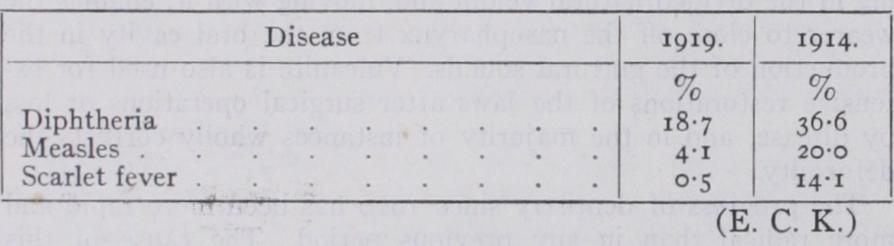
In this test 20,000 children of the first five school grades were under observation and treatment. The average number of car ious cavities was found to be over 7% per child; 30% claimed that they brushed their teeth occasionally; 6o% stated that they did not use a tooth-brush and io% had fistulous openings on the gums from abscesses at the roots of decayed teeth. Systematic application of oral hygiene, the intelligent and systematic use of the tooth-brush and the elimination of accretions, dental decay and suppurative conditions were followed by great improvement in general health and mental efficiency. Whatever may be the full explanation it is certain that deaths of Bridgeport children from diphtheria, measles and scarlet fever were fewer after oral hygiene had prevailed (i g i g) than they were before (I 9 I 4) . This is seen from the following table:— Under the direction of Supt. Willis A. Sutton, a dental clinic was installed in a school of 987 pupils in Atlanta and a hygienist, a dentist, a dietitian and a visiting teacher were selected. The number of days the children had been absent, in the past year, causes of the absences, the number of subject failures and the physical condition of each child as to weight and general appear ance were all carefully noted. Each child's mouth was then put in good condition and after three weeks new records were kept. All other factors entering into improvement were as carefully eliminated as possible. Upon comparison of the two records many significant deductions were made. First, the 987 children had less absences than the preceding year. Second, whereas the preceding year practically 20% had failed in one or more subjects, the year following the experiment less than 6% had failed. Third, every child in the entire group had gained in weight, ranging from 6 lbs. for the 9 months' period to 22 lbs., with an average of I I•2 pounds. Normally an average gain of about 8 lb. would have been expected. Fourth, the general appearance of the children had im proved remarkably, and they were far more spontaneous and happy than before. The dental clinics were then installed in other schools, with the result that of the 6o.000 children enrolled, 6,000 more per day attended school than formerly. The percentages of failures were reduced in the elementary schools by 8% and in the junior and senior high schools by 6%. The direct saving in money was $1 5o,000–$200,00o per year in a budget of $3,000,000.
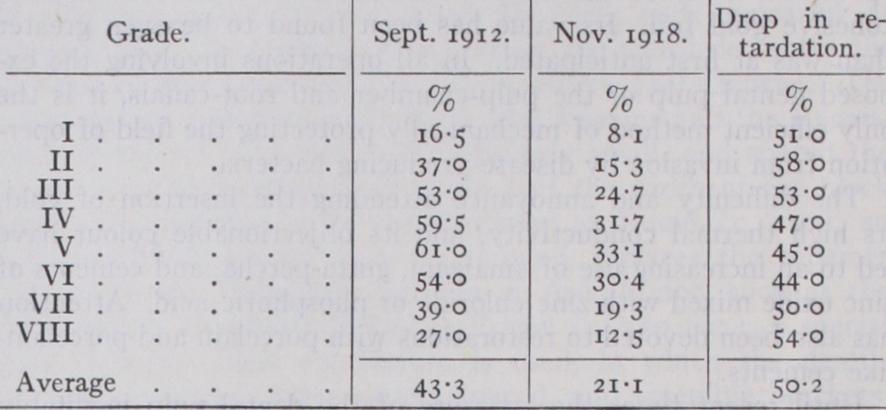
(W. A. S.) Dental Disease and Mental Efficiency.—An improvement in mental efficiency is deduced from the reduction in the percent age of retarded children, i.e., children who are not less than two years older than the normal age for the school grade to which they should belong. The percentage of retarded children before and after the introduction of mouth hygiene in the Bridgeport schools is shown in the following table:— Retardation represents inability of the child to advance with his class, necessitates repetition of his grade work, and becomes an economic question of serious importance to the ratepayer. The cost of re-education in Bridgeport in 1912 was 42% of the entire budget, and for 1918 only 1 7 %. Among the 20,900 children under observation in the schools of Bridgeport, 98% had various forms and degrees of malocclusion of the dentures, a condition now generally recognized as associated with asymmetrical develop ment of the bones of the face and the brain case. Many children with malocclusion owing to the arrested development of the facial and cranial bones suffer from impeded nasal respiration, and develop adenoids and tonsilar hypertrophy, leading to infection with its systemic sequelae and the interferences with bodily nutrition incident to insufficient oxidation of the blood. Ortho dontic treatment for the correction of malocclusion in children is a therapeutic and prophylactic measure having an important health relation rather than a procedure for the relief of deformity.
During the World War bad teeth were so serious a bar to re cruiting that the matter called for attention in all armies. Every where the dental service was increased. In 192I Great Britain created a definite Army Dental Corps, but in the United States such a corps had been formed some years earlier.
A systematic survey of the whole field of dental education has been made by the Carnegie Foundation for the Advancement of Teaching, with a view to recommending such adjustments as will bring systematic dental education fully up to the standard of present requirements from a public health standpoint.
The entire development of modern dentistry dates from the century, and mainly from its latter half. Beginning with a few practitioners and no organized professional basis, educa tional system or literature, many thousands of its practitioners are, at the present time, to be found in all civilized communities. Its educational institutions are numerous and well equipped. It possesses a large periodical and standard literature in all lan guages. Its practice is regulated by legislative enactment in all countries in the same way as medical practice. The business of manufacturing and selling dentists' supplies represents an enor mous industry, in which millions of capital are invested.
F. Litch, American System of Dentistry; Julius Scheff, jun., Handbuch der Zahnheilkunde; Charles J. Essig, American Text-Book of Prosthetic Dentistry; Tomes, Dental Anatomy and Dental Surgery; W. D. Miller, Microorganisms of the Human Mouth; Hopewell Smith, Dental Microscopy; H. H. Burchard, Dental Path ology, Therapeutics and Pharmacology; F. J. S. Gorgas, Dental Medi cine; E. H. Angle, Treatment of Malocclusion of the Teeth and Fractures of the Maxillae; G. Evans, A Practical Treatise on Artificial Crown-and-Bridge Work and Porcelain Dental Art; C. N. Johnson, Principles and Practice of Filling Teeth, American Text-Book of Operative Dentistry (3rd ed., 19o5) ; Edward C. Kirk, Principles and Practice of Operative Dentistry (2nd ed., 1905) ; J. S. Marshall, American Text-Book of Prosthetic Dentistry (edited by C. R. Turner; 3rd ed., 1907) . (E. C. K.)