
DENVER, the capital of Colorado, U.S.A., and the largest city between Kansas City and San Francisco, on the South Platte river, in the centre of "the West." The population in 1920 was 256,491 (83% native white) , and was 287,861 in 1930 by the Federal census. It is on Federal highways 4o and is served by the Burlington, the Rock Island, the Santa Fe, the Union Pacific, the Denver and Rio Grande Western, the Colorado and Southern and the Denver and Salt Lake railways; and has air-mail and commercial air service. There are three aviation fields. The Moffat tunnel of the Denver and Salt Lake railway through James Peak in the Continental Divide, built by the city of Denver in co-operation with parts of several counties in north-western Colorado (opened 1928), has eliminated 27m. of 4% grade and made possible shortening the distance to Salt Lake City and other points west by '73 miles.
The altitude of Denver, at the State capitol, is exactly one mile above the sea. Its area, co-extensive with that of the county of Denver, is 58.75 square miles. It lies at the edge of the Great Plains, in the river valley running north and south, 12m. E. of the main range of the Rocky Mountains, which stretches in a snow capped background visible for I 5om. from Pike's Peak on the south to Long's Peak on the north. The climate, with a low de gree of humidity throughout the year and a high percentage of sunshine, is favourable alike to health, industry and recreation. The city is well planned, with broad streets and a system of boulevards and parkways. Because of severe restrictions against wooden structures adopted in the early days, most of the resi dences, as well as the business and public buildings, are of brick, stone, tile or cement. All trains except those of the Denver and Salt Lake railway enter the Union Station, a fine and commodious structure built in 1914 at a cost of over $3,000,000. There are parks and 17 supervised playgrounds within the city limits, comprising I,674ac. ; and the city owns a chain of 38 mountain parks (in one of which is the grave of "Buffalo Bill"), aggregating over 1 o,000ac. in area, and connected with one another and with the city by loom. of boulevard.
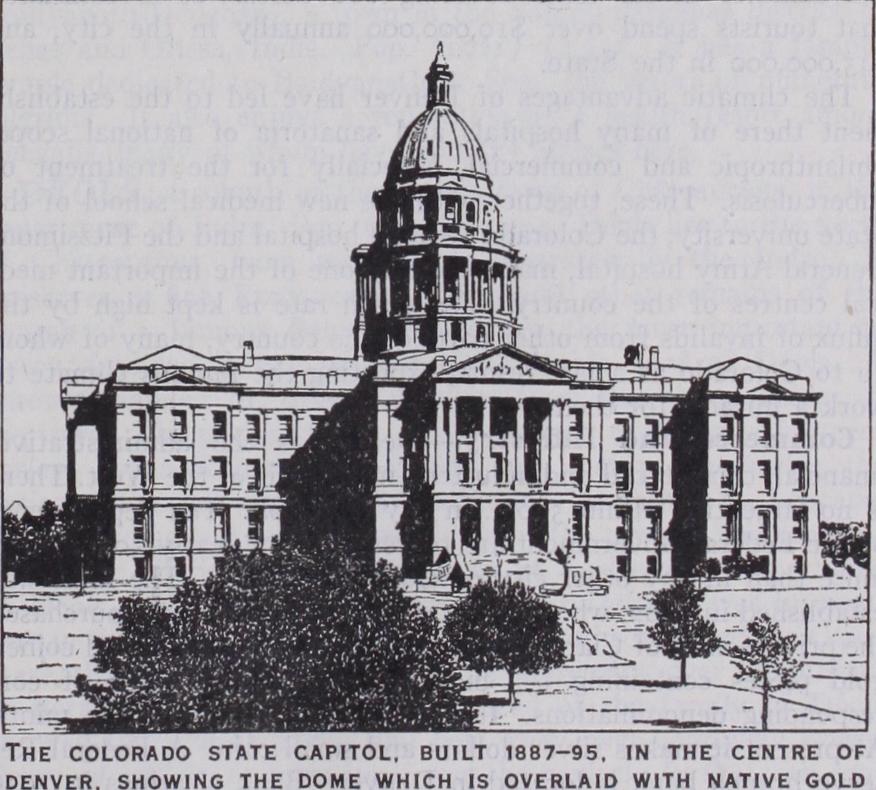
In the centre of the city is a stretch of half a mile (4oac.) de voted to public buildings set in landscaped grounds. The massive State capitol of native granite (built in 1887-95, at a cost of $3,000,000), topped by a dome overlaid with gold from Colorado mines, stands on a terraced hill, flanked by the State office build ing of white marble and the State historical museum, which con tains exhibits of prehistoric and Indian life and of pioneer days. Immediately west of the capitol grounds is the beautiful civic centre (due to the initiative of the late Robert W. Speer, who was Mayor 1904-12 and 1916-18) including the public library, a Greek theatre and the city and county building (under construc tion 1928) ; and beyond this group is the U.S. mint. In City park, a tract of 4o8ac. set aside at an early date, is the Colorado mu seum of natural history. There is a municipal auditorium, seat ing 12,000, where the Democratic National Convention which nominated William J. Bryan met in i9o8. The water supply from the river, taken at a point 23m. above (i.e., south-west of) the city, is supplemented by a reservoir in the mountains which has a capacity of 26,000,00o,000gal., enough to supply the city for a year and a half without replenishing. The 8ft. pioneer bore of the Moffat tunnel, parallelling the main bore, is designed to bring water from the western slope of the Continental Divide whenever additional supplies are needed. The percentage of home ownership in Denver is high, and the index figure for cost of living is be low the average for large American cities. The assessed valuation of property in 1927 was Education.—The public school system includes 63 elementary, 9 junior high, 5 senior high and several special schools, including one for deaf children. School attendance is high ; illiteracy and child labour are low. Among the institutions for higher education are the University of Denver (Methodist), chartered in 1864 as Colorado seminary, Colorado Woman's college (1889), Regis col lege (1886), the Iliff School of Theology (Methodist Episcopal) and the Medical school of the University of Colorado.
The climatic advantages of Denver have led to the establish ment there of many hospitals and sanatoria of national scope, philanthropic and commercial, especially for the treatment of tuberculosis. These, together with the new medical school of the State university, the Colorado General hospital and the Fitzsimons General Army hospital, make the city one of the important med ical centres of the country. The death rate is kept high by the influx of invalids from other parts of the country, many of whom go to Colorado as a last resort, expecting the famous climate to work a miracle for them.
Denver's trade territory embraces parts of ten States, besides Colorado, and has a population of about 6,000,000. There are some 30o jobbers in the city, who have agents and distributing warehouses at many points. Administrative headquarters of the beet-sugar, metal-mining and coal industries of the State are located in Denver. It is the distributing centre of the automobile industry in the Rocky Mountain region, and ranks fourth among the cities of the country as an administrative centre for the in surance business. The Denver stockyards are the largest cattle and sheep market in the West. At the National Western stock show (held annually in January since 1907) pedigree breeding cattle are bought and sold in carload lots, feeder stock by the train load. The annual value of jobbing transactions in 1926 was $323,599,300; of the city's retail trade, $155,672,800.
Distance from the manufacturing centres of the East forced Denver in its early days to develop industries to supply the needs of the mining and frontier population for wagons and harness, mining machinery, meat, flour and other necessities. On this foundation, utilizing the raw materials—mineral, animal and vege table—at its doors, developing its specialties, but also diversifying its products, and gradually extending its markets, the manufac tures of the city have grown until in 1927 there were 73o estab lishments within the city limits, employing a daily average of 15,054 wage-earners, paying $19,457,786 in wages, and producing goods valued at $116,747,939. An estimate for 1929, including some plants in the suburbs, indicated an output valued at $125, 000,000. A favourable factor is the abundant supply of coal and fuel oil from mines and refineries within a very short haul. In 1928 natural gas was piped in from the Amarillo district of Texas.
The leading industry, in point of value of product, is slaughter ing and meat-packing. Receipts at the stockyards in 1926 included 529,051 cattle, 497,047 hogs and 1,825,922 sheep. The average receipts for the five years 1921-26 were 21 times as many cattle, over four times as many hogs, and 61 times as many sheep, as in 1900. Other manufactures of importance are mining machinery, which is marketed all over the world ; sugar-mill equipment, which goes as far as Hawaii and the Philippines; and luggage that is sold in every State of the union. A rubber factory supplies all the floor mats used by an automobile manufacturer of Detroit, and sends fan belts to Australia. The manufacture of candy is fa voured by the dry atmosphere. Because of its distance from the ports, Denver had no great volume of World War business, and consequently suffered less than most cities from the post-war de flation.
On Oct. 29, 1858, in a blinding snowstorm, two men drove in with a wagon train and opened the first "store." A second was opened on Christmas Day, and a jewellery store a few days later. At the opening of 1859 lumber sold for $ioo per i,000ft.; flour for $2o to $4o per i oo lb.; and sugar, coffee and tobacco, for al most their weight in gold dust, the currency of the region for some years. The first hotel ("The Eldorado") was opened in a large log house on Feb. 1, 1859. On April 23 the first number of the Rocky Mountain News was issued. On May 9, arrived the first coach of the Leavenworth and Pike's Peak Express Company, which carried letters at 25 cents an ounce. News of Lincoln's elec tion was brought from St. Joseph, Mo., nearly loom. by the Pony Express in 69 hours. Letter postage by Pony Express was $5 per letter. Telegraph connection with the East ($9 for io words) was established in 1863. A private mint and a bank were opened in 186o. In 1863 there was a severe fire, and in 1864 a terrible flood came down Cherry creek and washed away many buildings. The first school teacher, dressed in a black broadcloth frock coat and a silk hat, drove into town late in the summer of 1859, behind a team of oxen which he apostrophized with Greek and Latin oaths that won him infinite respect from the local masters of profanity. In October he opened a school in a log cabin, after $25o had been subscribed for its "endowment." In 1864 Colorado seminary was established, largely through the efforts of Gov. John Evans, who had been one of the founders of Northwestern university at Evanston, Illinois. When the Union Pacific passed through io6m. to the north of Denver, a local company was organized to con nect the city with it by a line to Cheyenne, and on June 23, 187o, the first passenger train arrived. On Aug. 15, the Kansas Pacific was completed to Denver, and other transportation facilities soon followed.
By 187o there were 1,5oo buildings in the city, and the popu lation was 4,759. In the next 20 years it grew to io6,713. All the facilities of a modern city were introduced in the '7os, and the '8os were a period of great activity in real estate. Since 1890 growth has been steady, though less spectacular. In the early days benver had its problems with "squatters." and "land jumpers." There were the social conditions usually found in new I mining communities, including crimes of violence and some exer cise of extra-legal methods of administering justice. At the Pal ace gambling hall and variety theatre, celebrated the world over, fortunes were won and lost in a night. A flood in 1878 and the famous strike in Denver and Leadville in 1879-8o were tempo rary checks to prosperity. In 188o there was a memorable election riot, under the guise of an anti-Chinese demonstration. A serious street-car strike in 192o involved the loss of seven lives, the im portation of drmed strike-breakers, the intervention of Federal troops, and military rule for a month. Denver was the first city to undertake to finance its charitable agencies by a joint "commu nity chest." Its juvenile court, under Judge Ben B. Lindsey (b. 1869), who served from i9o1 to 1927, was a pioneer in its field. In 1902 a city-and-county of Denver was created, with power to frame its own charter, and the charter was adopted in 1904. A commission form of government was in force for four years from 1912, but in 1916 the mayor-and-council form was resumed.