
DESTROYER, an unarmoured warship of approximately i,000 to 1,400 tons, very fast, with a powerful torpedo armament and a few medium calibre guns (usually 4" or 4.7"). A larger type, used as senior officer's ship of a division of destroyers, is known as a flotilla leader. These latter are of 1,50o to 2,000 tons and carry a rather more powerful gun armament.
The destroyer as a type xvas evolved about 1892 as the answer to the torpedo boat, which was then regarded as being as serious a menace to the large surface warship as is the submarine, in certain quarters, to-day. Partly as the result of the evolution of the destroyer, but largely because the ineffectiveness of the original small torpedo boat was gradually realized, the latter as a type has ceased to exist in all the more important navies, while the de stroyer has not only replaced it as a means of executing torpedo attacks, but has proved of great value for innumerable other naval services. Destroyers are essential auxiliaries to the battle fleet. In a fleet action their functions are to attack the enemy's battle fleet under cover of the fire of their own battleships, or by taking advan tage of low visibility or smoke screens; to counter the attacks of the enemy flotilla, by going out to meet them before they can manoeuvre into position to launch their torpedoes; and to form an anti-submarine and anti-aircraft screen to protect the battle fleet against these forms of attack, when necessary. As the principal safeguard of the battle fleet against submarine attack the destroyer proved highly efficient in the World War, so much so that no single battleship or battle cruiser of the British Grand Fleet was torpe doed by a submarine throughout the war, although the fleet was repeatedly in waters where the German "U Boats" were in wait.
Destroyers may find special scope for their powers of offence during dark hours, particularly if they can locate their quarry and surprise it unprepared. On the other hand, the exPerience of the war showed that a battleship, well prepared and with a good fire control system for her secondary armament, is by no means the simple prey to the destroyer that it was sometimes anticipated she would be. For example: the German battle fleet, in its desperate break through the British destroyer flotillas the night after the battle of Jutland (q.v.), displayed remarkable powers of self-pro tection; although repeatedly engaged by torpedo craft, only one of their battleships was sunk. This ship succumbed to a well-. executed attack by a British destroyer flotilla just before dawn. A battleship lying unprotected in an open roadstead is likely to fall an easy prey to a destroyer attack. (See DARDANELLES.) In the World War, destroyers had to be built for many services besides battle fleet work. A large force was maintained at Har wich, where they co-operated with the light cruisers in making sweeps into the Heligoland Bight. Another force was employed in the Dover Command in safeguarding the approaches to the Chan nel, in supporting mine-sweeping and bombarding operations and in escorting transports, convoys and shipping generally. Some of the very oldest class of destroyers, knoi,vn as the "3o knotters," were particularly hard worked in the early days of the War.
The question of whether, on the very limited displacement, a gun or a torpedo armament shall predominate has always been rather a moot one, but, with the increase in size of modern destroyers, a fairly satisfactory compromise has been arrived at ; the torpedo armament is adequate for offensive purposes and the gun armament is sufficient to counter that of potential opponents of a similar type. Special destroyers are fitted for mine laying, their speed enabling them to dash in, under cover of fog or dark ness, run their line of mines, and escape before they can be detected or brought to action. The extent to which the destroyer can provide protection to the larger surface ship against torpedo attack by aircraft is a problem which modern navies have yet to work out. (E_ Previous to 1877 the torpedo vessels of the various navies had been small craft fitted with spar or towing torpedoes; in that year the British Government introduced the "Lightning," the first torpedo-boat—a vessel of 34 tons and 19 knots, with one bow tube and equipped with the Whitehead torpedo. This step was soon followed by other navies. The torpedo boat steadily incre,ased in speed and armament, till in 19o8 the last torpedo boats built for the British Navy displaced 28o tons, carried two i2-pounder guns, three i8-in. tubes, and developed 26 knots.
The next step was to build boats capable of overtaking and destroying the torpedo boats before they could launch their attack. It was evident that the type of vessel to perform this duty must be very similar to the torpedo boat itself, but of larger size and greater speed and power. So the torpedo boat destroyer (to give the type its full name) appeared, and soon rendered the torpedo boat ineffective and obsolete.
The first destroyers were the "Havoc," "Hornet," "Daring" and "Decoy," started in 1892. Their displacement was 275 tons, speed 27 knots (4,20o and they were armed with one i 2-pounder and three torpedo tubes. The success of these boats warranted the wholesale building of destroyers, and from that time until the outbreak of the World War in 1914, some 24o vessels of this type were built. The size and speed increased from year to year, and, by 1900, the speed had risen to 3o knots and the displacement ranged from 35o to 450 tons. A typical vessel of the period was the "Albatross" of 430 tons, 31 knots (7, 50o i.h.p.), armed with one i 2-pdr., five 6-pdr., and two i8-in. tubes.
With reciprocating machinery it was impracticable to obtain greater speed than 31 knots, but the advent of the steam turbine provided means of obtaining greater engine power, the first war ships to be fitted with turbine machinery being the destroyers "Cobra" and "Viper," laid down in 1899. The power obtained was 12,000 s.h.p., giving a speed of 34 knots on a displacement of 37o tons.
In order to obtain high speeds on small displacements, destroy ers up to this period were structurally very light and the machinery weights were reduced to the minimum possible. Several vessels after extended voyages showed signs of weakness and demands were made for greater strength and reliability. These were met in the "River" class of 1902-04. The displacement became 5 50-600 tons, they were armed with four i 2-pdr. guns and two i8-in. tor pedo tubes; and they were made more seaworthy by the addition of a forecastle.
In 1904, the Committee on Designs recommended the use of oil as the sole fuel for destroyers. This in conjunction with turbine machinery permitted the high speed desirable and enabled the engines and boilers to be handled with comparative ease, while there was a marked decrease in fuel consumption and consequent increase in radius of action. The first destroyers to have oil-fired boilers and turbines were the "Tribal" class of "ocean-going" destroyers, of which 12 were built during the years 1905-08. The displacement of this class was 90o tons and speeds of 33 knots were obtained with 15,000 s.h.p. It was in the later vessels of this class that the 4-in. gun was first introduced into destroyer arma ment. The "Basilisk" class, which followed in 1908–o9, saw the introduction of the 21-in. torpedo tube, all previous destroyers having mounted only i8-in. tubes. Destroyers subsequently con tinued to develop in the direction of increased speed and displace ment and heavier armament both of guns and torpedoes, and at the outbreak of war the "M" class, of the 1913-14 programme, were beginning to be delivered from the builders. These vessels had a displacement of 1,025 tons and were armed with three 4-in. guns, two 2-pdr. guns and four 2i-in. torpedo tubes. The pro pelling machinery developed 2 5,00o s.h.p., which gave a speed of 34 knots.
The utility of destroyers was very fully demonstrated in the World War, and during the period of hostilities some 28o were built. The first destroyers under the war programme, ordered in September 1914, were similar to the "M" class. Greater efficiency in the propelling machinery was realised in the "R" class which followed, as they had geared turbines in place of the direct drive hitherto fitted. This enabled the revolutions to be reduced and more efficient propellers to be fitted. The displacement of this class was 1,o65 tons, the dimensions and armament remaining the same as in the "M" class. The horse-power was, however, in creased to 2 7,000, giving a speed of 36 knots.
Developments during the war, and especially the heavier guns of the enemy submarines, made a more powerful gun armament indispensable for destroyers, and in the "V" and "W" classes which followed late in 1916, an advance in fighting power was made. They were fitted with four 4-in. guns of a heavier type, and the system of superimposing these guns in pairs forward and aft was adopted. This arrangement gives these vessels a high gun command and concentration of fire, so making them superior to the previous classes. They carry a 3-in. anti-aircraft gun amid ships, and the torpedo armament is increased to two sets of 2 i -in. triple tubes. These improvements increased the displacement to 1,30o tons, and consequently the 27,00o s.h.p. propelling ma chinery entailed a reduction of speed to 34 knots.
Later vessels of the "W" class under construction at the cessa tion of the war, had the 4.7-in. gun in place of the 4-inch. These vessels, of which 14 were completed, also carry two 2-pdr. pom poms, and six 21-in. tubes in two triple mountings, and in many respects approach more closely to a small light cruiser than to the destroyer of the pre-war period.
The progress of the World War called for many and varied duties, quite different from those for which the destroyer was primarily designed ; not the least important of these was the active part taken in combating the enemy's submarine campaign, for which most British destroyers were fitted with special apparatus. A cast or forged steel ram, in association with double shell plating at the bows, proved successful in several instances in action with enemy submarines. Explosive "depth charges" fitted at the stern proved effective in dealing with submarines when they submerged before the destroyer could incapacitate them with gunfire or by ramming. Certain destroyers were fitted out as minelayers, and many were provided with mine and submarine sweep gear.
The building of British destroyers ceased altogether soon after the Armistice, and no vessels of the class were built till "Amazon" and "Ambuscade" were completed in 1927. These have been fol lowed by the eight vessels of the "Acasta" class being built in 1930. All these vessels very closely follow the "W" class design.
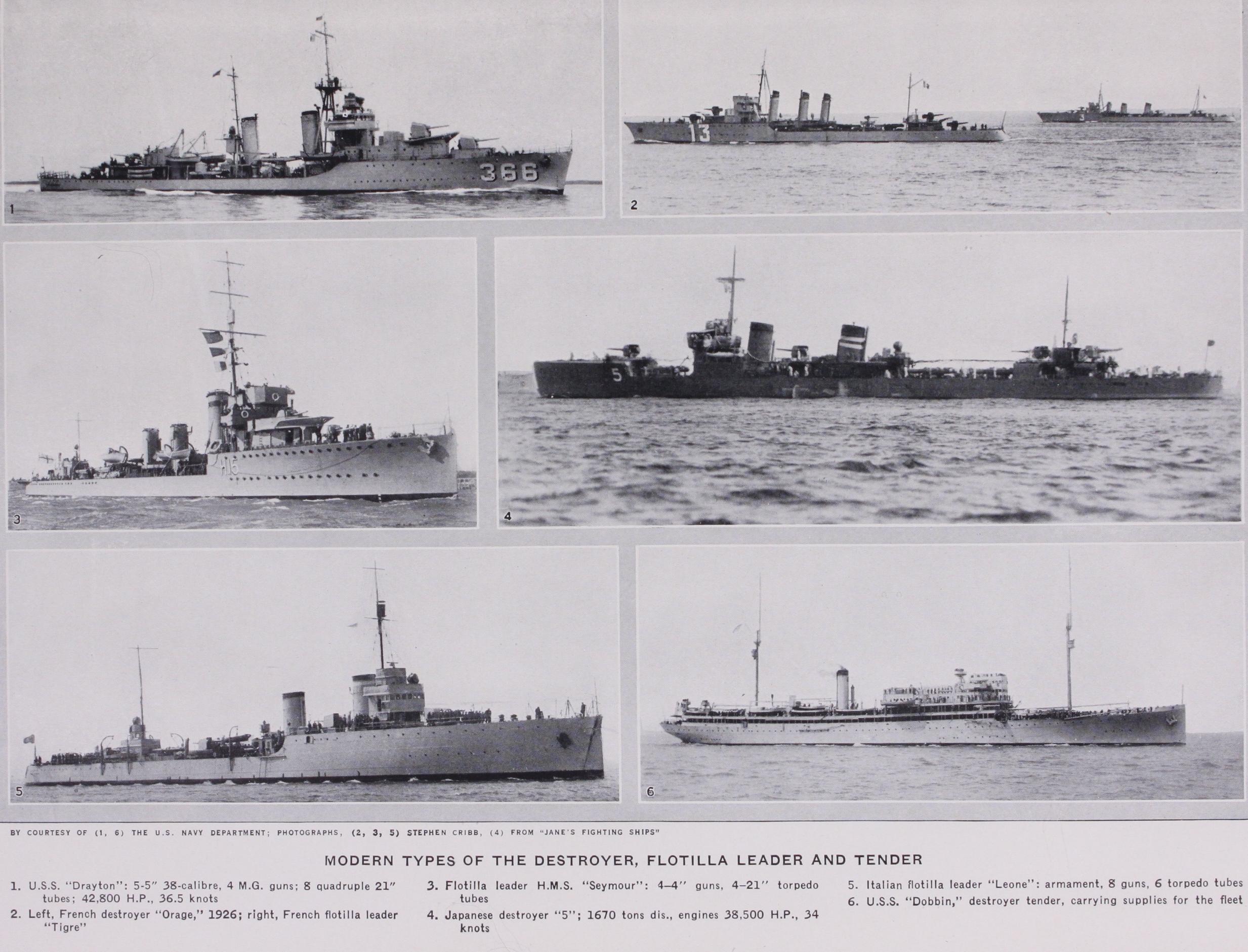
During the war period France built very few destroyers, but in 1917 obtained 12 vessels of the Japanese "Kaba" class. In 1922, 12 vessels of the "Bourrasque" class (see "Orage" Fig. 2 on plate) were laid down, followed in 1924 by 14 vessels of "L'Alcyon" class. These last were of 1,97o tons displacement, 34 knots (3 5,00o s.h.p.), armed with four 5.1-in. guns and one 3-in. anti aircraft, with six torpedo tubes.
Italy has built destroyers steadily from 1916, averaging about three vessels per year, starting with "Sirtori" class of Boo tons and 3o knots speed. The last to be laid down were the 16 ships of the "Nembo" class, the latest of which were of 1,35o tons dis placement, 38 knots speed (44,000 s.h.p.), armed with four 4.7-in. guns and six torpedo tubes.
American destroyers up to 1916 were of the "Porter" and "Manley" classes of 1,125 tons displacement, 32 knots speed (22,000 s.h.p.), armed with four 4-in. guns, one 3-in. anti-aircraft and twelve torpedo tubes. When the United States entered the World War a very large programme of destroyer building was started, the vessels being of 1,215 tons displacement, 34 knots speed (2 7,00o s.h.p.), with the same armament as the vessels of "Manley" class. Some 25o vessels of this class were ordered, of which about 4o were delivered before the Armistice (see "Farn holt," Fig. I on plate).
Japan's latest type of destroyer in 1914 was the "Kaba" class of 12 ships, 665 tons displacement, 3o knots speed (9,50o s.h.p.), armed with one 4.7-in. and four i8-in. torpedo tubes. Ships of similar type to the British "R" and "W" classes were laid down, and the building of destroyers has since been continuous, the latest class being the "Kamikaze" class of ships. These are of tons displacement, 34 knots speed (38,500 s.h.p.), armed with four 4.7-in. guns and six torpedo tubes (see Fig. 4 on plate for similar type) .
The most recent class of destroyers in each nation are approxi mately of the same type as the British "W" class, the principal difference being that, in France and Italy, greater length and power have been adopted.
The forerunner of this class was the "Swift" of 1,800 tons dis placement, built under the recommendations of the Committee on Designs in 1904. The first leaders, built definitely to lead flotillas of destroyers, were the four vessels of the "Kempenfeldt" class- I,600 tons displacement, 34 knots speed, armed with four 4-in. guns and four torpedo tubes. These vessels were acting as leaders to flotillas of "K" and "L" class destroyers in 1914. During the war 25 leaders were constructed for service with flotillas of the "M," "R," "S" and "W" classes, the last being the "Campbell" class of 1,80o tons-36 knots (40,00o s.h.p.), armed with five guns and six 21-in. torpedo tubes. (See Fig. 3 on plate.) Since the war, the only flotilla leader laid down for the British Navy was the "Codrington" of 1,520 tons displacement, speed 35 knots (39,000 s.h.p.), armed with five 4.7-in. guns and eight 21-in. torpedo tubes, built for service with "Acasta" class destroyers. America has started no leaders, but Japan has laid down 15 ships of the "Fubuki" class of 1,70o tons displacement, speed 34 knots (50,00o s.h.p.), armed with six 4.7-in. guns and nine torpedo tubes.
Since 1922 France has laid down 6 flotilla leaders of the "Tigre" class, 2,36o tons displacement, speed 35.5 knots (5o,000 s.h.p.), armed with five 5.i-in. and two 3-in. anti-aircraft guns, and six vessels of the "Guepard" class of 2,646 tons displacement, speed 38.5 knots (70,000 s.h.p.), armed with five 5.5-in. guns and six 21.7-in. torpedo tubes.
During the same years, Italy has laid down three flotilla leaders of the "Leone" class, 1,960 tons displacement, speed 35 knots (42,000 s.h.p.), armed with eight 4.7-in. and two 3-in. anti-aircraft guns, and six i8-in. torpedo tubes, and 12 ships of the "Naviga tore" class, 1,980 tons displacement, speed 38 knots (5o,000 s.h.p.), armed with six 4.7-in. guns and six 21-1n. torpedo tubes. The tendency of flotilla leaders has been to increase in size and speed, particularly in France and Italy, until they much more re semble light cruisers than leaders for torpedo boat destroyers.