
DETROIT, fronting I2m. on the river of the same name, and 4m. on the navigable river Rouge, is the oldest city of any size in the U.S.A. west of the original seaboard colonies. Founded in by Antoine de la Mothe Cadillac with 1 oo settlers and soldiers, it was 17 years old when De Bienville began operations in New Orleans, and 63 years old before St. Louis was founded. The city antedates Buffalo by about a century, and it was 137 years old when Chicago received its first charter.
The first settlers as well as the first soldiers were French, and the government was French until 1760 when, as one of the results of the French and Indian War, it was occupied by the British under Col. Robert Rogers. A few English settlers took up farms near by, but the place remained chiefly a military and trading post through the whole of the first century. During the Revolutionary War, Detroit was a centre of British influence, and a point from which Indian forays into the Ohio country were directed. Under the treaty that closed the war, Detroit passed nominally to the united colonies, but on various pretexts the British held pos session until Jan. II, 1796, when, under the Jay Treaty, the American flag was raised over the fort. During th War of 1812, the place was surrendered to the British under Gen. Brock, but the next year, after the battle of Lake Erie, it was returned to United States control. In the year 1805 Michigan was organized as a separate territory with Detroit as its capital and also as the county seat of Wayne county, which included what are now Michigan, Wisconsin and part of Minnesota. The territory was afterwards narrowed down, and Detroit continued to be the capi tal of the territory until 1837. It was then the capital of the State until 1847 when the seat of government was moved to Lansing.
In 18o5 every house in the town except one was destroyed by fire. This gave opportunity for an entire replanning of the place. The old division into narrow streets and small lots was entirely abandoned. To each citizen, whose old site was obliterated, a much larger lot was awarded free. The arrangement of streets left a number of open spaces which were dedicated as parks. The whole effect was one of openness and roominess unusual in the planning of towns at that early day. The older portions of the city retain the old characteristic of wide streets with occasional triangular parks. From this centre radiate the main thoroughfares which follow the lines of the old territorial roads. Michigan avenue is the starting point of the old "Chicago road"; Grand River avenue runs across the State to the "rapids of the Grand river," now the city of Grand Rapids; Woodward avenue leads north to "The Saginaws," and Gratiot to the foot of Lake Huron. Outside the city limits these roads were generally four rods wide, but modern improvement has transformed them mostly into wide paved roads. Woodward avenue is 12of t. wide within the city limits and 204f t. wide from the city limits to Pontiac, making it one of the finest main roads in the country. When the automobile began to create a need for improved highways, the County of Wayne, of whose wealth and population Detroit constitutes the largest part, established an efficient road commission. Through its work the county has been covered with an extensive network of paved roads. For a number of the main thoroughfares 2o4ft. has been established as a standard width. The road system has been supplemented by ample provision for parks. The largest of these, River Rouge park, is 1,204 acres; but Belle Isle park is the gem of the system. It is an island of 85oac. in Detroit river, connected with the mainland by a bridge. Palmer park, 287ac., Water Works and Owen parks on the river, are also highly developed. The total park system in 1930 comprised 4,049 acres. A boulevard long and i 5of t. wide encircles the central section of the city.
The city's remarkably rapid growth is shown by the increase in population, which in 1890 was 205,876; in 1900, 285,704; 1910, 1920, and in 1930 by the Federal census it was 1,568,662.
Administration.—When Michigan Territory was first organ ized, both it and the town of Detroit came under the rule of the governor and judges. This administrative body had the very un usual combination of legislative, executive and judicial powers, and continued in force about 20 years. In 1818 the question of establishing a republican form of government with elective officers was submitted to the people, but the conservative French element voted it down. In 1824 a city charter was given to Detroit, and this was extensively amended or revised in 1827, 1837, 1857 and 1883. The settlement was officially styled the "Town of Detroit" till 1815. It was then called the "City of Detroit" till 1837, when it was enacted that the corporate name should be "The Mayor, Recorder and Aldermen of Detroit." In 1857 it again became the "City of Detroit." The old charters provided for elective officers, with aldermen elected by wards. The board of education and board of estimates were elected in the same way.
In 1918 an entirely new charter was adopted making radical changes in this form of government. In place of a board of alder men of two members from each ward, there is a common council of nine members, elected at large and all elected at the same time. The term is two years. Members of the council must be at least 25 years old, and resident in Detroit at least three years, and may not hold any other civil office. The member having the highest number of votes at the election becomes president of the council and acting mayor in the absence of the elected mayor. The council is required to meet as a committee of the whole every day except Saturdays, Sundays and legal holidays for the purpose of receiv ing communications, complaints, petitions and reports, holding public bearings and discussing pending matters, and must meet in regular session at least once in each week in the evening. It has full legislative powers on all subjects that are within the scope of the city charter. At the same time that members of the com mon council are chosen, the voters also elect a mayor, city clerk and city treasurer, nominations for all of these officers being made at a primary. The mayor under the new charter has ex ceedingly wide powers. He may veto acts of the common council. He has the appointment, without reference to the council, of a large number of administrative officials and commissions, and also may remove any official without trial and cause assigned. The mayor also appoints the members of the board of assessors and board of health; city planning, public lighting, water, street railway, fire, public welfare, police and other commissions. An at tempt to change the number of councillors to chosen by wards and to reduce the mayor's power was defeated in November 1936 for the fourth time since the adoption of the 1918 charter.
The mayor and common council together have the final determi nation of tax levies and the issue of bonds, subject to certain limitations. The amounts to be raised by taxation in any one year, aside from the school expenses, cannot exceed 2% of the assessed valuation, and Detroit bonds are not marketable in New York if issued in excess of 7% of the assessed valuation. The charter also requires that all new issues of bonds shall be submitted to vote of the electorate. The heads of city departments are required to transmit to the controller, on or before Jan. 15, an itemized state ment of amounts needed for the next fiscal year. The controller compiles these in a budget book which he transmits to the mayor, who has until March for its consideration. He may increase any items, but the total may not exceed the 2% limit, and the amounts required for interest and sinking fund of outstanding bonds may not be impaired. The mayor transmits the amended budget to the common council, which has about a month for its consideration. It is then returned to the mayor for his second revision which is final except that the council can, by seven affirm ative votes, override the mayor's action on any particular item.
The city's fiscal year is from July to June 3o. On account of the expansion of its territory and business, its financial record has been on a constantly rising scale. The assessed valuation of the city for the fiscal year 1917-18 was $1,176,517,900; for 1933-34 it was $2,251,405,970. The tax rate was $18.52 in the former year and $29.59 for the latter ; tax budget in the same period increased from $16,378,778 to $66,610,875. In 1911 the public debt, less amount in the sinking fund, was $8,088,098. Ten years later it was $68,208,347; in 1934 it had increased to $322,705,941. In the first period Detroit had the smallest per capita debt of any of the large cities in the country. In 1934, however, it had the third largest. In the fiscal year 1933-34 the total amount raised for municipal pur poses was: tax levy $51,104,57I ; assessments, subventions, rent, $19,884,091; department earnings, $3,417,442; public service earnings, $21,620,073; total, $96,056,177.
To a remarkable extent the manufactures of Detroit have been associated with the instruments for transportation. The Pullman car works were first established there and continued in operation till 1893. The first freight car works were established in 1853. In the year 1904 these works employed 7,20o men with a production value of $23,000,000.
Detroit's situation led to the construction of small water craft. The building of large vessels for lake traffic commenced in 1852 and has continued till the present day. In 1863 the building of marine engines was commenced; large shipyards on the river front and at Ashtabula, Ohio, are established. During the World War many steamers were built in Detroit yards for overseas service.
About the time that freight car building began to decline, a new vehicle for transportation came into existence. Robert E. Olds at Lansing and Henry Ford at Detroit were for years at work solv ing the problem of a vehicle to be "propelled by power generated within itself." Both succeeded, but Olds was first in the market. In 1899 he commenced the manufacture of the "Oldsmobile" in Detroit. The Cadillac Motor Car Company was incorporated in i9o1 and the Ford and Packard in 1903. This first appeared as a separate industry in the census reports in 1904 when it had 2,034 employees together with an output for the year valued at $6,24o,000. From this beginning the increase was rapid. Detroit was well situated to become the centre of this new industry. Detroit and three of the neighbouring cities of Michigan had been centres of carriage making, and hence had the necessary raw materials available with workmen skilled in the making of springs, wheels and bodies and in upholstering. Detroit was making a larger number of gas engines than any other city in the entire country. Its growth was rapid. The manufacturing census of 1909 showed 17,137 employees in this work with 45,5oo cars built, valued at $59,536,000. Ten years later the figures were: employees 136,000, cars i,i0o,000, value $88o,000,000. In 1926 the number of employees was nearly 2oo,o0o, cars nearly 2,000,000 and value well over $1,160,000,000. In 1933, 85 concerns employed 116,117 persons, with a product valued at $965,577,679. The year 1937 was marked by production of the 25,000,000th Ford (January 18).
At the same time that the automobile was under production in such immense numbers, Detroit began taking a leading place in the making of the aeroplane. The first all-metal aeroplanes in the country were made here, and the construction of this kind of craft is conducted on an extensive scale. A canvass of the business made in the year 1929 by the Board of Commerce disclosed 57 companies in Detroit engaged in manufacturing or jobbing air craft or their motors or supplies. Of these eight companies were assembling the completed planes, and 43 were making aircraft engines or parts. There were also at that time companies doing experimental work. Consolidation has reduced the number of companies, however, for only nine reported statistics in 1931 and but four in 1933. Detroit was one of the first cities to estab liSh regular passenger and freight planes flying to other cities.
Apart from its prominence in the manufacture of aids to trans portation lines the Detroit district has been notable for other achievements. The first iron furnace west of Pittsburgh was built by Dr. Geo. B. Russel in Hamtramck in 1848. The first iron vessel built in the country was launched at the Wyandotte yards of the Detroit Dry Dock Company and the first Bessemer steel forged in this country was produced at Capt. Ward's mill at Wyandotte. The city has never been a great iron furnace centre, but it is one of the largest pig-iron consumers. It also excels in a number of specialties. Among the most valuable products in 1933 were electrical machinery, machine tools, foundry and machine shop products, stoves, wirework, cigars and malt liquors.
The appropriations for the public schools in Detroit for the fiscal year 1933-34 were as follows: from taxes, $13,683,386; pri mary school money from State, $7,074,011; federal aid, $69,75o; county funds, $67,000; all other sources; $2,822,7o6; a total of $23,716,853. Of the total public debt of the city, $67,918,520 was incurred for school buildings.
Every year a census of "children of school age" (5 to 20 years) in the city is taken, and upon this is based a dividend from. the primary school interest fund. The census showed 412,802 such persons in Detroit in the summer of 1935.
Besides public institutions there are in the city 116 parochial schools, chiefly Catholic and Lutheran, two law schools, the Uni versity of Detroit (Catholic) and a considerable number of private schools, literary, art and music. On opposite sides of Woodward avenue, each in the midst of grounds two blocks in extent, are the public library and the Art Institute. The library was estab lished in 1865 with a collection of 5,000 volumes, occupying an annex to the old Capitol building. It was for several years under the direction of a committee of the common council, but in 188o the control of the library was given to a board of six members elected by the board of education. The building at present occu pied by the library is of white marble and is arranged in eight different departments including the noted Burton historical collec tion. The library had 18 branches and 891,532 volumes in The Detroit Institute of Arts goes back in its foundation to a noted loan exhibition in 1883. After the close of the exhibition a society was formed consisting of 4o incorporators each of whom contributed $I,000 for establishing a permanent art institution. The subscription was subsequently increased to $roo,000, and the first Art Museum building was erected. It remained the prop erty of the corporation until 1919 when it was taken over by the city. The new building which was opened to the public in Nov. 1927, is of Vermont marble, of Italian Renaissance style, and cost about $4,000,000. It is divided into three main depart ments, for European, American and Asiatic art.
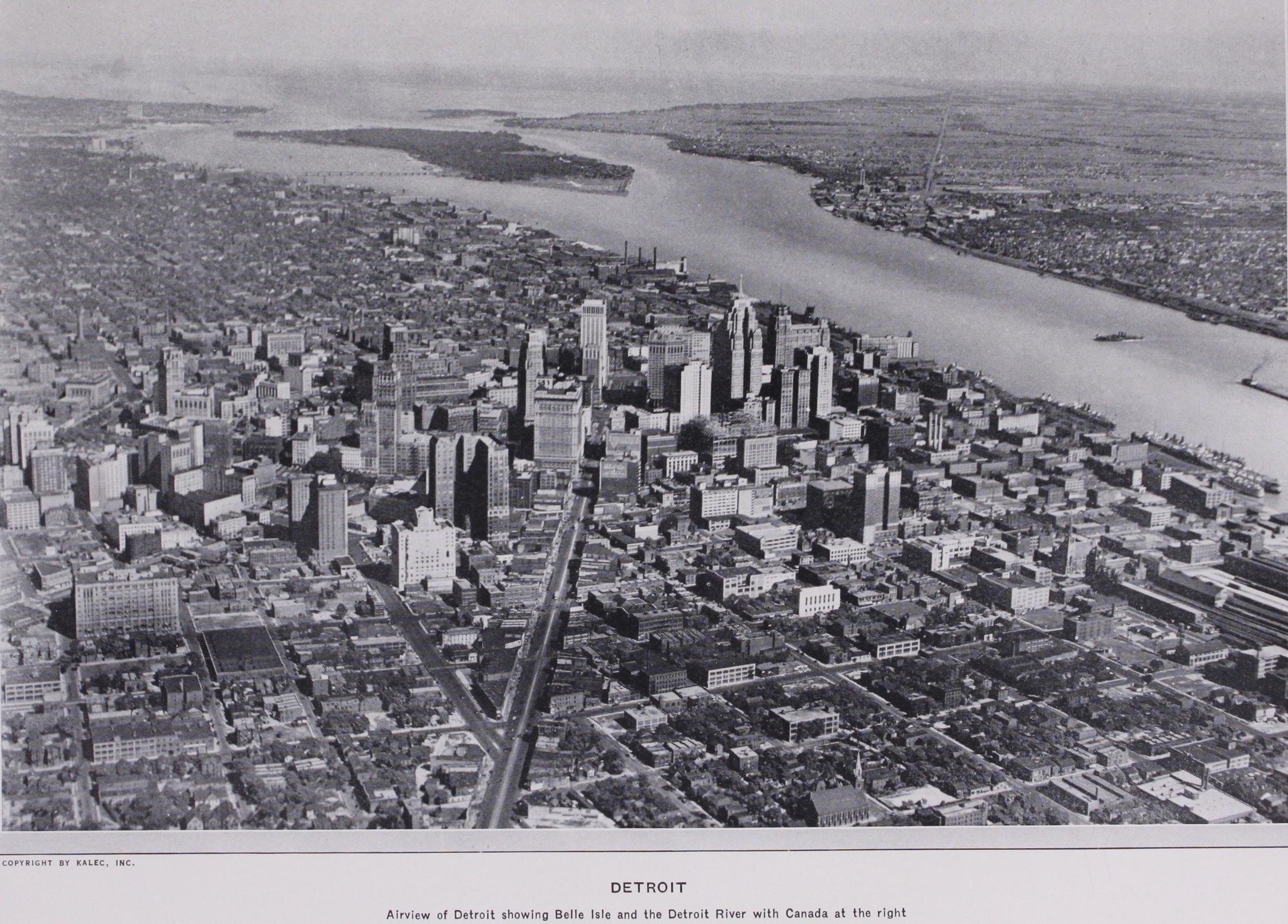
land transportation needs are sup plied by the following railroads: Michigan Central, Pere Mar quette, Lake Shore, Wabash, Detroit, Toledo and Ironton, Grand Trunk and Canadian Pacific. The two first named have each a number of lines, and together form a network of tracks covering the whole of Michigan's Lower Peninsula. The two last named have direct connection with the whole Canadian railroad system. The railroads are supplemented by motor bus and motor truck lines extending in all directions from the city. Detroit's situation on the strait connecting the Upper and Lower Lakes, gives the city peculiar advantages for water transportation.
Detroit has been the centre of national interest on several occa sions during recent years. In 193o Mayor Bowles was successfully recalled following charges of political corruption. Two years later the precarious financial situation of the city contributed to the failure of leading Detroit banks which led to the national bank crisis of March 1932. The year 1936 was marked by local and federal investigations of the Black Legion, a secret organiza tion centring in Wayne County. During 1937 the city was the scene of numerous industrial strikes. (W. ST.)