DISTEMPER. A distemper in its simplest form consists of whiting, glue (size) and water, and is sometimes called whitewash. The glue acts as a binder, preventing the coatings from rubbing off. Distempers so made are exceedingly cheap, cover well, and are quickly and easily applied with large brushes, but they will not stand washing. They are largely used for whitening ceilings and cheap interior decorative work. When, in course of time the coatings become dirty, it is quite an easy and inexpensive matter to wash them off and apply a fresh coating.
Distempers are sold in the form of a thick paste or jelly, or as a dry powder, and only require mixing with cold or warm water to make them ready for use. A good distemper can be made according to the following recipe : Take 14 lb. of gilders' whiting and cover with water. Allow it to stand overnight. Next morning pour off the excess of water and work up well. A small amount of ultramarine blue mixed with water should be added to the whiting to improve the colour. Add about 5 lb. of hot jelly size to the whiting and mix well. Strain through a sieve and it is then ready for use. If it is desired to keep the distemper for any length of time before use, a small amount—about oz.—of alum or borax should be added as a preservative.
The term "water-paint," on the other hand, denotes a superior type of modern distemper which contains—in addition to the usual distemper ingredients—a proportion of oil or varnish, which acts as an additional binding agent. With these additional ingred'ents a good water paint should give insoluble coatings on drying, and the coatings should adhere so firmly that they can be washed a few days after application. This property is very val uable, as walls coated with these washable sanitary distempers, which have become dirty in course of time, can be easily cleaned and freshened up by simply sponging over with clean cold water.
Water-paints have also much better covering and hiding power than the ordinary distempers, because, in addition to whiting, a proportion of lithopone, zinc white or other strong pigment is incorporated, which increases their body or opacity, and gives more solid coatings.
Since they contain oils, varnishes, etc., these water paints are sold in paste form only. The paste is of a soft jelly-like con sistency which only requires mixing with cold or warm water to thin it to a suitable consistency for use.
Water paints are largely used as flat wall paints for interior decoration. They are comparatively cheap and can be obtained in a large variety of beautiful shades. They dry very quickly after application, with a pleasing mat or flat finish; and on account of the firmness of adhesion and insolubility of these paints it is possible to apply a second coat a few hours af ter the first coat has dried, without working up the first coat. This property is very useful in those cases where two or more coats are necessary in order completely to hide the surface which is being painted, and give what is known as a "solid" effect.
Flat distempered surfaces are often "stippled" or dabbed whilst still wet with a special flat soft hair brush known as the "stip pler." By this process all brush marks that might otherwise be in evidence are removed, and the surface is given a beautiful mat velvet-like finish.
When painting large wall areas, as in town halls, council cham bers, schools and so on, these water paints are often applied by means of a spraying machine; in this way very large areas can be quickly and successfully covered with the distemper.
Water paints are manufactured as follows:—About no lb. of strong glue or size powder are put in a steam-pan, covered with o gal. of water and left to soak overnight ; steam is then passed through till all the glue has gone into solution. The steam is turned off and about gal. of linseed oil, copal varnish or mix tures of these is then added, and the whole well beaten up until an emulsion is formed. A small proportion of carbolic acid, formaldehyde, or other preserv-ative is added to the emulsion, otherwise it would go mouldy if kept for any long period. This medium—usually known as petrifying liquid—is then mixed while hot with roughly its own weight of white base consisting of whiting, lithopone, blanc-fixe, or mixtures of these, and ground through stone-mills. The resultant thin paste is then packed in kegs or tins where it sets on cooling to a soft jelly-like con sistency. The coloured distempers are obtained by adding the necessary quantity of lime-fast colour to the white base during the grinding process. There are some paste distempers 'on the market which are made by using casein—an insoluble white prod uct obtained from skimmed milk—in place of glue or size. In these varieties the casein is dissolved in water with the aid of some alkali, such as carbonate of soda, ammonia or borax, which is added to the water in order to render the casein soluble. The procedure is then carried on in the way already described.
Outside quality distempers contain more oil than is generally used in the preparation of distempers for indoor use. This helps to bind them better, and serves as a protective agent against weathering influences. They should be thinned ready for use with a medium—known as petrifying liquid—which is specially made for this purpose, and is of a similar composition to the medium in which the pigments are ground in making the paste distemper.
Powder Distemper.—Dry distempers (called calcimines in America) consist of whiting or carbonate of lime with either finely powdered glue or casein as their binding agent. They are manufactured by grinding the whiting and powdered glue or casein in special grinding and sifting machinery in order to get a thorough incorporation of all the ingredients. Great care must be taken to see that all the materials are thoroughly dry before mixing, as even a small amount of moisture present would make the powder cake and set up hard, and of course render it use less. A little borax, salicylic acid, alum or other dry preservative is added to keep the dry powder sweet and prevent any decom position that might take place on standing.
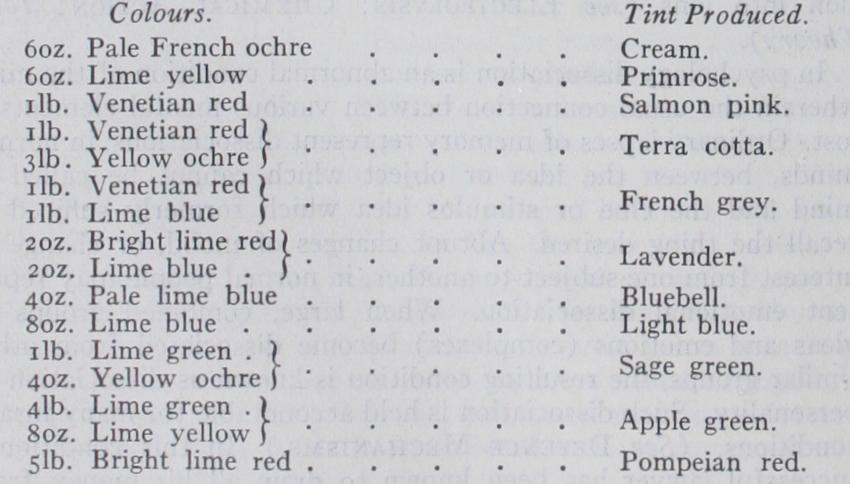
In the case of coloured distempers, sufficient lime-fast pig ments are incorporated during the mixing process in order to give the desired shade.
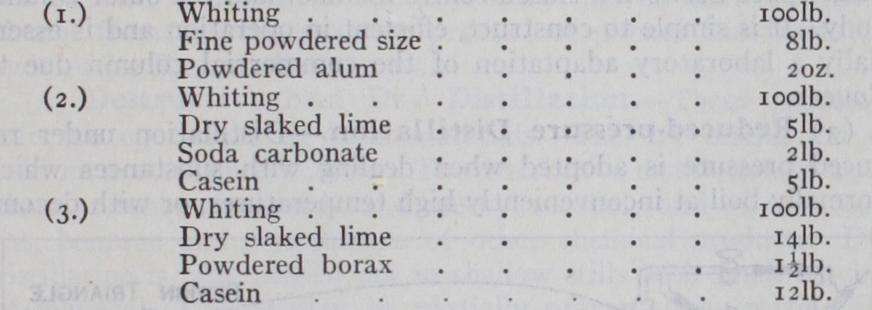
These dry distempers are now very largely used both in this country and America on account of their comparative cheap ness. The following recipes will give a general idea as to their composition :— These white dry distempers may be tinted to any desired shade by adding lime-fast colours. (J. G. BE.)