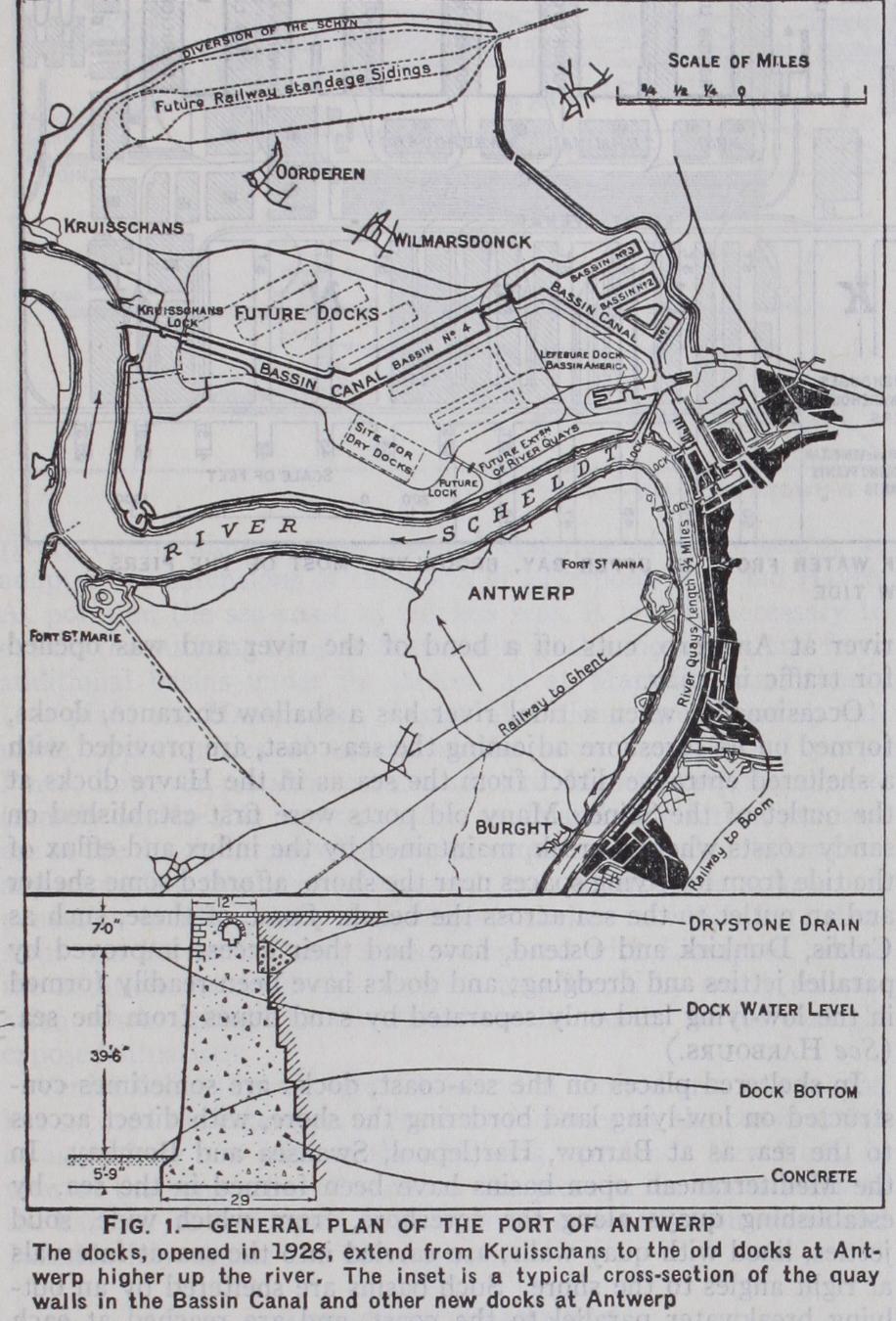
DOCKS. The principal function of a commercial port is to provide means whereby cargoes may be discharged from and loaded into vessels frequenting it for the purpose. The transfer of goods may be from ship to quay warehouses and other storage places; or to wagons on the quays; or to river and canal craft lying alongside the ship; and vice versa. The facilities provided must be in sheltered positions and suitable appliances are neces sary for the convenient and expeditious handling of cargoes. A basin constructed for these purposes, surrounded by quay walls, is known as a dock. The term is specially applied to basins, at places with a large range of tide, usually more than 15f t., in which the water is maintained at a fairly uniform level by gates, which are closed when the tide begins to fall as at the docks of Liver pool (Plate I., fig. 9) and Havre. (The word "dock" should, strictly speaking, be applied only to wet-docks closed by gates, and to dry-docks and floating docks used for the repair of vessels. It is, however, commonly and popularly employed in a wider sense and is so used in this article.) Sometimes, however, at both river and sea-coast ports with lesser range of tide such as Glasgow, Ham burg, Rouen, Southampton and New York, dock gates are dis pensed with, and open basins and river quays serve for the ac commodation of vessels. In tideless seas, such as the Mediter ranean, the rivers are usually barred by deltas at their outlets, like the Rhone and Tiber, and thus rendered inaccessible. Ports have often been established on the coasts of such seas by con structing open basins protected by breakwaters, as at Marseilles. Genoa and Naples. Open basins, however, are precisely the same as closed docks, except for the absence of dock gates.
The accommodation for shipping in basins in river ports is so frequently supplemented by river quays, that closed docks, open basins and river quays and wharves are all naturally included in the general consideration of dock works. The present article therefore comprehends brief descriptions of wet-docks and basins and their approaches; locks and entrances; quay walls, piers and wharves ; dry docks and slipways ; dock and lock gates and cais sons; the equipment and machinery of docks; and the methods of handling cargo in them. Reference is made to Naval docks but for these see also the article DOCKYARDS AND NAVAL BASES. For cognate subjects see the articles HARBOURS, BREAKWATER, RIVER