
DODDER, the popular name of the annual, rootless, leafless, twining, parasitic plants forming the genus Cuscuta, formerly re garded as representing a distinct family Cuscutaceae, but now in cluded in the Convolvulaceae. The genus contains nearly Too species and is widely distributed in the temperate and warmer parts of the earth. The slender thread-like stem is white, yel low, or red in colour, bears no leaves, and in the seedling stage attaches itself by suckers to the stem or leaves of some other plant round which it twines and from which it derives its nourish ment. It bears clusters of small flowers with a four- or five toothed calyx, a cup-shaped corolla with four or five stamens in serted on its tube, and sometimes a ring of scales below the sta mens; the two-celled ovary becomes when ripe a capsule splitting by a ring just above the base. The seeds are angular and contain a thread-like spirally coiled embryo which bears no cotyledons. On coming in contact with the living stem of some other plant the seedling dodder throws out a sucker, which penetrates the host, its tissues establishing organic union with the tissues of the host.
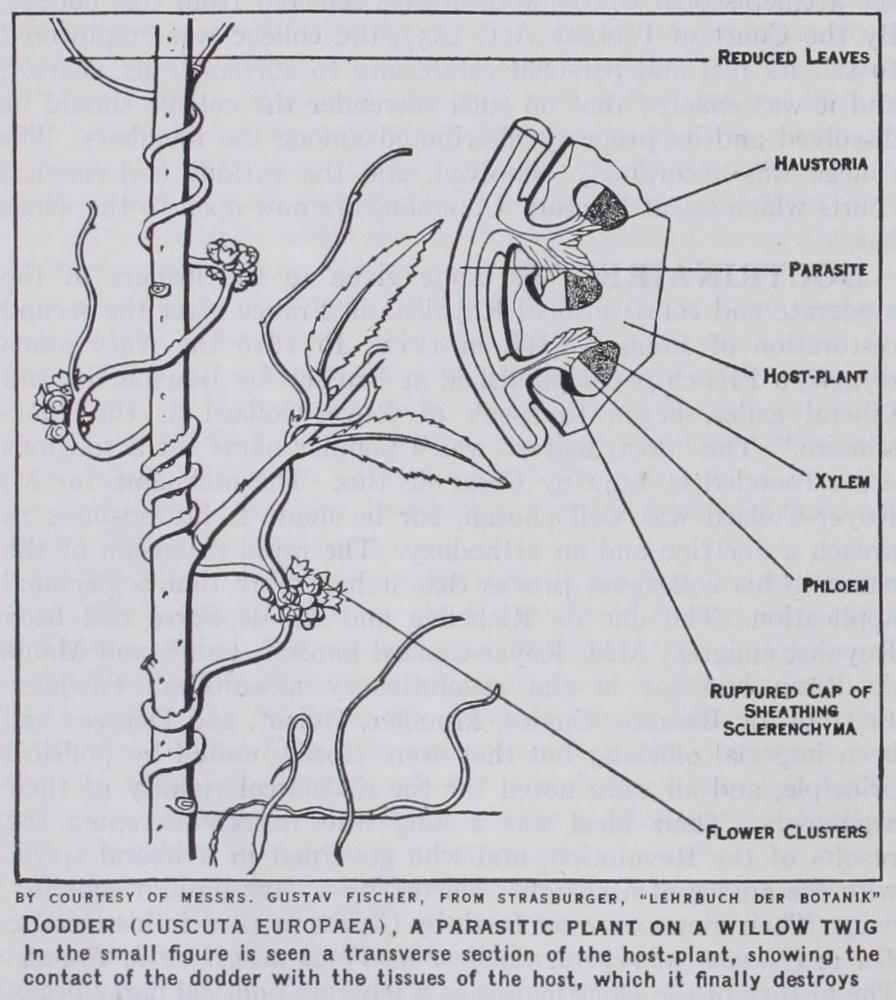
By this means water is drawn from the wood and nutriment from the bast of the host. The dodder then soon ceases to have any connection with the ground. As it grows, it throws out fresh suckers, establishing itself very firmly on the host-plant. After making a few turns round one shoot the dodder finds its way to another, and thus it continues twining and branching till it re sembles "fine, closely-tangled, wet catgut." The injury done to flax, clover, hop and bean crops by species of dodder is often very great. C. europaea, the greater dodder (see fig.) is parasitic on nettles, thistles, vetches and the hop; C. epilinum, on flax; C. epithymum, on furze, ling and thyme. C. tri f olii, the clover dod der, is probably a sub-species of the last mentioned.
In the United States and Canada about 3o species occur, a few of which have been naturalized from the Old World. Among the native species are the love-vine (C. Gronovii), common on herbs and low shrubs in the Eastern 'States and adjacent Canada; the glomerate dodder (C. paradoxa), which forms dense ropes of flowers on tall herbs in the Central States ; and the marsh dodder (C. salina), abundant in salt marshes of the Pacific coast, forming golden patches on various saline herbs.