
SARI BAIR AND SUVLA BAY How to employ the fresh divisions coming out from home had to be decided by Hamilton. The French had from the outset favoured operations on the further side of the straits, and there was something to be said for such a plan of campaign. But a descent in that quarter must involve a disembarkation in face of opposition, the perils of which had been made apparent on April 2 5 ; moreover, granting the landing to be successful, the forces would start work much farther from the narrows of the Dar danelles, the objective, than were either Helles or Anzac. There were also not wanting inducements for the Allies to attempt a landing at Bulair, seeing that their presence at that point would carry with it the severance of the Turkish land communications with the peninsula. But this would likewise mean a landing in face of opposition; and the distance of Bulair from the Island of Imbros, the nearest base of operations for the peninsula, pro vided a strong argument, from the point of view of ship trans port, against such an undertaking. Moreover, a landing either on the Asiatic side or at Bulair meant a dispersion of the Allies' forces as a whole, unless Helles or Anzac, or both of them, were to be abandoned; and the fact that the Ottoman commander-in chief had to be prepared for his opponent adopting one of these two plans, offered a strong argument against selecting either of them, apart from any other considerations as to their tactical advantages or disadvantages.
The utmost secrecy was observed by the Allies' staff. Steps were taken to mislead the Ottoman authorities by means of feints and of reconnaissances executed at localities other than those selected for operations. False reports were circulated as siduously by the intelligence department. Liman von Sanders was well aware of the arrival of large bodies of British troops in the islands; but he remained in complete ignorance of his rival's real design until this was actually in course of execution. He had organized his forces as a southern group watching Anzac, while two divisions were retained near Bulair, where he was disposed to anticipate that the blow would fall. There were also large bodies of Turkish troops in reserve about Chanaq, and others about Kum Kale and Besika bay. Numerically the contending armies at this critical juncture were about equal, but the Turks were necessarily much dispersed, so that the result of the im pending clash of arms really hinged upon the speed with which the attacking side should gain ground before the defenders had time to concentrate.
The Allies' offensive started on Aug. 6 with two preliminary enterprises. An onset was made upon part of the Turkish lines in the Helles area. Portions of Birdwood's force broke out of the southern end of the Anzac position and gained ground. But the real purpose of the two operations was to occupy the enemy's attention and to conceal a design of much greater moment. Attack on Sari Bair.—So dexterously had the assembling of the reinforcements in the Anzac area been effected that the Turks were entirely unaware that Birdwood's army had been nearly doubled. The plan for gaining possession of the Sari Bair mountain was that several columns were to move out from the northern end of the Anzac position at nightfall on Aug. 6 and, on reaching their appointed stations, were to wheel to the right and to work their way in the dark up certain steep but well-defined gullies that led up to the summit. But although the Turks were to some extent surprised, and although the outlets of the gullies were in consequence in the assailants' hands by midnight, so stubborn a resistance was offered by the defenders that by day break the columns were not much more than half way up, and all attempts to win the upper ridges failed on the 7th in the face of the Turkish reinforcements.
After a rearrangement of the troops during the night the of fensive was resumed on Aug. 8; but except at one point very little progress was made. After a fresh reorganization during the dark hours another effort was made on the 9th, and on this oc casion a small body of British and Indian troops actually fought their way to a commanding summit from which the narrows were seen, but they were driven off again. Next day the Turks, now in great force, counter-attacked and thrust those opposed to them back down the slopes all along the line, whereupon strenuous fighting ceased. Both sides had lost heavily, but victory for all practical purposes rested with the Osmanlis, even if the Anzac position had been extended considerably in a northerly direction as a result of the operations.
Hamilton's carefully devised scheme of offensive operations had in fact come to nought in its most important features. The determined effort to secure possession of Sari Bair had mis carried. A footing had, it is true, been gained at Suvla, giving the Allies control of a fairly well sheltered inlet on the outer coast of the peninsula; but as the high ground within easy ar tillery range of the landing places, which overlooked the whole occupied area, remained in the hands of the Turks, much of the benefit hoped for from its acquisition was neutralized. Only a restricted patch of Ottoman territory had in fact been occupied, thanks to the new undertaking, and although the position at Anzac had been extended and improved it remained a very bad one. The Allies now occupied many miles of front in the penin sula, but there was scarcely a spot where the enemy did not en joy the advantage in respect to ground; what the attacking forces needed from the outset was depth rather than breadth, and depth they had failed to secure. They had, moreover, incurred very heavy losses during the succession of combats lasting from Aug. 6 to o, and, except for a mounted division coming from Egypt to fight on foot, no reinforcements were on the way; the 54th Div. had already been swallowed up at Suvla. The defend ing side had also, no doubt, suffered heavily in casualties, not ably on Sari Bair; but Liman von Sanders could fairly claim that, even if some valuable ground had been lost by the Turks, he had held his own in a contest in which his adversary had en joyed the initiative and had been in a position to effect a sur prise.
An effort was made hy the troops on the extreme left of the Allies' position at Suvla to gain ground along the ridge north of the Suvla plain on Aug. 15, but nothing came of it. Hamilton, however, did not despair of improving the situation in this area, so the mounted division from Egypt and another division from Helles were quietly concentrated there in support of the troops already on the spot, and on the a 1st a determined attempt was made to capture some of the high ground which had baffled the attempts of the invaders on the 9th and loth. Large forces were engaged on either side in this battle, and the attack was prepared by a heavy bombardment of the Ottoman trenches, in which war ships moored in Suvla bay, where they were secure from sub marines, participated. But after a sanguinary encounter the as sailants met with a decisive rebuff, and from that date onwards no serious offensive operation was attempted by the Allies in the Dardanelles campaign. The conditions of stalemate which had prevailed before the arrival of the five new divisions from Eng land set in afresh and continued to the end.
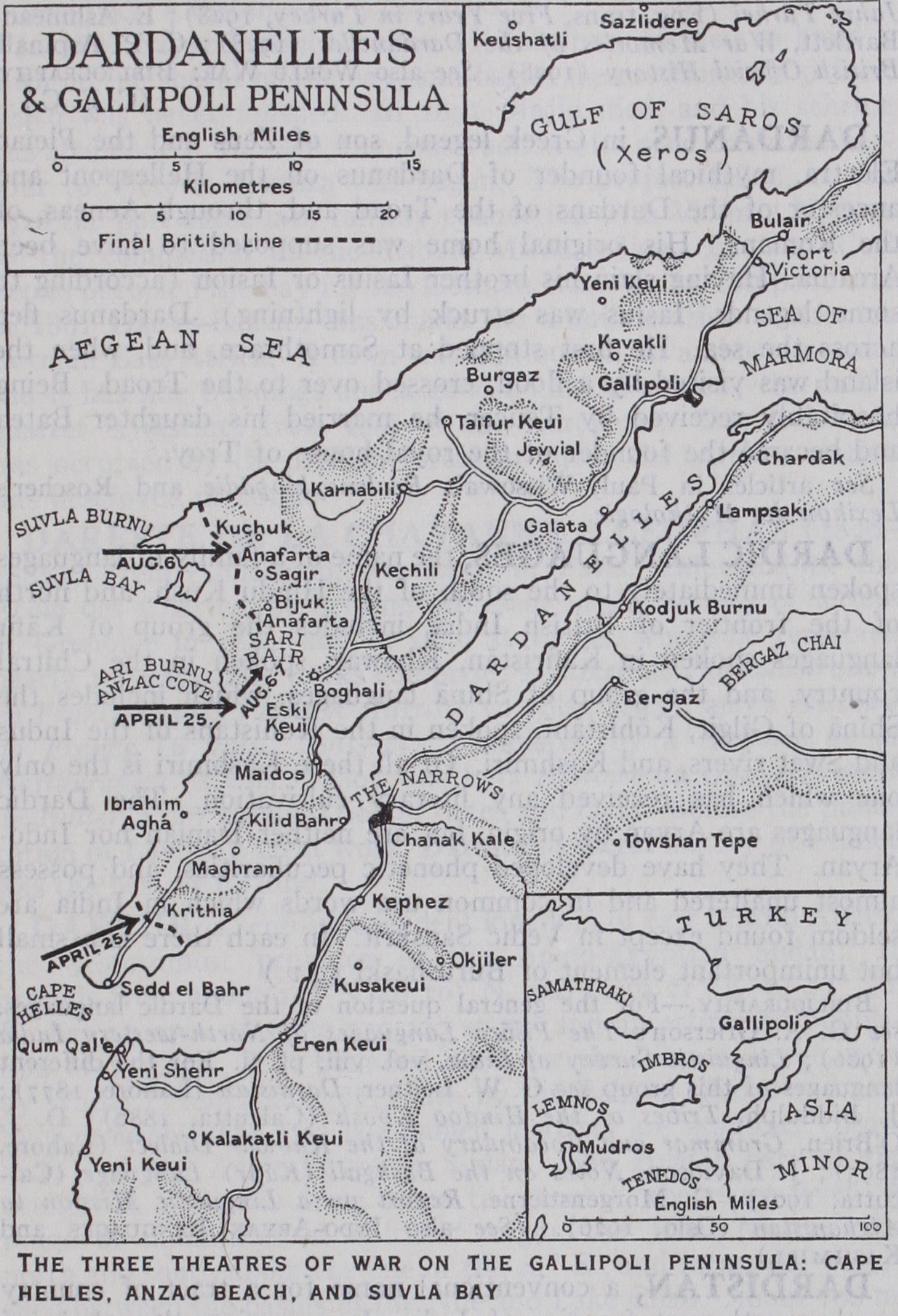
As a consequence of the failure at Suvla during the early days of its occupation certain changes in command were carried out, Gen. Byng, especially sent out from home for the purpose, taking over command in this area. Gen. Davies was in command at Helles, and, as the right of the Suvla force was in touch with the left of the Anzac force in the low ground near the shore, Byng and Birdwood now held a continuous front extending from a point on the coast about 3m. N.E. of Suvla bay near to Gaba Tepe, overlooked for practically the whole of its length by high ground in occupation of the Turks. Owing to the losses that had been suffered during the August combat and even before the final reverse of Aug. 21, Hamilton had cabled home asking for reinforcements and for the very large drafts needed to bring his depleted units up to their war establishment, amounting to a total of 95,00o men. He had, however, been informed that no large bodies of fresh troops could be spared for the Dardanelles theatre. A temporary change of plan did occur a few days later owing to a French proposal to despatch four divisions to the scene to operate on the Asiatic side of the st;aits, whereupon the British Government became disposed also to send fresh divisions.