
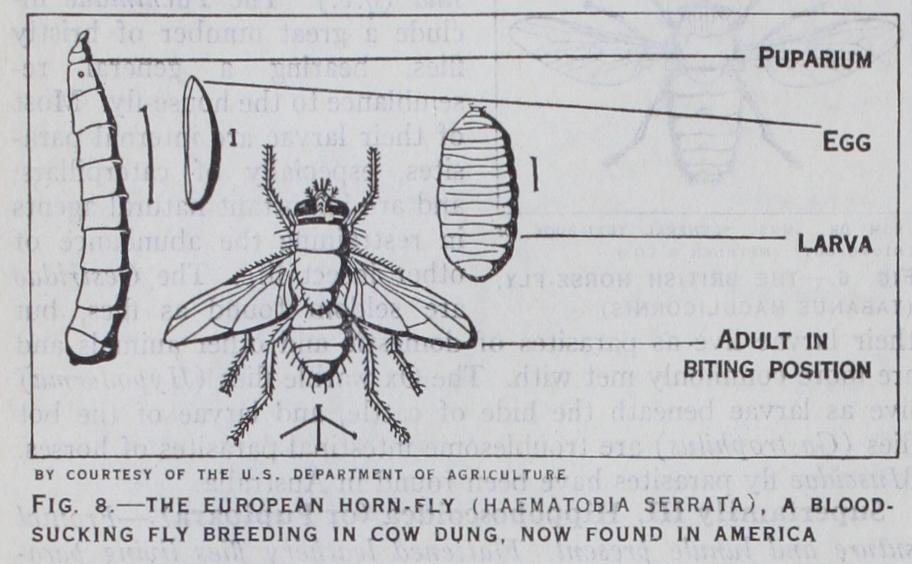
SUB-ORDER II. BRACHYCERA Mostly stoutly built flies whose antennae are three to six jointed and maxillary palpi one or two jointed. Wings usually with a median cell. Larvae gen erally with a much reduced head, (fig. 8) pupae free or enclosed in puparium.
This large sub-order is divisible into two series as follows: Series I. ORTHORRHAPHA.
Head without a frontal suture: antennae with a terminal bristle or prolongation (fig. 1). Larvae with a reduced Bead; pupae free and splitting by means of a dor sal fracture.
There are 14 families in this series, of which five are men tioned below.
The Stratiomyidae are more or less flattened flies usually with white, yellow or green markings, while some are metallic. The scutellum is often spiny and the last antennal joint is generally ringed. More than i,000 species are known and their larvae live in water or damp earth; the pupae are loosely enclosed in the last larval skin.
The Tabanidae (fig. 6) or horse-flies have a broad head, piercing mouth-parts and brilliantly coloured eyes. The costal vein is pro longed right round the wing and the halteres are hidden by a membranous scale or squama. The various species of Tabanus and the clegs (Haematopota) are troublesome blood-suckers, attack ing man, horses and cattle. Their larvae frequent damp earth and bear circlets of papillae around many of the segments. The family is widely distributed, none of the species is very small and over 2,0o0 kinds are known.
The Asilidae, or robber flies, are large insects with long, hairy bodies and elongate, bristly, prehensile legs. They prey upon other insects, extracting their body-fluids by means of their pierc ing mouth-parts. Their larvae live in soil and rotting wood.
The Empidae have similar habits but are not hairy and are less robustly built ; a tuft of hairs, forming a mouth-beard, present in Asilidae, is absent in this family. Both families are widely dis tributed and include many species.
The Bombyliidae, or bee-flies (fig. 7), are usually densely pubes cent and bee-like with a long projecting proboscis, slender stiff legs and often marbled wings. The flies suck nectar from flowers, and their larvae are chiefly parasitic upon those of solitary bees. Although only nine species occur in Britain, at least 2,000 kinds are known from various parts of the world. None of the above types are remarkable for brilliancy of colouring.
Series II. CYCLORRHAPHA. Head usually with a frontal suture with a small hard plate or lunule (fig. 2) above it: antennae with a dorsal bristle or arista (fig. I). Larvae with only a vestige of a head: pupae enclosed in the hardened larval skin or puparium (fig. 8) which ruptures by means of a circular fracture.
In these flies a kind of bladder (the ptilinum) is protruded through the frontal suture in order to force open the puparium, thus allowing the insect to emerge : the bladder is then withdrawn into the head.
Three families belong here, the most important being the Syrphidae, or hover flies, distinguished by the spurious vein, which crosses the wing without reaching the outer margin, and by the presence of an inner vein running parallel with the apical wing margin (fig. 9). Many of these flies are banded like wasps, while others are hairy and resemble bumble bees. The drone fly (Eris talis tenax) is a familiar example and, like most of the other species, hovers in the air with rapidly vibrating wings. The larvae exhibit diverse habits; many are predaceous upon aphids, etc., while others are scavengers in decaying matter or in the nests of bees and wasps.
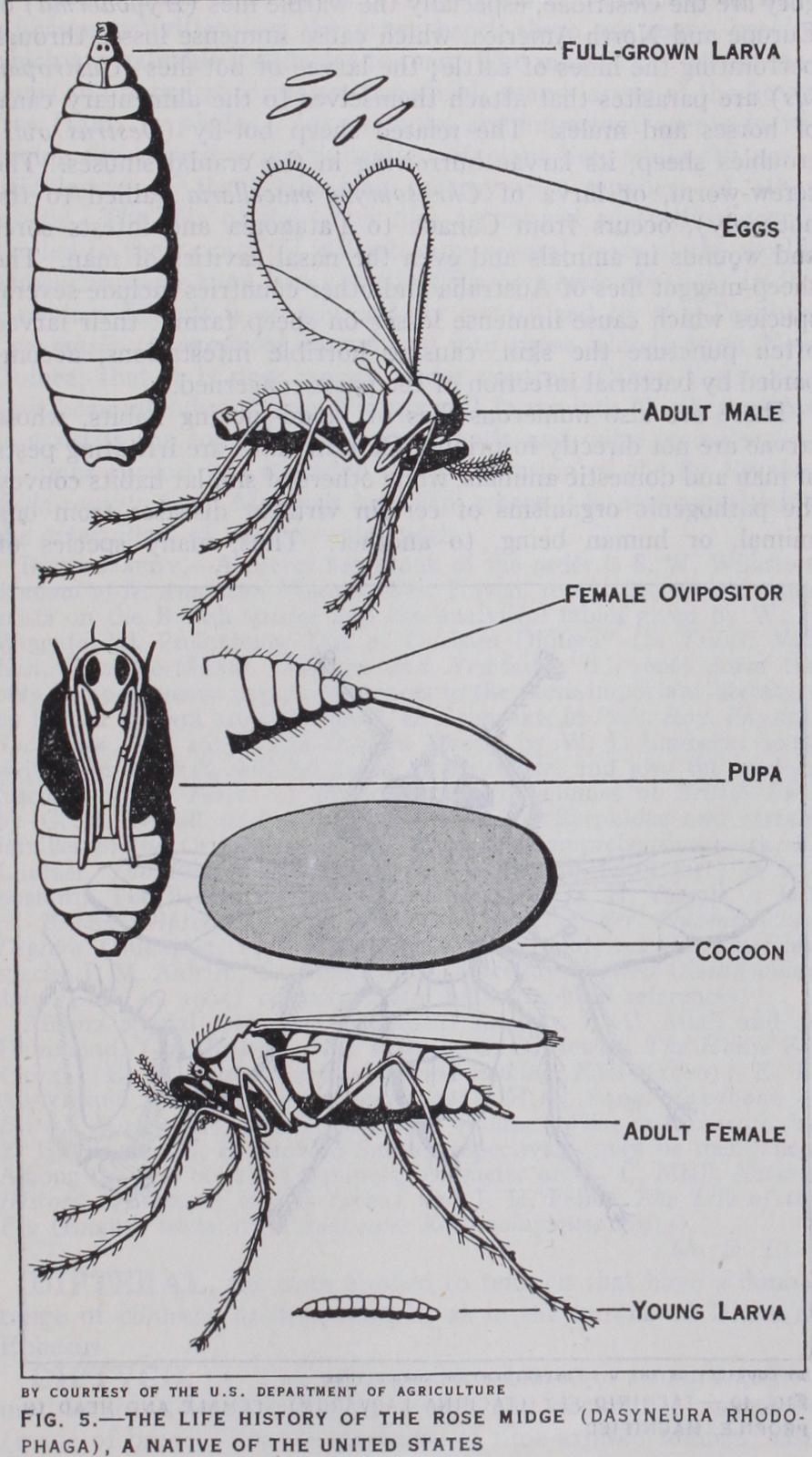
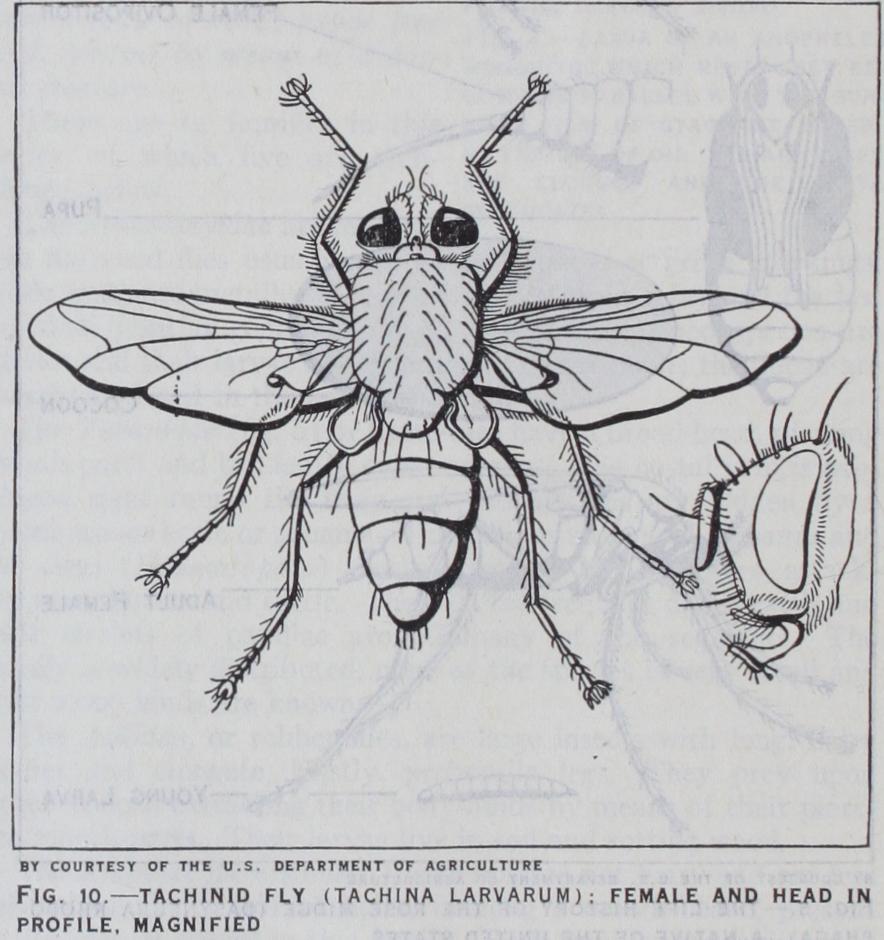
This is an immense group containing many families, some of which are ill-defined and difficult to separate. The fruit-flies (fam. Trypaneidae) usually have prettily marked wings and their larvae attack various fruits, mine leaves (as in the celery fly) or form galls. The gout-fly of barley and the frit-fly of oats are well-known members of the family Oscinidae. The Agromyzidae include many flies whose larvae mine the leaves and other tissues of plants. The Muscidae are a very important family most of whose larvae are scavengers, or prey upon other fly larvae. known examples are the common house-fly, Musca domestica (q.v.), the blue-bottles phora) and the Tsetse flies, sina (q.v.). The Tachinidae clude a great number of bristly flies, bearing a general semblance to the house-fly. Most of their larvae are internal sites, especially of caterpillars, and are important natural agents in restraining the abundance of FIG. 6.-THE BRITISH HORSEFLY, other insect life. The Oestridae Fig. 6.-THE BRITISH HORSEFLY, other insect life. The Oestridae (TABANUS MACULICORNIS) are seldom found as flies, but their larvae live as parasites of domestic and other animals and are more commonly met with. The Ox warble flies (Hypoderma) live as larvae beneath the hide of cattle, and larvae of the bot flies (Gastrophilus) are troublesome intestinal parasites of horses. Muscidae fly parasites have been found in Australia.
Superfamily III. Hippoboscoidea (or Pupipara) . Frontal suture and lunule present. Flattened leathery flies living para sitically upon mammals and birds: the larvae are retained within the bodies of the females until about to pupate.
Three families belong here, the most important being the Hip poboscidae which include the forest-fly (Hippobosca equina) and its allies: the wingless sheep ked or tick (Melophagus ovinus) and the genus Ornithomyia, which infests birds, are also included. The families Nycteribiidae and Streblidae include highly aberrant insects found in many parts of the world living on bats. The members of the first-mentioned family are all wingless creatures of spider-like form.
The curious wingless crane-fly, Chionea, is found in Europe and North America on the surface of snow, while other wingless or semi-wingless Diptera are found on the shores of Kerguelen and other far-distant ocean islands.
There are other flies whose larvae are injurious to man and domestic animals, and the affections induced by their presence are included under the general term of myiasis. Included in this cate gory are the Oestridae, especially the warble flies (Hypoderma) of Europe and North America, which cause immense losses through perforating the hides of cattle; the larvae of bot-flies (Gastrophi lus) are parasites that attach themselves to the alimentary canal of horses and mules. The related sheep bot-fly (Oestrus ovis) troubles sheep, its larvae burrowing in the cranial sinuses. The screw-worm, or larva of Chrysomyia macellaria (allied to the house-fly), occurs from Canada to Patagonia and infests sores and wounds in animals and even the nasal cavities of man. The sheep-maggot flies of Australia and other countries include several species which cause immense losses on sheep farms: their larvae often puncture the skin, causing horrible infestations, accom panied by bacterial infection of the parts concerned.
There are also numerous flies of blood-sucking habits, whose larvae are not directly injurious. Certain kinds are irritating pests of man and domestic animals, while others of similar habits convey the pathogenic organisms of certain virulent diseases from one animal, or human being, to another. Thus, many species of Anopheles mosquitoes are the direct carriers of malaria parasites from man to man. Yellow fever is only contracted when the mosquito Aedes aegypti (formerly known as Stegomyia fasciata) sucks the blood of man after having previously fed upon an in fected person (fig. 3). Another mosquito, Culex fatigans, is a carrier of the Maria worm which induces the disfiguring disease of elephantiasis, while the Tsetse fly (Glossina) is a carrier of the pathogenic organisms (Trypanosomes) of sleeping sickness in man and of nagana in domestic animals. The minute moth flies (fam. Psychodidae) include the blood-sucking genus Phleboto rnus, the members of which are small enough to pass through the meshes of mosquito curtains. Sand-fever or pappataci fever of Southern Europe, North Africa, etc., is transmitted from man to man by a member of this genus. Mention must also be made of the horse-flies (fam. Tabanidae) a species of which (Tabanus striatus) has been shown to transmit the pathogenic organism of surra among horses and other animals in the Orient.
The house-fly (Musca dornestica), although innocent of blood sucking habits, is a dangerous carrier of the germs of typhoid, infantile diarrhoea and other diseases. Being attracted to excre mentous matter, often containing disease germs, the insect's mouth-parts and body thus become contaminated and its faeces include ingested bacilli. Flies infected in this way readily con taminate food which consequently becomes a source of infection to human beings.
The economic importance of Diptera is not confined to their injurious activities: on the other hand, there are many species which are valuable auxiliaries to man. The majority of the preda ceous and parasitic forms are beneficial : many larvae of the hover flies (fam. Syrphidae), for example, are important agents in re ducing the excessive multiplication of plant lice, while the para sitic larvae of the Tachinidae destroy vast numbers of other insects. The role of the latter flies as natural controlling agents has led to their practical utilization in several parts of the world. Thus, the sugar cane borer beetle (Rhabocnemis obscura) in the Hawaiian Islands is so successfully parasitized by the Tachinid Ceromasia sphenophori, introduced into those islands from New Guinea, that it is now largely under control. Other Tachinidae have been introduced from Europe and Japan into North America to assist in the control of the gipsy moth, and quite recently con spicuous success has attended the importation of the fly Ptycho myia remote from Malaysia into Fiji, where it is now parasitizing the caterpillars of the coca-nut moth.
useful handbook of the order is S. W. Williston, Manual of N. American Diptera (New Haven, 1908). No general work exists on the British species and the analytical tables given by W. J. Wingate, "A Preliminary List of Durham Diptera" (in Trans. Nat. Hist. Soc. Northumb. Durham and Newcastle, ii., 1906) form the only comprehensive paper ; references to the more important literature on British Diptera are given by P. H. Grimshaw in Proc. Roy. Physical Soc. Edin., xx., 1917. The Diptera Danica by W. J. Lunbeck, being written in English, will be found of assistance, and also the various fascicles of the Faune de France; the two volumes of British Flies by G. H. Verrall deal exhaustively with the Syrphidae and certain families of the Orthorrhapha. As a modern comprehensive work, E. Lindner, Die Fliegen der Palaeartischen Region (Stuttgart) is im portant. The British species are catalogued by G. H. Verrall, A List of British Diptera (19oi), while the Katalog der Palaeartischen Diptera (Budapest, 1903-05) covers a wider field; for the American species J. M. Aldrich, Catalogue of N. American Diptera (Smithsonian Misc. Coll. 46, 1905) contains useful bibliographical references.
Among special works on individual subjects, L. C. Miall and A. Hammond, The Harlequin Fly (i9oo) ; C. G. Hewitt, The House Fly (1914) ; E. E. Austen, British Blood-sucking Flies (ioo6) ; E. E. Austen and E. Hegh, Tsetse Flies (1922) ; Ii. C. Lang, Handbook of British Mosquitoes (192o) ; and two volumes, Flies and Disease, by E. Hindle and G. S. Graham-Smith, respectively, may be mentioned. Among the few books of a popular character are L. C. MialI, Natural History of Aquatic Insects (1902) and J. H. Fabre, The Life of the Fly (English trans. from Souvenirs Entomologiques (1913) .
(,A. D. I.)