
SUBORDER I. NEMATOCERA Mostly slender flies with elongate antennae of seven or more joints: maxillary palpi four or five jointed. Wings with median cell usually absent. Larvae with an evident head, pupae free.
The Nematocera include 13 families; the most important are the following: The Tipulidae include the crane-flies or "daddy-long-legs" which are recognizable on account of their large size and very long fragile legs. The larvae of several species are greyish objects called "leather jackets" which live underground and feed upon roots. Crane-flies include many species and are found all over the world.
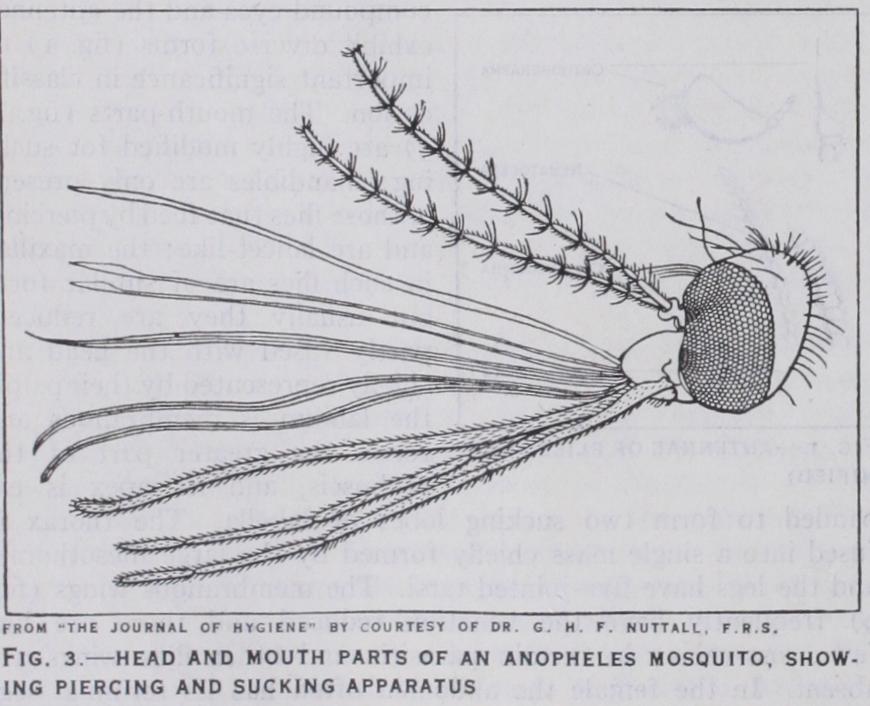
The Culicidae (fig. 4) are known as gnats or mosquitoes (q.v.) : the body and wings are invested with scales and the mouth-parts are stylet-like and used for sucking blood. Their larvae and pupae live in water and are very active. More than 1,500 species are known and at least 25 kinds occur in Great Britain. The common gnats are species of the genus Culex while members of the genus Anopheles are concerned with the transmission of the malaria organism.
The Cliironomidae or midges resemble mosquitoes in form, but scales are wanting and the mouth-parts are usually degenerate. Their larvae and pupae are mostly aquatic and red or green in colour, the red larvae being known as blood-worms.
The Cecidomyidae or gall midges (fig. 5) are minute flies with very few veins to the wings and the antennae bead-like and adorned with circlets of long hairs. Their larvae are often orange in colour, with a minute head : Lhey live in plant-tissues, forming galls of various types.
Mention should also be made of the Mycetophilidae or fungus midges and the tiny hairy Psy chodidae which comprise the moth-flies, sand-flies and the Simuliidae, or buffalo gnats.