
VIKINGS.) Mediaeval.—The consecutive history of Denmark begins early in the loth century with the reign of Gorm, "the Old." He, like his predecessors, is a shadowy figure. But he certainly founded a permanent dynasty, and the name of his wife, Thyra, is asso ciated with one of the greatest public works of the dark ages, the Dannewirk, which bounded Denmark against the German terri tory to the south. His son, Harald "Bluetooth," played a wider part in history. He himself claimed to have conquered Denmark and all Norway and made the Danes Christian. To him, in fact, is probably due the permanent unification of Denmark and the introduction of organized Christianity under royal authority. He also, it would seem, began the attempt at the acquisition of Nor way in which much of the energy of his successors was destined to be expended, and he founded a highly organized community of Vikings at Jomsborg at the mouth of the Oder, which gave him by far the strongest military force in all the north. But it was his son, Sweyn "Forkbeard," who brought Denmark once more into the forefront of European affairs. The wide dominion of his son, Canute the Great, and his importance in English history have tended to obscure Sweyn's achievements. Nevertheless, Sweyn was the real founder of the power which Canute enjoyed, and it was he who first made the Danish kingdom a rival to the more ancient States of western Europe and laid the foundations of the power of Denmark in the early middle ages.
The careers of Canute and his sons are described elsewhere. (See ENGLISH HISTORY: Canute the Great.) In the next genera tion Denmark becomes once more a purely Scandinavian power, occupied in rivalry with formidable Norwegian kings and in the extension of its influence over the peoples of the southern Baltic coast line. The last king of Denmark who consistently attempted to achieve an Anglo-Danish kingdom was Sweyn Estrithson, who died in 1074. With the collapse of the great expedition planned against England by his son, Canute "the Holy," in 1085 Danish history enters upon a new phase. The kings of Denmark hence forward abandon their English ambitions and Danish history once more centres upon the Baltic. (A. M.) Consolidation of the Kingdom Under the Valdemars. To the early part of this period belongs the growth and consolida tion of a national church, which culminated in the erection of the archbishopric of Lund (c. 1104) and the consequent ecclesiastical independence of Denmark. The third archbishop of Lund was Absalon (1128-1201), Denmark's first great statesman, who materially assisted Valdemar I. (1157-82) and Canute VI. (1182 1202) to establish the dominion of Denmark over the Baltic. The policy of Absalon was continued on a still vaster scale by Valdemar II. (1202-41), at a time when the German kingdom was too weak and distracted to intervene to save its seaboard; but the treachery of a vassal and the loss of one great battle sufficed to plunge this unwieldy, unsubstantial empire in the dust.
On the death of Valdemar II. a period of disintegration ensued. Valdemar's son, Eric Plovpenning, succeeded him as king; but his near kinsfolk also received huge appanages, and family discords led to civil wars. Throughout the 13th and part of the 14th cen tury, the struggle raged between the Danish kings and the Schles wig dukes; and of six monarchs no fewer than three died violent deaths. Superadded to these troubles was a prolonged struggle for supremacy between the popes and the Crown, and, still more serious, the beginning of a breach between the kings and nobles, which had important constitutional consequences. The prevalent disorder had led to general lawlessness, in consequence of which the royal authority had been widely extended ; and a strong op position gradually arose which protested against the abuses of this authority. In 1282 the nobles extorted from King Eric Glip ping the first Harnd f aestning, or charter, which recognized the Daneho f, or national assembly, as a regular branch of the Admin istration and gave guarantees against further usurpations. Chris topher II. (1319-31) was constrained to grant another charter considerably reducing the prerogative, increasing the privileges of the upper classes, and at the same time reducing the burden of taxation. But aristocratic licence proved as mischievous as royal incompetence; and on the death of Christopher II. the whole kingdom was on the verge of dissolution. Eastern Denmark was in the hands of one magnate ; another magnate held Jutland and Fiinen in pawn ; the dukes of Schleswig were practically inde pendent of the Danish Crown; the Scandian provinces had (1332) surrendered themselves to Sweden.
It was reserved for another Valdemar (Valdemar IV., q.v.) to reunite and weld together the scattered members of his heritage. His long reign (1340-75) resulted in the re-establishment of Denmark as the great Baltic power. To re-establish public order he had to re-establish the royal authority by providing the Crown with a regular and certain income. This he did by recover ing the alienated royal demesnes in every direction, and from henceforth the annual landgilde, or rent, paid by the royal tenants, became the monarch's principal source of revenue. Throughout his reign Valdemar laboured incessantly to acquire as much land as possible. Moreover, the old distinction between the king's private estate and Crown property henceforth ceases; all such property was henceforth regarded as the hereditary possession of the Danish Crown. Valdemar took a remarkable personal interest in the organization of his kingdom and the smallest detail was not beneath his notice.
The national army was also reorganized on its ancient footing. Not only were the magnates sharply reminded that they held their lands on military tenure, but the towns were also made to con tribute both men and ships, and peasant levies, especially archers, were recruited from every parish. It resulted that under such a ruler law and order were speedily re-established. The popu lar tribunals regained their authority, and a supreme court of justice, Det Kongelige Retterting, presided over by Valdemar him self, punished the unruly and guarded the prerogatives of the Crown. He voluntarily resorted to the old practice of summoning national assemblies, the so-called Daneho f . At the first of these assemblies held at Nyborg, Midsummer Day 1314, the bishops and councillors solemnly promised that the commonalty should enjoy all the ancient rights and privileges conceded to them by Valdemar II., and the wise provision that the Daneho f should meet annually considerably strengthened its authority. The keystone to the whole constitutional system was "King Valdemar's Charter" issued in May 1360 at the Rigsrnode, or parliament, held at Kal undborg. This charter was practically an act of national pacifica tion, the provisions of which king and people together undertook to enforce for the benefit of the commonweal. (X.) 1397-1625 The Union of Kalmar.—In 1397 all the most important mag nates of the three Scandinavian kingdoms assembled at Kalmar to attend the coronation of Queen Margaret's nephew, the young Duke Erik of Pomerania, whom she had succeeded in having chosen as her successor as joint king of three kingdoms. At this meeting a committee was formed which projected an act of union; but Margaret took care that this project should not become law, for in it both the right of the inhabitants to self government was insisted upon and great political influence was accorded to the privy council of each kingdom. It was Margaret's intention, however, that union should be maintained under Den mark's suzerainty and a strong monarchy. To this end she set up men on,whom she could rely in the Swedish and Norwegian castles and episcopal sees, and after 1412 Erik VII. pursued the union policy which she had outlined. Erik did not appreciate, however, that the strengthening of the union was the chief task which Margaret had bequeathed to him. Although he was the first Danish king who was German by birth, he held that in order that the Danish people should maintain their national individual ity he had to combat Germanism in Denmark. Schleswig, which since 1386 had been ceded as a fief to the counts of Holstein, had to be regained. He proceeded against the counts first by suits laid before the German emperor, then by declaring war—a war, however, which ended by his being forced to leave the counts in possession of Schleswig except for Haderslev and the most northerly regions. He sought also to drive the German merchants out of Denmark by means of a decree of 1422 in which he gave the Danish merchants a monopoly in trade; in 1425 he began to levy what was called the Sound Dues at HelsingOr on all ships sailing through the Sound. The natural consequence was that the Hanseatic League supported the Holstein counts against him. Copenhagen, which the king had taken in 1416 from the bishop of Roskild, and from this day onwards was to remain the permanent seat of the Danish Government, was attacked in 1428 by the fleet of the Hansa towns, but under the leadership of the heroic Queen Philippa, sister to England's great warrior-king, Henry V., the city defended itself successfully. When in 1435 Erik abandoned the strife with the League and the Holstein counts it vvas because the Swedes, who were being plagued by the Danish sheriffs and the taxation resulting from continual war, had risen in revolt. In the years that followed he repeatedly made serious efforts towards devising a different form of union from that which Margaret had established; but becoming weary of this, and discouraged by opposition even from the Danish Rigsraad (privy council), he retired to Gottland, where in 1439 he received tidings that the privy councils of the three Scandinavian kingdoms had dethroned him and set up his nephew, Duke Christopher of Bavaria as his successor. In 1449 Erik handed over Gottland to Denmark. He died in Pomerania in 1459.
With the death of Christopher, known as Christopher III., in 1448 the Kalmar Union had really come to an end. Denmark and Norway had elected Christian of Oldenburg king and in 145o concluded a permanent union. Sweden on the other hand elected a native nobleman, Karl Knutsson, as king and this called forth strife between the different parties of the Swedish nobles; now and again one or other would seek to resume the union with- a view to overcoming its opponents with the aid of the Danish king, and thus Christian I. 0448-80 was acknowledged the nominal ruler of Sweden from 1457 to 1464 and Hans (148r-1513) from 1497 to 15or. The party strife in Sweden intensified into a bitter feud between the two most powerful of the noble families, the Stures and the Trolles. The Swedish archbishop, Gustav Trolle, called in the help of Christian II. 0513-23) against the Swedish regent (Riksforestandare) Sten Sture; and when the Danish sovereign at the head of a great force had conquered Sweden, it seemed for a moment as though Queen Margaret's idea of union might be taken up again. Christian II. received allegiance as heir to the Swedish throne in 152o. But Gustav Trolle, availing him self of his triumph, instigated a wholesale massacre of his oppo nents, in what came to be called the "blood-bath of Stockholm." When two years later Christian II.'s enemies joined together to effect his overthrow, the peasant population of Sweden also rose against the foreign invader, and in 1523 Gustav Vasa succeeded at last in founding the national Swedish kingdom (see GUSTAVUS I. and SWEDEN).
Schleswig and Holstein.—In the meantime the Danish king had won back Schleswig and secured the alliance of Holstein. In 1459 Duke Adolf VIII., the last representative of the Holstein counts, had died, and in 146o Christian I. of Denmark, his sister's son, had been made a member of the nobility of the country as duke of Schleswig and count of Holstein on his promising that the two lands should remain "for ever together undivided." The nobles thought that in this way they had abolished the rights of inheritance of the family of dukes from that time forward. In 1474 the emperor made Holstein also a dukedom. Ditmarsh was still at that date independent of Holstein, and when in 15oo King Hans tried to conquer it his army of nobles experienced a bloody defeat; it was not till 1559 that Frederick II. succeeded in con quering this free country of peasants.
The election of Christian I. entailed the making of heavy pay ments to various would-be claimants to the succession and this was one of the reasons why the king, on the marriage of his daughter Margaret to the Scottish king, James III., in 1469, was obliged, in lieu of dowry, to mortgage the Norwegian Orkneys and Shetland to Scotland, which has possessed them ever since. The question of the inheritance to the dukedoms arose afresh after the death of Christian I., and in 1490 the nobles were forced to submit to the division of the lands into a Segeberg and a Gottorp region between King Hans and his younger brother, Frederick, the unity of the country being formally maintained by the ar rangement that the two dukes should reign together. United afresh through the fact that Duke Frederick in 1523 became king of Denmark, in 1544 they were once again shared in the same way, between King Christian III. and his brother Adolf who became duke of the Holstein-Gottorp.
Administration.—In the 5th century there had come into full development the differences which from this time forth were to characterize the Danish political situation down to the i9th century. The constitutional problem was, to whom should belong the chief power in the country, the king or the landowners repre sented in the Rigsraad, which at this time was made up of the country's seven bishops and about 20 noble landowners, whom the king indeed chose but whom he had to take from the leading families, and who thus corresponded in some degree to a privy council. This Rigsraad possessed in theory the highest constitu tional powers, for it elected the king, who ever since 1481, before being elected, had to sign a charter drawn up by the Rigsraad, embodying the constitution of the country and asserting that the king should conduct no important State affairs without the sanc tion of the Rigsraad. But except by open revolt the Rigsraad possessed in reality no means of compelling the king, once elected, to observe the rules laid down in this charter; and further, this large assembly of men from all parts of the land, who were themselves fully preoccupied with their own concerns, had naturally to leave to the king and his chancery the actual daily management of the political affairs of the country. One land owner of noble birth as high steward, acted in some sort as a political leader, while another as chief constable was at the head of the nobles in their capacity as Denmark's armed cavalry, but their influence on the Government's conduct could always be set on one side by the king and his chancellor, the head of his chancery. Only in matters of local government was the king vir tually compelled to make use of the nobles, who, insisting on their right to be appointed lord lieutenants, were in charge of the local administration in the 200 herreder (hundreds) of the provinces which were governed from the king's castles.
In 1466 a cleavage had come about between King Christian I. and the then leading Danish-Swedish family of Thott. In 1468 Christian called together at Kallundborg the first Danish assembly of the estates of the realm, consisting of representatives of the Church, the nobility, the burghers and the peasants, so that they might vote him means for waging war against Sweden. From that time on the Government was on the side of the burghers against the landowners. It sought to create competition with the Han seatic League by concluding treaties of commerce with England and the Netherlands. Christian II. at this time was guided by the Dutch woman, Sigbrit Willemszoon, whose standing was more or less that of a controller of customs and finance, and by Hans Mikkelsen, burgomaster of Malmo, who was a kind of minister of the interior. This Government made the king, espe cially after the great victory in Sweden, an absolute monarch. Under the leadership of Hans Mikkelsen were formulated two great laws, the law for the land and the law for the towns, which came into force at the end of 1521. They contained many pro visions which seem of a very modern nature ; their tendency may best be gathered from the fact that they forbade "the evil and unchristian custom of selling the poor peasants" and strongly maintained the monopoly of the Danish towns and burghers in regard to Danish trade. Thus the landowners of noble birth and their rights were entirely set aside.
It is not surprising therefore that the Danish landowners, when Sweden was in a state of insurrection in 1522, should resolve to sweep aside this burgher Government. The nobles from Jutland co-operated with Duke Frederick and the Hanseatic League, re nounced allegiance to King Christian and on March 26, 1523, acclaimed the duke as Danish king. On April 13 King Christian sailed from Copenhagen on his way to the court of his brother in-law, the Emperor Charles V. Some years later in 1531 he made an effort to win back his kingdom, but was taken prisoner in Norway and remained in captivity until his death in Reformation and Reorganization.—It was not until that Frederick I. (1523-33) assured his position; when Copen hagen and Malmo, which had heroically supported King Christian, were forced to surrender by the great Holstein general, Johan Rantzau. The victory was that of the Danish landowners and the Rigsraad; King Christian's two great laws were abrogated and the actual documents publicly burnt ; the landowners were now once more free to sell their peasants and to trade with any foreign merchants they wished. It was the Rigsraad that governed ; Frederick I. was king only in name. He came however to exercise a considerable influence in Denmark, for he, and even to a greater extent his son, Duke Christian, gave their pro tection to the zealous reformers of the church, whose leader was Hans Tausen and who were striving to bring about Denmark's accession to Lutheranism. This movement secured strong sup port among the burghers and the peasants; nor were all the land owners blind to the fact that they might benefit by demanding back the properties which their forefathers had bestowed upon the church and the monasteries, although the majority sided with the Catholic Church. When the struggle was at its height, in 1533, King Frederick died and the Rigsraad decided under the leadership of the Catholic bishops, who would not have Duke Christian king at any price, that Denmark should do without a king altogether, and that the Rigsraad would be Government enough. The Danish burghers, however, would not agree to this. Their leader, Ambrosius Bogbinder, the burgomaster of Copen hagen, and the burgomaster of Malmo JOzgen Kock, concluded a treaty with Lubeck—where Jurgen Wullenweber had really over thrown the old aristocratic ruling council—and they joined to gether to restore the burgher King Christian II. on the throne and to incorporate Copenhagen and Malmo in the Hanseatic League. The lay members of the Rigsraad then, in 1534, recognized the necessity of choosing Duke Christian, and a bitter civil war fol lowed, known to history as the "Count's War"—the count in ques tion being Christopher of Oldenburg, great nephew of King Christian I., whom Lubeck and her allies raised up to oppose Duke Christian. He acted throughout as the nominee of the captive Christian II. Everywhere the burghers and the peasants took up arms and in North Jutland they won victories over the Danish nobles. But Johan Rantzau returned with his Holstein and Ger man troops, and the peasants suffered severely alike in Jutland and on the islands. With Swedish and Prussian assistance a fleet was formed which, under Peder Skram as admiral, defeated the citi zens of Lubeck. The Holstein army was conveyed over to Zea land and in July 1535 the siege of Copenhagen and Malmo began. Malmo surrendered in April, Copenhagen not until it had been besieged for a year, in July 1536. On Aug. 6 Christian III. 59) made his entry into Copenhagen and soon afterwards Am brosius Bogbinder committed suicide.
It was the king who had won the victory with the help of his Holstein troops; the effects of this decisive triumph of the mon archy became very perceptible in the future political development of the country. The most direct outcome of the conflict was the remodelling of the church. In accordance with a decision come to by the king's council of war on Aug. 22, the bishops resident in Copenhagen were imprisoned, then the others all over the coun try; they were released only after they had submitted to the new organization of the church. At an assembly of the estates in Copenhagen in Oct. 1536, at which representatives of the peasants were present for the last time, assent was given to the king's charter and to a statute which established the new church. The social life of the country was revolutionized. The Church became a Lutheran State Church with the king as its supreme head, while seven bishops were to exercise supervision over the parish clergy. The property of the bishops and eventually also all the property of the monasteries fell to the king, and as at the same time a half of the farms of the peasant-proprietors were con fiscated, as a punishment for having sided against the king, the possessions of the Crown were trebled, so that it now owned a little over one-half the soil of the country. The bishops' tithes henceforward went into the king's coffers, the revenues of whicn were increased through the better administration of the Crown estates.
The lord lieutenants more often than not held their fiefs on a fixed rent or else only in return for feudal military service : in future they were obliged to account for the expenses and revenues of the fiefs so that the king should receive the balance. In 1533, of the country's 162 herreder (Schleswig not included) 43 were on the register, in 1559 there were 123 ; in the succeeding years efforts were made to combine the herreder into larger fiefs, the number of which in 1642 was 54. Centralization of Government was carried out on a firmer basis; financial matters were dealt with under an exchequer, while the chancellors took over the ad ministrations of the interior and the exterior. The defeated es tates, the burghers and the peasants, lost in 1536 their political influence, the burghers for a century, the peasants for more than three centuries. The burghers had to abandon entirely their great trade policy and to be content with sharing with the landowners the right to export bullocks, which gave the latter almost a monopoly, and generally to put up with the commercial opera tions of the landowners. For the peasants, of whom in the middle of the 17th century, 94% were leasehold farmers, what was of most importance was that the king and the landowners, during the second half of the i6th century had started farming on a large scale. A great many leasehold tenants were thereby turned out of their fathers' farms, and since the larger new estates called for increased labour the leasehold tenants in the parishes of the large estates were called upon to give their services three days a week. In order to compel the unwilling, both the Crown and the landowners began to make use of legal punish ments, and many of the latter set up law-courts on their own estates where they themselves or their bailiff sat in judgment on the peasants. Moreover the landowners retained in 1536 all their rights as nobles and even extended them. To exemption from taxes was added exemption from tithes, to a monopoly in posts like the lord lieutenancies was added what was practically a mo nopoly of the Government offices and the Exchequer, together with a right to a seat in the Rigsraad (which now consisted often of 23 members) and the exclusive right to promotion to the chief posts, such as high steward, chancellor, chief constable, lord high admiral or lord chancellor of the kingdom.
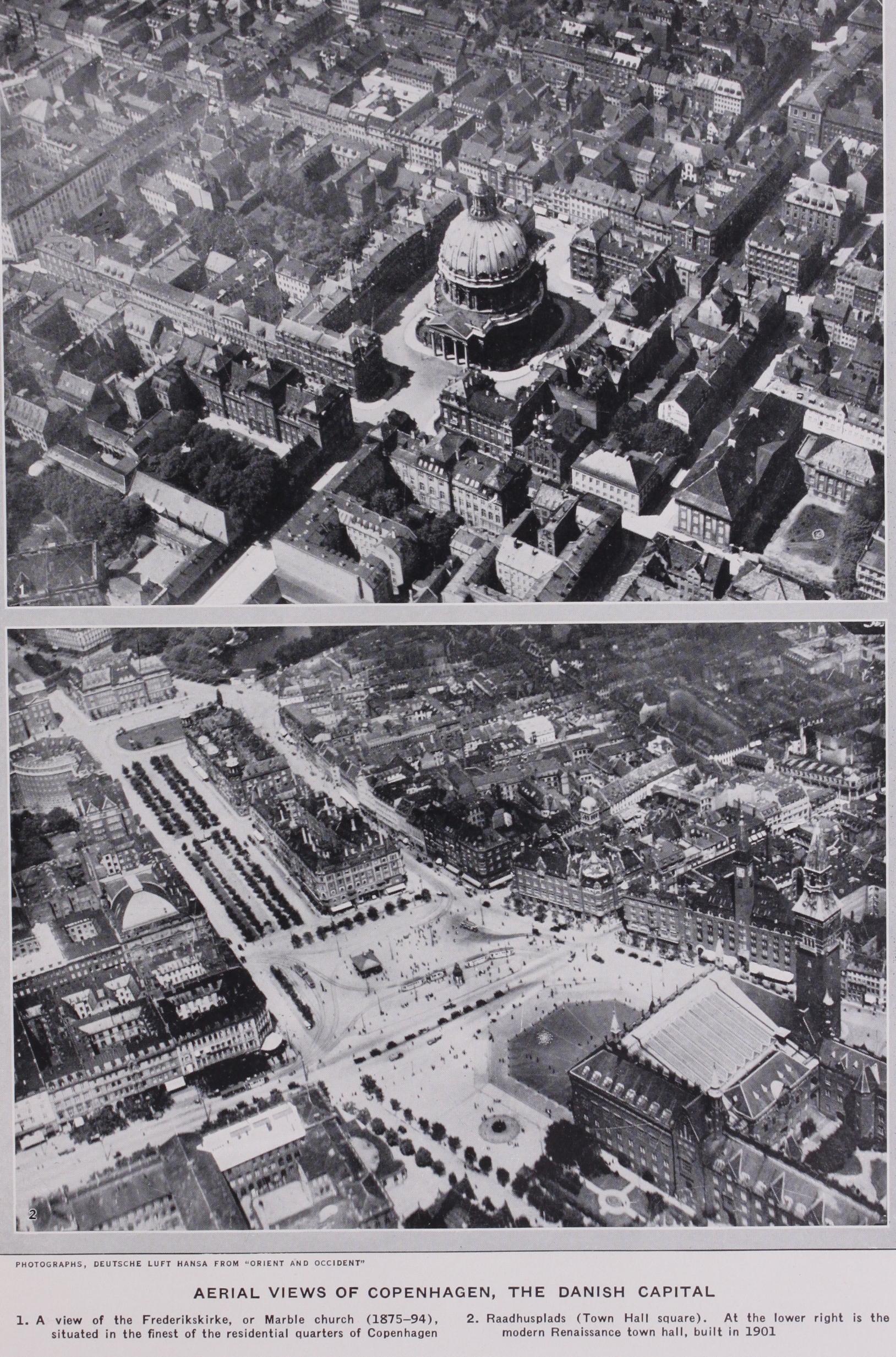
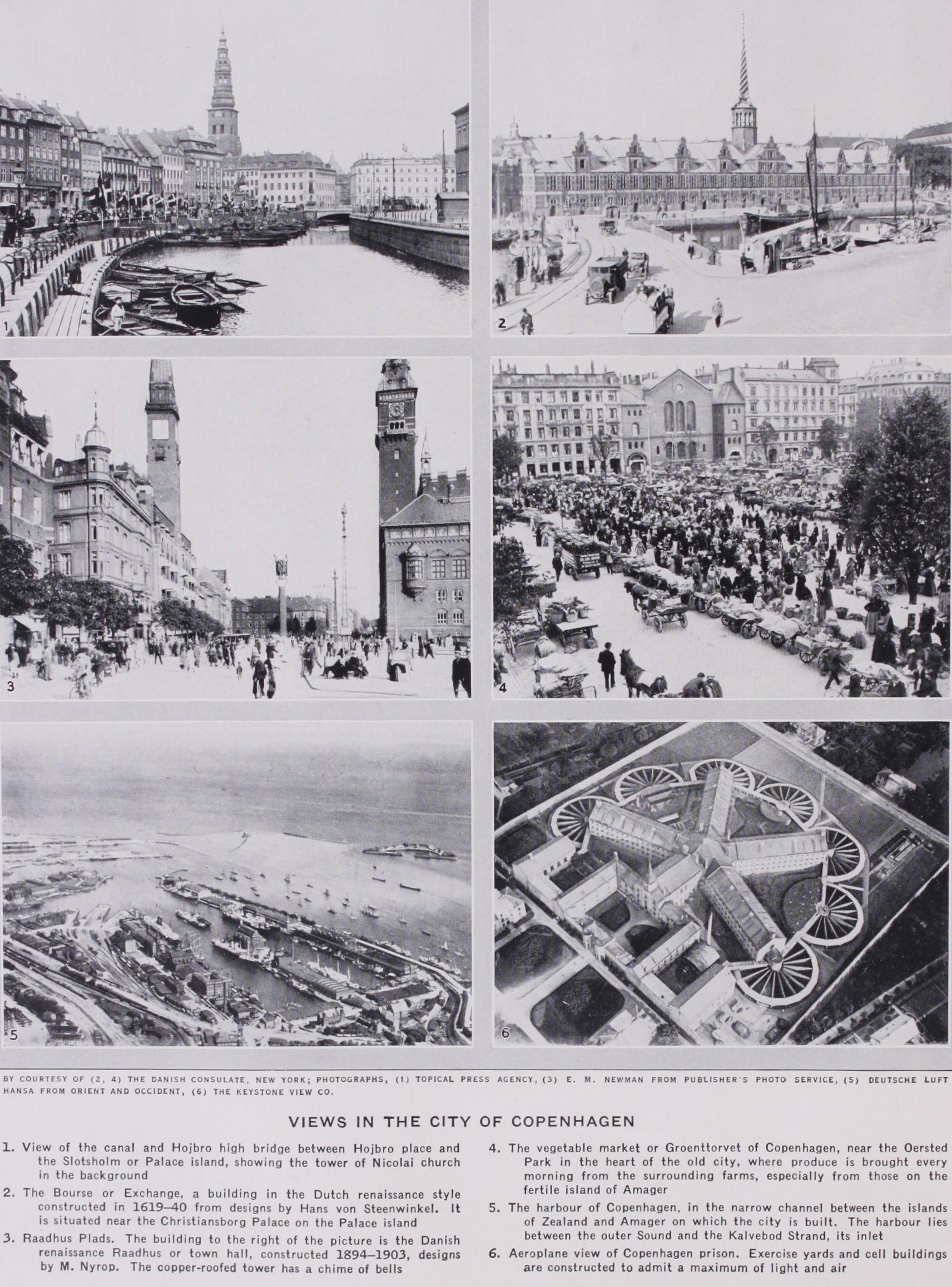
From 156o, with the new discoveries of silver in America, agriculture became increasingly a remunerative occupation, and, further, since 159o, the Dutch had been steadily buying corn in Denmark and the Baltic provinces for shipment via Amsterdam to southern Europe. Apart from two quite fruitless wars against Sweden (1563-7o, 1611-13), Denmark had enjoyed peace and was able to make full use of it. The landowners especially ac quired much matter, which many of them used for the creation of beautiful dwellings, and the names of Tycho Brahe, the astron omer, Holger Rosenkrans, the theologian, and Arild Hvitfeldt, the historian, show that in the intellectual world also Denmark played its part. The burghers too were acquiring capital and were thus enabled to compete with the Hanseatic towns—for instance in the trade with Iceland. The commercial navy grew, and Christian IV. was able to found new cities like Gliickstadt and Christian shavn, while enlarging and beautifying Copenhagen with new edifices, notably the Bourse, and new harbour-works and fortifi cations. Frederik II. (15 59-88) built Kronborg as a support for the collection of the Sound dues, which continued to bring in larger and larger revenues. Christian IV. (1588-1648) built in the Dutch renaissance style the beautiful castles of Frederiks borg and Rosenborg.
A period of misfortune began for Denmark when Christian IV., at the behest of England, intervened in the Thirty Years' War, first as Protestant leader against the emperor (1625-29), later, when he had had to cede this position to Gustavus Adolphus, as a mediator, until prevented by a Swedish attack in the years Both wars resulted in bitter defeats for Denmark. While the Danish islands were defended by the navy, Jutland was pillaged and laid waste by hostile armies, first by the imperial forces under Wallenstein, then by the Swedes under Thorstenson. Denmark had to purchase peace in 1645 by surrendering the is lands of Gottland and Oesel and the provinces of Norway, Her jedalen and Jemteland. In order to find the money to defray the wars, Christian had to increase greatly the Sound dues, but this evoked much ill-will on the part of the western Powers, and although the Dutch in 1645 obtained considerable reductions they came to feel strongly that it would be a good thing if Denmark did not possess both banks of the Sound. Over and above all this, the Thorstenson conflict brought the friendship of the duke of Holstein-Gottorp to the side of Sweden, and this developed into a definite alliance when Frederick III. (1648-70) rashly declared war on Sweden in 1657. This war, which is famous for the bold advance of the Swedish king, Charles X., over the ice from Jutland to the islands, ended in 1658 with the Peace of Ros kilde by which Denmark had to give up Skaane, Bornholm and Trondhjem and the duke of Gottorp was acknowledged as a reign ing prince in his part of Schleswig.
These wars were of special importance to the internal history of Denmark because they caused the Danish burghers' hatred of the nobles to break out anew more strongly than ever, without justification inasmuch as the Rigsraad had striven to the best of its ability to prevent the wars, but with justification inasmuch as the nobles had shown but little heroism and above all would not make, in common with the lower estates, the sacrifices required to remedy the poverty resulting from the wars. These differences were accentuated at the State assemblies which from 1638 on wards were now and again called together. All the proposals made, even those on behalf of the king, for the betterment of the condi tion of the country, were rejected by the Rigsraad, which was led by the high steward, Korfits Ulfeldt, the husband of Christian IV.'s daughter, Leonora Christina. As a condition of his accession the high steward compelled Frederick III. to sign a charter which considerably decreased the royal prerogative in nominating at his own pleasure lord lieutenants and members of the Rigsraad. With great shrewdness and firmness, Frederick III. began to work for a change in the constitution. He succeeded in overthrowing Korfits Ulfeldt, who had been found guilty of frauds ; and when Charles X., vexed at not having completely conquered Denmark, recommenced the war in 1658 and soon invested Copenhagen, the burghers of the city were stimulated into a heroic defence by the offer of great privileges : Copenhagen became a free Rigstad (Crown city) whose assent was necessary for the settling of State affairs and whose burghers were to enjoy the same privileges as the nobles. The Dutch, who did not relish the idea of both shores of the Sound being in the hands of the Swedes any more than in the hands of the Danes, despatched a fleet to the relief of Copenhagen and on Feb. 11, 16S9, the Swedish attack on the capital was repelled. Charles X.'s death was followed by the Peace of Copenhagen in 166o : Bornholm and Trondhjem, which in the meanwhile had freed themselves, were given back to Denmark, but in other respects the Treaty of Roskilde was confirmed be cause the Western Powers so willed it : the region of Skaane was for ever lost to Denmark.
The constitution which Frederick III. had promised was at last drafted by the king's Kabinetssekretdr (State secretary) Peder Schumacher. The king signed it on Nov. 14, 1665, but it was not made public until 1709. The king's law, as it was called, made the Danish sovereign absolute inasmuch as it imposed on him the sole duties of keeping the kingdom undivided and of maintaining the Christian religion in accordance with the Confession of Augs burg, while it further settled the succession on Frederick III.'s heirs both in the male and female lines. An absolute monarchy was, indeed, the necessary and only possible constitution for Denmark in 1660 if it was desired to deprive the nobles of their political power. For the burghers were clever enough to perceive that, however influential the nobles still were, a constitution would only have given them new power. The absolute monarchy meant that from now onwards every distinction of rank between the noble and de ufri staender (the unfree estates)—was done away with and from now onwards, as far as possible, all Danish citizens would be on a level under the absolute rule of the king.
The first task awaiting the monarchy was to bring about a new order in the kingdom. After the terrible misfortunes of the wars military affairs were completely separated from the civil administration. In the sphere of local government the country was divided anew into districts under superior magistrates who replaced the lord lieutenants. In the sphere of central govern ment there were established administrative boards (Kollegie ordningen) ; the two chanceries to which the name kancelli was applied and the office of the Exchequer were changed into ad ministrative boards and other boards were instituted to deal with war and the admiralty, while yet another special board was set up apart as the supreme court of law of the kingdom. The boards laid proposals before the king, who gave his decisions soon of ter the matter had been dealt with by a secret council the members of which, selected chiefly from among the heads of the boards, were nominated by the king. While the old Danish nobility held aloof on their country estates their places in the administration were taken by burghers.
A joint code of laws for the entire kingdom was issued under the name of Christian V. (167o-99) in 1683; serfdom was abol ished in i7o2 and for a brief period the Zealand peasant became free; trade and industry were protected in accordance with mer cantile principles; schools were opened in the provinces and thus a foundation was laid for a system of elementary education. But almost the most important reform of the whole period was the setting up in 1684 of a registration system throughout the king dom whereby the land was classified in accordance with its value with the intention of attaining a more equitable distribution of taxes. ,For it was soon found that the absolute monarchy needed heavy taxes to cover the great expenditure involved in maintain ing it, one item being the erection of a number of castles in North Zealand, another the great cost of the army and navy.
The absolute monarchy regarded it as an inherited responsibility to fight the traditional enemy Sweden and to reconquer Skaane. Hence the Skaane war of 1675-79 and the great Scandinavian wars of 17oo and 1709-2o, which entailed terrible sacrifices. Skaane was not regained, but it was as a result of victories over Charles XII. and his ally, the duke of Holstein-Gottorp, that Frederick IV. (1699-173o) in 1721 was able to take possession of the ducal part of Schleswig and include it in the monarchial. In Sept. 1721 there took place in Schleswig a great ceremony in connection with the taking of an oath of fealty "in accordance with the king's law." The outcome naturally was a bitter hatred against Denmark on the part of the ducal family of Gottorp, and this grew the more dangerous in that the dukes became in 1743 heirs to the crown both in Sweden and in Russia.
When the duke himself in 1761 became emperor of Russia as Peter III., a war seemed inevitable and Denmark had to arm on a great scale. But the tsar was murdered at the instigation of his wife, who succeeded him as Catherine II., and Denmark's foreign policy, which since 1775 had been controlled by Johann Hartvig Bernstorff, took on a new aim, namely, to induce the empress to exchange the Gottorp portion of Holstein for Oldenburg which Griffenfeldt had won in 1673 for Denmark. This aim was achieved in 1773 and the Danish king once again held possession of both the dukedoms, Schleswig as a Danish, and Holstein as a German fief.
In the middle of the i8th century, however, an economic ad vance became observable, when, under the leadership of France, colonial goods from the West Indies, and especially sugar, coffee and tobacco, began to find a European market. Denmark ac quired three West Indian islands, of which the most important was St. Thomas. The eastern Asiatic trade also began to flourish under the leadership of England. Danish trade expanded and the new Asiatic and West Indian companies both prospered. In 1736 a Danish bank of issue was founded which supported these ven tures and when the great colonial war broke out between France and England, the neutral trade of Denmark greatly benefited thereby. A. G. Moltke, the favourite of Frederick V. (1746-66), and a great landowner as the result of the king's generosity, was the first person to realize that this might also benefit Danish agri culture by opening up greater possibilities of production. But the landowners Government was thoroughly conservative and would not consider the economic freedom of the peasants. The land owners' rule was overthrown in 177o by Struensee, an accom plished physician and a man of great gifts, who secured power through his close relation with Caroline Matilda, sister of king George III. of Britain, who had been united in an unhappy mar riage with the degenerate and morbid Christian VII. 0766-1808). Struensee carried through a number of reforms, but Conservatism again revived under Hogh-Guldberg, who declared that the "yoke of the peasants could not be removed without Denmark shaking and quivering to its foundation." Agricultural reforms were imminent, however, and when the Crown Prince Frederick in 1784 had acquired power by a coup d'etat, he found a brilliant spokesman in a Danish landowner of old Danish stock, Christian Ditlev Reventlow, who had studied agriculture in England. Reventlow became the life and soul of a commission which brought about the liberation of the Danish peasant. The Stavnsbaand was ended on June 20, 1788 ; villeinage was stopped, compensation in money being given; the ancient agricultural associations were done away with, and the peasant was allotted his own plot of land. Many at once quitted the vil lages for the country. Transition to freehold ownership was the ultimate aim of this great land reform, which was carried through thoroughly and with excellent results in Denmark several years before any such reform had occurred to any other European nation.
The period was favourable also for Danish trade, for the Danish foreign minister, A. G. Bernstorff, succeeded like his uncle before him in keeping Denmark out of the wars. After his death in 1797 there came, it is true, a clash with England, for Denmark together with Russia and other neutral powers was attempting to safeguard trading vessels by convoys of men-of war. This displeased England, and Nelson was sent with a fleet to break up the alliance of the Northern Powers. There followed the sea-fight off Copenhagen on April 2, 1801. After a gallant resistance the Danish fleet was destroyed, the capital bombarded and Denmark had to undertake to cease sending convoys. The period which followed brought great benefits to Danish agricul ture and trade. Commerce had been facilitated by the toll law of 1797 which extended the principle of free trade. Wealthy busi nesses grew up in Copenhagen, and the bank of issue which had been founded in 1736 granted ever-increasing credit. After 1757 the bank was exempted from having to meet its notes with silver, and after it was taken over by the State in 1773 it had not only to emit as many notes as were required for the carrying on of business but also to meet in this respect the State's need of money.
In 1807 England called upon neutral Denmark to give up her considerable navy lest it should be used by Napoleon against England. Canning's demands had to be complied with, but not before an English fleet had laid large portions of Copenhagen in ruins. In anger over this, Frederick VI. (1808-39) from that time onwards attached himself politically to Napoleon. Seven burdensome war years followed, in the course of which relations between Denmark and Norway were completely broken off and Danish trade was gradually brought to a standstill. When at last victory fell to the coalition Denmark had to conclude a peace at Kiel in 1814 by which Norway was handed over to Sweden and Heligoland to England ; in exchange Denmark acquired Lauenburg.
The war had cost immense sums of money which, since neither taxes nor loans were available, the bank of issue had to meet by a limitless issue of notes. The consequence was a fall in their value to worthlessness; in 1813 the bank went bankrupt and a new National Bank was founded, which in 1818 became a private concern entirely independent of the State. Its notes first reached par in 1838 and in 1845 became payable on demand. The failure of the bank, the destruction of Danish trade and the fall of corn prices during the first ten years after the war left a period of poverty and stagnation during which, moreover, the land reforms came to a standstill.
The June Constitution.—This condition of things naturally called forth criticism of Frederick's absolute government and when he tried to keep down criticism by means of a censorship a Liberal Party came into existence which, in accordance with the growing Liberalism of other countries, set itself the task of substituting for the absolute Government a new constitutional Government representative of the people. Even Christian VIII. who as king of Norway in 1814 had co-operated in framing Norway's free constitution, did not seem disposed to perform the same service for Denmark. Immediately after his death on Jan. 20, 1848, came the revolution of February and the short-lived victory of Liberalism. In Copenhagen the move ment had its outcome in a public procession on March 21 to the new King Frederick VII. (1848-63), who was able to reply that he intended to renounce the absolute rule and that he had already taken steps towards forming a Government responsible to the representatives of the people. This was appointed next day with A. V. Moltke as premier; among the ministers were leading Na tional Liberals like Monrad, Tscherning and Lehmann. On Oct. 23 a national assembly met which, on the basis of a draft submitted by Monrad, prepared the constitution of the Danish kingdom of June 5, 1849. The legislature became a Rigsdag, with specified powers, consisting of a Landsting and a Folketing; the members of the former were to be elected for eight years by indirect vote and the latter for three years by direct vote.
The Schleswig-Holstein Question.—In the meantime even the question of the new constitution was thrown into the shade by the differences between Germans and Danes which was taking a more acute form. The Napoleonic wars had awakened the Ger man national feeling and the ardent desire to see the entire Ger man race united in one political entity. The political bonds which had existed between Schleswig and Holstein ever since 146o suggested that these two regions should form a single country which should be included in a united Germany. These efforts evoked a counter-movement among the Danish population in North Schleswig, and since 1838 in Denmark itself, where the Liberals especially had taken up the fight and after 1842 were insisting that Schleswig had belonged to Denmark for centuries and that the frontier between Germany and Denmark must in the future as in the past be the Eider. (See SCHLESWIG-HOL STEIN QUESTION.) This difference between Eiderdanism, as it.came to be called and Schleswig-Holsteinism led in March 1848 to an open Schleswig-Holstein revolution which was helped by the armed intervention of Prussia. The outcome of this was a three years' war (1848-5o) which finished in a victory for Denmark. Great Britain, France, Russia, Norway-Sweden in 185o recognized the integrity of the Danish monarchy and in the London Conven tion of 1852, together with Austria and Prussia recognized Prince Christian of Gliicksburg as heir to the whole monarchy after the death of the childless Frederick VII. In the agreement with Prus sia, 1851-52, however, the Danish Government was obliged to undertake that in the ultimate framing of the constitution of the monarchy Schleswig should not be brought into closer relation ship to Denmark than to Holstein. The impossibility of fulfilling this condition was soon to be seen.
In the Danish Rigsdag three parties had been formed: the Conservatives, comprising the landowners and all those who were against the free constitution, the National Liberal Burgher Party, which had carried through the June constitution, and the Left, including the Peasants and "Friends of the Peasants" (bonde vennerne), whose chief desire was for a continuation of the land reforms. The Conservatives were in favour of restricting the June constitution as much as possible, being ready to fulfil their promise to Prussia by creating a conservative joint constitution for the whole kingdom, with a joint Rigsraad in which the Holstein land owners should also be represented. Such a constitution came into existence in 1855 but the Holsteiners promptly refused to meet in a joint Rigsraad. After 18S7 the National Liberals returned to power with Carl Christian Hall (q.v.) as prime minister. He abolished the joint constitution for Holstein and on Nov. 18, 1863, prevailed upon the new king, Christian IX. (1863-1906) to sign a new joint constitution for Denmark and Schleswig which brought Schleswig into closer relationship to the kingdom than to Holstein. Bismarck was anxious for a popular war and desired the harbour of Kiel for Prussia; Austria agreed to join in and the two predominant Germanic Powers crushed down Denmark's heroic defence at Dybbol (Duppel) in 1864. By the Treaty of Vienna the three dukedoms were surrendered and also Danish North Schleswig; in 1866 after the Austro-Prussian War they became part of Prussia. Napoleon III. in the Treaty of Prague procured the insertion of an article (Art. V.) to the effect that North Schleswig should be reunited with Denmark when the majority of the population by a free vote should so desire; but it was in vain, for in 1878 Prussia and Austria agreed to the cancellation of the article.
The July Constitution.—The National Liberal Eider-Danish policy had brought about Denmark's defeat. The Conservatives took office and carried through in co-operation with the Peasants, who disliked the National Liberals, the new constitution of July 28, 1866, which was considerably more conservative than that of June : the general suffrage was indeed retained in the case of the Folketing, but in the composition of the Landsting the landowners and the most highly-taxed people were given an altogether over whelming influence. This resulted in the two chambers entering into a state of permanent opposition to each other. In 1872 the Left severed their alliance with the Conservatives, who soon com bined with the National Liberals to form a Right. This Right leaned on the Landsting and maintained the king's privilege of selecting his ministers without regard to the general voting.
Economic Progress.—The period following 1848 was a period of great economic progress for Denmark as for the whole of Europe. The continual rise of prices down to 1873 had made possible a resumption of the land reforms which the "Friends of the Peasants" and the Left desired, and which were sup ported also by the National Liberal Government in the case of Monrad's Law of 1861 changing the leasehold tenancies into freehold land. By 1873 76% of the farms were freehold, which in 1905 had risen to 94%. The increasing exports of corn from America and Russia between 1873 and 1895 again brought Danish agriculture to a precarious state, but it bore up through this crisis and saved itself by making changes in its production. In stead of corn it produced butter and pork, and by its to-operative dairies and co-operative slaughterhouses made these goods standard commodities in the English market. Later there came co-operative export associations. When better times arrived these associations had a progressively good effect on Danish trade; the function of Danish commerce now came to be the exportation of the coun try's agricultural produce.
Estrup's policy had made Esbjerg an important centre for the English export trade. Tietgen founded the United Steamship Co. (whose Esbjerg-Harwich line took over the export to England) and the great Northern Telegraph Co., which acquired its great est importance through its relations with China and Japan. New banks were founded, including the Landmandsbank (Agricultur ists' Bank) in 1871 and the Handelsbank (Trade Bank) in 1873. The towns grew; in the course of the '7os Frederick III.'s old ramparts round Copenhagen were pulled down and new quarters arose on their site. A wage-earning class came into existence who were soon identified with the Social Democrats, which party in 1884 sent two representatives to the lower chamber. A labour conflict in 1899 led to the establishment of a court of arbitration for the settlement of labour disputes. The constitution of June had already acknowledged the full and unfettered right of asso ciation and this has never since been challenged in Denmark. During the period of development even the Government of the Right felt that its duties and responsibilities were not merely poli tical but also social. In 1891 there was introduced an Old Age Pension Law, in 1892 an Health Insurance law, in 1899 an im portant law for the establishment of small farms with State help. Meanwhile the loss of Danish Northern Schleswig was a sore which the Prussian policy in that region made only more painful. Danish historians taught the Danish people to understand that the juridical question which the National Liberal party had wished to enforce was wrong, and that Denmark should no longer wish to recover Schleswig except those parts which declared themselves Danish and in a referendum would return under the principle of self-determination.
In 1910 the Left opened an agitation for a democratic amend ment of the constitution. The Right, which was strong in the Landsting opposed, and no solution had been reached when the elections were held in May 1913. The Radicals and Socialists now held 63 seats out of the 114 in the Folketing, and united to force the reform under a new Zahle cabinet containing Eric Scavenius (Foreign Affairs) Brandes, Rode and Munch. The Right an swered by obstruction in the Landsting which the Government then dissolved. The new Landsting contained 38 supporters and 28 opponents of the constitutional amendment.
After the first anxiety caused by the war had been allayed the constitutional problem was again taken up. The oppo sition of the Right having weakened, on June 5, 1915, the king signed the new constitution. This introduced full equal suffrage in the elections for both Houses, men and women being entitled to vote under identical conditions ; the privileged suffrage of the land lords and the wealthier classes came to an end ; the voting age was fixed at 35 years for the Landsting and was lowered succes sively from 3o to 25 years for the Folketing. Of the members of the Folketing, 93 were elected in individual districts, 27 in greater Copenhagen according to proportional representation, while 23 supplementary seats were divided among the parties that had received too few representatives at the other polls in proportion to their number of votes. Of the members of the Landsting 54 were indirectly and proportionally elected in large districts, while 18 were elected by the retiring Landsting according to the same principles. In the case of a constitutional amendment a refer endum must take place, and 45% of the eligible voters must vote to give it validity. The constitution came into force on April 2I, 1918.
Other important legislative enactments of the first years of the war, which the Zahle Government succeeded in passing without opposition, were the Reform of the Administration of Justice (April II, 1916), which separated the administrative and judicial systems and introduced oral proceedings and publicity, with trial by jury in criminal and political cases, and the Accident Insur ance law (July 6, 1916), which made it the duty of all employers to insure their employees. The privileged suffrage in respect of the elections to the arntsraad (county councils) was abolished with the consent of all parties.
In the late summer of 1916 a bitter opposition arose on the Government's announcement that it had concluded a treaty with the United States ceding the Danish West Indies to that country for $ 2 5,000,000. Finally the cabinet was supplemented by repre sentatives of each political party and a plebiscite taken on the sale. At the polls (Dec. 14, 1916) 283,67o votes were cast in favour and 15 8,15 7 against, and shortly afterwards the Rigsdag ratified the cession. A similar but less far-reaching contest arose over the rearrangement of the relation of Iceland to Denmark. Iceland demanded political independence and integrity. Despite the oppo sition of the Conservatives, the support of the other three parties sufficed to pass an Act of Union (Nov. 1918) in which Denmark acknowledged the independence of Iceland. The king remains joint ruler of both countries, and Denmark has charge of Iceland's foreign relations. The Act of Union is valid till 1940.
From 1917 onwards the submarine warfare on the one hand. combined with the stricter measures of the blockade on the other, caused increasing difficulties in the economic life of Denmark. The Government sought to mitigate the effects of the increase in prices by an extensive policy of control and relief, especially as regards the now fast increasing number of unemployed. At the elections for the Folketing in the spring of 1918 when women voted for the first time (68% voted to the men's 84%) , 72 sup porters of the Government were elected, 39 Socialists and 33 Radicals, and 68 opponents. The Landsting was constituted as follows: 17 Conservatives, 26 Left, 13 Radicals and 15 Socialists.
The Allied victory affected Denmark chiefly through the pros pects of a reunion with the Danish part of Schleswig, where plebiscites were held in the spring of 1920 (see SCHLESWIG). Cer tain circles fostered a forlorn hope of preventing the final union of Central Schleswig with Germany by a so-called "internationali zation" of Zone 2, which, however, was not considered in the Versailles Treaty. Political opposition combined with this nation alist agitation, and when the Government refused to order new elections in view of the necessity for a new electoral law, the king dismissed it. A cabinet of non-politicians formed by Liebe, March 30, 1920, took the responsibility for the king's action, which was regarded by the supporters of the dismissed cabinet as unconstitutional and raised the threat of a general strike from the Socialists. During this "Easter crisis" Denmark looked as if it were on the verge of a revolution. The mediation of the city council of Copenhagen and others conciliated the Crown and the Socialists, and on April 5 a new ministry, consist ing chiefly of State officials, was appointed to formulate an elec toral law and to order new elections. The new law was based on proportional representation in the county districts (amtskredse), and the supplementary seats system was retained in a slightly altered form.
As a result of the Folketing elections held on April 26, 1920, Niels Neergaard formed a new Left Cabi net on May 5. In the fresh elections called forth by the incorporation of North Schles wig (Dan. Nord Slesvig) in Denmark, the number of members of the Folketing had been increased to 149 and of the Landsting to 76. The elections were held on Sept. 21, 1920, the voting age being 25 years for the first time. The results were 412, 00o votes for the Left (52 seats), 390,000 Socialists (48), 217,00o Conservatives (27), 147,00o Radicals (18), 27,000 "Erh vervsparti" (trades party) (3) and 7,000 for the German candidates (I) . The Neergaard ministry continued to direct the policy of the country, supported by the majority which its own party, the Left, composed of Danish farmers, formed in conjunction with the Conservatives, the citizen class of the market towns, against an opposition consisting of Social Democrats, Labour and the Radicals, the smallholders of the agricultural districts and some portion of the Liberals in the towns.
Denmark joined the League of Nations at an early date (March 8, 1920). In 1920 also negotiations were entered into with Soviet Russia, and, after a temporary interruption, led to a commercial agreement (April 23, 1923) which was approved by the Rigsdag on June 8. The extension of the Danish monopoly in Greenland in 1921 to embrace the whole of that country led to some objections on the part of Norway, based on existing Norwegian interest in the East Greenland waters. After diplo matic discussions, an agreement between the two States was signed on July 9, 1924, whereby Norwegian subjects and Nor wegian companies were guaranteed certain rights in East Green land for a period of 20 years, though the question of Danish Sovereignty was left undecided.
In Denmark, as elsewhere, it was the general economical de velopment after the war, and its effect on home affairs, which presented the greatest difficulties. It was not the purpose of the Government to renounce the social obligations assumed by the State and substitute retrogressive for progressive principles.
In 1922, however, the economic crisis reappeared in a more violent form and the rapid depreciation of the currency became the leading political question. The Government, however, took no measures to stop depreciation, considering that it must be a matter for the Danish National Bank to raise the value of the krone by suitable deflation with reasonable restriction of the note issue and of credit.
(E. AP.)