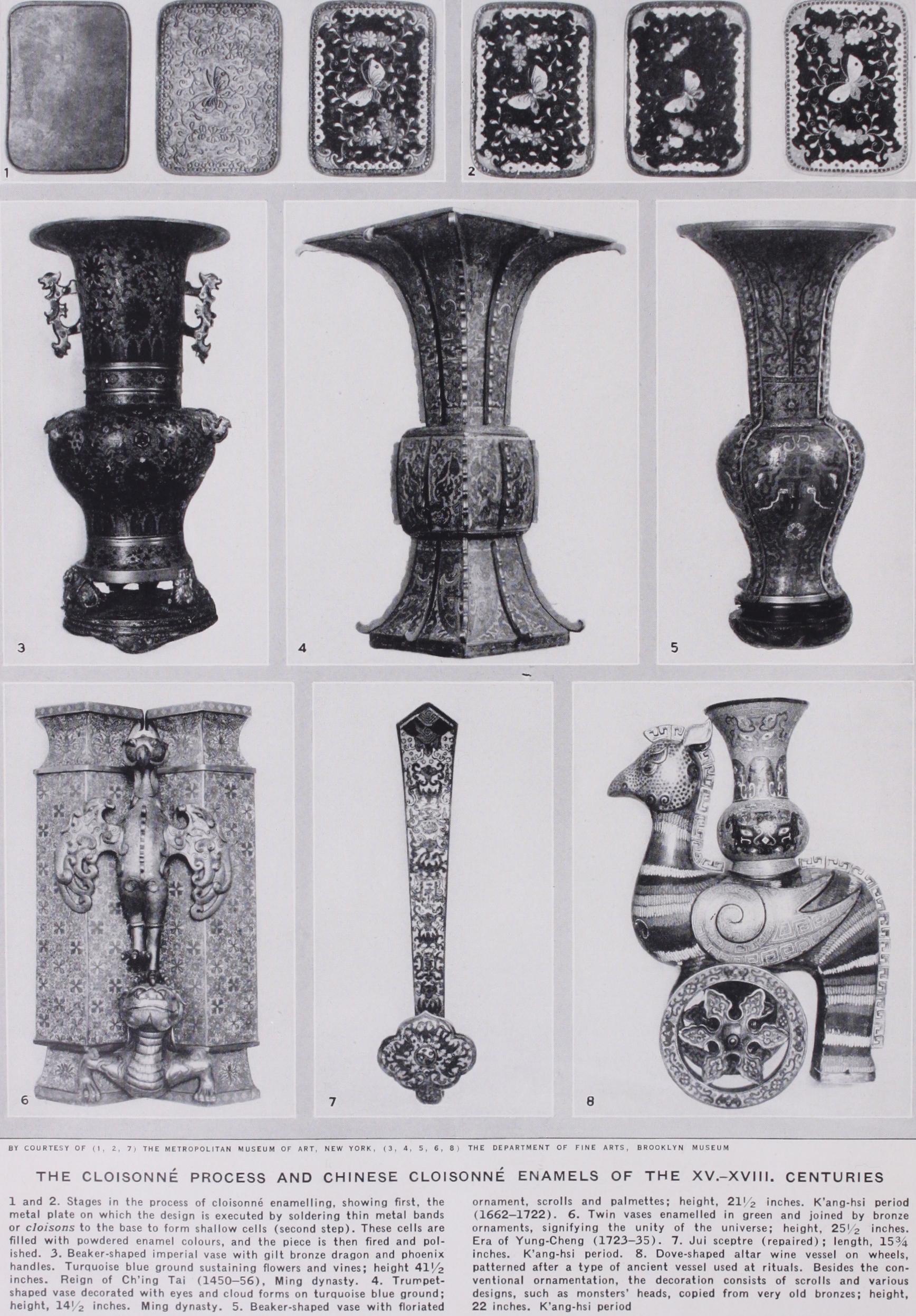
CHINESE AND JAPANESE ENAMELS Enamels do not appear to have reached China until long after they were to be found throughout Europe. The Chinese make no claim to their invention; but, on the contrary the native term, "Fu-lin ware" (hence Fa-lan), directly suggests an origin in the eastern Roman provinces, that name having been applied to the Byzantine empire by Chinese historians as early as the 7th cen tury. The derivation of the word has been the subject of contro versy and is uncertain ; but all authorities are agreed as to the western origin of the art ; which was, in all probability, introduced into China by Arab traders, or by travelling craftsmen working their way eastwards as opportunity arose of plying their craf t profitably. Glass, which in China was also of alien origin, was imported from the Roman empire certainly as early as the 3rd century A.D. ; but it was not until the reign of T'ai Wu (424-452) of the northern Wei dynasty that craftsmen from an Indo Scythian kingdom on the north-west border of India came to the Wei capital in Shansi and succeeded in making excellent opaque glass of various colours from local minerals.
Although the Chinese were thus informed as to the production of an essential material for the making of enamels and were already most highly skilled in the working of bronzes and other metals, it is remarkable that there appears to have been no de velopment of the art of enamelling at least until the 13th century, when the Mongolian conquests introduced into the Far East so many arts hitherto unknown. A record exists, in the Ko ku yao lun, a book on antiquities published in 1387, of the production on a large and varied scale of enamelled ware which "resembles the cloisonné work of Fo-lang." This is herein termed also Kuei kuo yao, ware of the devils' country. It also states that natives of Yunnan have established factories for this ware in Peking and that the enamels made at the provincial capital, Yunnan-fu, are "fine, lustrous and beautifully finished." It appears therefore that the Ta sliih yao or Arabian (so-called) enamel ware was well established in China at this period ; and that Byzantine work of similar character was also so well known as to invite comparison with the native product and that, as pointed out by M. Paleologue, "the workmanship (of the Chinese enamels) presents occasionally, in fact, striking resemblances with certain enamels of the Byzan tine School : the mixture of different enamels inside the wall of the same cell, the employment of gold encrustations in the treat ment of the figures and hands, etc." From the technical point of view, Chinese enamels fall into three categories—cloisonné, champleve and painted. In none does the technique vary appreciably from that employed in western countries.
The earliest examples of cloisonné enamel that can be authen tically associated with the Far East, are mirrors in the Shoso in ("lonely building"), at Nara in Japan. The backs of these have cloisonné work, somewhat crude in character. There is no doubt that these and other objects in the collection were deposited in the Shoso in in the year 756 by Komyo-Kogo, widow of the Em peror Shomo-Tenno (724-749), with other treasures collected during his life. We have here, therefore, authentic examples of the art that must date back at least to the T'ang dynasty, and may, as is certainly the case with some other objects in the collection, be of Chinese workmanship. It is generally agreed that they are nei ther Japanese nor Byzantine. So far as is known at present, the sequence of Chinese enamels with which we are acquainted begins, however, only in the Yuan period ; and the earliest recorded marks belong to the reign of the last emperor of that dynasty 1367). The great period of the production is certainly that of the Ming dynasty which followed and existed until The mark most commonly found within this epoch is that of the Ching T'ai reign (1450-1456) ; so Dr. Bushell suggests that there must have been a great revival of the art at this time, as even in his day, the term Ching T'ai Lan was "commonly used in Peking as a general synonym for cloisonné enamels." He points out the significance of the fact that this reign covers the time of the last siege and capture of Constantinople by the Turks ) when some of the craftsmen then dispersed may have even pene trated to China. However this may be, the Ming enamels, bold in design, with fine depth and purity of colour, were never surpassed in later epochs. The two shades of blue, a dark lapis-lazuli tone and a pale sky-blue with a very slight tinge of green, are par ticularly excellent. The red is of dark coral tint and the yellow full-bodied and pure. Greens derived from copper are sparingly used and Dr. Bushell states that rouges d'or (reds made of gold) do not come into the colour scheme at all. The black and white are the least successful ; the former shallow and dull, the latter clouded and muddy. At the same time, an imperfection of tech nique is noted, a close examination revealing minute pitting in the enamels, due to inadequate packing of the material, and some want of polish in the surface. These technical defects, however, do not appreciably detract from the artistic value of the Ming enamels and, indeed, serve as a clue to their identification.
To the patronage of the Emperor K'ang Hsi (1662-1722) was due a great revival of art industries. In 168o he established a whole series of imperial factories for this purpose, of which that devoted to the manufacture of enamels was No. 6 on the official list. Here he had made sets of incense vessels of cloisonné enamel for presentation to the numerous Buddhist temples in the neigh bourhood of Peking, founded under his auspices and other objects for the honorific gifts which were characteristic of his enlightened reign. The enamels of his time were marked by an improvement in technical quality as compared with those of the Ming period, while the finer qualities of the latter are still, to a considerable extent, in evidence. In many cases the forms of ancient bronze vessels were revived for these purposes, with the addition of enrichments in enamel. The style of this reign persisted during that of K'ang Hsi's successor, Yung Cheng (1723-1735) ; while the long period on the throne occupied by Ch'ien Lung (1736 was marked, as in the case of many other industrial arts, by a further perfection of technique, but with the loss of much of the vigour of design and breadth of execution that distinguished the products of earlier periods. Modern enamels, chiefly imitations of older work, are more hurriedly made and not so well finished.
The quality of the gilding especially is far below that of the older productions.
Translucent (as opposed to opaque) enamels were occasionally made by Chinese artisans. Important pieces are rare, but some times of fine quality, a deep blue, obtained from a native cobalti perous ore of manganese, and a pale turquoise blue from copper being especially successful. This method more often appears in conjunction with gold and silver in Chinese jewellery; in which, also, imitations, in enamel, of real gems are frequently employed.
Modern Japanese artists have modified the cloisonné process with remarkable ingenuity and have produced work of great inter est, in which the cloisons are sometimes completely veiled, the resultant effect being that of enamelled porcelain with realistic designs of flowers, etc., and a wide and almost unrestricted range of colour. Namikawa of Tokyo has been one of the most success ful of these. A Kyoto artist of the same name has worked with credit in true cloisonné. J. Ando of Nagoya has obtained novel effects by the use of translucent enamel on a silver basis. These developments have carried the art of enamel very far from the old traditions, but, while the skill and ingenuity of technique they evince may be appreciated, it cannot be said that in decorative value they compare with the older Chinese tradition. During the i9th century, the Japanese produced many imitations of the latter; which, for a time gave rise to quite a false appreciation of their place in the history of the art.