
EDWARD IV. (1442-1483), king of England, son of Rich ard, duke of York, by Cicely Neville, was born at Rouen on April 28, 1442. As a boy he was styled earl of March, and spent most of his time at Ludlow. After the Yorkist failure at Ludlow field in October 1459, Edward fled with the earls of Salisbury and War wick, his uncle and cousin, to Calais. Thence in the following July he accompanied them in their invasion of England, to be welcomed in London, and to share in the victory over the Lan castrians at Northampton. After the acceptance of Richard of York as heir to the crown, Edward returned to the Welsh marches, where early in the new year he heard of his father's defeat and death at Wakefield. Hastily gathering an army he defeated the earls of Pembroke and Wiltshire at Mortimer's Cross on Feb. 2, 1461, and then marched on London. He was acclaimed by the citizens in an assembly at Clerkenwell, declared king by a Yorkist council, and took possession of the regality on March 4. Soon after the new king and the earl of Warwick went north, and on March 28, won a decisive victory at Towton.
Edward owed his throne to his kinsmen the Nevilles, and he was content for the time to be guided by them. For himself he was young and fond of pleasure. Still he made frequent progresses, and took some part in the fighting that went on in the north dur ing 1462 and 1463, but he was absent from the final victory at Hexham on May 15, 1464, being engaged in contracting a secret marriage with Elizabeth, daughter of Richard Woodville, Lord Rivers, and widow of Sir John Grey of Groby (d. 1461) . The mar riage was disclosed at Michaelmas, much to the vexation of War wick who, in pursuit of his foreign policy, had projected a match with a French princess. Edward heaped favours on his new rela tives; his father-in-law was made treasurer, and great marriages were found for his wife's sisters and brothers. In foreign affairs also Edward thwarted Warwick's plans by favouring an alliance with Burgundy rather than France. There was, however, no open breach till 1469, when Warwick, taking advantage of the unpopu larity of the Woodvilles, and supported by the king's next brother George, duke of Clarence, appeared in arms. Edward was surprised and made prisoner at Middleham, and Rivers was beheaded. For six months Edward had to submit to Warwick's tutelage ; then on the occasion of a rising in Lincolnshire he gathered an army of his own. Sir Robert Welles, the leader of this rebellion, made a con fession implicating Warwick, who fled with Clarence to France. The king thought himself secure, but when Warwick and Clarence made terms with the Lancastrian exiles, Edward in his turn had to seek refuge in Holland (September 147o). His brother-in-law, Charles of Burgundy, at first refused him any assistance, but at last furnished him with money, and on March 14, 1471 Edward and his brother Richard landed with a small force at Ravenspur near Hull. Marching south he was welcomed at London on April I I, defeated Warwick at Barnet three days later, and the Lancas trians at Tewkesbury on May 4. From thenceforth Edward's pos session of the crown was secure. His position was strengthened by the birth of a son (Nov. 2, 147o, during his exile), and by the wealth which he acquired through the confiscation of the estates of his opponents. Clarence had made his peace with Edward, but was at enmity with his other brother Richard of Gloucester, who now married Warwick's second daughter and claimed a share in the Neville inheritance. Their rivalry and Clarence's continued in trigues furnished Edward with his chief domestic difficulty ; the trouble was ended by the judicial murder of Clarence in 1478.
The only serious enterprise of these latter years was the short French war of 1475, from which Edward was bought out by the treaty of Pecquigny. As foreign policy it was inglorious, and in volved a departure from Edward's earlier plan of a Burgundian alliance. However, it shows a certain recognition of England's need to concentrate her energies on her own development. The annual subsidy which Louis XI. agreed to pay further served Ed ward's purposes by providing him with money for home govern ment, and enabled him to avoid possible trouble through the neces sity for too frequent parliaments and heavy taxation. So Edward's personal rule became in its character autocratic ; but it was in the art of courting popularity and concealing despotism that he most shows himself as a type of tyranny. He lacked neither ambition nor capacity, but was indolent and only exerted himself spasmodi cally. He could be ruthless, but was not habitually cruel. His strongest weapons were the fine presence, the affable manners (even with citizens), and the love of pleasure and entertainments which secured his personal popularity. In his last years he was given to self-indulgence and scandalous excesses, which did not, however, alienate the London citizens, with whose wives he was too familiar. Most of thy power at court was in the hands of the Woodvilles, in spite of their unpopularity ; the more arduous work of administration in the north was left to Richard of Gloucester. If as a prince of the Renaissance Edward was the first to rule tyrannically in England, he also deserves credit as a patron of the new culture and friend of Caxton ; he further resembles his Italian contemporaries in the commercial purposes to which he applied his wealth in partnership with London merchants.
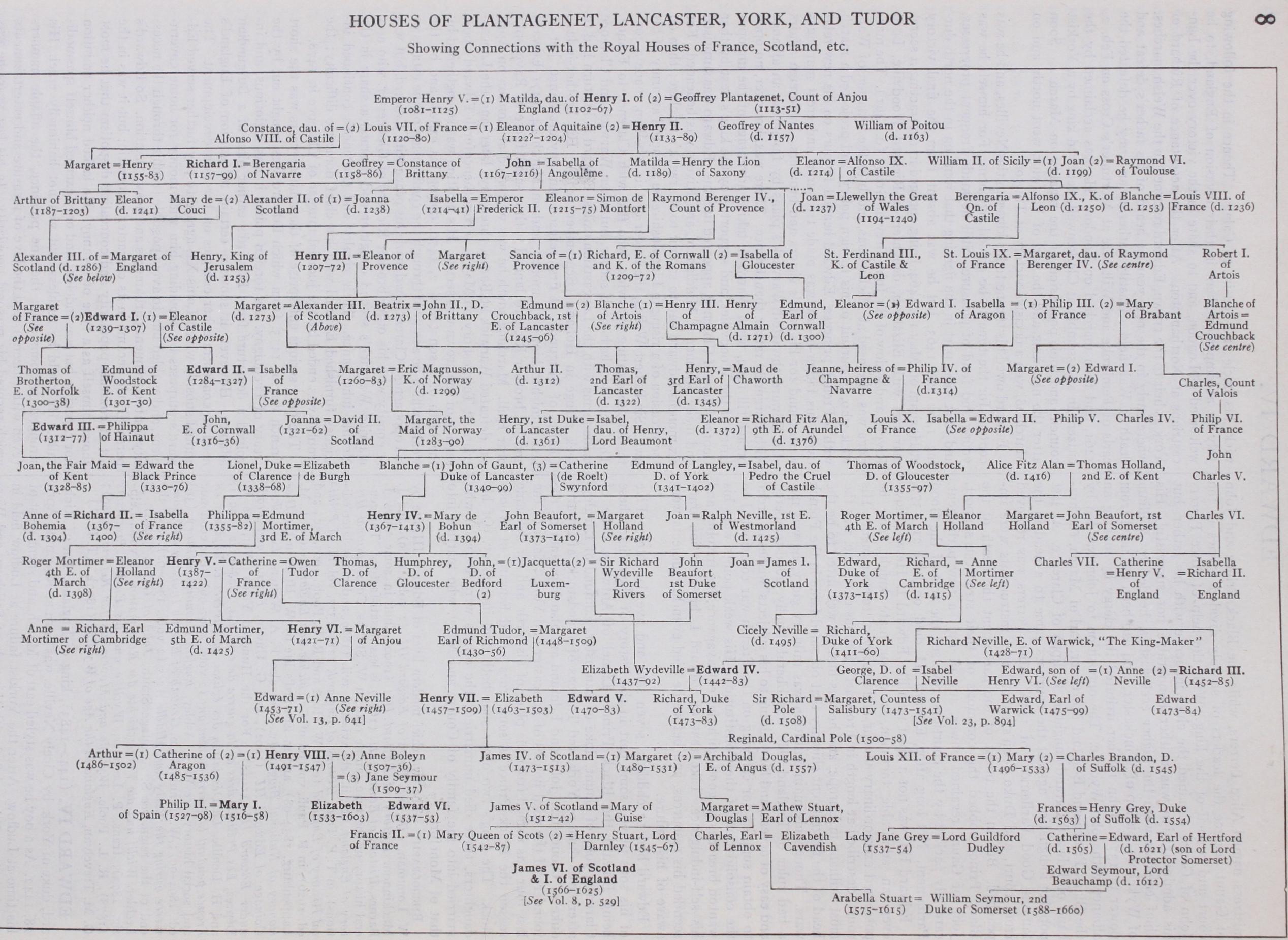
Edward died at Westminster on April 9, 1483, and was buried at Windsor. By Elizabeth Woodville, who died on June 8, 1492, he had two sons, Edward V. and Richard of York, who were mur dered in the Tower; and five daughters, of whom the eldest, Eliza beth, married Henry VII. Of his numerous mistresses the most notorious was Jane Shore. Before his marriage he had been con tracted to Lady Eleanor Butler, and this was alleged by Richard III. to have made his children by Elizabeth Woodville illegitimate. Iii. to have made his children by Elizabeth Woodville illegitimate. BIBLIOGRAPHY.-Of original authorities for Edward's reign the chief are the Continuation of the Croyland Chronicle in Fulman's Scriptores; the various London Chronicles, especially for the early years Gregory's Chronicle; Warkworth's Chronicle, and the Arrivall of King Edward IV. (a partisan account of events in 1470-71) , published by the Cam den Society ; the Paston Letters with Dr. Gairdner's valuable "Intro duction" ; and for foreign affairs the Memoires of Philippe de Comines; the collection called Chronicles of the White Rose is useful. For modern authors, see Sir James Ramsay, Lancaster and York (1892) ; the Politi cal History of England, vol. iv. (1906), by C. Oman; Laws, Statutes etc. Statute Rolls of Parliament of Ireland, ed. H. F. Berry (1914) ; and C. L. Scofield, Life and Reign of Edward the Fourth, 2 vol. . (C. L. K.)