
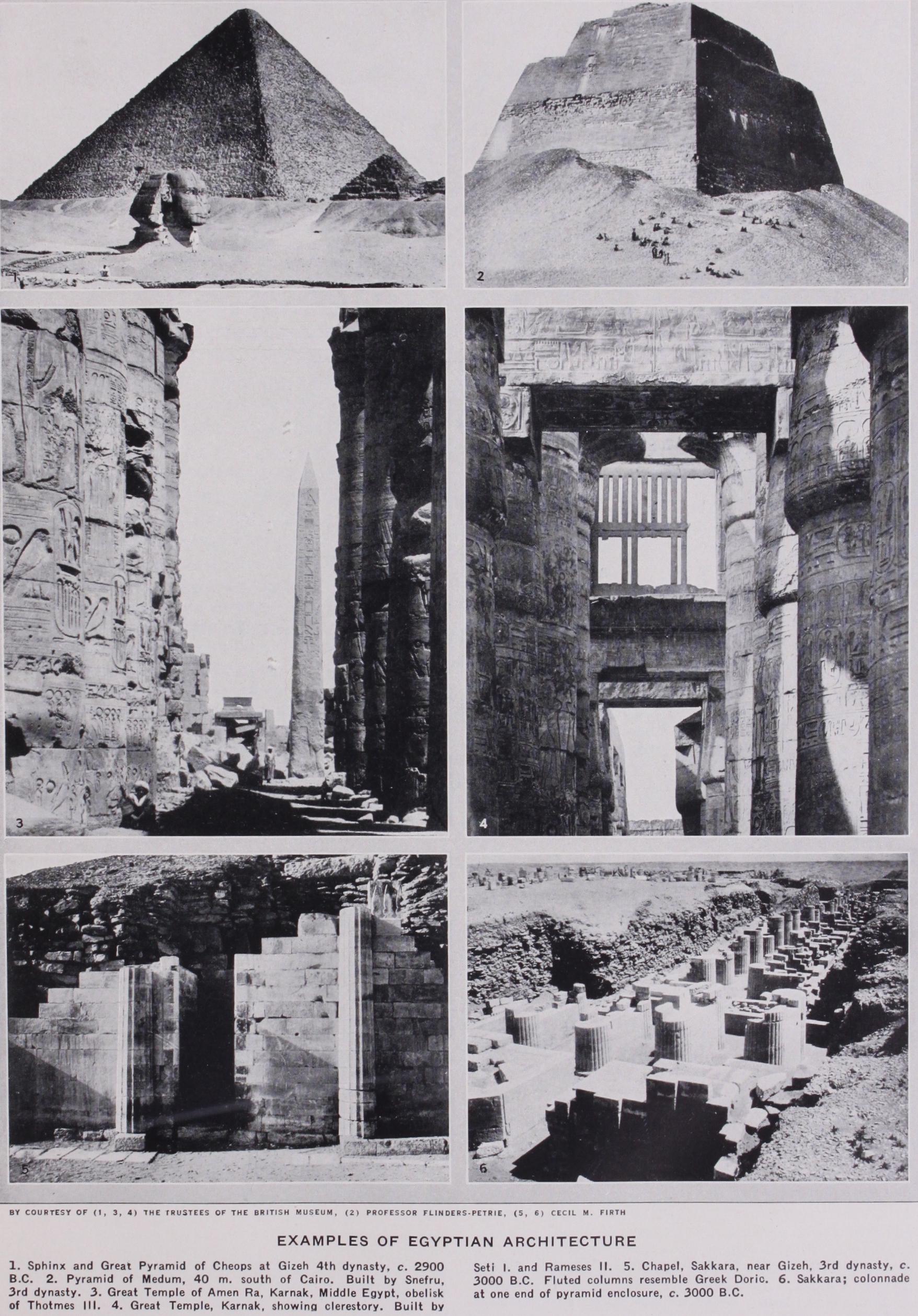
EGYPTIAN ARCHITECTURE. The architecture of an cient Egypt is a primary contribution to world architecture. Its methods of construction were so essentially simple and its ma terial for monumental work so imperishable, that its survival is unique. The modern designer has much to learn from the severity and grandeur of its masses, its treatments of broad planes and the sculpturesque qualities of its highest manifestations. Some of its monumental work was rock-cut, but most of it was built with enormous masses of stone or granite, set with the utmost nicety and care and worked to the finest possible surface. Egyp tian architecture was perfectly suited to its natural environment —the sandy desert adjacent to the Nile. It was of the simplest possible form : the arch or vault was not used, except with crude brick, in subsidiary positions and constructed in a manner that produced the minimum of risk. It is clear, however, that the principle of the true arch was understood. There is no other instance in the world's history of a prevailing type of structure persisting, comparatively unchanged, for such a long period of time. Emerging, probably from the East, over 3,00o years be fore our era, its principal forms have stamped themselves in delibly on the consciousness of mankind. Even the dominance of Rome failed to make any permanent impression; and it was only when Rome ceased to exploit a province that had no po litical significance that these forms became extinct.
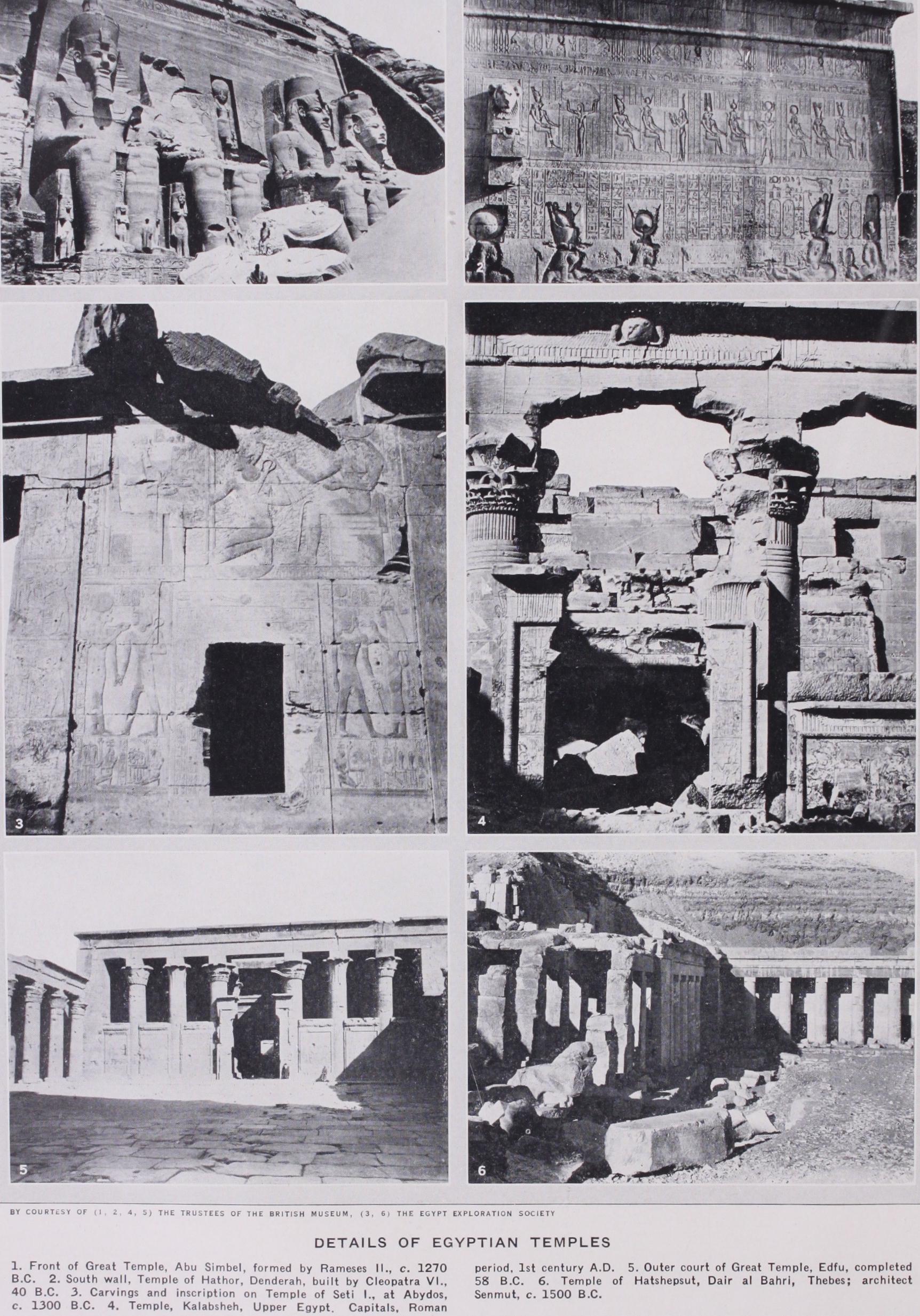
The great temple at Edfu—which, though of "Ptolemaic" or Graeco-Roman times, contains all the unchanging elements of Egyptian architectural form—is very well preserved. The dignity of unbroken wall surface built to a slight slope and of immense mass in association with pylons in almost perfect preservation, can be seen there to perfection. The effect of the whole is rendered much more impressive by the all-over decoration of incised figures arranged in tiers. Taken as a whole, perhaps the most impressive building in Egypt at the present day is the i9th dynasty temple of Seti I. at Abydos, which is of peculiar plan, as its arrangement was dependent on nine shrines placed in a row, one of them dedicated to Seti himself. It is in a remarkable state of preservation and an adequate idea can be formed of the value of rooms of great size containing their ceilings, doorways and decorative treatments, almost intact. No building illustrates more clearly what Egyptian architectural form really meant in these comparatively simple elements of expression. It is a lesson in the use of form and in the richness that can be obtained by an all over method of decorating with delicate relief and colour con trolled by simple lines. These facts should give it peculiar value to modern designers and decorators. The Ptolemaic temple of Hathor at Denderah, though coarse in detail, is also a valuable example because of its completeness. This building practically exists now as it was built, so that the effect of a stone flat-roofed structure can be realized both externally and internally.
Columns, Pillars, Obelisks and Domestic Work.—Columns and pillars have an important function in all early styles and Egyptian architecture is no exception. The character of the Egyptian column was distinctive and peculiar in most of its many forms, persisting for some 3,00o years. It usually suggests natural growth, as a grouped collection of budding or flowering stalks, bound together at the base and near the top of the shaft; and it is decorated to enforce this suggestion. Circular columns discovered recently at Sakkara, by Firth, show a remarkable approximation to pure Greek Doric ones of the fifth century B.C. ; and as the Egyptian ones are ascribed to the third dynasty and must have been executed about 300o B.C., they are of great significance in the history of art. The pillar is essentially a square and not a round support. Plain square pillars can be seen in the "granite temple" at Ghizeh but many-sided ones, cut out of square, are more usual. This principle is sometimes carried so far that the effect of circular columns is obtained, as in the tomb at Beni Hassan, already cited. Some pillars at the temple of Seti I., Abydos, have shallow flutings, with a plain inscribed strip on each of the four cardinal faces. Egyptian pillars are more suggestive of Indian forms than of the Aegean or Greek ones. They often have fine sculpturesque quality and could be used appropriately in the concrete constructions of to-day.
The obelisk is an Egyptian form of commemorative pillar which survived into Renaissance and modern times. It is akin to the inscribed pillars of the Sumerians in Chaldea and had, prob ably, some special religious significance. It is peculiarly suited to its surroundings as used in Egypt and has great monumental value in certain positions. The earliest examples date from the II th dynasty. Senmut used obelisks in the temple at Deir el Bahari.
Domestic buildings have, of course, completely but we know from painted representations that some of them were treated with great delicacy and fine decorative quality, sug gestive of a kind of pole and curtain construction. There is a slight but graceful cornice of the prevailing type and, obviously, a flat roof. This form of structure may well have influenced Pompeian decoration.
is customary to regard Egyptian building as destitute of any but the simplest mouldings; what is known as the "gorge"—or overhanging hollow moulding—with a plain roll member beneath it which was also carried down the external angles of the walls and doorways, being accepted as practically the only mouldings used. It is true that these, based on natural forms, were universal and were used for every kind of cornice and crowning member. Nevertheless, there is a considerable feeling of moulded form in many of the columns. Apart from mouldings the ornamental form of many of the spreading capitals is most pronounced and constitutes a definite emphasis which amounts, in places, to richness. Of other architectural enrichment there is really only one form but it is a most effective one—the winged solar disc, which was used over doorways and pylons in the hollow of the cornice.
Surface Decoration.—If pronounced sculpture in the round was of considerable architectonic value, it was overshadowed in that respect by the relief sculpture and incised work which were the prevailing forms of wall decoration in all periods. To decorate walls with any completeness, there must be subject material and, like other races of the early world, the Egyptians were at no loss in this respect. With a thoroughness which has never been ex celled, they carved on their wall surfaces the intricate systems connected with their worship of the dead as well as the ceremonies and observances of their life on earth. At its best, it is neither sculpture nor painted decoration, but both of these combined. Nowhere is it seen to greater advantage than, as at Abydos, in the smooth limestone which was capable of taking the most delicate relief. In the dry climate of Egypt, parts of the painted finish seem as fresh to-day as when they were executed. The method is one of incision as well as relief in which the grades of sharpness in definition were treated with amazing skill. Even in granite this system prevailed, combined with the simpler incised work of symbols and hieroglyphics, the schematic material being grouped by means of incised lines and delicate bands. The decoration travels round doorways and enhances their value by a skillful arrangement of shallow panels emphasizing posts and lintels. Nothing could be more complete and, in its way, more successful. The Hindu decorated by serried ranks of figures in relief ; the Assyrian by delicate reliefs in fine stone or alabaster; the Greek by a restrained scheme of friezes ; but nothing at once so compre hensive and so architectonic as the finest Egyptian decoration has ever been produced. It is an all-over principle which even includes columns without interfering with their sense of structural stability.
At a certain brief period in Egyptian art—that of the ill-fated Akhenaton (Ikhnaton, q.v.) of the i8th dynasty—an extraordi nary development in painted plaster decoration occurred, which was contemporary with and doubtless influenced by somewhat similar work in late Minoan Crete. The floors of Akhenaton's palace at Tel-el-Amarna were covered with this plaster, for the most part representing Nilotic plants and birds arranged in large panels with an astonishing richness and variety of detail. See EGYPT, ART AND ARCHAEOLOGY.