
EUROPEAN ELECTRICAL SCHEMES Great Britain.—The British public service of electricity sup ply has been carried out by local authorities and by power companies, the former accounting for about 64.5% of the total production by public undertakings. A number of tramway, rail way, water-power and aluminium undertakings, not to be directly classified with public utilities, produce an additional 18 per cent. In 1927 the number of supply undertakings with distributing rights were 623, possessing 491 generating stations with a total output. in 1927-28, of 8,55o,000,00o units. To these should be added railway, tramway and non-statutory undertakings possessing 79 stations with a production of 1,450,000,00o units, so that the real national total in that year was I o,000,000,000 units.
Acting on the report of a special committee, presided over by Lord Weir, dealing with the power situation, the Government de 'See Lord Kelvin, Reprint of Papers on Electrostatics and Magnet ism (1872) ; "Electrophoric Apparatus and Illustrations of Voltaic Theory," p. 319 ; "On Electric Machines Founded on Induction and Convection," p. 33o; "The Reciprocal Electrophorus," p. 337.
cided to introduce legislation reinforcing the acts of 1919 and 1922 and establishing a central electricity board which would have a constitution similar to that of an industrial company outside of direct Parliamentary control. The functions of the central board, as constituted in the Electricity (Supply) Act of 1926, were to develop a national super-power system, erect main transmission lines to cover the whole country, to finance standardization of frequency so that one standard of transmission and distribution could be adopted—namely, that of So cycles—to take over the out put of all the stations selected to supply the country under the new scheme, and to sell it to authorized distributors at cost price.
It was estimated that, by 194o-41, the national production of electricity would be 25,000,000,00o units, supplied by 6o stations with a total installed capacity of about i i,000,000 kw. The average working cost of electricity, when such concentration had been effected, would fall from .94d. as recorded in 1925-26 to less than .4d. per unit, while the large industrial consumer would be able to obtain his power requirements at 2d. per unit, and the national average for all supplies would lie in the vicinity of id.
The central electricity board worked on a triple programme : (a) The creation of giant power stations located in the main indus trial areas under the control of public supply undertakings.
(b) The construction of a main transmission system operating at a pressure of 132,00o volts, so that the entire country would be held in a power ring or series of power rings radiating out from the giant power stations. To this system would be attached also smaller secondary lines tapping agricultural and other outlying areas.
(c) Standardization of frequency in the areas where so cycles were not used for generation and distribution—namely, on the North-East Coast, in the west of Scotland and in the area covered by Birmingham corporation and the Shropshire, Worcestershire and' Staffordshire Elec tric Company in the Midlands.
All three developments were estimated to reach a first point of completion in 1934-35, when the main transmission system would have been constructed, and the greater part of the con version to a standard frequency effected in the west of Scotland and the Midlands.
The zones surveyed and under construction in 1927 were South East England, which included London and the surrounding area, with a population, according to the census of 1921, of 11,400,000; Central England, covering the five shires of Leicester, Northamp ton, Stafford, Warwick and Worcester, with a population of 5,218,000 ; Lancashire and North Wales; Yorkshire ; Northumber land and Durham; Lincolnshire; South-West England and South Wales ; North-West England; Central Scotland and probably Northern Scotland.
By April 1928, three main power zones had been surveyed and definite schemes of development drawn up for them—the three being South-East England, Central England and Central Scotland. These three areas, with a combined population of 21,000,000 and an estimated output for 1941 of 11, 760,000,000 units produced in power stations with a total capacity of 4,668,00o kw., represented three of the most important industrial and economic areas in Great Britain, responsible for the maintenance of 48 per cent. of the entire population. The fourth great scheme, devoted to South-East Lancashire, was due to be published in June 1928, and the remain ing zones were to be surveyed and designed before the end of 1929, so that the actual work of constructing the main transmis sion system and of bringing the whole national production of electricity into a scientific scheme would be definitely initiated by 1930.
Under full development—i.e., by 194o-41—it was estimated that main transmission and standardization of frequency would account for an expenditure of between £30 and £35 millions, all to be incurred by the central board, which would raise the capital required for this purpose in the open market with a Treasury guarantee, while the supply undertakings owning the selected sta tions and furnishing the central board with their entire output would probably expend on generation alone about f i 20 millions. The elaboration of distribution systems connecting the con sumer to the main transmission zones would account for an additional Imo millions, so that the average annual expenditure on electricity supply alone would not be far short of £250 millions.
progress of electricity supply in Germany has been similar to that of Great Britain. Much the same problems had to be overcome and the legislative measures destined to ad vance reorganization were based on the same principles in Ger many as in Britain.
In Britain the national production of electricity has been spread over a number of undertakings, few of them large enough to take advantage of modern technical and administrative experience; in Germany, small undertakings have been even more firmly established. Thus, inclusive of industry, the total number of power stations in 1925 was 7,492 and of this number 6,930 were responsible for an output of 3,313,000,000 units, and 562 for 17,015,000,000 units. Thus 85 per cent. of the national production was concentrated in 562 power stations.
The most spectacular developments were associated with the large corporations, and through their activities a number of super power zones were determined by 1927 in Germany. Thus, in Central Germany, the Elektrowerke A.G. (State-owned) developed a main transmission system from its three super-power stations at Zschornewitz, Lauta and Trattendorf, operating at 1io,000 volts. This system covered the whole of the brown-coal area of Central Germany, fed into Berlin and extended into Lower Silesia with connections to Breslau. In Saxony proper it linked up with the system elaborated by the Sachsische-Werke (owned by the State of Saxony), which owned two main generating stations at Hirsch felde and Bohlen with a smaller plant at Chemnitz. This under taking supplied Dresden and fed into Leipzig as well as Lower Silesia. To the south-west, at Herlasgriin, it was connected to the 110,000 volt system constructed by the Bayernwerk, which, ob taining its electricity from the water-power plant owned by the iValchensee-Werk A.G. at Walchensee and the Mittlere-Isar A.G. on the Isar, was supplying electricity north to Nuremberg and Bamburg, and, at Hochst, came into the super-power zone con trolled by the Rheinisch-W est f alisches E.W. From Nuremberg to Regensburg a main transmission line had been constructed to bring the Kachlet water-power plant into the Bavarian scheme. Through Kachlet the southern German zone was connected with the Austrian system. Further south, through Stuttgart, it came again, at Karlsruhe, into touch with the super-power zone owned by the Badenwerk, and in this way was able to tap the giant brown-coal stations of the Ruhr and the water-power stations of the Black Forest and the Alps.
The fourth great zone had been elaborated by the Rheinisch W est f alisches E.W., operating from its giant station at Knapsack, interconnected with smaller stations at Reisholz, Essen and the Fortuna station of a different company which supplied Cologne. This undertaking constructed main transmission lines at 110,00o volts as far north as the Dutch border, and was connected with Dutch undertakings. To the south it constructed a 220,000 volt line from Knapsack to Coblenz and Mannheim, with a further projection through Stuttgart to the Swiss Alps. Its main line would ultimately operate at 380,00o volts and connect the Swiss water-power resources with the Ruhr and with Holland. A fifth smaller zone was served by the Badenwerk, with a system extend ing from Ludwigshafen to Homberg in the west, Karlsruhe, Villin gen and Laufenburg in the south.
Secondary transmission lines operating at 33,00o to 8o,000 volts radiated out from these main systems to cover wide areas in the south and in the centre of Germany. The result was that, under full development, five series of great power rings may operate in Germany: one extending from the Ruhr north to Emmerich and north-east to Bremen and Emden; a second from the Ruhr to Nienberg and thence north-east to Hanover, Herschel, Borken, Frankfurt, Hochst, returning to the Ruhr; a third cover ing the whole of southern Germany with its northern limits at Frankfurt, its south-western at Laufenburg, its south-eastern at Walchensee, its eastern at Kachlet and the eastern frontier, and its north-eastern at Herlasgrun. The fourth power ring was com posed of the two systems operated by the Elektrowerke A.G. and the Sachsische-Werke, covering Saxony and feeding into Berlin; while the fifth ring covered Lower Silesia. Under full development, one great ring will surround the whole of Germany between the Ruhr, Berlin, Silesia, Saxony, Bavaria, Wurttemberg and Baden.
This had been very largely the work of the mixed supply corporation, where the model of the private industrial company had been adopted, with a majority public control in administration and finance, and these undertakings were due to become more and more important in the production of electricity. Thus, in 1927, the Elektrowerke accounted for an output of 1,678,000,000 units, the Rheindsch-Westfalisches E.lF. for 1,450,000,000 units, the Sach sische-IVerke for 538,000,000 units, the Bayernwerk for 450,000, 00o units, the Badenwerk for 280,000,000 units, while the Berliner Elektrizitatswerke, which was linked up with the system of the Elektrowerke, produced over 700,000,000 units, and the Ham burgisclie Elektrizitatswerke, 320,000,000 units. These seven undertakings accounted for a total of almost 5,500,000,000 units, the greater part of which was derived from brown-coal and water power stations.
France.—The main principles at issue in France, as in Britain and Germany, were :- I. The construction of efficient super-power stations interconnected to create power pools; 2. The exploitation of water-power sites with a view to effecting the maximum economy in fuel, with interconnection of the steam generat ing stations with these water-power stations to permit of the exchange of energy ; 3. The elaboration of a high-pressure transmission system which would link up the main power zones, permit of railway electrification on the largest possible scale, and transform the whole country ulti mately into one great power system.
Five power zones could be distinguished in 1927: i. The coal-mining and textile areas of the Nord and Pas-de-Calais 2. Paris 3. The Meurthe et Moselle 4. The Massif Central 5. The Pyrenees.
The reconstruction of the devastated territories made it possible to equip French coal-mines with the most modern machinery and to carry out a complete scheme of electrification. Thus the Nord and Pas-de-Calais became one of the most highly electrified coal-mining areas in the world, already supplied by a number of highly efficient stations located at the pit-heads, using waste fuel and waste heat, and interconnected to effect the fullest pos sible exchange of energy. The main stations located in this area were Comines, Pont-a-Vendin, Beuvry, Bully, Harnes, Seguedin, Wasquehal, Lomme, Valenciennes and Sin-le-Noble. The total productive capacity of the area was in excess of 1,200,000,000 units, and the main connecting lines operated at 45,000 volts. Through Maubeuge, Hirson and Mezieres, this zone was linkeci up with the Meurthe et Moselle, while an elaborate system operat ing at the same voltage brought it, through the power station at Beaugarde and the transforming stations at Laon and Soissons, to the outskirts of the Paris zone, so that interconnection with the latter can be effected easily when necessary.
In Paris, the situation had become so simplified through re organization that four undertakings supplied power for the entire zone. They were, in order of importance :—Union d'Electricite, with super-power stations at Gennevilliers (340,000 kw.), Vitry (90,000 kw.) and Vitry-Sud (ioo,000 kw.) under construction; the Coinpagnie Parisienne de Distribution d'Electricite at Issy les-Moulineaux (130,00o kw.) and Saint-Ouen (400,000 kw.) ; the Societe d'Electricite, with the Saint-Denis station (120,000 kw.) ; and the Societe d'Electricite de la Seine at Ivry (under construc tion, 1928). All these stations, with the exception of Saint-Denis, were interconnected by underground cables operating at 6o,000 volts, while from Gennevilliers overhead transmission lines at 6o,000 volts branched out to Creil. Paris was encircled by a high pressure power ring capable of developing 1,000,000 kw., while an additional 200,000 kw. projected in 1927 would bring the total plant capacity of the zone to 1,200,000 kw. by the end of 1929. The total productive capacity of the area, under full development, would be in excess of 4,000,000,000 units.
In 1928 the Paris power scheme could be regarded as almost fully developed, but in the Meurthe et Moselle area important plans were under consideration in 1927 which would render it almost as important as Paris. The consumption of electricity in the area was, in 1924-25, 600,000,000 units, while it might be estimated at 1,400,000,000 units in equivalent to a generat ing plant capacity in the latter year of 520,000 kw.
A second significant move could be seen in the authorization granted in 1927 to the Societe des Forces Motrices du Haut Ruin to build a water-power station at Kembs. This meant that one of the biggest water-power schemes in Europe would be begun within a short time. The exploitation of the Rhine, according to the scheme, should mean the construction of eight generating plants along the river from Kembs to Strasbourg, with a total final capacity of 581,500 kw.
In the massif central and in the Pyrenees, water-power provided the main source of energy. From the new super-power station at Chancy-Pougny on the Rhone, a main transmission line operat ing at ioo,000 volts went north-west via Le Creusot to Dijon, while large stations were projected at Bellegarde, Maty, Bailey, Bregnier, Le Sault Brenaz and Villette d'Anthon, all the stations being ultimately interconnected, and feeding into Lyons, which was already supplied from one water-power plant and three steam power stations. From Lyons, one main transmission line operat ing at i oo,000 volts went to Villefranche in the north, Albertville and Moutiers in the east, with a second main transmission line finishing at the Viclaire water-power station on the Italian frontier. Further south, new schemes were under consideration, covering Salembert, Tournon, Valence, Montelimar, Villeneuve-les Avignon. With the completion of these schemes, the Rhone area would be come one of the most important in France.
The supply undertakings in the Pyrenees area were grouped together in a central association, with an annual output of more than 600,000,000 units. One main transmission line at ioo,000 volts ran from Toulouse to Lannemezan as far as Pau, and sup plied power to the important electrified railway of the Midi corn pany, linking up at that point with the main transmission system running between Laruns, Dax and Bordeaux. Under full develop ment, the massif central and the Pyrenees should be intercon nected through Albi, Le Truel and Monistrol, while main con nections would run north to Strasbourg, or link up with Swiss companies and would join the elaborate system already in exist ence in the Meurthe et Moselle and Alsace-Lorraine areas. In the centre the construction of the main transmission line from Paris to the large water-power plant at Eguzon and thence to Cham pagnac and Le Truel should complete the system of interconnec tion, and transform the country into one scientifically developed power zone. In 1927, the consumption of electricity in France was in excess of 11,000,000,00o units, about 45 per cent. of which was supplied from water-power stations.
Ita?y.—Even more spectacular developments in electricity supply than in France took place in Italy after 1919. While, ac cording to the official returns of the minister of finance in Italy, the consumption of electricity rose from 2,553,000,000 units in 1914-15 to 3,696,000,00o units in 1919-20—an increase of 45 per cent. in five years—it rose from 4,021,000,000 units in 192o 21 to 7,363,000,000 units in 1925-26--an increase in the second five years of 83 per cent.
The capacity of water-power plant installed at the end of 1927 in undertakings accounting for 90 per cent. of the national pro duction was 2,116,932 kw., and of steam-power plant 555,269 kw. —a total of 2,672,200 kw. If we assume that the capacity of generating plant corresponded closely to the state of produc tion, Italy had, at the end of 3,300,00o kw. of generating plant installed. The important areas which lay north of a line drawn from east to west through Rome represented one of the most highly developed power zones in the world.
In northern Italy, the Edison group of companies, with an annual production of slightly more than 2,000,000,000 units, had been the great co-ordinating force. Allied with it were three main groups, one connected with the Societa Idroelettrica Piemonte, the Adamello Group, and the Adriatic Group which was active in Venetia and supplied electricity as far south as Bologna. In the areas supplied by the Edison group, main transmission lines operating at i i o,000 volts ran from the Swiss frontier at Campodolcino, north of Lake Como, to Piacenza, Parma and Bologna. The second system branched out from the complicated group of water-power plants installed north of Piedimulera, with connections into Switzerland, to Novara, ending at Arquata north of Genoa, with a branch stretching between Gozzano and Bru gherio outside of Milan, to link up with the system already mentioned.
In the Adamello area, one main transmission line of Iro,000 volts ran from the north of Edolo to Gorlago, thence to Parma ending at San Polo d'Enza. In the Trentino a main transmission line of the same voltage went from Milan down the valley of the Adige also to San Polo d'Enza, while in the Adriatic area Bel luno in the valley of the Piave was connected to Porto Maggiore and Bologna. Those were the main transmission lines in Northern Italy, but secondary systems operating at lower voltages radiated out to connect the main centres of consumption with the generat ing stations and transmission systems. Thus the entire region provided a perfect example of a power pool developed on scientific lines.
In central Italy, developments had been less notable, since no considerable industrial area existed. In southern Italy proper, the development of large power schemes on the Sila necessitated main transmission between the main water-power plants and Taranto and Bari, with a secondary line running from that point to Benevento, Naples, with connections leading into Rome, Ascoli, and ultimately Ancona.
The entire country had been accurately surveyed with the result that electricity could be transmitted, if necessary, from the Alps as far south as the toe of Italy, and interchange take place readily between central Italy and the Alpine companies.
A further development lay in the erection of lines of 220,000 volts to supplement those already in existence, while energy was imported in increasing bulk from Switzerland. In Dec. 1927, for example, 16,000,000 units were imported from that country. On the Ligurian frontier interconnection had been effected with the French system operated by the Energie Electrique du Littoral Mediterraneen, while the development of power schemes on the Brenner would allow it to exchange energy with Austria.
The large public supply company had been established in cer tain areas, often with high pressure transmission lines. The Nor dostschweizerische Kraftwerke A.G., with an annual output of 550,000,000 units, owned an elaborate main transmission system with its centre in Winterthur. From Winterthur main transmis sion lines operating at 45,000 volts went up to Schaffhausen and thence into Germany, while, to the south-east, it reached Lontsch power station and linked up at Siebnen with the main high pressure system operated by the municipality of Zurich. From Beznau to the west of Winterthur, it constructed a line at 132,000 volts leading to Basle and thence into France.
These four companies and the Swiss federal railways were responsible for the greater part of the main transmission system extending over northern and central Switzerland and the Rhone valley, while, in the south, two companies, the Officine Elettriche Ticinesi and the Kraftwerke Brusio (with an annual production in excess of 250,000,000 units), brought the Swiss Alpine power system into touch with the Italian at Lugano and Campocologno. Further schemes, associated with the Kraftwerke Laufenburg (350,000,000 units) and the E. W. Rybourg-Schworstadt (55o, 000,000 units) were being developed in 1927.
Holland.—The development of a large super-power scheme for the Netherlands was rendered difficult through purely natural conditions ; the country did not lend itself easily to the erection of long-distance transmission lines, and developments were con fined to the areas of densest population. In 1927 the output of electricity for the whole territory could be estimated at 1,roo,000, 00o units, with a total capital expenditure of less than £30,000,000. Central Holland had already, in 1927, a main transmission system operating at 5o,000 volts, more than 120 miles in length, with ex tensions in the vicinity of Amsterdam, Nijmegen, Arnhem, and the State coal-mines in Limburg. All these areas were due to be interlinked by overhead transmission lines of 50,000 volts and, ultimately, of ioo,000 volts. Outside of this main transmission system, the country was parcelled out into areas corresponding to the provinces, with transmission networks of ro,000 volts.
Other European Countries.—In Sweden, as in Germany, the State itself played an important part in the administration of electricity supply. Out of a 1927 output of 4,350,000,000 units, State-owned power stations accounted for 1,400,000,00o units or slightly less than one-third. Six large water-power stations, interconnected by lines operating at r ro,000 volts, at Trollhattam. Aelkvarleby, Motala, Porjus, Lill Edet and Noufours, in addition to a steam generating station at Vasteras, accounted for this total. The State system was connected at certain points with those ad ministered by private companies and municipalities, but the initia tive in creating the super-power zone lay with the former. The public supply of electricity proper represented rather less than half of the total annual output, while the electrochemical, electro metallurgical, paper and cellulose industries accounted for the greater part of the demand. The private companies operating in these industries generally possessed water-power stations inter connected for exchange of energy and for the development of a power reserve which would be available in the event of interrup tion in supply.
In other countries, notably Poland, Rumania, Hungary and Greece, electrical development had been held up, owing purely to political and financial factors, but, in 1927, strong power finance groups, using British, American or Belgian capital, were con structing large power stations and main transmission lines in all four countries. It was estimated at that time that, within ten years, super-power schemes would be in operation similar in character and efficiency to those in other European countries.
(H. Q.) Russia.—The Government of the U.S.S.R. has given much at tention on the development of the electrical industry. The figure of output in 1913 (in the territory of the present Soviet repub lics) was 1,945 million kw. and in the financial year 4,100 million kw. The National (or Central) Electrification Scheme includes (a) large district stations, (b) small local stations (often attached to factories) for which grants-in-aid have been given to the local authorities by the Central Authorities who retain control. The programme of the State Electrification Commission falls into three parts:— Part I. Arrangements for the maximum utilization of existing stations.
Part II. Plans for the erection within 10-15 years of 3o district stations of total output capacity of 1, Soo,000 kw.
Part III. Supplies to areas requiring only small ad hoc stations.
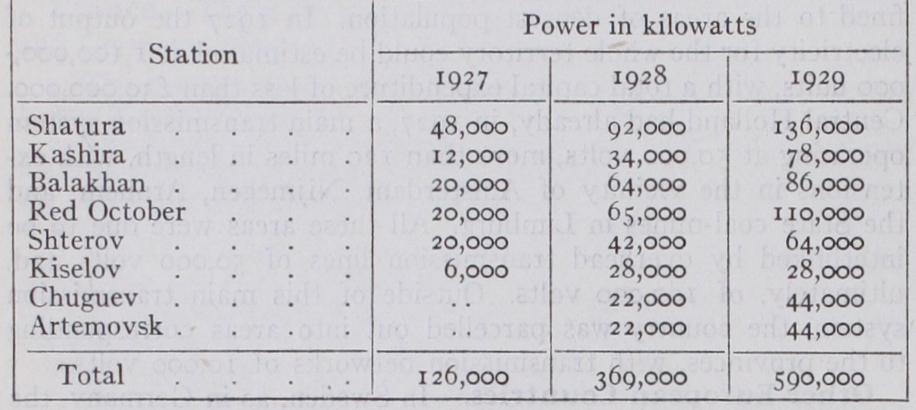
In 1926 the construction of the following district stations with coal as fuel was begun : Chuguev (near Kharkov), 44,00o kw.
Shakhtinsk (S.E. Donetz basin) using anthracite dust. Kiev 22,000 kw. and Saratov ii,000 kw.
The progress aimed at by the State Planning Commission can be judged by the following table of district stations: In 1927 the construction of a third group of II stations was initiated: Five hydro-electric stations:— Dnieper works: 1o5,000 kw. to be extended to full capacity, 220,000 kw.
Svirsk, 8o,000 kw.
Of the remaining six stations of this series, three using peat for fuel, have been started at Ivanovo-Voznesensk, 44,00o kw., Bryansk, 2 2,000 kw. ; and Osinovsk in the White Russian Re public, 2 2,000 kw. A further station has been erected at Chelya binsk in the Urals, 44,00o kw. burning brown coal, and two others are in process of construction at Novorossisk, 2 2,000 kw., and Krasnodar II,000 kw., both to use oil fuel. Additionally, stations at Moscow, Leningrad and Baku are being extended.
The capacity of district stations was by the end of 1927 increased to 500,00o kw., as compared with 1916 figures of 00o kw. In fact the plans of the State Electrification Commis sion are being fulfilled to the extent of 9 2 % and the total pro gramme, it is estimated, will be completed within the specified ten years.
The output of the electrical industry of Russia before the war amounted to about 65 to 68 million roubles; in 1926-27 it was 142 million roubles, and in 1927-28 it is estimated to reach the figure of zoo million roubles. With the centralization of supply, the cost of production has been reduced, the cost of electric cur rent in 1927 being 17% lower than pre-war. (X.) In Canada electrical power development has taken the form of the utilization of large water-power resources. The main trans mission systems are to be found in Quebec and Ontario, where three undertakings, the Hydro-Electric Power Commission of Ontario, the Shawinigan Water and Power company, and the Montreal Light, Heat and Power company, have been instrumental in developing super-power zones. The total production of elec tricity in Canada in 1927 amounted to 12,093,OoO,0oo units from plant with a total installed capacity of 2,820,00o h.p.
The Hydro-Electric Power Commission of Ontario, with a total capacity of generating plant amounting to almost 800,000 kw., had a total output, including purchased energy, of 4,134,000,00o units.
The Shawinigan Water and Power company, with a total installed capacity of 41 1,35o kw., had a corresponding output of 3,021, 000,000 units; and the Montreal Light, Heat and Power company, with a total plant capacity of 2 20 ,000 kw., accounted for 000,000 units. In addition, the Dominion Power and Transmis sion company, with a total output in 1927 of 2 S4,000,000 units, has been active in Ontario. The total capacity of all water-power plant in the Province of Ontario alone was in excess of 1,200,000 kw. at the end of 1927.
The super-power zone served by the Hydro-Electric Commission of Ontario stretches from the outskirts of Montreal to Detroit, with extensions north to Port Elgin and Huntsville. The core of the system is to be found in the area lying between Toronto and Detroit; main transmission lines operating at i io,000 volts go north from Niagara Falls to Toronto, round the shores of Lake Ontario, branch off towards Guelph, go due west to London, St. Thomas and Detroit, where they link up with the system operated by the Detroit Edison company. At Niagara Falls there is inter connection with the system operated by the Buffalo, Niagara and Eastern Power group of companies, so that Lake Ontario is sur rounded north and south by a ring of power lines.
Further east, in the province of Quebec, the Shawinigan Water and Power company has constructed ioo,000 volts transmission lines to link up the power-houses on the St. Lawrence river with the main centre of demand in Montreal. From the Shawinigan falls, lines operating at from 5o,000 to 6o,obo volts go north to Quebec and St. Joachim, where they link up with the system of the Laurentian Power company. From the same falls lines operat ing at similar voltages go due south to Sherbrooke, and form a power system touching on the American Frontier.
The Montreal Light, Heat and Power company owns the system linking up almost completely the two main systems operating in Quebec and Ontario, so that the eastern part of Canada now constitutes one of the most powerful super-power zones in the world.
Further west, similar self-contained areas have been created round Winnipeg by the City of Winnipeg and the Winnipeg Elec tric company working in co-operation. These two undertakings between them produced in 1927 over 86o,000,000 units. Further west still, in British Columbia, a number of undertakings, chief among them the West Kootenay Power company and the British Columbia Electric Railway company with an aggregate output of 708,000,00o units, have also mapped out large high-pressure transmission zones. (H. Q.) In the United States, the development of regional schemes for the service of electricity supply has proceeded with great rapidity until, at the present time, electric current is available in all com munities throughout the more densely inhabited portions of the country. The evolution of this service has taken place along lines which have largely been dictated by the economies made possible by the progressive improvements in the technical aspects of the art of the production and distribution of electric energy, as well as by further economies inherent in the organization of business enterprise upon a very large scale.
During the early years immediately following the successful demonstration by Thomas A. Edison and others of the practi cability of the generation of electricity and of its delivery to con sumers, electric service was confined to small portions of the larger cities. Because it could not be transported to any material dis tance, electricity had to be produced in the immediate neighbour hood of its consumption. This resulted in the erection of a large number of small, isolated power-houses, conducted by enterprises essentially local in character and usually independent of each other. These earlier years marked an era of competition between struggling and often antagonistic groups, with the usual result of impaired service and occasional financial distress among the under takings By the year 1900, however, the practicability of the commercial transmission of electricity to points at considerable distances had been conclusively proved and, since then, the volt ages (or pressures) at which electricity can be transported have steadily increased. As a result, the radius of transmission has been proportionately lengthened. The transfer of electric power in large quantities over distances of 200 m. or more became an operating actuality in 1920 and this, in turn, has effected wide-spread and fundamental changes in the organization of the service and in the economics of the schemes of regional supply.
The successful delivery of energy at points remote from its source of supply made possible the abandonment of many of the smaller power-producing plants and their replacement by larger units located at strategic points. It also made possible the utiliza tion of water-powers located at considerable distances from the cities where the power was to be used. This era marked the dis appearance of the little, isolated steam-using plants of the former period, the consolidation of many of the numerous competi tive urban undertakings into single enterprises, and the inception of a large number of hydro-electric projects in those regions of the country where water-power was available. It was attended by a rapid growth in the size of the power-producing plants and by a corresponding increase in efficiency. As a corollary, it also made possible the production and distribution of electricity at lower costs (and therefore at reduced tariffs) which, again, was attended by a corresponding increase in use because of its added attractiveness to the consuming public.
With the established proof of the economies inherent in pro duction on a very large scale, it soon became apparent that the next step lay in the further extension of transmission and in the additional concentration of production in still larger units. Fur ther progress in the development of regional schemes, therefore, resulted in the inter-linkage of neighbouring enterprises and in the tying together of many different power-producing sources. This concept, known as the "interconnection" of electric service enter prises, has resulted in the evolution of systems of great size and has had a profound effect upon the organization and financial structure of most of the large regional undertakings of the United States. For the proper consideration of the several large enter prises which furnish the bulk of the country's electric service, further mention must be made of the fundamental advantages of the interconnection of electric power supplies and their place in the industrial structure of the United States. In brief, the tying together of separate sources of power under a scheme of unified operation produces : (a) A marked lowering of the cost of producing power, largely because the great bulk of the energy can be generated in very large plants located at exceptionally favourable central points and distributed in all directions over the several systems.
(b) An increased reliability of service, because the failure of one power-plant, through some mishap, will not extinguish the flow of energy to the consumer. Any of the other plants connected to the lines can immediately step in and make up the deficiency. In many sections of the country this is a matter of great import. Many of the water-power plants have been constructed along rivers of remarkable fluctuations of flow and in regions of inter mittent (though occasionally heavy) rainfall. A deficiency of water supply, while it may cause the temporary shut-down of such a plant, will not cripple the lines of interconnected systems where other power-houses are available to carry the load. In many cases, where a territory of wide extent is covered, it has been found advantageous to install water-power plants upon different rivers. On these, the increased stream flow from one drainage area will often offset a diminished flow from others. There are several outstanding examples of the successful application of this theory, where power has been relayed from one system to its neighbour and deficiencies in one section of the territory has been remedied by aid from others. In recent years, this has enabled many manufacturing establishments to continue opera tions when, in times of severe drought, local utilities would other wise have been faced with drastic curtailment.
(c) Again, where a wide area is served, it is often found that the maximum electrical requirements of the various consumers come at different times of the day in different cities. Where they can be served by one unified system, a marked improvement in the continuity of the operation of the power-plant machinery can be effected. A notable example of this is the daily diversity of electrical demand between the manufacturing city of Wilmington, Del., with its daytime industrial load, and the neighbouring sea side city of Atlantic City, N.J., with its great blaze of nightly lighting.
These regional schemes of long distance transmission have had a notable effect upon the general industrial development of the country, inasmuch as they have made possible the location of fac tories at economic points dictated by markets and materials, with the guarantee of sufficient power no matter where located. Power supply for factory operation has thus become generally available over wide areas, and industry has been relieved of the necessity of locating factories at the point of power generation and has been free to consider other factors. The results of the expansion of these regional schemes are evident in the progressive electrification of industry. In 1939 approximately one-half of all factory ma chinery operated on power from public service enterprises as compared with a negligible amount at the turn of the century.
Typical Regional Schemes.—The United States of America cover an area which is continental in extent. Within its borders are found geographic and topographic features of every descrip tion, accompanied by climatic, industrial and social conditions of all types. Each of these has had its effect upon the character and magnitude of the regional electrical schemes serving that par ticular territory and has accordingly produced systems of various sizes and degrees of complexity.
Some of the more important are: In New England, with its compact population and its numerous large industrial cities, the service of electrical supply is carried on mainly by local enterprises serving their own immediate neigh bourhood. The larger plants are situated along the sea-coast, where electricity is generated by steam dependent, for the most part, upon fuel-oil or coal transported by water. An intercon nected system, however, has been established in a generally east and-west direction through the middle of Massachusetts, with branches extending southward into Connecticut and northward to the large water-power plants of the upper valley of the Connecti cut river, and with the high-efficiency Edgar Steam Plant of the Boston Edison Company as the eastern terminus of a trunk line extending westward through New York State to Niagara Falls.
In the Chicago district the regional scheme of electricity sup ply has taken the form of a ring of high-tension transmission lines around the city, with the installation of large steam-using plants within the city itself and at strategic points to the north, east and south-west of the ring. The close proximity of this region to the large Illinois coal-fields to the south has resulted in the establish ment of an industrial zone of great importance throughout this area, in which the manufacture of iron and steel products pre dominate and which, in turh, has resulted in the demand for great volumes of electric energy. In this district are to be found some of the larger power-plants of the country (Waukegan, 29o,000kw., Crawford 39o,000kw., Powerton, 215,000kw., State Line, 358, 000kw.) . The three great plants at the extremities of the ring are in turn interconnected with trunk transmission lines tying-in to other systems. Waukegan, to the north, is linked with the lines leading through Milwaukee to the hydroelectric plants of northern Wisconsin. Powerton, to the south-west, connects with lines traversing the Illinois coal-fields and reaching the City of St. Louis. State Line, to the east, constitutes the western terminus of a trunk-line passing eastward across northern Indiana, through Ohio and connecting with the Pittsburgh industrial district to the east and with the southern regional scheme to the south-east.
In the South there has been developed a regional scheme of great magnitude. This takes advantage of the varied water-powers of the rivers of the Blue Ridge, or southern extension of the Alle gheny mountains, supported by fuel-burning plants situated in the heart of the several coal-fields. Beginning at the Government hydro-electric plant at Muscle Shoals on the Tennessee river, the lines of the Alabama Power Company run south-eastward, past the Gorgas steam-plants of 13o,000kw. capacity in the Warrior coal fields, through the centre of the iron and steel district of Birmingham. Beyond this, they are reinforced by large hydro electric plants located on the Coosa and Tallapoosa rivers (Mitchell, Lay, and Jordan dams 233,000kw.; Martin, Upper Tallassee and Thurlow dams 181,000kw.) and at the Georgia State line they connect with those of the Georgia Power Com pany, and with those of the Gulf Power Company which serves northwestern Florida. These lines connect on the north with those of the Tennessee Electric Power Company (whose opera tions include large hydroelectric plants at Hales Bar and others along the upper Tennessee) and with the Georgia com pany's water-power plants on the Tallulah and Tugalo rivers. At the South Carolina boundary the lines are interconnected with those of the Duke Power Company, which serves the larger part of the States of North and South Carolina and operates hydro electric plants on the Broad and Wateree rivers. In the eastern part of North Carolina the Duke Power Company connects with the system of the Carolina Power and Light Company, which, in turn, is tied into a great trunk line leading north-westward through the western tip of Virginia, through West Virginia, etc., to the industrial region of Ohio and western Pennsylvania and served by many large fuel-burning plants located in the heart of the more northerly coal-fields. The development of this regional scheme with its many and varied water-powers, and with the support of the coal-burning plants interspersed throughout, has helped in the solution of the flood control problem and the volumes of continuous power at comparatively low tariffs have greatly aided in the attraction of much industry into this region.
In May 1933, the Muscle Shoals Bill of Senator Norris was enacted into law. The provisions of this act included the organiza tion of a Tennessee Valley Authority to be appointed by the President and confirmed by the Senate. The administrative offi cials of this Authority were granted power to employ a personnel for carrying out the project independent of the Civil Service, and to utilize and extend existing governmental plants, and to construct new plants and necessary transmission equipment to deliver power to its customers. In 1939 the generator capacity in operation included 184,000kw. at Wilson dam (the new name for Muscle Shoals dam), 1 oo,000kw. at Norris dam, and 64,000kw. at Wheeler dam (both completed in 1936), and 72,000kw. at Guntersville dam (completed in 1938). The total ultimate ca pacity of the T.V.A. development is estimated at nearly 2,000,000 kilowatts. Although much importance is attached to the necessity of developing additional power for defence purposes, and for taking up the increased industrial load, the T.V.A. program is a more inclusive project and includes the social and economic re habilitation of the valley region. The completion of the Chicka mauga and Gilbertsville dams will make the Tennessee river navi gable for more than 5oom. from its mouth, and the water storage capacity will contribute significantly to the control of flood waters. The co-ordination of T.V.A. power with other power enterprises in this region is in process and involves the delimitation of terri tories served by the various agencies, and the transfer among them of certain transmission and distribution properties.
Another Government project of tremendous magnitude involves the development of the water powers in the Columbia river and its tributaries in the Pacific Northwest. Special 'features of this project are the improvement of navigation on the Columbia river, and the placing in service of vast stretches of high-grade agricul tural land through the process of irrigation. The two large dams and power houses now under construction are the Bonneville dam, with an ultimate capacity of 45o,000kw., and the Grand Coulee dam, with an ultimate capacity of 1,94o,000 kilowatts. This great regional scheme will also stimulate great industrial activity in the Pacific Northwest. The Boulder dam project, the first of the Government-sponsored developments, has an ultimate capacity of 1,320,00o kilowatts. Besides furnishing water for the irrigation of agricultural lands in the Pacific Southwest, it fur nishes electric power and water supply to Southern California.