
EUROPEAN ENAMELS It was upon pottery and brick that the ancient Egyptians and Assyrians achieved their greatest work in enamelling. As yet no work of such magnificence as the great enamelled walls of the palace of Rameses III. at Tell el-Yehudia in the Delta of the Nile, or the palace of Nimrod in Babylon, has been discovered upon metal of any kind. But there were gold ornaments and jewellery enamelled of noble design in opaque turquoise, cobalt, emerald green and purple, some of which can be seen at the British Museum and the Louvre.
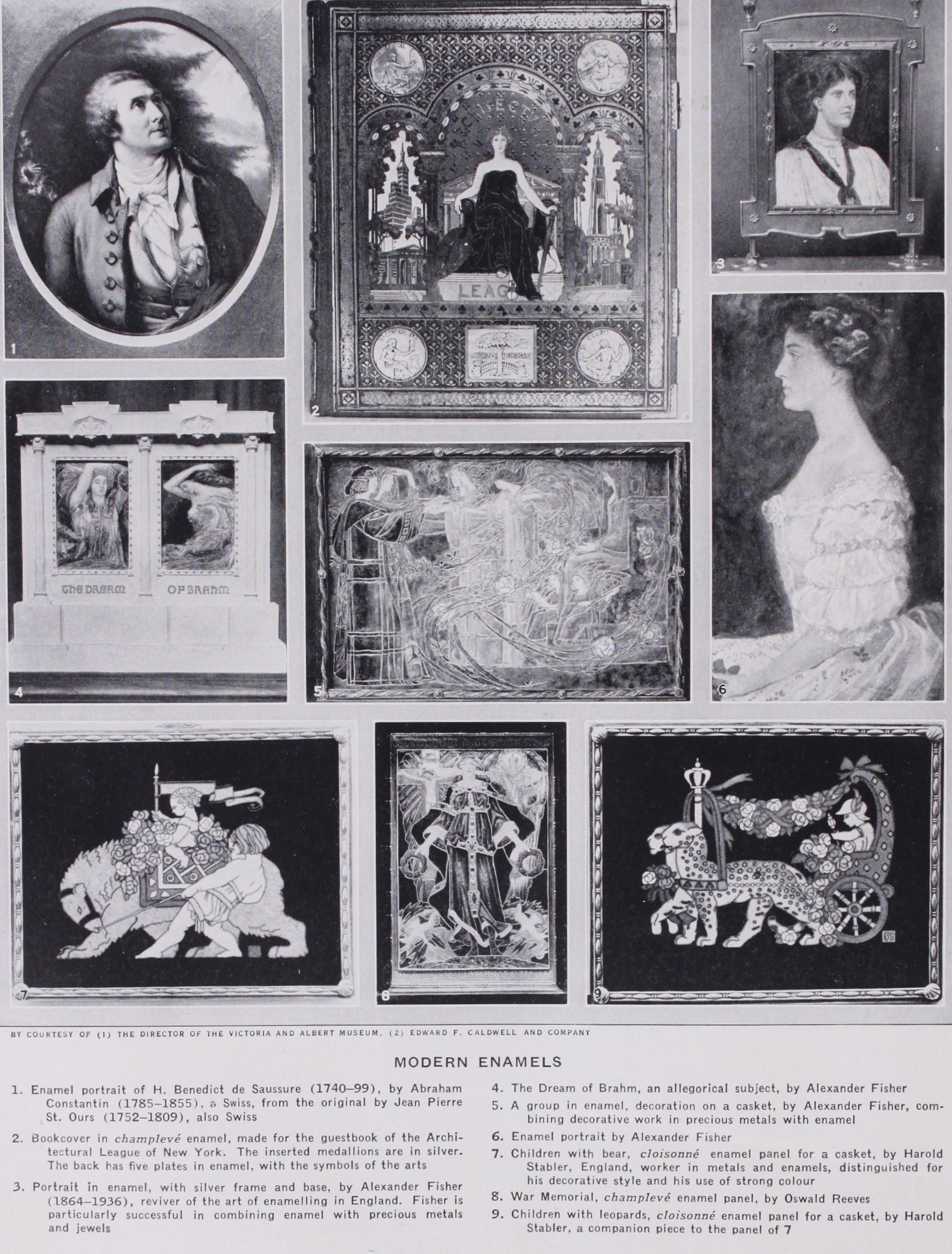
Many exquisite pieces of enamel jewellery from the subsequent Greek and Roman civilizations have been found. The Greek sculp tors of the 4th and sth centuries B.C., moreover, in many in stances, made not only the eyes of enamel, as in the fine bronze head found at Anticythera (Cerigotto) in 19o2, but in the colossal figure of Zeus for the temple at Olympia made by Pheidias the gold drapery was gorgeously enamelled with figures and flowers. This work, now destroyed, was in all probability the crowning triumph of a long series of essays in this material. The art of ancient Rome lacked the inspiration of Greece, being mainly con fined to copying Greek forms and style, and enamelling was no exception. But the Roman and Etruscan glass has many beautiful qualities of form and colour that do not seem entirely borrowed, and the enamel work upon them so far as we can discern is of graceful design and rich colour.
The next time enamelling appears is in an oft-quoted passage (c. A.D. 24o) from the writings of the great sophist Philostratus, who says (hones, i. 28) :—"It is said that the barbarians in the ocean pour these colours into bronze moulds, that the colours be come as hard as stone, preserving the designs,"—a more or less inaccurate description of the process of champleve (see description of enamel process appended) . This has been understood (from an interpretation given to a passage in the commentary on it by Olearius) to refer to the Celts of the British Islands. It also goes to prove that enamelling was not practised at this day in Greece. We have no British enamels to show so early as this, but be longing to a later period, from the 6th to the 9th century, a num ber of fine gold and bronze ornaments, horse trappings, shields, fibulae and ciboria have been discovered of Celtic and Saxon make.
The close resemblance of method, style, design and colour would suggest that from Ireland the art was transferred to Byzantium. At all events it flourished there for several centuries. The finest known work belonging to this period is the Pala d'Oro at St. Mark's, Venice, believed to have been brought from Constanti nople to Venice about I I os. This magnificent altar-piece is in cloisonne enamel. A typical example is the ciborium and chalice belonging to the South Kensington loan collection. The design entirely covers the whole of the surface in one rich mass com posed of circular or vesica-shaped medallions filled with sacred subjects and foliated scrolls. These are engraved and enamelled, and the metal bands of the scrolls and figures are engraved and gilt. The characteristic colour scheme is composed almost wholly of primaries. Red, blue and yellow predominate, with a little white and black. Occasionally the secondaries, green and purple, are used, but through the whole period of Byzantine enamelling there is a total absence of what to-day is termed "subtle colouring." The arrangement of the enamels is also distinct, in that the divisions of the colours are not always made by the cloison, but are frequently laid in side by side without the adjoining colours mingling or running together whilst being melted. In most in stances the enamels were made in separate little plates rudely fastened with nails, screws or rivets to a metal or wood foundation. The design and drawing of the figures in Byzantine enamels is similar to the mosaic and carving. The figures are treated en tirely as decorations, with scarcely ever the least semblance of expression, although here and there an intention of piety or sorrow is to be descried through the awkward postures in which they are placed. In spite of this, the sense of decorative design, the simplicity of conception, the strength of the general character and the richness of the colour places this period as one of the finest that the art• of enamelling has seen.
The next great application of these kinds of enamelling was at Cologne, for there we find not only the renowned work of Nicolas of Verdun, the altar front at Klosterneuberg, which consists of so plates in champleve enamel, but in that Rhenish province there are many shrines of magnificent conception. From here the secrets of the craft were taken to Limoges, where the greatest activity was displayed. But no new method or distinct advance is to be noticed, during these successive revivals at Byzantium, Cologne or Limoges, and it is to early i 4th-century Italy that we owe one of the most beautiful developments, that of the process subse quently called basse-taille, which signifies a low-cut relief upon which transparent enamel is fused.
Basse-taille demanded the highest knowledge of an artist with the consummate skill of both sculptor and enameller. Witness the superb gold cup, called the King's Cup, now in the British Mu seum, and the silver cup at King's Lynn. The first is in an ex cellent state of preservation, as it is upon gold, but the latter, like most of the ancient enamelling upon silver, has lost most of its enamel, due—the present writer, after much experiment, be lieves—to the impurity of the silver employed. The King's Cup (r3th century) is one of the finest works in enamelling extant. It consists of a gold cup and cover, hammered out of pure gold ; and around the bowl, base and cover there are bands of figures, illustrating scenes from the life of St. Agnes. The hands and faces are of pale amethyst which over the carved gold gives a beautiful flesh tone. The draperies are in most resplendent ruby, sapphire, emerald, ivory, black and orange. The stem was subse quently altered by an additional piece inserted and enamelled with Tudor roses.
The discovery about the same time of the process called plique a-jour forms another most interesting and beautiful development. Owing to the difficulty of its manufacture and its extreme fragility there are very few examples left. One of the finest specimens is now at the Victoria and Albert Museum, South Kensington. It is in the form of two bands of emerald green enamel which decorate a silver beaker. They are in the form of little stained glass win dows, the cloisons forming (as it were) the leads.
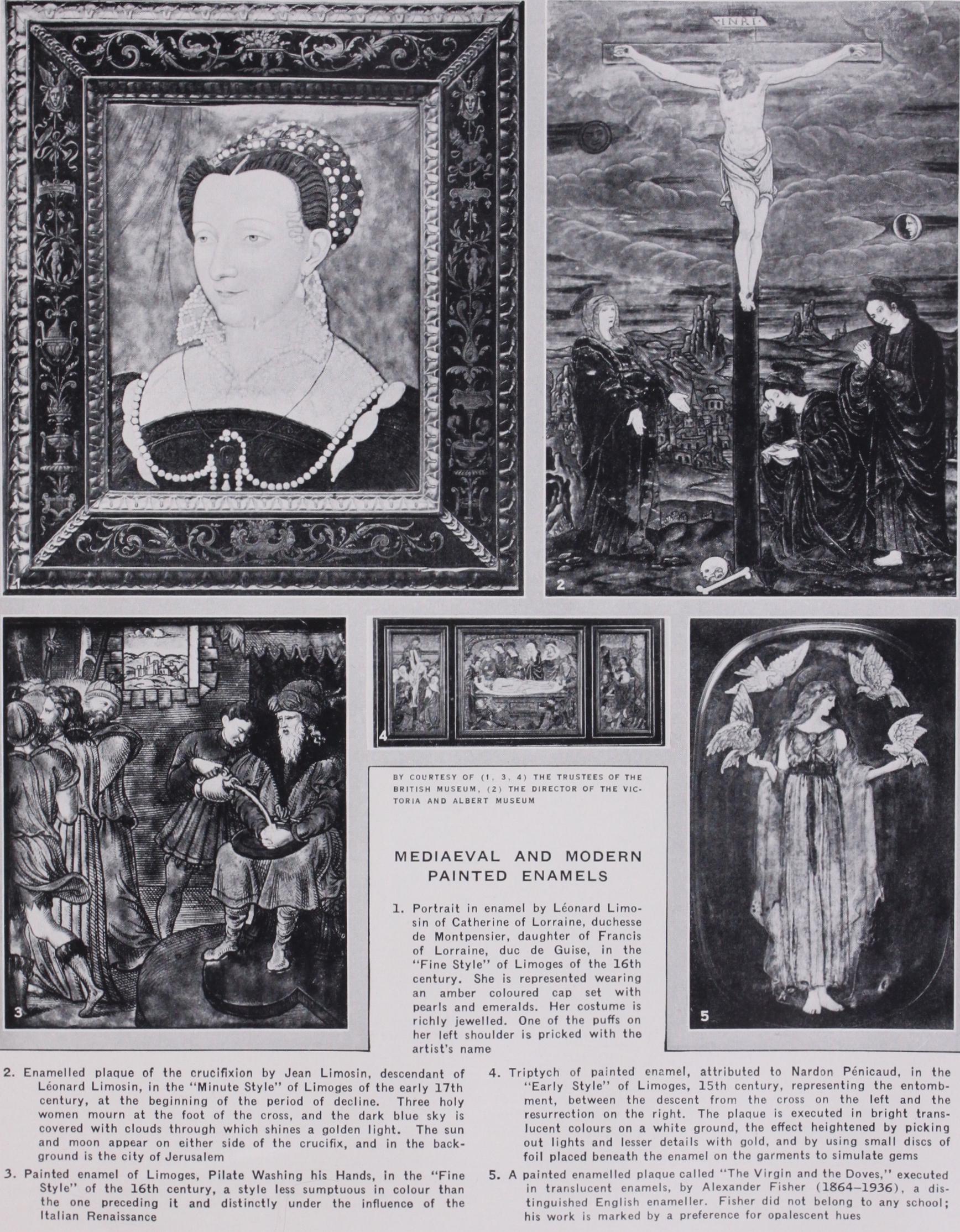
The end of the r sth century saw a revolutionary development. Until then enamelling had relied on the enclosing edges of the metal or the cloison to hold it to the metal ground and in part to preserve it in the shape of the pattern, much as a setting holds a jewel; all enamel had been sunk into cells or cloisons. Two discoveries were made; first, that enamel without enclosing ribbon could be fused on both sides of the metal object; secondly, that after an enamel had been fused to a surface of metal, another could be superimposed and fused to the first layer without any danger of separation from each or from the metal ground. In most of these enamel paintings the subject was laid on with a white enamel upon a dark ground. The white was modulated ; so that possessing a slight degree of translucency, it was grey in the thin parts and white in the thick. Thus was obtained a certain amount of light and shade. This gave the process called grisaille. But strange to say, it was not until a later period that this was prac tised alone, and then the modelling of the figures and draperies became very elaborate. At first it was only done in a slight degree, just sufficiently to give expression and to add to the richness of the form. Probably the earliest painter in enamel was Nardon Penicaud, many of whose works (one of them, dated 1503, is in the Cluny Museum) have been preserved. He had many followers, the most distinguished of whom was Leonard Limosin (i.e., of Limoges). He excelled in portraiture. Examples of his work (be tween i S32 and I 574) are to be found in most of the larger public and private collections. Jean Penicaud, Jean Court de Vigier, Pierre Raymond and Pierre Courteys excelled in grisaille.