THE AMATEUR FOOTBALL ASSOCIATION When a large number of the amateur clubs, including nearly all the old boys' clubs, seceded from the Football Association in 1907, they unwisely retained the old name with the addition of the word "amateur," thus beginning their new career by causing confusion. They instituted an Amateur Football Association cup on the lines of the already famous Football Association cup; but the Football Association promptly replied by taking a much greater interest in their own amateur cup. The result was that footballers at large refused to take the trouble to differentiate between the Amateur Football Association cup and the Football Association Amateur cup. The new association abolished the pen alty kick, which most amateur players so much disliked; but very little headway was made, partly because the committee did not understand the use of advertisement, partly because there was no sort of punctuality in beginning the matches, and partly because the actual position was never properly realized. There seemed at first no reason why the new association should not become as powerful an organization as the Rugby Union, but the position of the two bodies was not the same. When the Rugby Union began its career its clubs were few, and the great players had to be dis covered, whereas the A.F.A. had many clubs with the best players already well known. What happened was that the greater players, being all members of the Corinthian football club, had no strong opposition to meet, and they soon desired to meet the profes sionals again. In 1914 the Amateur Football Association and its clubs returned to the Football Association, but still retained its title and its own cup. Times had changed, and the separatists found that they were not on the old footing. Their best players had been deteriorating, and the league clubs opposed to them were generally content to put reserve teams in the field against them. By slow degrees their players were eliminated from the Interna tional teams, and by 1927 these were practically confined to pro fessionals. The Amateur Association also found that when public school after public school began to play Rugby, there was an always increasing difficulty in obtaining recruits for the universi ties and the old boys' clubs; and as, by the terms of readmission, they were not allowed to recruit from the amateur clubs already belonging to the Football Association, the teams became weaker every year. In 1927 an arrangement was made by which they might recruit from certain other clubs.
When the professional clubs had become so strong and their players so well trained that the untrained amateurs had no chance at all of beating them, the amateur clubs dropped out of the association cup. But there were some great players among the amateurs, and they very naturally regretted their want of opportunity to try their strength against professionals. In 1882 the idea occurred to N. L. Jackson, who was then honorary secretary of the London Association and assistant honorary secretary of the Football Association, that if a club was formed to include only the very best of the amateurs, it would not only enable the great amateur players to meet pro fessional opponents, but would help towards combination in international matches. A meeting was convened at which the Corinthians came into being, and in the second year of the new club N. L. Jackson became its honorary secretary, an office which he held until 1898. The new club quickly became so popular that the professional clubs were glad to arrange matches with it. The result was interesting and scrupulously fair football; it became even a rare thing for the referee to blow his whistle—in many of the Corinthians' matches against the professionals the whistle would be heard no more than half a dozen times during the game, including the "kick-off," "half-time," and "time." So long as Jackson directed the fortunes of the club it flourished greatly, but when he retired it began slowly to lose ground. It had a great opportunity of reviving its former greatness when it seceded from the Football Association with the other amateur teams and joined the Amateur Football Association. If it had followed the example of the M.C.C. and had been content to be a missionary club, sending out well-chosen teams to all parts, and not caring overmuch whether victory or defeat was the result, the matches would have had an immense educational value. Unfortunately this method was not adopted, and the Corinthians gained a series of bloodless victories which were of no use to them or to any body else. On the return of the amateurs to the Football Associa tion, the Corinthians resumed their matches with the League clubs; but their glory had departed, and the leagues seldom put their strongest teams in the field. From the earliest days of the club the Corinthians had resolutely refused to enter for any com petition, except for the Sheriff of London's shield ; but apparently in hope of regaining their old supremacy, they entered for the Football Association cup in 1922. They were exempted from pre liminary matches, but have had little success.
At the beginning of the loth century Association football was more or less confined to Great Britain and Ireland, but since then and more especially since the World War, it has made so great an advance abroad that it would be difficult to name a country where it is not played. It is becoming almost as popular in France, Holland, Belgium and Germany as it is in England. It is rapidly gaining a foothold in Spain, Portu gal and Italy; it is making great progress in the United States, where it is already holding its own with baseball; it is popular in Canada, South Africa and Australia; it is played in Japan and Egypt; and the most remote outposts of the British empire have their clubs. There are associations and federations and leagues overseas, but in some of the countries the ideas of the authorities as to what constitutes an amateur are distinctly hazy.
Association Football (1899) ; B. 0. Bibliography.-N. L. Jackson, Association Football (1899) ; B. 0. Corbett, The Annals of the Corinthian Football Club 0908) ; K. R. G. Hunt, Association Football (192o) ; J. A. H. Catton, Wickets and Goals (1926) . (W. A. BE.) Association football (soccer) of a kind has been played under varying conditions of popularity in the eastern United States since colonial days. Although at times it has been in danger of discontinuance because of lack of interest or greater interest in other games, it has shown a gradual increase in public favour. From a contest under limited and ill-defined rules with an irregu lar number of players on a side, played occasionally by towns people or school boys, soccer has developed into a definite and well-codified game with a place among the leading sports of the eastern States. Other parts of the country have been slower but no less sure in recognizing its merits. It is estimated in 1928 that 75,00o individuals played soccer in the United States. A great number of these were Europeans employed by industrial com panies and professional leagues or immigrants who played soccer previous to emigrating. Strenuous efforts are being made to in crease the popularity of soccer among the native youth of America.
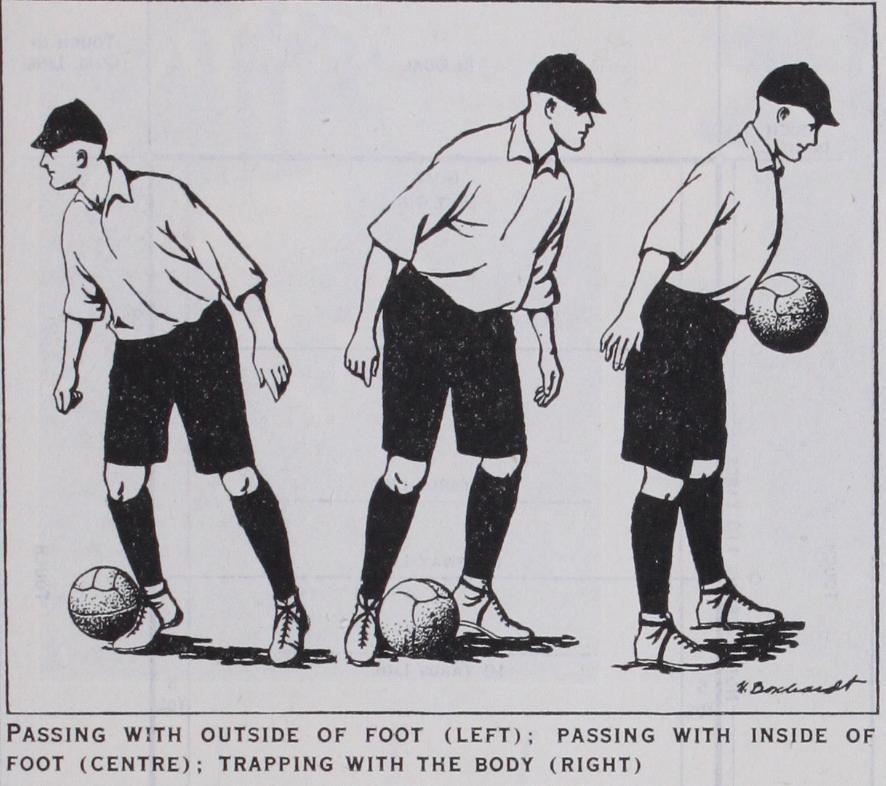
With the exception of a brief period in the '5os and '6os, before Rugby was developed, soccer had not been generally re garded in the United States as a school and college game until about 1920. Its increased use by colleges and schools, however, is enhancing its popularity among non-scholastic and non-col legiate groups, particularly among city leagues, industrial leagues, composed largely of foreign-born players and occasional teams.
As early as 183o a sort of football was played between the classes in Harvard college, and by
football was being played in a number of American colleges. It varied in different institutions and, strictly speaking, was neither Association football nor Rugby. In general characteristics it was closely related to the former, however, and in fact developed in a logical fashion into the Association game. During the '4os and '5os everything concerning the game was excessively informal. There was no definite number of players, no special uniform was worn by the players, any available space relatively flat and open was utilized as a field, and the ball consisted of rubber or cloth, or perhaps a pig or beef bladder in its natural state or inserted within a covering. Rules were practically non-existent. By 186o a dozen colleges along the Atlantic seaboard were playing Associa tion football regularly (no inter-collegiate contests as yet) and the game had become somewhat uniform in its standards of play. On Nov. 6, 1869, the first inter-collegiate contest was played at New Brunswick between Rutgers college and Princeton college. It was essentially Association football. Stimulated by this intro duction of inter-collegiate matches, the game was popular for the following six or eight years. Each of the colleges, Princeton, Rut gers, Columbia, Yale, University of Pennsylvania, Harvard, Haver ford, Stevens, New York university and the College of the City of New York, as opportunity afforded, arranged one or more inter collegiate games unless prohibited—as Yale and Harvard were in 187i. For each contest a compromise was necessary, since each college had its own code of play. Delays were frequent. About 1874 Harvard began to favour the Rugby game. Other colleges soon did likewise, and by 18 7 7-78 Rugby football, which was fast making strides toward the modern brand of the American game, replaced Association football as the official fall sport.
Association football did not entirely disappear from college campuses before the gains of its rival, Rugby, but the years
1905 were a lean period for the game. During 1904-05 interest was revived and enough inter-collegiate matches were played in the spring to decide a championship. In 1914 the season was changed to autumn, as originally. For most of the academic year, however, the game is found on the campus, an extended period that gives opportunity to develop native players. There is a larger percentage of foreign students on soccer teams than on teams in any other sport. Since the World War a growing number of insti tutions have adopted soccer. Experienced ex-players have not been obtainable for coaching in sufficient numbers, with the result that many of the college teams—even occasionally successful teams— are being coached by men who know the game chiefly from a theoretical standpoint. Consequently soccer in the colleges generally is not played with the same finesse as in Europe.
It is significant, however, that an increasing number of colleges and universities are giving soccer a permanent place on their intra mural and inter-collegiate programmes from year to year. The quality of playing is improving quite naturally as boys who have learned the game in secondary schools enter the colleges. In 1926 32 or more institutions played inter-collegiate soccer matches with four to eight games on a schedule, making a total of approximately 15o contests. In addition these institutions and some 30 others play intramural matches. The number playing at any one institu tion ranges from 15 at a very small college where the sport is new to
at a large university like that of Pennsylvania or Ohio
Slight changes and adaptations of the rules by colleges (the use of substitutes, four quarter-periods, goal judges, offside rule, pro viding two defenders instead of three) are not looked upon with favour by non-collegiate officials. Association football is also being adapted for women at a few colleges and universities.
In general, Association football among colleges in the United States is strongest in the East, making fair headway in the Middle West and on the Pacific coast, and being introduced in the South. While at the University of Pennsylvania and Dartmouth college it has been given the standing of a "major" sport, at most institu tions it remains in the "minor" sports class. Until this handicap is removed, soccer can not come fully into its own as a college game.
Practically all soccer associations, clubs, leagues and competitions in the United States whether amateur or professional are affiliated with and controlled by the U.S. Football Association, Inc. This association, which also regu lates international competition through its affiliation with the Federation Internationale de Football Association, was incorpo rated April 5, 1913, as an outgrowth of the revived interest in soccer in America, the need for international affiliation, and the progress of the game during the previous decade. Prominent among the regional associations which had already existed was the Ameri can Football Association, organized in 1884 and reorganized in 1906. The U.S.F.A. sponsors the organization of city, county, and district leagues and State associations the country over. Ap proximately 20 State associations have been organized and more than i,000 clubs are playing. A large proportion of these are in and around centres with a prominent foreign-born population. The association stimulates competition through the National Challenge Cup Competition which it has conducted annually since 1913. Entries are permitted from all clubs under the jurisdiction of the association either by direct or indirect affiliation. In the 1926-27 contest, 124 teams participated. Total attendance at these matches has reached as high as 17 2,00o in one year. Rounds commence as early as October and extend to the grand finals in late spring. Since 1922-23 an amateur cup competition has also been con ducted by the association. In 1926-27 57 teams entered. General public interest which has been relatively small is increasing.
Professional soccer in the United States began in 1918 with the organization of the Bethlehem team. Practically all the players were Europeans. Since that time the same practice has been fol lowed, so that few of the men playing on professional teams are native Americans. The professional organizations are privately owned but controlled by the U.S.F.A. Approximately 215 of the 2,000 registered players are employed by the American Soccer League comprising io leading teams in the East.
In public and private high schools soccer is notably popular in a few sections and is gaining acceptance consistently in many others. In New York city and Philadelphia schools the game is officially encouraged. Rugby is prohibited in State high schools of Maryland while soccer has been :nade a "major" sport in that State. The Playground Athletic League in Baltimore has had as many as 372 teams playing in one season. In the District of Columbia Municipal League the numbers participating doubled from 1925-26 to 1926-27. At the tournament held by the Uni versity of Pennsylvania 12 teams competed. In Michigan, and more particularly in Detroit, soccer among boys of school age is popular. Eighteen schools competed in the Tulsa (Oklahoma) league. Chicago, St. Louis, Cleveland and other large cities are sponsoring soccer among school boys. Over a great portion of the country, however, the game has not been introduced or has not as yet gained foothold.
Presbrey and j. Hugh Moffatt, Athletics at Bibliography.-F. Presbrey and j. Hugh Moffatt, Athletics at Princeton, a History (1901) ; National Collegiate Athletic Association, Proceedings (1906 et seq.) ; U.S. Football Association, Rules and Regu lations and Reports and Minutes of Meetings (1914 et seq.) • A. M. Weyand, American Football, Its History and Development (1926) ; Spalding's Athletic Library, Soccer Guides. (H. W. BE.)
