
FEDERAL RESERVE SYSTEM, THE, a United States banking system which began operation on Nov. 16, 1914. The system consists of 12 Federal Reserve Banks, 25 branches, two agencies, and a Government supervisory body in Washington known as the Board of Governors of the Federal Reserve System. The 12 Reserve Banks are in Boston, New York, Philadelphia, Cleveland, Richmond, Atlanta, Chicago, St. Louis, Minneapolis, Kansas City, Dallas, San Francisco. Every Federal Reserve Bank, with its branches, serves a separate district not coterminous with State boundaries. The Reserve Banks are bankers' banks in that they perform for the banks of the United States a service similar to that which commercial banks of deposit perform for their cus tomers. They receive deposits from banks, they make loans to banks, they receive and collect checks. In addition, they have power to issue Federal Reserve notes and act as fiscal agents of the United States. In more technical language, they are banks of issue and rediscount, with somewhat similar powers to the Bank of England, the Bank of France, the Reichsbank and other Euro pean banks of issue.
Reasons for Establishment.—Although the United States was among the last of the important countries of the world to establish a bank of issue and rediscount, there is no other country where the needs for such an institution had been so thoroughly demon strated. The outstanding peculiarity of the U.S. banking system has been its large number of independent banks. Until recent years branch banking had developed hardly at all. By 1914 as many as 27,000 independent banks had been organized, each operated by its own local board of directors and its own separate official staff and each carrying its cash reserve in its own vaults, or in the vaults of other similar banks in large cities. Not only was there this large number of independent banks, but they dif fered greatly in powers, size and character. About 7,500 of them were national banks, incorporated under laws of the U.S. Govern ment and supervised by the comptroller of the currency, who is a Federal political officer. The others were all created pursuant to the laws of the several States of the Union governing the estab lishment of banks, which differed widely.
The disadvantages of this system of many independent banks, with their reserves widely scattered or redeposited in city banks, became apparent, not only at every period of serious credit stringency, but also at times of normal seasonal demands for funds. There was no certain means by which a fairly inelastic supply of credit and currency could be supplemented at times of stress. Other difficulties arose from the lack of a competent fiscal agent for the Government. Under a plan instituted in 1846, known as the Independent Treasury system, all revenues were paid into the Treasury or a Subtreasury in actual cash, causing stringency, especially as taxes were largely collected at certain seasons of the year. Then the disbursements caused undue plethora of funds. To overcome this the Government deposited money in the national banks. Abuses grew out of that practice. In time of stringency the Government had to take special, and frequently extraordinary, measures. The Treasury thus found itself with many of the responsibilities of a central bank of issue, but without the ma chinery necessary for fulfilling the duties of such a bank.
The evils arising from the lack of a central bank of issue and re discount were long recognized in the United States. In 1908 the U.S. monetary commission was appointed by Congress under the chairmanship of Senator Nelson W. Aldrich of Rhode Island and produced an exhaustive report covering monetary conditions in the United States and the experiences of other countries with banks of issue and rediscount. A change of political parties occurred and the recommendations of the Aldrich commission were not adopted. The Federal Reserve Act as passed, represented a series of compromises between the recommendations of the commission and other proposals. The act in its present form was largely a product of the Committee on Banking and Currency of the House of Representatives under the chairmanship of Carter Glass of Virginia. The principal points at which the Federal Reserve Act is a harmonization of differences between divergent interests, are its compromises between national and local interests, between Government and private interests and between banking and busi ness interests.
Dividends on the capital stock of the Reserve Banks are lim ited to 6 per cent. per annum, and any remaining earnings beyond expenses and dividends are paid into a surplus fund. In the event of dissolution or liquidation of a Reserve Bank, all assets after payment of all debts and repayment of the par value of the capital stock are payable to the Government. These provisions remove any pressure for profits and enable those in charge to make decisions with the primary aim of serving the public.
The Reserve Banks are not Government Banks, but in view of the extensive supervisory powers exercised by the Government and the public character of the business conducted by these banks it might be said that they are quasi-governmental or quasi-public. The composition not only of the boards of directors of the Re serve Banks but also of the Board of Governors of the Federal Reserve System is designed to give diversified representation in the management of the System. The sentence in the Federal Reserve Act specifying the composition of the Board of Governors reads : "In selecting the members of the Board, not more than one of whom shall be selected from any one Federal Reserve district, the President shall have due regard to a fair representation of the financial, agricultural, industrial, and commercial interests, and geographical divisions of the country." A body known as the Federal Advisory Council was also created by the Reserve Act, composed of one representative from each Federal Reserve District elected annually by the boards of direc tors of the respective Reserve Banks, and required to hold at least four meetings each year. This Council is authorized to con fer with and make recommendations to the Board of Governors.
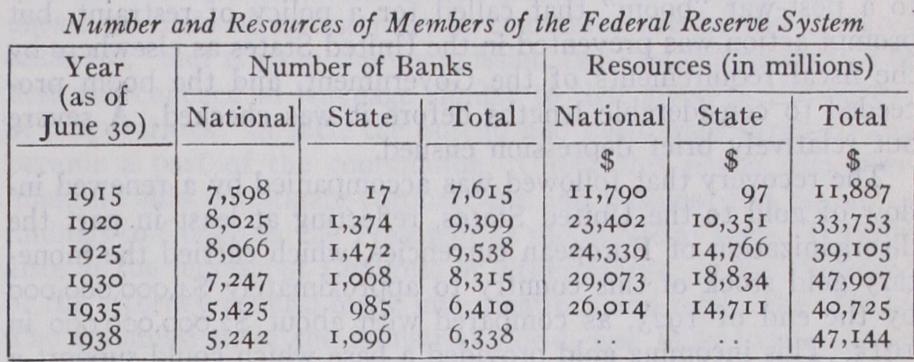
The growth in membership during the World War period is typical of all the operations of the Reserve Banks. With the entry of the United States into the World War in April 1917, there was suddenly thrown upon the Reserve Banks the responsi bility for handling Government financial operations and with it a great increase in lending operations, currency payments, check clearings, etc. The sale of huge war loans and short-time Treasury loans made it necessary for the member banks to begin borrowing heavily at the Reserve Banks and, simultaneously, war prices and war wages led to a large demand for additional currency which was met by the issue of Federal Reserve notes. The Reserve System thus was forced into an expansion which under normal conditions could have been the result only of many years of growth.
Following the conclusion of the war and post-war expansion, there were reductions in the amount of loans to member banks, the amount of Federal Reserve currency in circulation, and the size of fiscal agency operations. Other phases of the work con tinued, however, in increasing volume, as for example, the num ber of checks handled in the Federal Reserve collection system and the amount of currency received and paid out.
The total number of employees of the Reserve System is about 12,000. The largest Reserve Bank is that at New York, which em ploys some 2,400 people and being situated in the country's prin cipal money market carries on between one-quarter and one-third of the System's operations, including the handling of all foreign accounts and a large part of all direct operations in the money market.
By the terms of one of the clauses in an act of Congress signed by President Coolidge on February 25, 1927, the charters of the Federal Reserve Banks, which under the terms of the original act were for a period of 20 years, were made indeterminate and will continue indefinitely unless terminated by act of Congress.
At the outset it appeared from the experience in earlier crises that the chief need in the monetary organization of the United States was greater flexibility. But the establishment of the Re serve Banks was practically coincident with the outbreak of the World War in Europe which quite changed the monetary outlook and problems. For within a few months there was a heavy flow of gold to the United States, due to European war purchases. This gold flow, together with a reduction by the Federal Reserve Act of the legal reserve requirements of member banks, made the market and the member banks independent of the Reserve System and formed a base for credit expansion and price advances. The entry of the United States into the World War in 1917 made necessary a huge volume of Government financing through the use of bank credit, and the facilities of the new banks of issue were put vigorously to work. During this period the efforts of the Re serve System were perforce directed largely to facilitating the financing of Government requirements. After the war the infla tionary tendencies that developed out of the war expenditures led to a post-war "boom" that called for a policy of restraint, but prompt action was prevented in the United States as elsewhere by the fiscal requirements of the Government, and the boom pro ceeded to considerable lengths before it was checked. A severe but relatively brief depression ensued.
The recovery that followed was accompanied by a renewed in flow of gold to the United States, reflecting at least in part the disorganization of European currencies, which carried the mone tary gold stock of this country to approximately $4,000,000,000 by the end of 1923, as compared with about $2,000,0o0,o0o in 1915. This incoming gold provided a base which could support a very large expansion of bank credit. Under these conditions the Federal Reserve System found it difficult to follow what are sometimes considered orthodox precedents in its credit policy, as discount rate policy had to be guided largely by the nature and extent of credit expansion in the United States in its relation to business, rather than by any need for protecting the country's gold supply. The System was faced with a dilemma in that a dis count rate high enough to discourage excessive credit expansion in the United States would tend still further' to draw gold from European countries, and thus retard the stabilization of Euro pean currencies on the one hand, and provide a basis for further credit expansion in the United States on the other.
Despite this unusual credit situation, or perhaps partly because of it, the decade of the twenties was not only one of extraordinary prosperity in the United States but one of considerable stability of business and prices. The volume of production was high and advancing; the National income rose steadily; real wages ad vanced ; the country's standard of life rose.
Because there was no rise in commodity prices it was believed by many that the country had avoided the dangers which admit tedly lay in the huge gold holdings and the continued imports. But while commodity prices did not rise, inflationary forces were at work. The volume of bank credit advanced rapidly, and freely available credit was reflected in rising wages, an extraordinary amount of building construction, land booms in Florida and many urban centres, a large volume of new financing, and especially in rising prices of securities.
From time to time during this period business and nnancial movements appeared to be sensitive to Federal Reserve policy, which took the form of discount rate changes and open market operations, that is the purchase or sale of Government securi ties. But as the period of prosperity continued the sensitiveness decreased until in 1928 and 1929 even the most vigorous restrain ing action proved relatively ineffective.
Successive advances in discount rates and heavy sales of Gov ernment securities by the Reserve Banks in 1928 and 1929 were indeed successful in checking expansion of member bank credit, but the security market boom of those years was financed largely through loans from lenders other than member banks, including non-member banks, domestic corporations and individuals, and foreign lenders ; so that Federal Reserve efforts at restraint were circumvented.
During this period the Reserve System maintained very low dis count rates—I2 per cent. in New York for many months—and through open market operations kept an ample supply of funds in the banks pressing for use. Furthermore, from 1934 to 1935 there was an extraordinary inflow of gold, which, following an increase in the monetary gold stock of the United States from $4,000,000, 000 to $6,800,000,000 due to revaluation of gold from $20.67 to an ounce, raised the gold stock to above $16,000,000,000 and more than doubled the reserves of member banks. Conse quently, member banks by July 1939 held nearly four and one half billion dollars of excess reserves.
These last-named additional powers for the control of credit expansion place the Reserve System in better position to deal with such developments as those of 1928-1929. It must also be recognized that the economic and financial situation which the banking system faces is in some respects similar to the situation of the twenties. Business has made a considerable recovery from a great depression. The currencies of the world are again dis organized, as they were in the early twenties, and there is an even stronger tendency for gold to flow from other countries to the United States, building up a huge supply of loanable funds. Only a small part of the funds available has as yet been put to work in an expansion of bank loans and investments, for the effects of the depression are still evident in a small demand for business credit. Potentially, however, the basis now exists for a very large credit expansion. Thus, looking into the future, the problems of Federal Reserve policy appear to have much in common with the problems of the twenties, with this difference that the Reserve System now has added powers of restraint.
See Carter Glass, An Adventure in Constructive Finance (192 7) ; The Federal Reserve System, Its Purposes and Functions, published by Board of Governors (i939). (G. L. H.; X.)