
FRANZ JOSEF LAND, an arctic archipelago lying east of Spitsbergen and north of Novaya Zemlya, extending northward from about 80° to 82° N., and between 43° and 65° E. The islands are all very similar in appearance and consist of platforms of f ossilif erous clay, shales and sandstone rising to 400-600 ft. capped by 500-700 ft. of Tertiary basalt. Intrusive sills also occur. The basalts are related to those of Jan Mayen, Iceland, Greenland and W. Scotland. The islands are clearly remains of a more extensive land surface that was broken and partially sub merged along lines of faults subsequent to the volcanic period. Raised beaches indicate recent elevations. The islands have caps of ice or neve and valley glaciers or sheer ice faces to the sea. Vegetation is scanty and includes 14 flowering plants and some mosses and lichens. Pack-ice renders access difficult, but occasion ally Norwegian trappers have wintered there. The bear and fox are the only land mammals ; insects are rare ; but the avifauna includes at least 2 2 species of which probably 15, including the ivory gull, nest there.
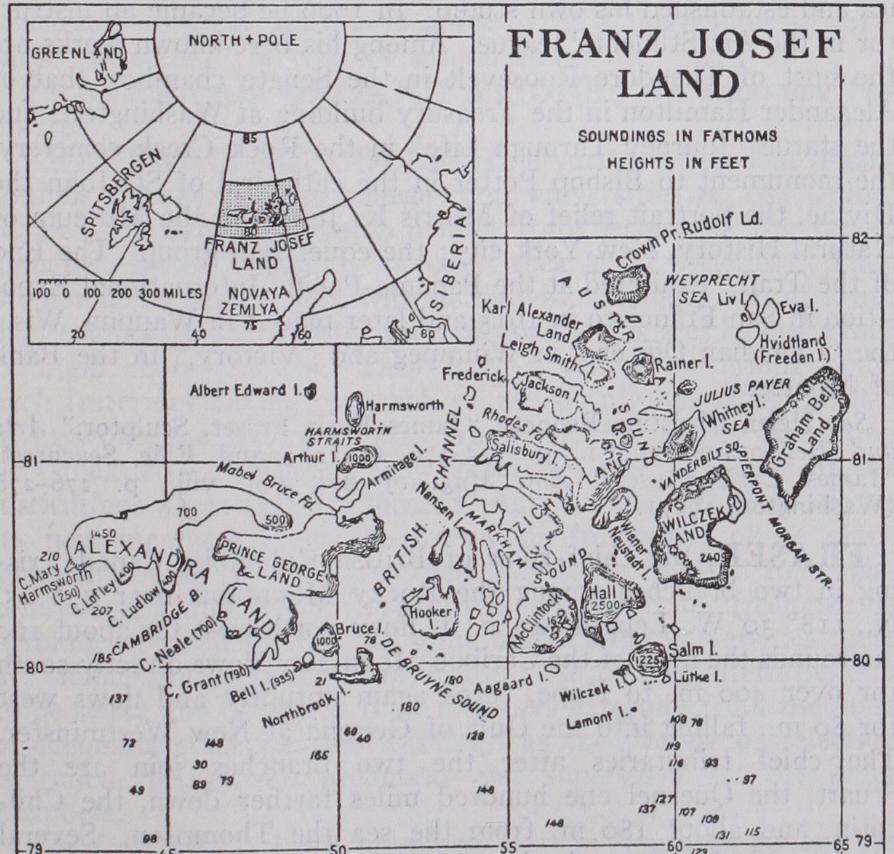
August Petermann expressed the opinion that Baffin may have sighted the west of Franz Josef Land in 1614, but the first actual discovery is due to Julius Payer, who was associated with Wey precht in the Austrian polar expedition fitted out by Count Wilczek on the ship "Tegetthof" in 1872. On Aug. 31, the "Tegetthof" being then beset, high land was seen to the north west. Later in the season, Payer led expeditions to Hochstetter and Wilczek islands, and of ter a second winter in the ice-bound ship, a difficult journey was made northward through Austria Sound, which was reported to separate two large masses of land, Wilczek Land on the east from Zichy Land on the west, to Cape Fligely, in 82° 5" N. Cape Fligely was the highest latitude attained by Payer, and remained the highest attained in the Old World till 1895. Payer reported that from Cape Fligely land (Rudolf Land) stretched north-east to a cape (Cape Sherard Osborn), and mountain ranges were visible to the north, indicating lands beyond the 83rd parallel, to which the names King Oscar Land and Peter mann Land were given. In 1879 De Bruyne sighted high land in the Franz Josef Land region, but otherwise it remained untouched until B. Leigh Smith, in the yacht "Eira," explored the whole southern coast from 42° to S4° E. in 1881 and 1882, discovering many islands and sounds, and ascertaining that the coast of Alex andra Land, in the extreme west, trended to north-west and north.
In 1894 Alfred Harmsworth (afterwards Lord Northcliffe) fitted out an expedition in the "Windward," under F. G. Jackson, with the object of establishing a permanent base in Franz Josef Land, from which a journey should be made to the Pole. Jackson's base was at "Elmwood," near Cape Flora, at the western extrem ity of Northbrook Island. After a preliminary reconnaissance to the north, the summer of 1895 was spent in extending discovery to the west. In 1896 the Jackson-Harmsworth expedition worked northwards and reached Cape Richthofen, whence an expanse of open water was seen to the north, which received the name of Queen Victoria sea. To the west of the British channel appeared glacier-covered land, and an island which was probably Payer's King Oscar Land lay to the northward. To north a water-sky appeared in the supposed position of Petermann Land. Thus Zichy Land itself was resolved into a group of islands, and the outlying land sighted by Payer was found to be islands also. Meanwhile Nansen, on his southward journey, had approached Franz Josef Land from the north-east, finding only sea at the north end of Wilczek Land. Nansen wintered near Cape Norway, Jackson Island, only a few miles from the spot reached by Jackson in 1895. He had finally proved that a deep oceanic basin lies to the north. On June 17, 1896, the dramatic meeting of Jackson and Nansen took place, and in the same year the "Windward" revis ited "Elmwood" and brought Nansen home, the work of the Jack son-Harmsworth expedition being continued for another year. As the non-existence of land to the north had been proved, the attempt to penetrate northwards was abandoned, and the last season was devoted to a survey and scientific examination of the archipelago, especially to the west, by Jackson, A. B. Armitage, R. Koettlitz, H. Fisher, W. S. Bruce and D. W. Wilton.
Further light was thrown on the relations of Franz Josef Land and Spitsbergen during 1897 by the discoveries of Captain Robert son of Dundee. In August 1898 an expedition under Walter Wellman, an American, landed at Cape Tegetthof. The eastern limits of the archipelago were explored by E. Baldwin and many new islands added to the map. Wellman reached 82° N. In June 1899, the duke of Abruzzi in the "Stella Polare," succeeded in forcing his ship through the British channel to Rudolf Land, and wintered in Teplitz bay, in 81° 33' N. lat. In March 1900, a sledge party of 13, under Captain Cagni, started northwards. They found no trace of Petermann Land, but with great difficulty crossed the ice to 86° 33' N. lat. (See ARCTIC REGIONS.) Baldwin did some work again in 1901-2 and A. Fiala, in 1904, lost his ship in Tep litz bay. The Russian, G. L. Sedoff, used Hooker Island in 1913 as a base for a sledge journey to the Pole, but died near Rudolf Land.
See Geographical Journal, vol. xi., Feb. 1898; F. G. Jackson, A Thousand Days in the Arctic (1899) (with appendices on geology and botany) ; Duke of Abruzzi, On the Polar Star (19o3) The Ziegler Polar Expedition 1903-5, Scientific Res., ed. A. Fiala (Wash. 1907).