
FREE REED VIBRATOR, in musical instruments, a thin metal tongue fixed at one end and vibrating freely either in sur rounding space, as in the accordion and concertina, or enclosed in a pipe or channel, as in certain reed stops of the organ or in the harmonium.
We have to deal with air under three different conditions in considering the acoustics of the sound produced by free reeds: (I) The stationary column in pipe or channel containing the reed, which is normally at rest; (2) The wind or current of air fed from the bellows with a variable velocity and pressure, which is broken up into periodic air puffs as its entrance into pipe or channel is alternately checked or allowed by the vibrator; (3) The disturbed condition of No. 1 when acted upon by the metal vibrator and by No. 2, whereby the air within the pipe is forced into alternate pulses of condensation and rarefaction.
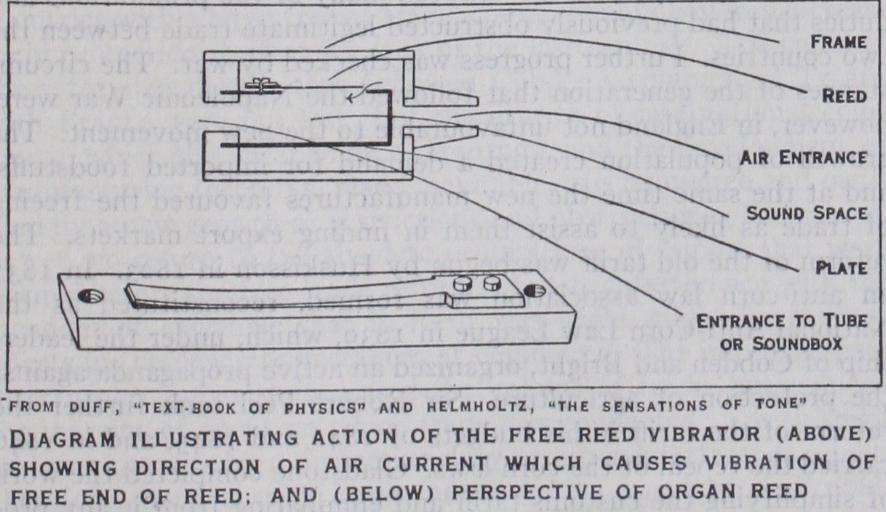
The most valuable characteristic of the free reed is its power of producing all the delicate gradations of tone between forte and piano by virtue of a law of acoustics governing the vibration of free reeds, whereby increased pressure of wind produces a pro portional increase in the volume of tone. The sound produced by the free reed itself is weak and requires to be reinforced by means of an additional stationary column or stratum of air. Free reed instruments are therefore classified according to the nature of the resonant medium provided: (I) Free reeds vibrating in pipes, as in organs ; Free reeds vibrating in reed compartments and reinforced by air chambers of various shapes and sizes, as in the harmonium (q. v.) ; (3) free reeds set in vibration through a valve, but having no reinforcing medium, as in the accordion and concertina.
The quality of tone of free reeds is due to the tendency of air set in periodic pulsations to divide into aliquot vibrations or loops, producing the phenomenon known as harmonic overtones or upper partials, which may, in the highly composite tone of free reeds, be discerned as far as the 16th or 20th of the series.
For the history of the application of the free reed to keyboard instruments, see HARMONIUM.