
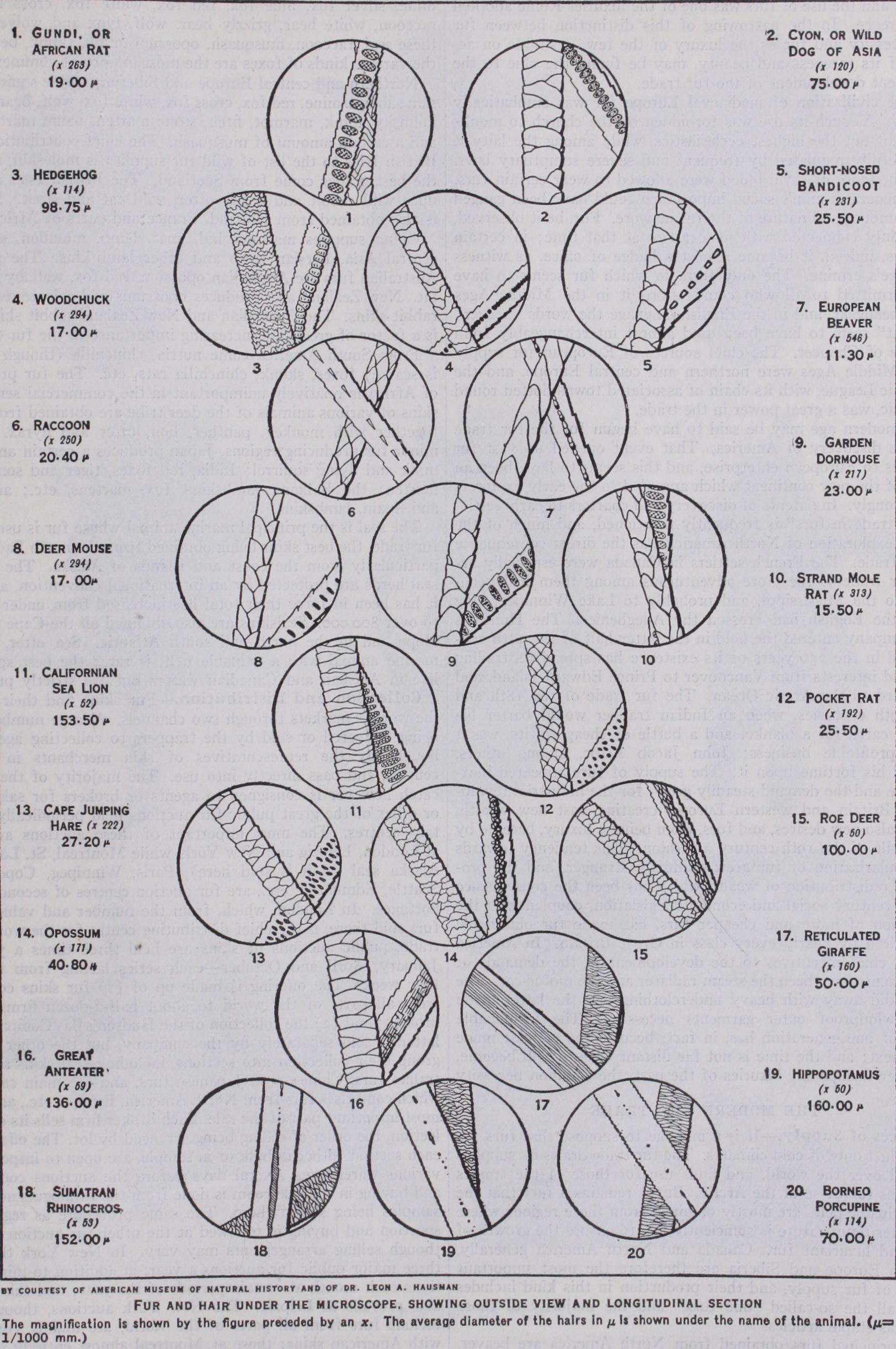
FUR, the covering of the skin in certain animals lying along side another covering called the overhair, or guard-hair. The fur is barbed lengthwise, and is soft, silky, downy and inclined to curl. On the living animal the overhair keeps the fur filaments apart, prevents their tendency to mat or felt, and protects them from injury, thus securing to the animal an immunity from cold and storm.
The use of fur as apparel probably dates from the early stages of human history. Primitive man's chief needs in the colder regions of the earth were food and warmth, and it is reasonable to suppose that the use of animal fur for warmth was not long separated from that of animal flesh for food. To the barbarian in his northern forests fur was a necessity, and as such had its value; but it is important to note that in almost every civilization of which history is cognisant fur has also had its value from early times as an ornament or decoration. The Chinese are said to have esteemed it highly 3,500 years ago; the Greek legend of Jason and the Golden Fleece may well have had its origin in some more than usually perilous and fortunate fur trading voyage to the Euxine ; and the use of furs was one of the luxuries Rome adopted from Greece. In the narrowing of this distinction between fur as a necessity and fur as the luxury of the few, desirable on ac count of its rareness and beauty, may be found the clue to the subsequent development of the fur trade.

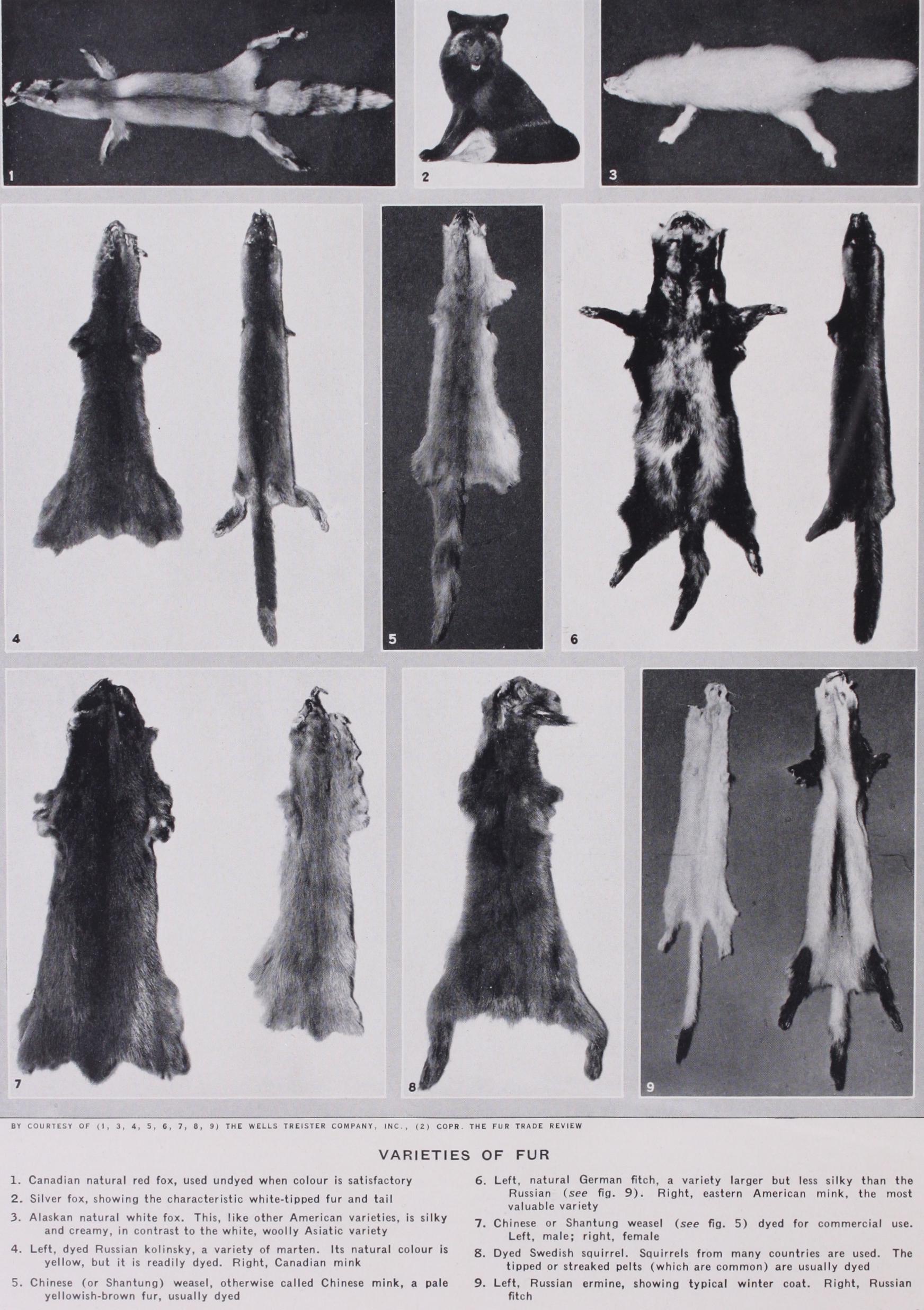
In the civilization of mediaeval Europe fur was emphatically a luxury. As such its use was forbidden by the church to monks and to all but the highest ecclesiastics, while among the laity it was carefully regulated by frequent and severe sumptuary laws. None but those of royal blood were allowed to wear certain furs, and in general a man's social importance could have been gauged by the amount and nature of the fur he wore. Fur, be it observed, was mainly connected with male attire at that time ; in certain instances, indeed, it became almost a badge of office, as witness the judge's ermine. The only form in which fur seems to have been permitted to all who could afford it in the Middle Ages was as headgear, and in the English language the words "beaver" and "hat" seem to have been used almost interchangeably from the time of Chaucer. The chief sources of European fur supply in the Middle Ages were northern and central Europe, and the Hanseatic League, with its chain of associated towns dotted round the Baltic, was a great power in the trade.
The modern age may be said to have begun for the fur trade with the discovery of America. That event opened up vast fur resources to European enterprise, and this seems to have been an aspect of the new continent which appealed to the early explorers most strongly. In patents of discovery and charters to early settle ments "trade in furs" is frequently mentioned, and much of the interior exploration of North America was the direct consequence of this trade. The French settlers in Canada were especially ar dent fur traders; the more adventurous among them had pene trated to the Mississippi, and probably to Lake Winnipeg, long before the English had crossed the Alleghenies. The Hudson's Bay Company entered the field in the latter half of the i 7th cen tury and in the 25o years of its existence has spread its trading posts and interests from Vancouver to Prince Edward Island, and northward to the Arctic Ocean. The fur trade of the i8th and early 19th centuries, when an Indian trapper would barter his winter's catch for a blanket and a bottle of cheap spirits, was a highly profitable business; John Jacob Astor, among others, founded his fortune upon it. The supply of furs appeared inex haustible and the demand steadily grew ; for the industrial revolu tion in Britain and western Europe, creating vast new wealth, created also new desires, and furs, from being a luxury, became by the middle of the i9th century a fashion. This tendency towards the popularization of fur grew gradually stronger, and the pro gressive redistribution of wealth which has been the consequence of loth century social and economic legislation, coupled with the production of more and cheaper furs, has made fur obtainable and desired by nearly every class in Great Britain. In America the two chief incentives to the development of the demand for fur garments have been the steam radiator and the motor-car. The former did away with heavy underclothing and the latter made warm, windproof outer garments necessary. The fashionable luxury of one generation has, in fact, become the popular mode of the next ; and the time is not far distant when it will become, like other fashionable luxuries of the past, the common necessity of all.