GABBRO, in petrology a group of plutonic basic rocks, holo crystalline and usually rather coarse-grained, consisting essentially of a basic plagioclase felspar and one or more ferro-magnesian minerals (such as augite, hornblende, hypersthene and olivine). The name was given originally in north Italy to certain coarsely crystalline dark green rocks, some of which are true gabbros, while others are serpentines. The gabbros are the plutonic or deep-seated representatives of the dolerites and basalts (also of some varieties of andesite) with which they agree closely in min eral composition, but not in minute structure. Of their minerals felspar is usually the most abundant, and is principally labradorite and bytownite, though anorthite occurs in some, while oligoclase and orthoclase have been found in others. The felspar is some times very clear and fresh, its crystals being for the most part short and broad, with rather irregular or rounded outlines; albite and pericline twinning is very frequent. Equally characteristic of the gabbros is the alteration of the felspars to cloudy, semi opaque masses of saussurite. These are compact, tough, devoid of cleavage, and have a waxy lustre and usually a greenish-white colour. When this substance can be resolved by the microscope it proves to consist usually of zoisite or epidote, with garnet and albite, but mixed with it are also chlorite, amphibole, serpentine, prehnite, sericite, and other minerals. The olivine in most cases is altered to green or yellow serpentine, often with bands of dark magnetite granules along its cleavages and cracks. Hornblende, when primary, may surround augite or be intergrown with it ; it is more frequently secondary. Dark-brown biotite, although by no means an important constituent of these rocks, occurs in many of them. Quartz is rare, but is occasionally seen intergrown with felspar as micro-pegmatite. Among the accessory minerals may be mentioned apatite, magnetite, ilmenite, picotite and garnet.
In a very large number of the rocks of this group the plagioclase felspar has crystallized in large measure before the pyroxene, and is enveloped by it in ophitic manner exactly as occurs in the dolerites. When these rocks become fine-grained they pass grad ually into ophitic dolerite; only very rarely does olivine enclose felspar in this way. A fluxion structure or flow banding also can be observed in some of the rocks of this series, and is character ized by the occurrence of parallel sinuous bands of dark colour, rich in ferro-magnesian minerals, and of lighter shades in which felspars predominate.
These basic holocrystalline rocks form a large and numerous class which can be subdivided into many groups according to their mineral composition; if we take it that typical gabbro consists of plagioclase and augite or diallage, norite of plagioclase and hypersthene, and troctolite of plagioclase and olivine, we must add to these olivine-gabbro and olivine-norite in which that mineral occurs in addition to those enumerated above. Horn blende-gabbros are distinctly rare, except when the hornblende has been developed from pyroxene by pressure and shearing, but many rocks may be described as hornblende or biotite-bear ing gabbro and norite, when they contain these ingredients in addition to the normal plagioclase, augite and hypersthene. We may recognize also quartz-gabbro and quartz-norite (containing primary quartz or micropegmatite) and orthoclase-gabbro (with a little orthoclase). The name eucrite has been given to gabbros in which the felspar is mainly anorthite; many of them also con tain hypersthene or enstatite and olivine, while allivalites are an orthite-olivine rocks in which the two minerals occur in nearly equal proportions; harrisites have preponderating olivine, an orthite felspar and a little pyroxene. In areas of gabbro there are of ten masses consisting nearly entirely of a single mineral, for example, felspar rocks (anorthosites), augite or hornblende rocks (pyroxenites and hornblendites), and olivine rocks (dunites or peridotites). Segregations of iron ores, such as ilmenite, usually with pyroxene or olivine, occur in association with some gabbro and anorthosite masses.
Some gabbros are exceedingly coarse-grained and consist of individual crystals several inches in length; such a type forms dikes or veins in serpentine or gabbro, and may be called gabbro-pegmatite. Still more common is the occurrence of sheared, foliated or schistose forms of gabbro. In these the minerals have a parallel arrangement, the felspars are often broken down by pressure into a mosaic of irregular grains, while greenish fibrous or bladed amphibole takes the place of pyroxene and olivine. The diallage may be present as rounded or oval crystals around which the crushed felspar has flowed (augen gabbro) ; or the whole rock may have a well-foliated structure (hornblende-schists and amphibolites). Very often a mass of normal gabbro with typical igneous character passes at its margins or along localized zones into foliated rocks of this kind, and every transition can be found between the different types. Some authors believe that the development of saussurite from felspar is also dependent on pressure rather than on weathering, and an analogous change may affect the olivine, replacing it by talc, chlorite, actinolite and garnet. Rocks showing changes of the latter type have been described from Switzerland under the name allalinites.
Rocks of the gabbro group, though not so common nor occur ring in so great masses as granites, are exceedingly widespread. In Great Britain, for example, there are areas of gabbro in Shet land, Aberdeenshire, and other parts of the Highlands, Ayrshire, the Lizard (Cornwall), Carrock Fell (Cumberland) and St. David's (Wales). Most of these occur along with troctolites, norites, serpentine and peridotite. In Skye, an interesting group of fresh olivine-gabbros is found in the Cuillin hills; here also peridotites occur and there are sills and dikes of olivine-dolerite, while a great series of basaltic lavas and ash beds marks the site of volcanic outbursts in early Tertiary time. In this case it is clearly seen that the gabbros are the deep-seated and slowly crystallized representatives of the basalts which were poured out at the surfaces, and of the dolerites which consolidated in fissures. The older gabbros of Britain, such as those of the Lizard, Aberdeenshire and Ayrshire, are of ten more or less foli ated and show a tendency to pass into hornblende-schists and amphibolites. In Germany, gabbros are well known in the Harz Mountains, Saxony, the Odenwald and the Black Forest. Many outcrops of similar rocks have been traced in the northern zones of the Alps, of ten with serpentine and hornblende-schist. They occupy considerable tracts of country in Norway and Sweden, as for instance in the vicinity of Bergen. The Pyrenees, Ligurian Alps, Dauphine and Tuscany are other European localities for gabbro. In Canada, great parts of the eastern portion of the Dominion are formed of gabbros, norite, anorthosite and allied rock types. In the United States gabbros and norites occur near Baltimore and near Peekskill on the Hudson river. Probably the largest mass of basic intrusive rock in the world is the great Duluth gabbro laccolith in Minnesota, which is computed to have a volume of So cubic miles. As a rule, each of these occurrences contains a diversity of petrographical types, which appear also in certain of the others ; but there is often a well-marked in dividuality about the rocks of the various districts in which gabbros are found.
From an economic standpoint gabbros are not of great importance. They are used locally for building and for road-metal, but are too dark in colour, too tough and difficult to dress, to be popular as building stones, and, though occasionally polished, are not to be compared for beauty with the serpentines and the granites. Segregations of iron ores are found in connection with many of them (Norway and Sweden) and are sometimes mined as sources of the metal, but the ore is often too rich in titanium to be of any value. Many great masses of iron pyrites, often copper-bearing, occur in association with rocks having the com position of gabbros, as in Norway and the Urals, and it is an interesting fact that in many cases the masses of sulphide found in association with norites are rich in nickel, as at Sudbury in Ontario and several localities in Norway.
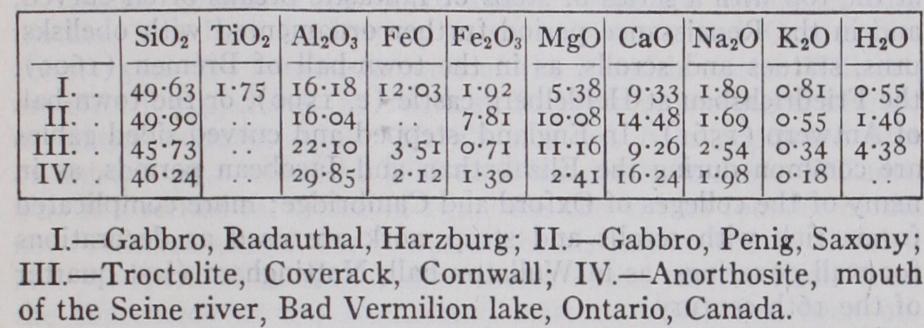
Chemically the gabbros are typical rocks of the basic sub division and show the characters of that group in the clearest way. They have low silica, much iron and magnesia, and the abundance of lime distinguishes them in a marked fashion from both the granites and the peridotites. A few analyses of well-known gab bros are cited here.