The Harp Shells
THE HARP SHELLS Genus HARPA, Lam.
Shell large, ventricose, longitudinally ribbed; columella polished, broad and fluted above, narrow and smooth below; outer lip thickened; aperture large; operculum, none.
A very distinct genus of nine species, distributed in all tropical waters except those of the Atlantic Ocean.
The general outline of these shells, and the parallel series of ribs stretched from spire to base, justify the name. Harpalis, Harparia, Lyra, Cythara, Buccinum—all these generic names have been applied to members of this small group. All credit them with grace of form and perfection of finish befitting instru ments of music. To these attributes are added richness of colour ing that alone would rank them above most other shell families. Combining colour harmonies of unsurpassed beauty with sym metry and grace of line and curve, the harp shells have perhaps excited more universal admiration than any other group of the "aristocratic shells." There is no door in a harp shell shutting the world out when the mollusk would retire and rest. There is not room enough inside for the animal. The head and tentacles, and the crescent shaped foot protrude when the body is completely withdrawn. The colours of these fleshy parts rival those of the shell. In Mauritius the natives go out at low tide with net rakes to catch harps on the sands. The mollusk crawls rapidly along to escape the net. When hard pressed it withdraws as far as possible within its shell, and may cut off part of the foot by pressure upon the lips! This observation was made upon H. ventricosa.
The shell grows through a certain period, then ceases for a time. In preparation for this period of rest the lip is thickened. The strong ribs of the harp thus correspond to the varices of Murex and Triton. The shorter the food supply, the closer the ribs of the shell. The mode of feeding of these large mollusks 97 The Olive Shells. Rice Shells. Harp Shells is a puzzle. The radula is of the olive type, but very much degraded. The central tooth only is left in each row.
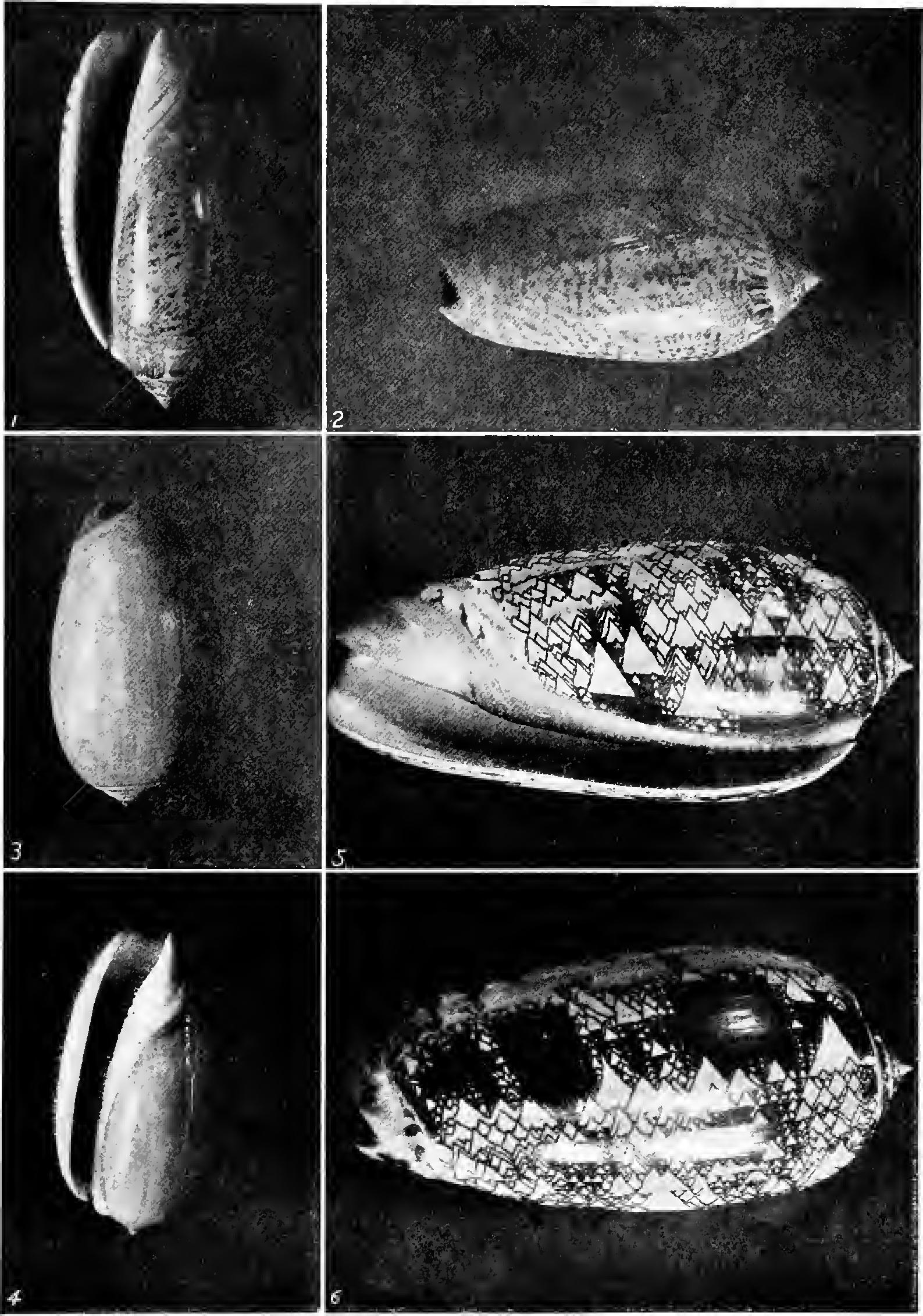
The Ventricose Harp (H. ventricosa, Lam.) is swollen greatly in the middle; the most characteristic feature is the sharp angular compression of the broad ribs, ending in spinous processes that encircle the spire. Square spots of purplish red form broad spiral
bands of dark colour on the paler brownish flesh-coloured ground. The interstices between the ribs are painted with bright festoons of light and dark brown. The bands show plainly in the wide aperture. The columella is widely reflected above and painted with brown blotches. Length, 21 to 5 inches.
Habitat.— Mauritius, Indian Ocean, Philippines.
The Imperial Harp (H. intperialis, Chemn., H. costata, Linn.) has a far greater number of ribs, and these are rounded and very closely set. There is no room between for the peculiar festooning pattern that traverses the grooves in the other species. The spiral bands of dark brown are narrower and more numerous than in H. ventricosa. The lining is bright orange as is also the reflected area of the columella. Length, 3 to 5 inches.
Habitat.— Mauritius.
The Noble Harp (H. nobilis, Lam.) is very distinct, its shell much contracted toward the base, the spire elevated, the ribs remote from each other, and painted with groups of fine black lines, forming dark spiral bands. The broad sulci are painted with curly lines of brown on a paler ground colour, or mottled with dark spots on a rosy ground. Sometimes the rose tint is restricted to large square spots. Length, 2 to 3 inches.
Habitat.— Indian Ocean, Philippines.
The Rose Harp (H. rosea, Lam.) is distinguished from its near relative, H. nobilis, by its delicate rosy colour, the faintness and irregularity of its flat ribs, and the absence of black cross lines. Length, 2 to 3 inches.
Habitat.— Senegal, Guinea.
The Articulated Harp (H. articularis, Lam.) is ventricose, thin and ashy gray, the distant ribs crossed by black spots or lines, sometimes grouped. Faint festoons of gray and yellow occupy about half of each wide interstice. Some forms are flushed with pink over the gray colour scheme. Length, 2 to 4 inches.
Habitat.— Pacific islands.
The Crenated Harp (H. crenata, Swains.) has a scalloped 98