The Horn Shells - Family Cerithiidae
THE HORN SHELLS - FAMILY CERITHIIDAE. Shell spiral, much elongated, of many whorls, surface tuberculated; aperture channeled in front; operculum horny, spiral ; the head bears short muzzle, slender tentacles and stalked eyes. A large family of tropical and sub-tropical mollusks, living on rocks or among marine vegetation. A few forms live in brackish and fresh water. Some spend much time out of water, on stems of marsh plants.
Genus CERITHIUM, Brug.
Shell turreted, imperforate, varices indistinct; aperture small, with short posterior canal, the longer, anterior one oblique; outer lip expanded; inner lip thickened, concave. Siphon short; body grooved, truncated in front, narrowed behind; foot secretes a thread by which body may be suspended. It is often attached to a piece of floating seaweed. When unattached the mollusk crawls quickly along by its slender, extensible foot. It emits a green fluid when disturbed. It feeds on all sorts of decaying organic matter, even the slime of snails. Fossil species, near five hundred. C. giganteum, an Eocene fossil, is two feet long. American representatives few and of small size. Marine or amphibious mollusks in tropical seas, with a few in temperate waters. In the West Indies they swarm in great numbers and variety. One species is the sole food of flamingoes after they attain adult size. One sweep of a hand-net in the tide pools at low water on the reefs just out of Key West will gather in hundreds of them, particularly of the species septem-striatum, Say. There are hundreds sunning themselves on every exposed rock.
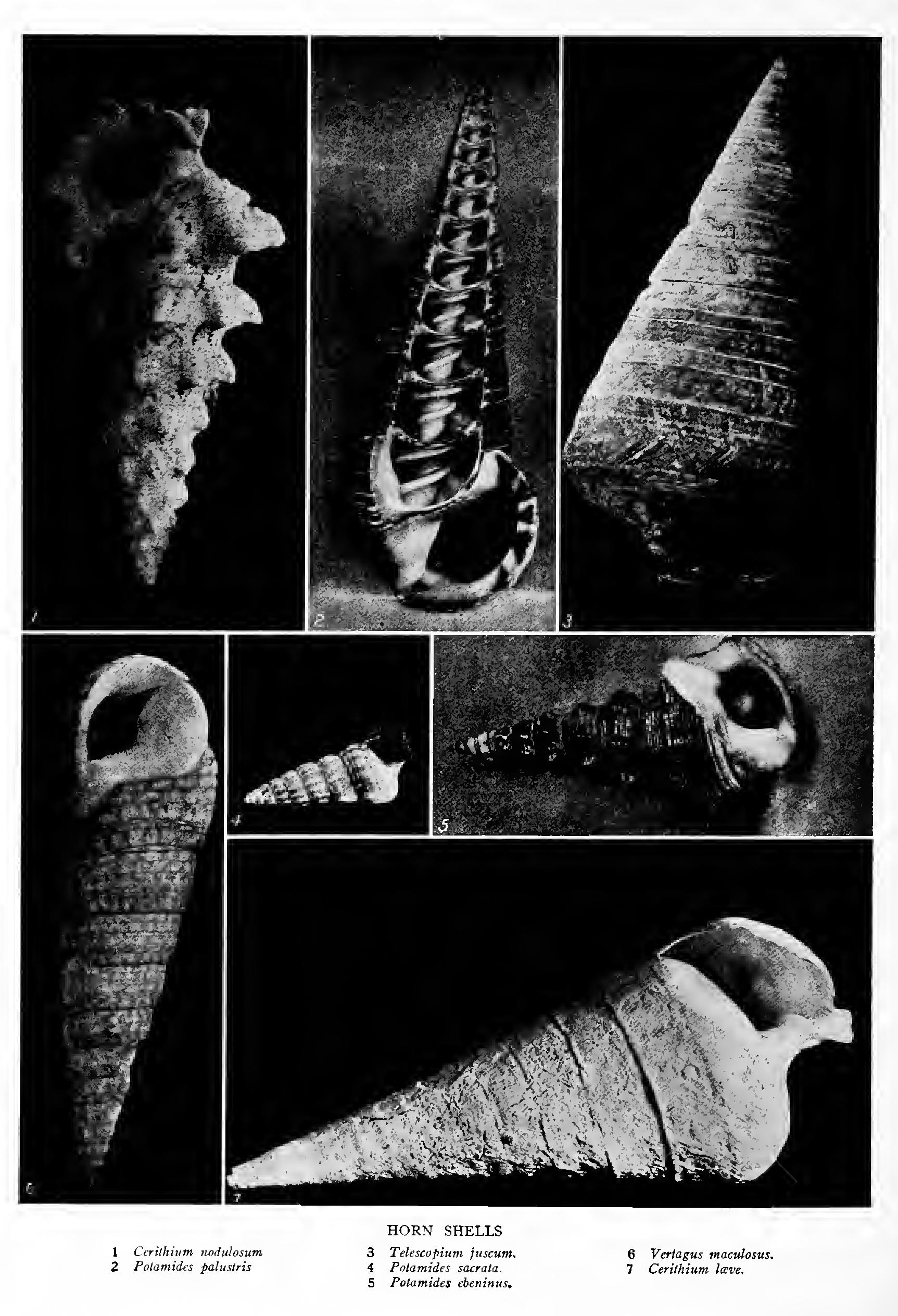
The Brown Horn Shell (C. eburneum, Brug.), about 1 inch long, has strong spiral ribs set with rounded knobs, the middle ridge bears the largest. Fine spiral strim and occasional varices The Horn Shells further sculpture the surface. Chestnut dots and patches colour the depression and the aperture. Sometimes the shells are colourless.
Habitat.— West Indies, Florida.
The Dark Horn Shell (C. atratutn, Born.) has a row of small nodules in the suture, and a larger row on the keel of the whorl, with fine strip between. A strong varix is opposite the
aperture. Colour, dark gray or chocolate; aperture bluish. Length, t, to i inches.
Habitat.—West Indies, Florida.
C. muscarum, Say, has rounded, spirally ribbed whorls crossed by longitudinal, finely knobbed, ridges. Small brown dots cover the more depressed surfaces and often the ridges as well. This is a slender species. Length, I inch.
Habitat.— Bahamas, Florida.
C.
litteratum, Born., is a stouter shell, i to I inches long, its whorls bordered above with the strongest set of tubercles, the depressed surfaces dotted and splashed with pale brown, in a pattern resembling letters.
Habitat.—West Indies, Florida.
C. ferrugineum,
Say, is two-thirds of an inch long, dark with orange red tinge, spirally ridged and faintly knobbed, with a dark aperture.
Habitat.— South Carolina to Florida.
C. lxve, Quoy, a smooth species, is the largest living mem ber of the family. It is white with many flattened whorls forming a regular spire, except that the body whorl is slightly swollen. Length, 5 to 6 inches.
Habitat.— Australia.
Genus CERITHIDEA, Swains.
This group is distinguished by the tree-dwellers and other amphibious forms it contains.
The Decollated Cerithidea, (C. decollata, Linn.), the type of the genus, is a widely distributed species of robust character, somewhat over an inch long. The apex is truncated, the rounded whorls brown, sometimes with a white line at the suture, with strong ridges and fine stria: crossing all over the surface. These molluSks live on swampy coasts of warm regions. They some I 8o The Horn Shells times cover the trunks of marsh trees in Natal so thickly that not an inch of the bark is unoccupied. A naturalist who collected them at this station says that the mollusks are attached by a trifle of brittle mucus that affixes the lip to the tree. None hangs by a thread.
Habitat.—Madagascar and India.