The Moon Shells and Velvet Shells - Family Naticidae
Habitat.— Maine to New Jersey.
144 The Moon Shells and Velvet Shells The Western Moon Shell (N. Lewisii, Gld.) is the largest species known. The shell is lighter and thinner than in N. heros. Faint spiral striations are seen on the whorls; the body whorl has an angular shoulder. The outside is yellowish white, the lining polished and stained brown. A callus lobe narrows the mouth of the deep umbilicus. This "snail of prey" has the same predatory habits as its counterpart of the east coast. Diameter, 3 to 5 inches.
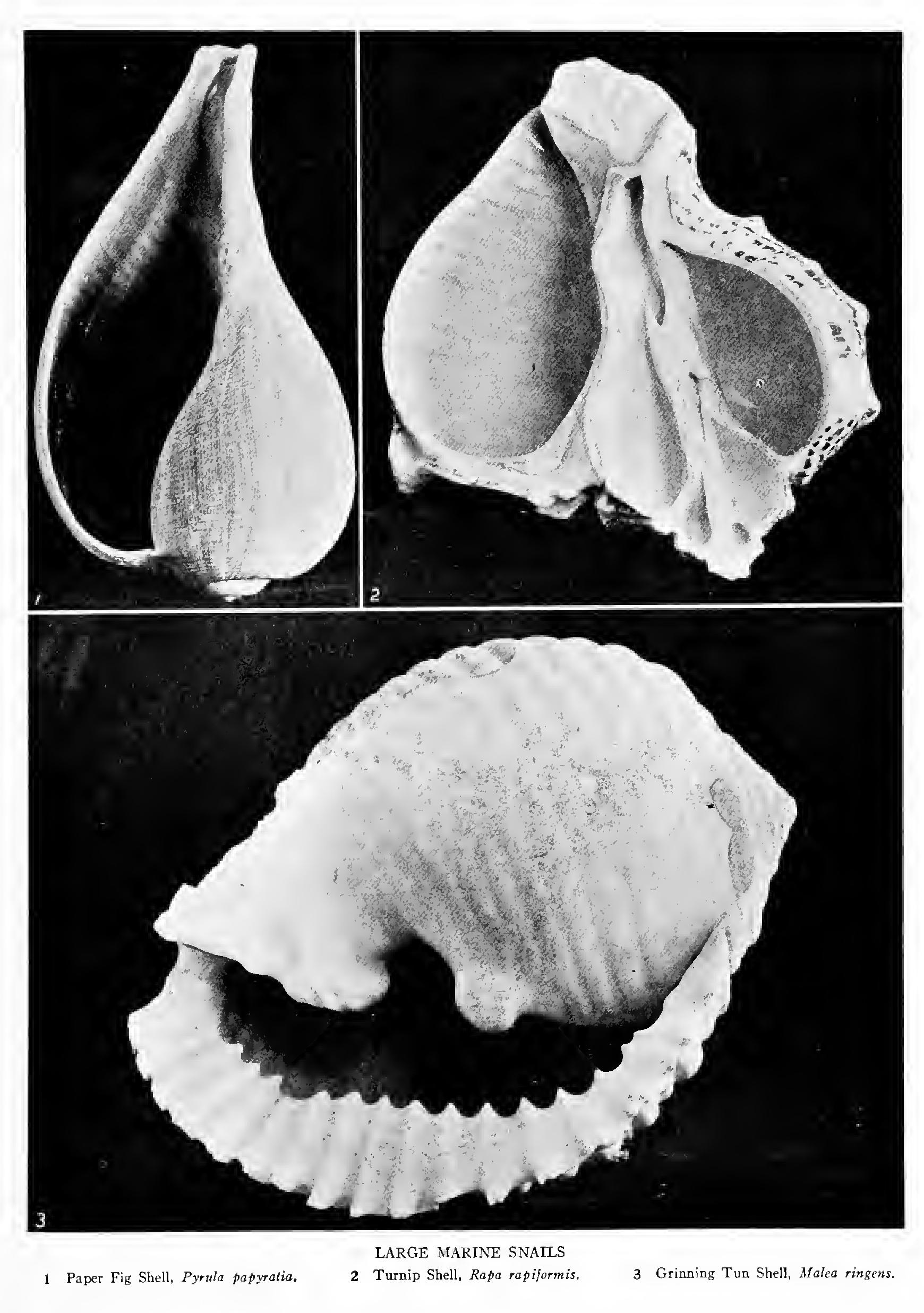
Habitat.— California to Alaska, Japan.
N.
duplicata, Say, has a flatter spire and a smoother shell thanN. heros, with bluish tinge on the pale brownish upper surface. The distinguishing feature is a thick brown lobe that extends over the wide umbilicus, but does not quite close it. The spiral umbilicus is also distinctive. The sand collar is ruffled on its outer border. This species reaches but three inches in diam eter. It has the same habit as N. heros, and a much wider range.
Habitat.— New England to Florida, Gulf of Mexico.
N.
clausa, Brod. and Sby., is a whitish moon shell, inch to 2 inches across, which has the small umbilicus entirely filled by a callus. The operculum is calcareous, bluish white. 1 t is found in cold seas and at considerable depths.
Habitat.— Greenland to Massachusetts.
N.
Recluziana, Desh., has a more conical shell than the eastern species, in fact is rather a turban shell in form, and,very thick and heavy, with brown banded whorls shading to pat ash colour. It is about 2 to 3 inches long. The umbilicus is closed by a very thick enamel callus. The "sand collar," shaped like a horse's hoof, often has rows of the eggs of Nassa along the top.
Habitat.— Southern California.
N.
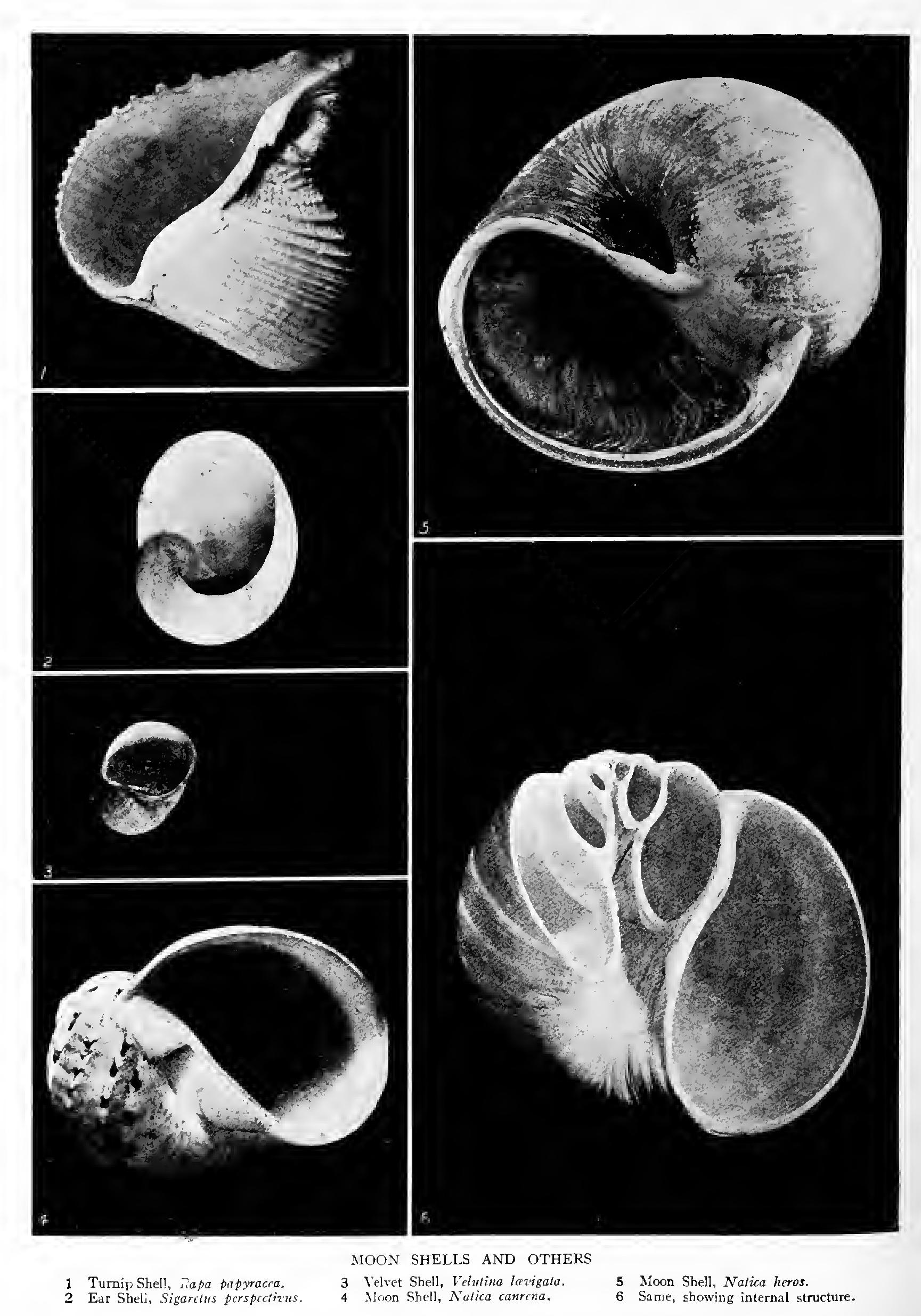
canrena, Linn., is a Floridian and West Indian moon shell found also along the Atlantic to Cape Hatteras. The shell has spiral chestnut bars streaked diagonally with purple on a whitish ground. The base is not coloured. The wide aperture is purple-lined. The umbilicus is partially plugged with a callus. The operculum is calcareous. This is one of the small Naticas, being 1 to 11 inches in diameter.
Some tropical moon shells are highly polished and brilliantly coloured. The Philippines furnish.several of these, the "zebra," 145 The Moon Shells and Velvet Shells and "painted" moon shells, suggesting in their common names their colouring and marking.
Genus SIGARETUS, Lam.
Shell ear-shaped, white, solid, flattened; spire lateral; aperture oblique, flaring; operculum very small: umbilicus wanting; foot very large, especially the burrowing part in front. It lives in muddy sand flats of warm seas.
S.
perspectivus, Say, differs from the Naticas in form and in its manners. The flattened white shell is shaped like that of a Haliotis. It is called "ear shell," a good descriptive name. The immense foot suggests its relation to the moon shells. But the aggressive methods of the previous genus are a striking contrast to the halting timidity of this one. It is a slow and cautious citizen. It may well be apprehensive, for the body is exposed to dangers unknown to Natica. When the foot is con tracted to the compass of the shell, the operculum is little or no protection, for it is a thin button, by no means large enough to cover the exposed surface of the body.
This mollusk is a dainty morsel to the various "littoral pigs" that root for their daily rations in the wet sand. In its turn, it falls upon the oyster which is smothered by being enveloped in the folds of the muscular body.
Rare on northern beaches, it becomes more abundant as we go down the Atlantic coast. A dotted form, S. maculatus, Say, is met on the beaches of Florida. Length, I i inches.
Habitat.— New Jersey to Florida.
The Frail Ear Shell (S. debilis, Gld.) is a very delicate, shallow saucer of white china, with a small spire at one end. The surface is beautifully cancellated. The creature lives just under the sand. Its food is small bivalves. Length, I inch.
Habitat.— Southern California.
Genus LAMELLARIA, Montagu Shell ear-shaped, internal, thin, pellucid, spire small, lateral; aperture large; operculum wanting.
L. Stearnsii,
DaII, is a thin, white, ear-shaped shell which in life is quite swallowed up by the mantle. Length, about i inch. Habitat.— Monterey, Cal.
146 The Moon Shells and Velvet Shells L. rhombica, Da11, white, and found in the same locality, is larger, has a squarish aperture; the reflexed mantle does not cover the shell.
L. pellucida,
Verrill, with a delicate transparent ovate shell, containing a yellowish brown animal, has been dredged from deep water off Martha's Vineyard. Length, about 1 inch.
The Lamellari2 come from deep water in February to spawn in the shallows. Their food consists of polyzoans. When about to lay her eggs a female eats a hole in a jelly-like compound ascidian, and in this makes a nest like a deep pot, lays the eggs in it, and covers them with a tight lid. As the young develop the nest rises above the level of the surface in which it was buried. The lid flies open at the proper time, and the fry emerge.