The Mussels and Rock Eaters - Family Mytil1dae
THE MUSSELS AND ROCK- EATERS - FAMILY MYTIL1DAE. Shell elongated or oval, beaks anterior ; hinge toothless ; ligament long, internal ; shell lining pearly ; periostra cum thick, dark, often hairy. Mantle open except between siphonal openings; four gills, elongated, leaf-like, attached to the mantle at their dorsal margins; foot cylindrical, spinning byssus; adductor muscles two, unequal.
A large family with abundant representation on all shores where they hang in masses on piers of wharfing, and cover sub merged driftwood if it is lodged near the level of low water. Some are burrowers ; some spin nests out of bits of shells and sand held together by byssal threads. Some hide in the burrows of rock borers, or excavate soft rock to make their own retreats. They are economically important as edible shell fish and as bait for long-line fishing. The principal genera are represented in this country.
Genus MYTILUS, Linn.
Shell obliquely and narrowly fan-shaped, rounded behind, with terminal, pointed beaks in front. Mantle margins plain, projecting slightly behind; incurrent tube of siphon fringed ; palpi long, pointed ; gills sub-equal ; flesh white ; byssal gland in "heel" of the small foot ; byssus strong, coarse. A world-wide, gregarious genus of sixty-five species.
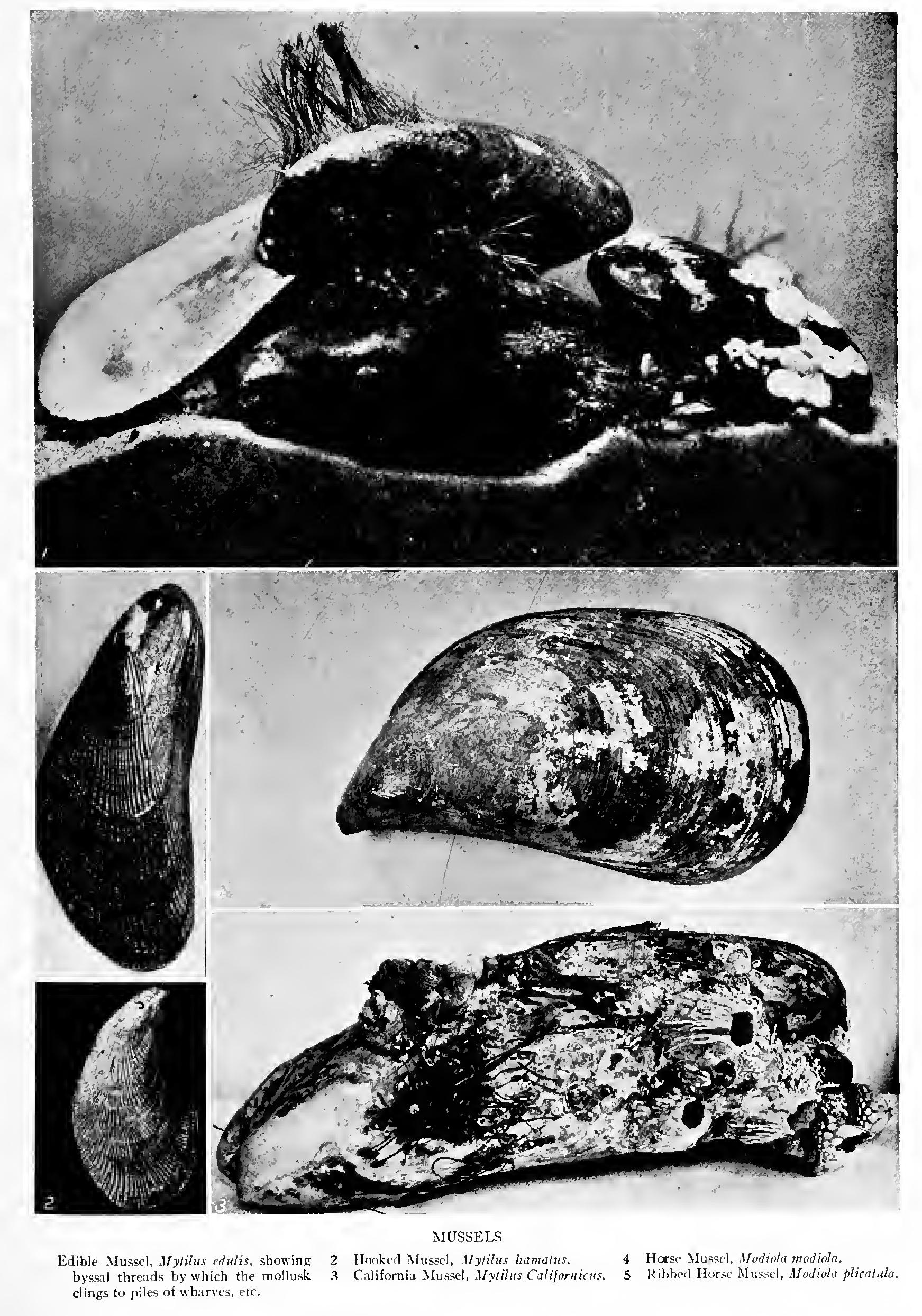
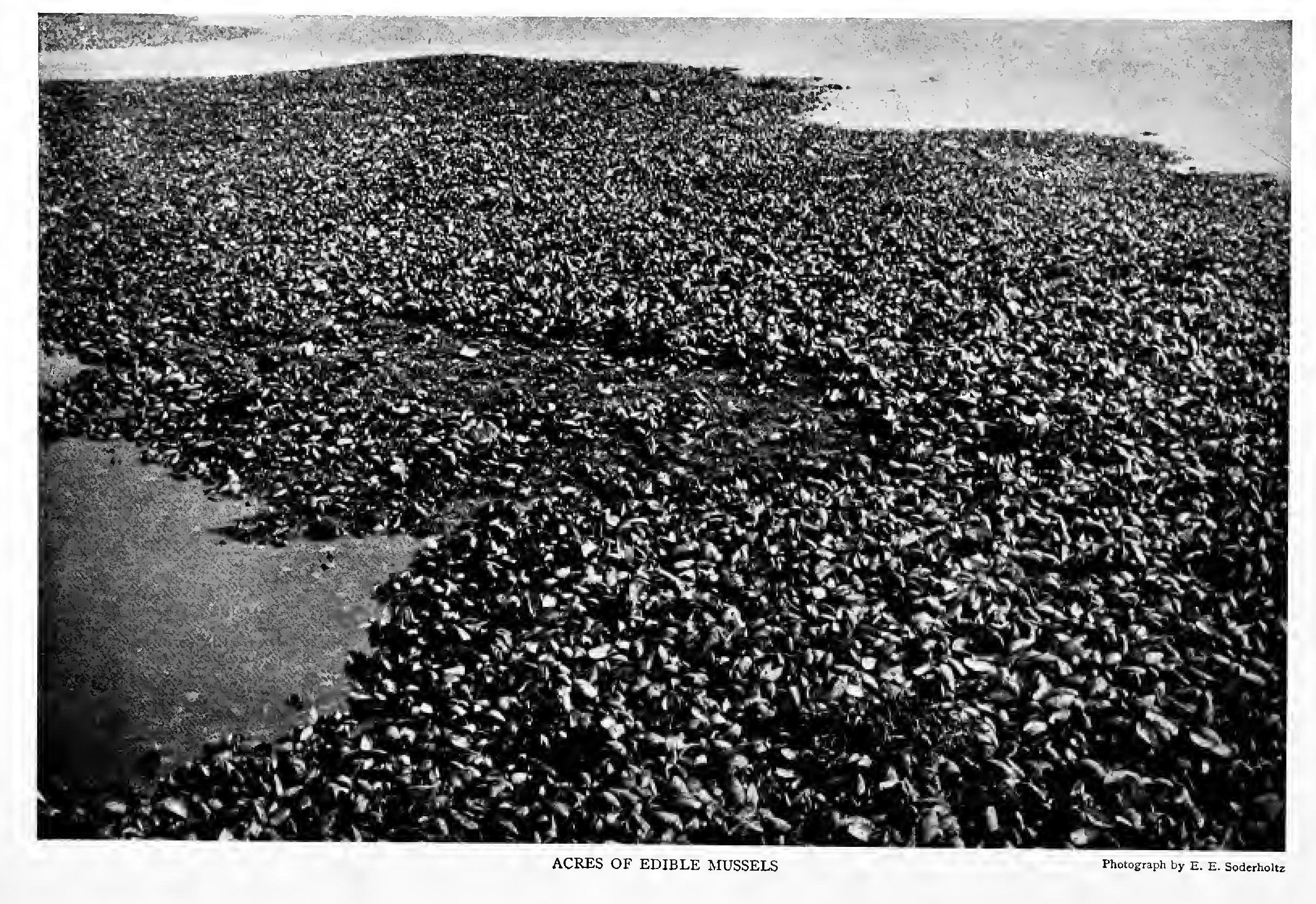
The Edible Mussel (M. edulis, Linn.) native to the tem perate shores of Europe, has proved a hardy immigrant to both our coasts. Acres of them are exposed to low tide on mud flats extending far up the estuaries of rivers that flow into the ocean. Again, we find them attached in masses to the rocks of exposed coasts, where the bottom is pebbly, and the water clear. A favourite station is the underpinning of wharves, in water be fouled by contact with trafficking towns. Every outgoing tide 387 The Mussels and Rock-eaters exposes the piers with their dingy incrustations of barnacles and black mussels of all sizes. Every fugitive timber, afloat or sunken, is coated. Vessels at anchor soon become loaded.
The young are numberless. At breeding time the mantle of the adult becomes transformed into .brood chambers. The enormous development of the reproductive organs minimises all others. The minute yellow eggs seem to fill all the space be tween the valves. The "fry" settle upon any support that
offers, to save themselves from suffocation in the soft mud.
We Americans do not eat mussels to any extent. They are in the fish markets because the foreign population demand them. In Europe they are rated a staple sea food; and consign ments are shipped inland, as clams and oysters are in this coun try. In the Bay of Kiel it is a regular practice to put down branches of elm and other suitable trees. In a few years these boughs are taken up, laden with fine, large mussels.
Mussel-farming is carried on by the French who set tall stakes in the liquid mud with six feet exposed at low water. Basket work connects the stakes, and mussels cover the whole. They require less care than oysters, but are very sensitive to cold. Acres are sometimes killed by a single gale. As every yard of the basket-work, called bouchots, is calculated to yield a cartload of mussels, worth six francs, the profit of mussel cul ture can be guessed at. The most important "farm" has a total mussel-bearing surface amounting to somewhat over one hundred square miles.
The old tale that the Bideford bridge is held together by the network spun by mussels has a grain of truth in a husk of fable.
rt is true that the town council, believing that the masses of mus sels protect the foundations from being undermined by the tide, has forbidden the taking of mussels from this place. Mussel beds in various places act as barriers, protecting lowlands from inundation. An artificial jetty is soon loaded with mussels and filled with silt, which year by year increase its stability and efficiency as a breakwater.
The Indians gathered mussels for food, and the colonists did likewise, but learned soon that clams and oysters were better food. The scow-loads of young mussels dredged or raked from beds along the coasts of New England and Long Island are sold to farmers who spread them as fertilizer on their fields. For 388 The Mussels and Rock-eaters the good of the oyster beds, it is well to keep the mussels in check. Thousands of bushels are taken yearly from the river mouths of Great Britain to supply bait for the long-line fisherman.