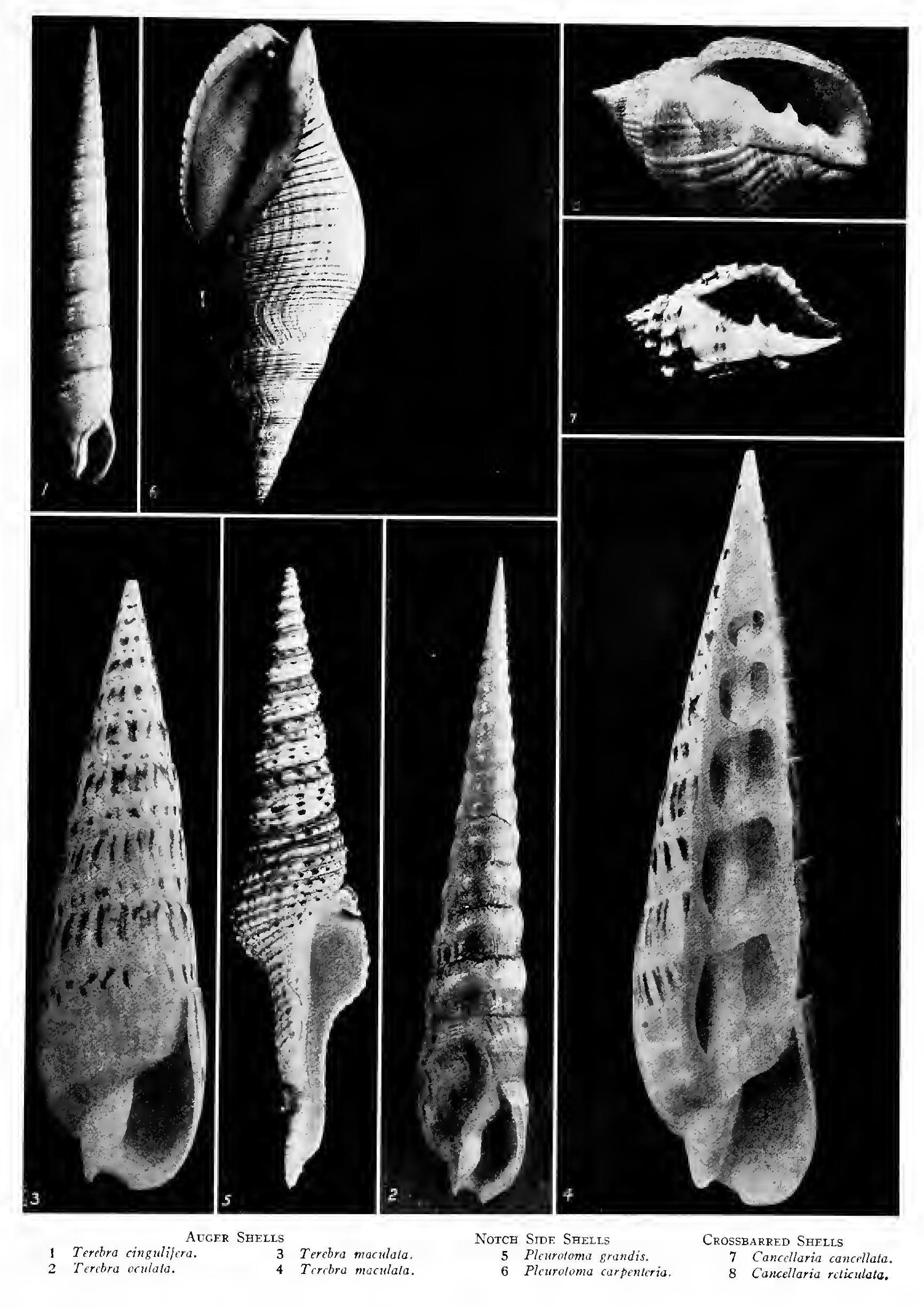
The Notch-Side Shells Family Pleurotomidae
P. torosa,
Cpr., is cross-ribbed along the shoulder of the whorls, the protuberances contrasting with the brown ground colour. Length, over I inch.
Habitat.— Southern California.
Genus DRILLIA, Gray Allied to Pleurotoma, and closely resembling it, but smaller and more delicately made throughout. Well represented on our west coast.
The Pencilled Drillia (D. pencillata, Cpr.) I first found alive on the sand at Terminal Island, below San Pedro harbour. It had been a notable day, for I found a large Pomaulax alive on the rocks at Dead Man's Island. The old jetty had yielded living Pectens, Pteronoti, Olivellas, bubble shells, and even a devil-fish of handy size to carry home. My good luck as a col lector came from having as a guide Mrs. Oldroyd, whose wide knowledge of the molluscan life of the Pacific coast is recognised by all modern conchologists. She had her reward in the discovery of a rare species of Thracia, and in showing a stranger the rich fauna of San Pedro.
The train was late, and we returned to the beach, for the tide was at its ebb, and daylight still lingered. Well up on the sand we discovered little pellets of sand lifted. Under each was a Drillia, thrusting itself out of the narrow doorway, as if to survey the landscape. The slender spire, the notch, and the close, angled cross lines on each whorl, identified the species. The sutural notch produces the fine herring-bone pattern of brown and yellow that decorates the coils. The largest specimens were under two inches in length.
Habitat. —Sout hern California.
The Knobbed Drillia (D. torosa, Cpr.) is a northern species, much darker brown, with a pale beaded line following the suture. Length, 3 inches.
Habitat.— California northward.
D. mcesta,
Cpr., like the last in size and form, substitutes 109 The Notch-side Shells cross ribs for the beading of the suture. It is olive or brown, and dull. Look for it under stones as the tide goes out. Habitat.— Southern California.
The Burnt Drillia (D. empyrosia, Da11) shades from yellow to dark brown, the 'colour deepening toward the latest whorls. The spire is stouter than that of its relatives. Across each whorl obtuse and pale knobs or ridges pass; the suture is outlined with white. The columella is arched decidedly at a point opposite the sutural notch. This species is dredged at some depth off San Pedro, and no shells are washed ashore. The largest are scarcely two inches long.
D. incisa; Cpr., ashy-hued, with revolving lines of red, resembles D. pencillata, but is half as large. Length, I inch. Habitat.—Puget Sound.
The related genus, Bela, Gray, is a group of spindle shells usually 'notched, so we may recognise family traits in most of the species. Our dozen or more species are very small, and rare in collections, being for the most part Alaskan, many taken from deep water.
Genus MANGILIA, Risso The spindle shape and narrow, long aperture characterise this group of a dozen west coast species. They are little, and rarely seen, for they are cold water forms for the most part.
M. merits, GId., has six whorls crossed by distinct, rounded ribs, intersecting sharp spiral ridges. They are pure white. Length, inch M. variegata, Cpr., with still more prominent longitudinal ridges, is a thin, yellow shell, darkening toward the apex. The pattern is mixed and indistinct. Length, inch.
Habitat.—Southern California.
110