The Purples Dog Winkles Family Muricidae
THE PURPLES. DOG WINKLES FAMILY MURICIDAE. Sub-family PURPURINL Shell bears nodules but no varices; columella flattened, spread out; canal short, or a mere notch; operculum oblong, with lateral nucleus. A large sub-family whose boundaries can not be definitely set at present.
Genus PURPURA, Brug.
Shell oblong-oval, last whorl large; spire short; aperture large, ovate, ending in short, oblique canal or notch; columella flattened; outer lip simple; operculum horny.
A carnivorous genus, living from the water line to twenty five fathoms' depth in all parts of the world. Recent species, fifty-seven; fossil species, forty, Tertiary.
By the recession of the tide these mollusks are left out of water twice a day for several hours. They breathe air which passes over a small quantity of water retained in the branchial cavity. They are amphibious, as well as carnivorous; and well protected by their strong shells against injury by the waves and by predatory birds and mollusks. Altogether, they are adapted to succeed in the race for life.
The common name of this genus has a long and interesting pedigree, which takes us far back into ancient history. The "Tyrian purple," famous because used solely for dyeing garments to be worn by emperors and kings, was obtained by crushing these mollusks in mortars or in pot holes along the rocky coasts of Tyre and other Mediterranean ports. Pliny says that 111 purx to zoo Buccina, pounded together, produced the richest shade of purple. The animals of large species were removed from their shells.
The colouring matter is not contained in the shell, but in a 42 The Purples. Dog Winkles vein or sac on the back of the body. Its use to its owner is the same as the ink of the common squid. A jet of ink colours the water, and enables the pursued to escape from an enemy. We can understand how hard and tedious was the process of obtaining this dye in quantities.
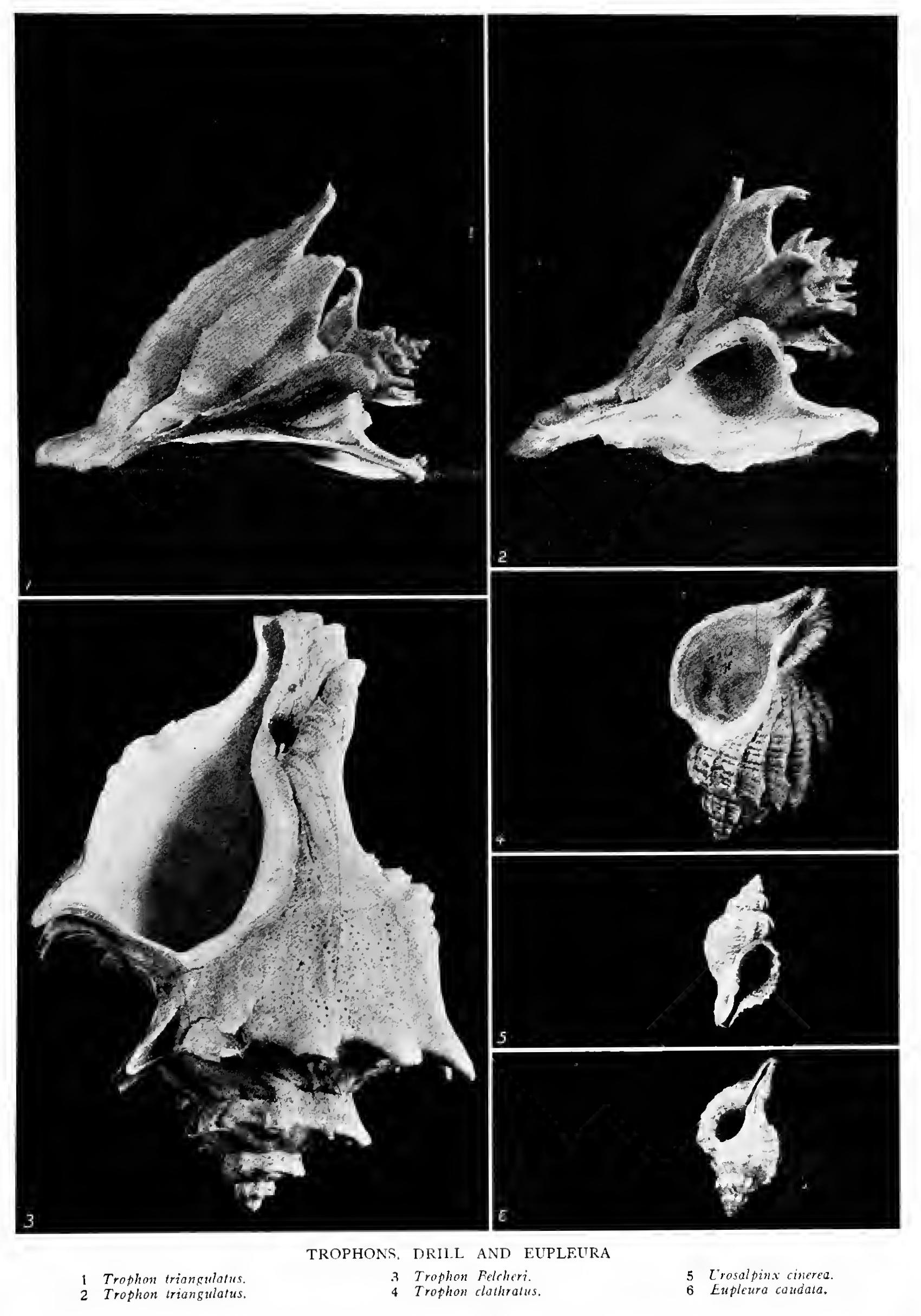
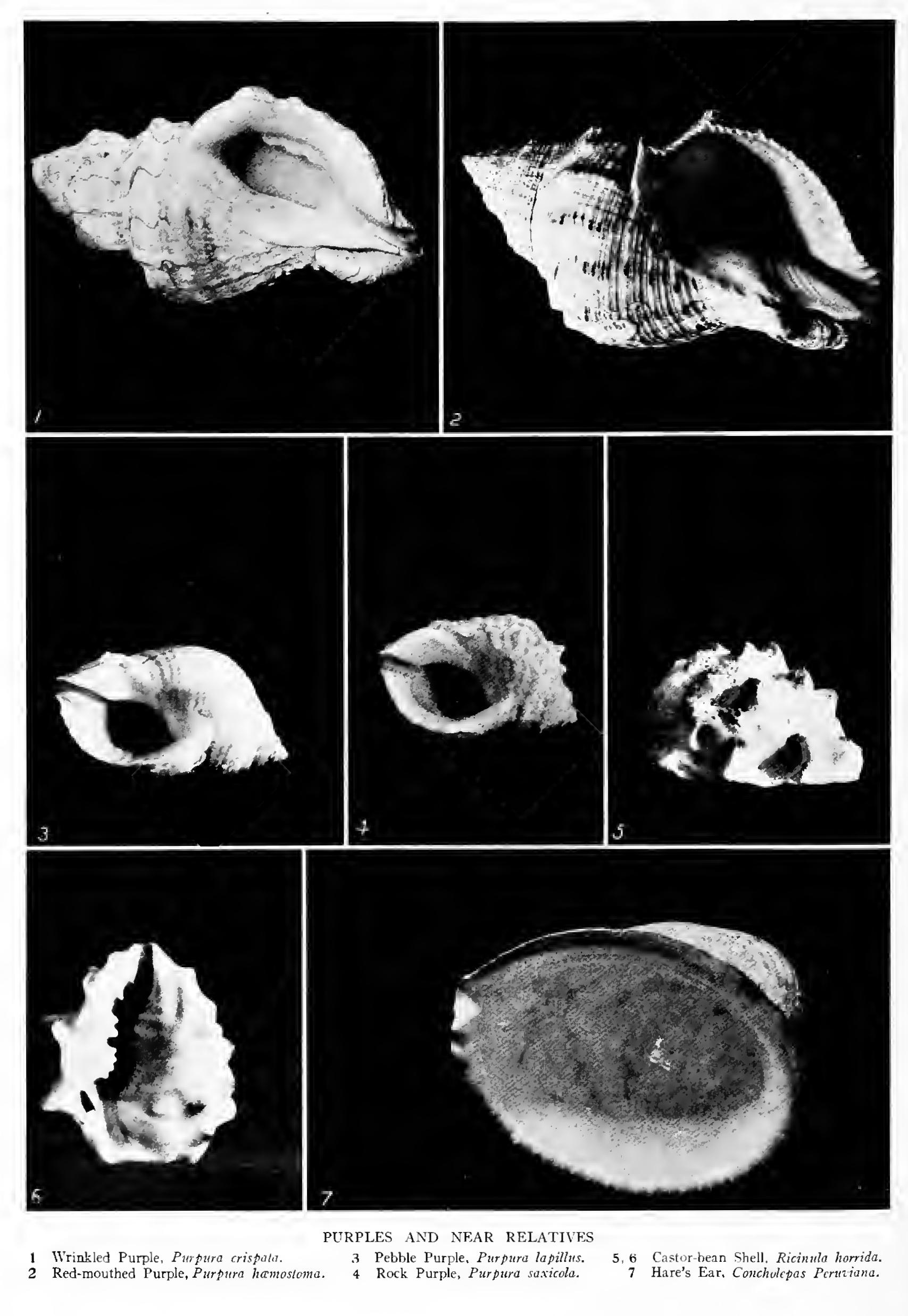
The complex art of blending the juices to produce the desired play of colouring was known only in ancient Tyre, and this secret was lost when the city was destroyed. Meanwhile the cochineal
bug and modern coal tar dyes have supplied cheaper materials.
"In the reign of Augustus one pound of wool dyed with Tyrian purple sold for about Z36 sterling." Six pounds of liquor were required to one pound of wool. Consequently fabrics when dyed often cost their weight in gold.
The Princely Purple (P. Persica, Linn.) is the type of this genus. It is oval, with a short spire; its brown surface is regu larly spirally grooved, and wound with a narrow band of white, dotted with brown. A row of nodules encircles the upper whorls. Columella reddish yellow; aperture wide, pinkish or bluish within; lip thin, with five interrupted brown lines crossing the inner margin. Length, 3 to 5 inches.
Habitat. — Philippines.
The Purple (P_ patula, Linn.) is like the preceding in size, colour scheme, wide columella and gaping aperture. The spire is depressed, however, and the spiral ridges are much stronger, and irregularly tubercled. The lip is fluted, and marked with the dark brown that alternates with white on the outer surface. The columella is reddish chestnut, with a dark brown semi-lunar patch at the top. The sculpture is much sharper in young than in adult specimens.
Habitat. — Gulf of California, Philippines, West Indies.
The Chocolate Purple (P. chocolatunt, Duclos), with deep chocolate exterior, knobbed along the square shoulders, and closely ridged on the thick lip, is described as a very active mol lusk. The early Peruvians must have used the mollusk as food, judging by the piles of shells found near the tombs at Arica. Length, 3+ inches.
Habitat. — Peru.
Another large species which Reeve calls P. gigantea, is con nected by intermediate forms with P. consul, Lam. Spire is sharp; whorls encircled with fine brown lines; shoulders square, tuber 43 The Purples. Dog Winkles culated; columella broad, flat, orange-red; aperture orange; lip margin ridged. Length 21 to 5 inches.