The Razor Shells Razor Clams - Family Solenidae
Genus ENSIS, Schum.
Shell elongated, transverse, curved or straight, gaping and squarish at ends; siphons short, divided; hinge teeth two and three at upper, anterior angle.
Very similar in structure to Solen, with which it is constantly confused. Fourteen species, in temperate and warm seas.
The Sword Razor (Ensis directus, Dall) is the common long razor of the east coast. The foot is thick and strong, and changes form with great suddenness, enabling the mollusk to disappear into the sand on the approach of danger. The valves curve slightly. The surface is marked longitudinally with fine growth lines, joined in the middle of each valve with cross lines concentric with the corner hinge. The white, thin shell is covered with glossy greenish epidermis.
This is Solen ensis, Linn., and Ensis Americanus, Gld. Length, 6 inches.
Habitat.— New England southward.
The California Sword Razor (E. Californicus, Dall) is a miniature of E.directus, delicate, slender, scarcely three inches long, and rosy-mottled on the cross lines, under the horny epidermis.
Habitat.— Monterey southward.
The Pod Razor (E. siliqua, Linn.) is the type. This is the "spout fish" of British coasts. It is curve but slightly and squared at both ends. The hinge at one corner has a single cardinal on the right valve fitting between two teeth on the left. The strong adductor muscles reinforce the hinge, else the valves would not be under control. Sand between mantle and shell 'cannot be expelled, so it is overlaid with nacre. This is the razor
that snips off a portion of its foot when excited, the valves acting as scissors. Length, 6 to 8 inches.
Habitat — Europe.
Genus SOLECURTUS, Blainv. (TAGELUS, Gray)
Shell elongated, ventricose, smooth hinge sub-central; ends rounded, gaping; animal too large for its shell; foot thick; siphons 32o The Razor Shells. Razor Clams separate; incurrent orifice fringed, excurrent plain ; arc ventrical, cylindrical. Eleven species. Burrows below low water, deep in sand and mud.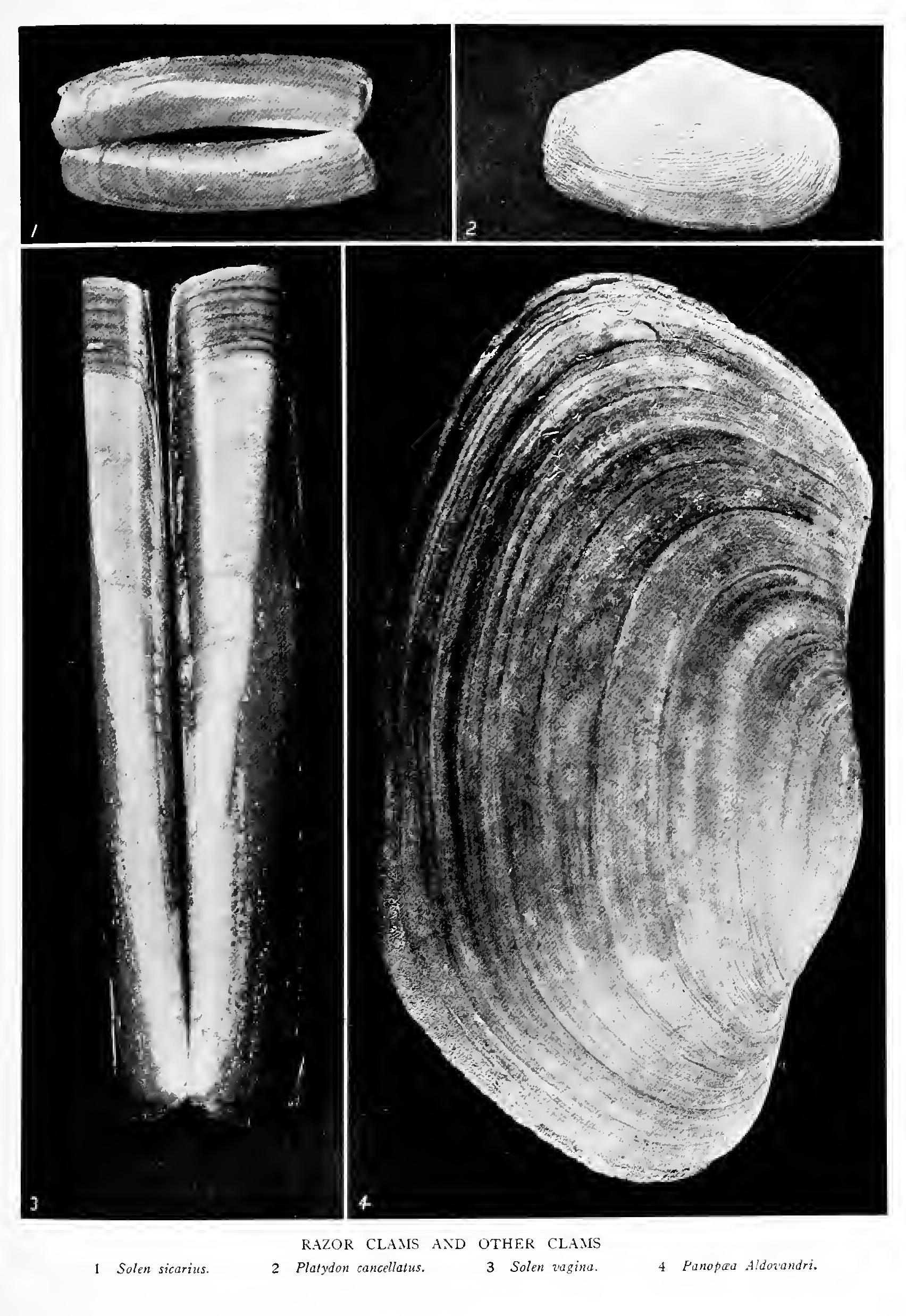
The Short Razor (S. gibbus, Speng.) is a common mud burrower, south of Cape Cod, on the Atlantic coast. It has orange eye spots about the siphons to warn it of approaching harm. The exceeding length of its separated siphons, the tongue like foot, and the yellowish epidermis, overhanging at the edges, distinguish this species. The burrow has two exits, one for each siphon. Length, 2 inches.
The Californian Short Razor (S. Californianus, Conr.) is abruptly rounded at each end. The shell has a dull epidermis, and a central hinge.. Wild ducks and gulls have a great liking for this mollusk. They know where to find the colonies in the mud flats. Length, 3 to 4 inches.
Habitat.— Southern California.
Var. subteres, Conr., is more delicate throughout. Violet rays show under the olivaceous epidermis. This is found with the common form. Length, 2 to 3 inches.
Habitat.— Southern California.
321