The Scallops Comb Shells - Family Pectinidae
Habitat.— Japan.
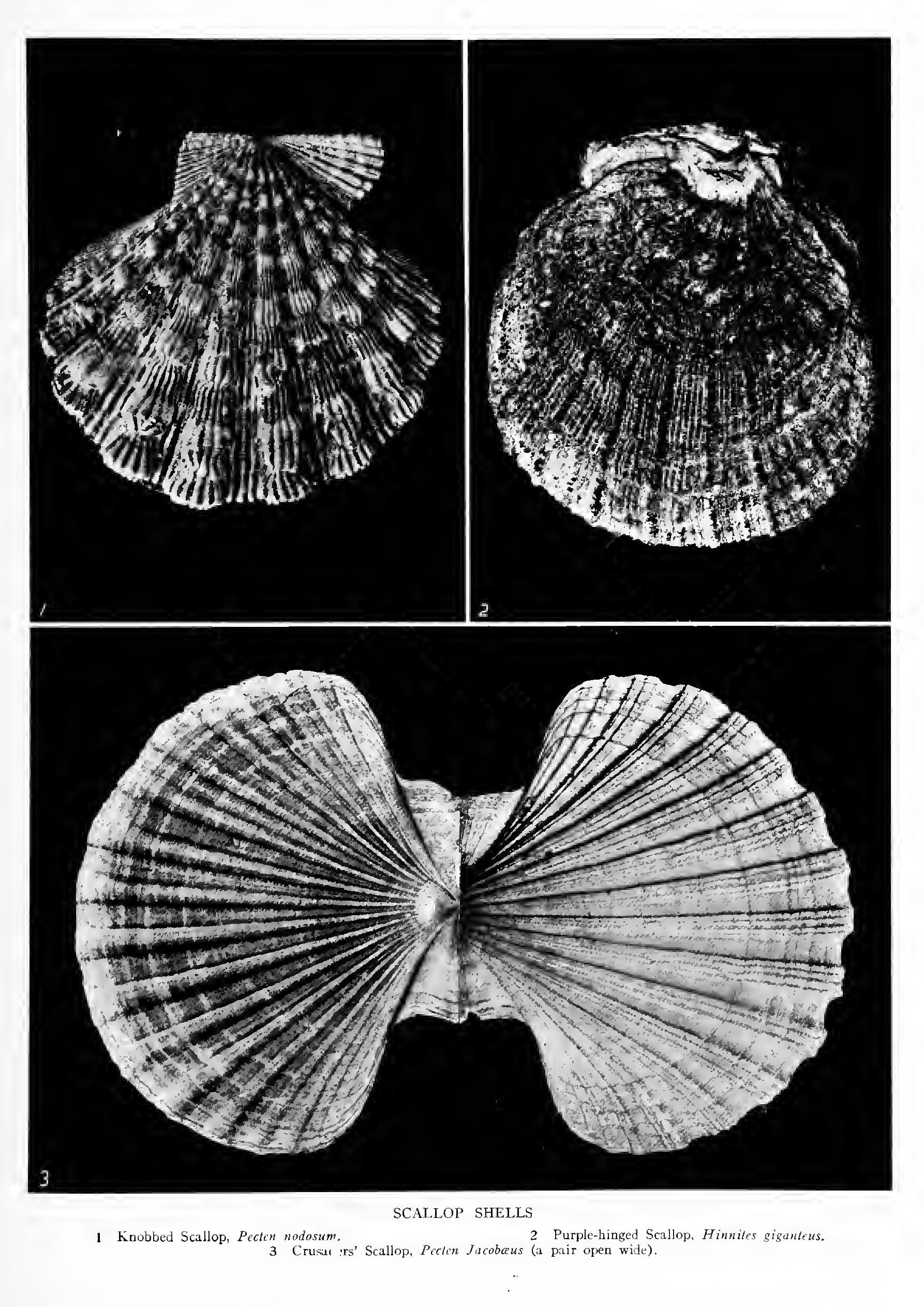
The Knobbed Scallop (P. nodosus, Linn.) has blunt nodules along the nine strong ribs; those near the ventral margin are squamose folds — apparently knobs in an unfinished state. The two valves are alike, flattened, and a uniform rich, dark orange or red. The large ears are unequal. Diameter, 3 to 4 inches.
Habitat.— West Indies, Mexico.
The Nothern Scallop (P. I slandicus, Miill.) is a lover of deep water along the coasts of the North Atlantic. It took its name from Iceland, where it was first discovered. Its hand some, circular valves are scored with a multitude of fine, scaly, ribs which persist on the inside of the shell. The left valve arches over the right, and is banded with circles, alternately dark and light. Purple, red, orange, salmon and bright pink specimens are before me. The most beautiful one is white with concentric bands of pink. The anterior ear is much the larger.
This species is rare in collections, even on its native coasts. Storms that drive inshore with unusual force may throw a few on the beach. Diameter, 3 inches.
Habitat.— Europe, New England.
The Magellan Scallop (P. Magellanicus, Gmel.) is thelargest American species. Though found only in northern waters it has been confused with a Patagonian species, and the name clings The valves are circular and dissimilar, gaping in front of the large, almost equal ears. The surface of the valves bears a great num ber of uniform radiating ridges, crossed and roughened by fine, upturned scales. The left valve is rose-coloured, deepening 415 The Scallops. Comb Shells toward the beak. The flat right valve is almost white. A deep water species. Diameter, 5 to 6 inches.
Habitat.— Newfoundland to New Jersey.
The Beaming Scallop (P. irradians, Lam.) is the most com mon species on the Atlantic coast, the edible scallop usually sold in our seaboard cities. Tons are dredged from the Jersey banks annually, and the demand is increasing. The shells sell also for "scalloping" shell fish, and for making fancy articles.
The outline of the valves is almost circular, with prominent, almost equal ears. The surface bears about twenty high, rounded
ribs, separated by rounded grooves. The exterior is brown, with concentric pale zones and radiating bars of red, purple or orange. A medley of rich colours is not uncommon. The lining is white and polished. A shallow water species. Diameter, 2 to 3 inches.
Habitat.— New England to Cape Hatteras.
P. dislocatus,
Say, replaces the preceding species below the Cape. Both its valves are convex, and set with close, rounded ribs. The ears are almost equal. The white ground is variously decorated with red or yellow in zigzag cross lines or in mottled designs. It occurs in a great variety of colors and patterns on the coast of Florida. In the shallow pools the young disport themselves, swimming about in gamesome mood. If frightened, they stir up the muddy bottom, and flee under the cloud that furnishes ample protection. Diameter, 1 to 2 inches.
Habitat.— North Carolina southward.
The Scallop (P. subnodosus, Sby.) is the most ponderous living species, named for the obscure raised nodules on the strong ribs. The surface is sharply striated and dark purplish brown, cross-waved with white. Old specimens attain surprising thickness and weight. They are as large as P. maximus.
Habitat.'— West coast of tropical America.
The Weather Vane Scallop (P. caurinus, Gld.) has flat, thin, very broad valves, with small ears, and about twenty low ribs. A very fragile, dark brown shell. Diameter, 5 to 6 Habitat.— Northwest coast.
The Pink Pecten (P. hericeus, Gld.) is white, rayed with pink; the cardinal ridges are toothed, and separated by wide channels. The ears are unequal. Diameter, 2 inches.
Habitat.— Washington to California.
416 The Scallops. Comb Shells The Speckled Scallop (P. aquisulcatus, Cpr.) has the symmetry of form, the even fluting and the various colouring and markings of the scallops of our warmer Atlantic coasts. Its scheme of colours leans toward shades of brown. Diameter, 2 to 3 inches: Habitat.— Southern California.