The Soft Parts
THE SOFT PARTS The mantle is the fleshy web that covers the body and lines the shell. In the spire it is attached to the body, and is very thin. In the body whorl it is free from the body, and en closes the mantle cavity. It forms a thickened collar around the body, and fits the shell aperture. This collar is attached at 21 A Typical Univalve Mollusk certain points in the margin, folded and prolonged at others. The large opening permits the foot to protrude.
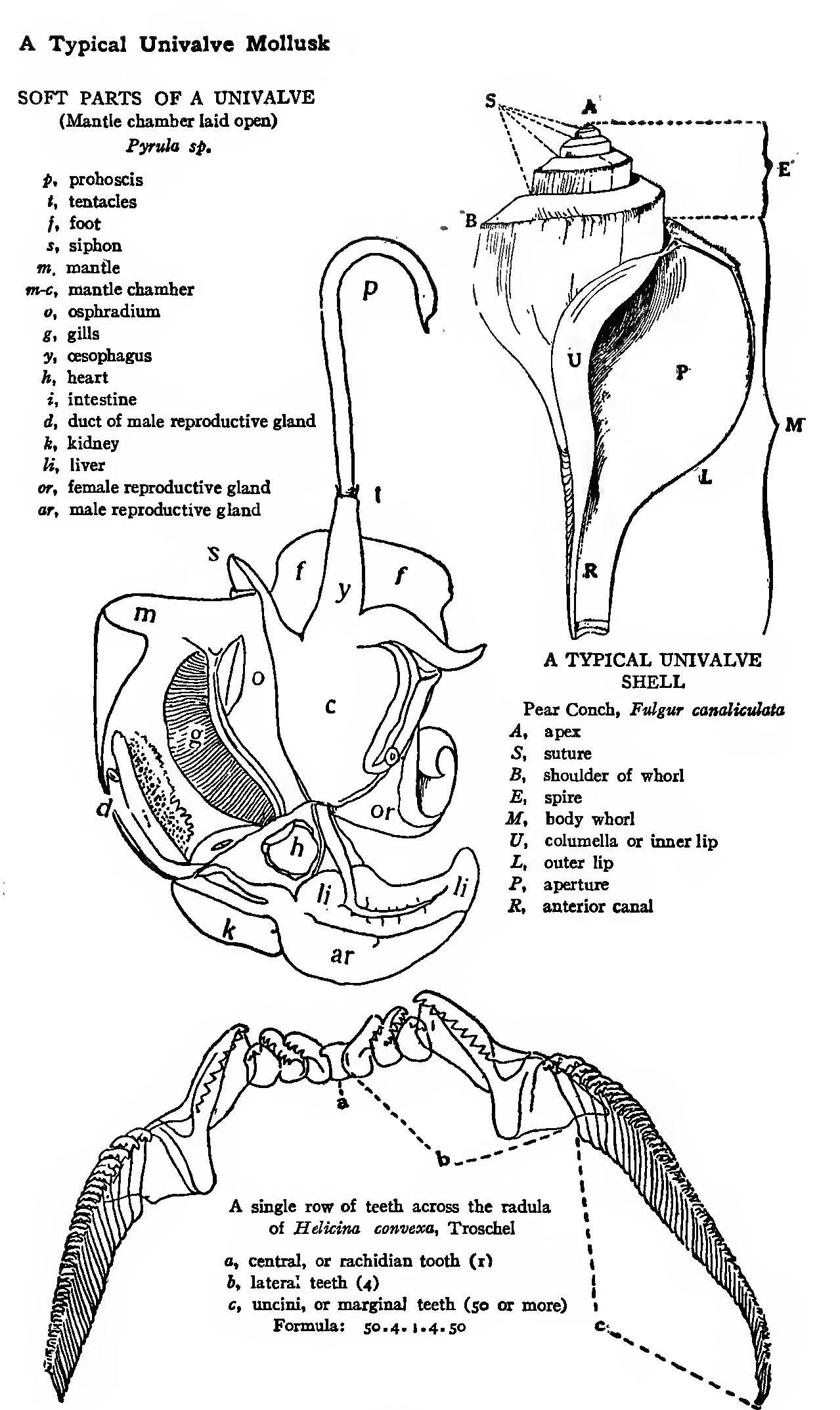
The siphon is a tubular prolongation of the mantle, which fits into the anterior canal. The muscular organ that bears the operculum is the foot. The pedal gland opens on the sole, or disc of the foot. An anterior fold of the mantle border forms the head. A central, retractile prolongation, the proboscis, contains the radula—odontophore or rasping tongue—a flexible band set with many transverse rows of teeth, which may be seen protruding from the mouth, at the tip. The central rachidian tooth in each row is flanked by the laterals; on the borders are the marginals or uncini. On each side of the head is an erect trian gular projection, the tentacle; each bears a dark eye on the outer edge.
The rounded arch of the body is the visceral dome. The mantle, transparent and thin here, forms the wall of the body. Through it various internal organs are visible. In the first two coils from the apex is a dark mass, the liver. The reproductive gland, brown, red or yellow, overlies the dorsal surface of the liver. The stomach, curved, light-coloured, often indistinctly seen, is just under the surface and overlies the liver on the left. The kidney, somewhat rectangular, yellowish brown to chocolate coloured, lies on the left side, anterior to the reproductive glands. The yellowish, two-chambered heart lies in a triangular sac, the pericardium, anterior to the kidney.
In females a large yellow nidamental gland lies over the back of the visceral dome, and along the side of the columellar muscle, which fastens the body to the shell. In front of the heart, and extending its overlapping plates into the mantle cavity, is the large, brown gill. The osphradium is a small brownish organ to
the left of the anterior end of the gill. To the right of the gill is the hypo-branchial gland.
Slitting open the mantle straight backward along the right side of the gill, and turning back the flaps, the mantle cavity lies open. Here on the right side is the anus, the opening of the intestine, on a short papilla. The opening of the nidamental gland is near by on another papilla, to the right and in front of the anus. The corresponding gland in the male is the testis. The large external male organ which resembles the proboscis, but is shorter, rises on the head behind the right tentacle. The 23 A Typical Univalve Mollusk kidney discharges by a narrow slit easily found at the back of the mantle cavity.
The gills are thin and their tubular passages are lined with cilia which continually wave, creating an inward current of water from the mantle chamber. The siphon is always lifted into clear water, no matter if the foot is in the mud, for the water supply of the gills must be clean and constant. In the network of gill passages the oxygen in the water passes into the blood and the carbonic acid gas passes out in the stream of foul water discharged.
The Circulation of Blood.
— A vein which brings blood back pure to the heart is found along the left side of the gill. It turns downward at the posterior end of the gill and empties into the auricle. Another vein brings blood from the kidney. The gill receives blood from a vessel that borders its right side. This blood is gathered by smaller vessels from the mantle and from the glandular part of the kidney.
The blood is sent from the ventricle through a short trunk, the aorta, which gives off a large branch, the visceral artery. This branches and distributes blood to the visceral dome. Now the aorta turns downward and forward, enlarges to form the "secondary heart," close to the oesophagus. From this trunk arise several vessels that carry the blood to the foot, the head, the siphon and other organs.