The Soft
THE SOFT PARTS.— By severing the adductor muscles with a knife blade close to the left valve, and then breaking the liga ment, the soft parts of a live clam are revealed, lying undisturbed 305 A Typical Bivalve Mollusk in the right valve. The mantle spreads over everything. It lines each valve, and is attached to each along the pallial line. Outside this it hangs free as a thickened frill. At the posterior end of the body the two mantle edges unite to form two tubes.
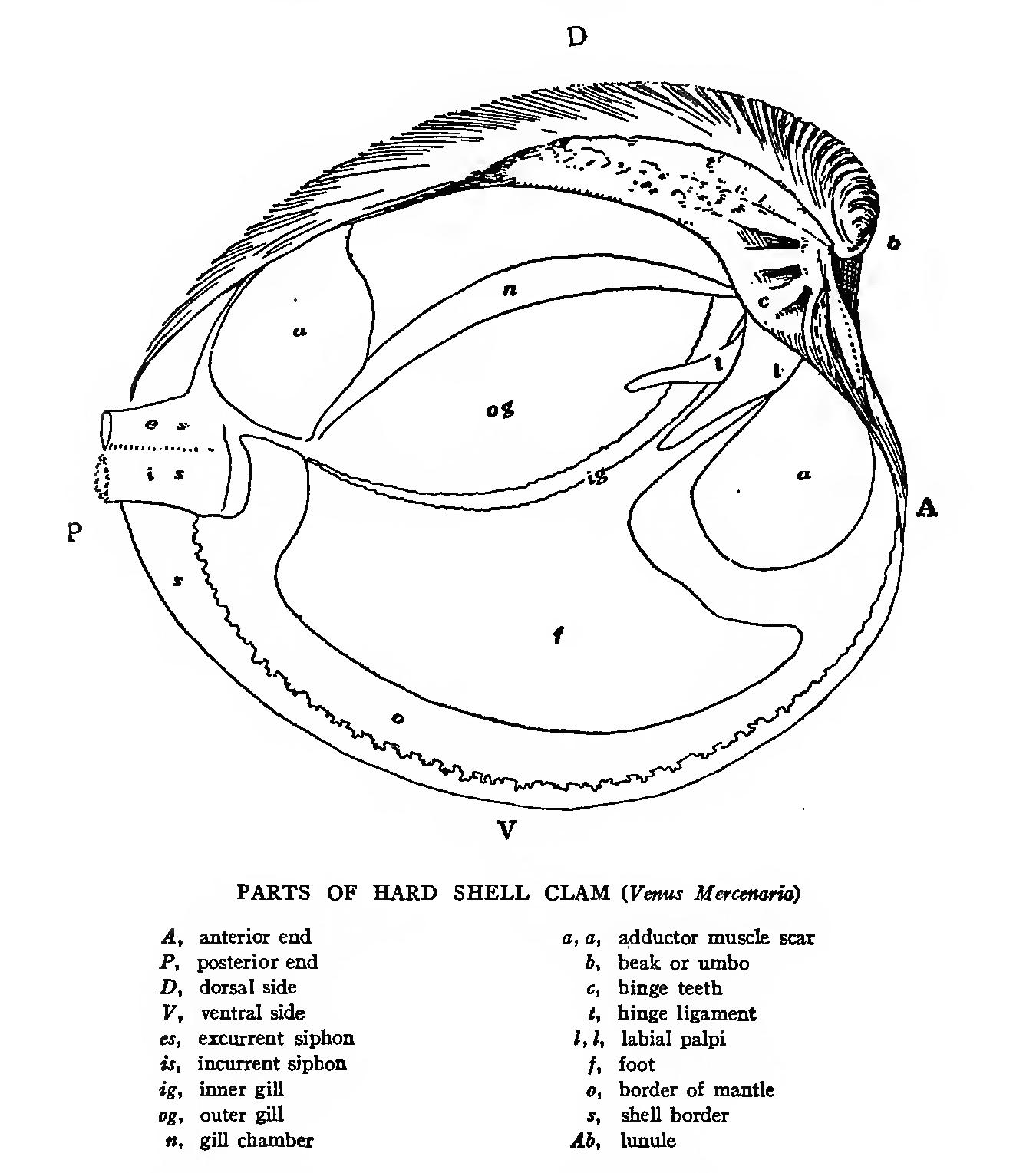
Through one, the incurrent siphon, water passes into the mantle chamber. Through the other, the excurrent siphon, water is discharged. When withdrawn these tubes occupy the pallial sinus. The siphons are always behind.
A Typical Bivalve Mollusk By throwing the mantle back over the dorsal margin of the valve, the left gills, two layers of brown plate-like membrane, of basket-work texture, appear. They are attached along their dorsal margins to each other, to the body underneath, and to the mantle above them. The right gills are like them. The central space between the two valves is occupied by the body of the clam, the visceral mass. Its ventral part is the oblique, muscular foot. Above the foot the kidney, liver, stomach and heart are embedded in the fleshy mass. At the anterior end two flaps, the labial palpi, conceal the mouth.
The bilateral symmetry of this mollusk is evident. The central body is flanked on each side by a pair of gills, a mantle and a hard valve. Right and left, the halves of the body are alike. In this particular the univalve exhibits a marked differ ence. Clams have no heads, no tentacles, no eyes.
The alimentary canal begins with the mouth, situated be tween the flapping palpi. There is no jaw nor radula. The muscular oesophagus widens into a pouched stomach, from which the intestine extends downward into the foot, and after several convolutions passes backward, through the heart, ending in the excurrent siphon. The liver surrounds a portion of the stomach.
The inner wall of the intestine is folded to increase its se cretory surface. In the stomach and intestine is found a gela tinous, transparent substance called the crystalline stylet, which often fills the space completely. Nobody knows the origin or the
use of this strange body. It may be a reserve store of food, partially digested. It dissolves gradually when food is withheld, and reappears when feeding is resumed. It may protect the stom ach walls from injury by sharp food particles. This is but one of many unsolved problems in molluscan anatomy. The digested food is absorbed by the veins in the intestinal walls.
Breathing and feeding are closely allied processes, for the inflow of water supplies the gills with oxygen and the stomach with food. The gills are four in number, and each consists of a double fold of delicate membrane. This membrane is composed of parallel gill filaments, united by connective tissue, bent back upon itself and stayed with cross bands between the two walls of the single gill. An intricate system of fine vessels distributes the blood through the gill substance, and an equally efficient sys tem of tubes and pores admits water, so that the interchange of 307 A Typical Bivalve Mollusk oxygen and carbonic acid gas goes on over an area greater many fold than the visible surface of the gills.
Microscopic, transparent cilia, like the pile of velvet, stand erect on every part of the gill that comes in contact with the water. These hairs have the property of rhythmic wave motion, stroking strongly inward at the mouth of the incurrent siphon, and urging the water steadily through the complex channels of the gill substance. The stream, polluted by waste, makes its exit through the other siphon.
All the food the clam gets accumulates in the groove between the gill plates, and, too coarse to get through the pores into the network of the gills, it is worked along by the cilia to the palpi, and enters the mouth. Small infusorians, diatoms, the eggs and young of many sea creatures, decaying organic matter — all is grist for this mill. The clam does not choose its diet, but takes what comes its way. No need for teeth nor jaw. The digestive fluids prepare the food for use.