The Top Shells and Dolphin Shells - Family Trochiae
Habitat.— California.
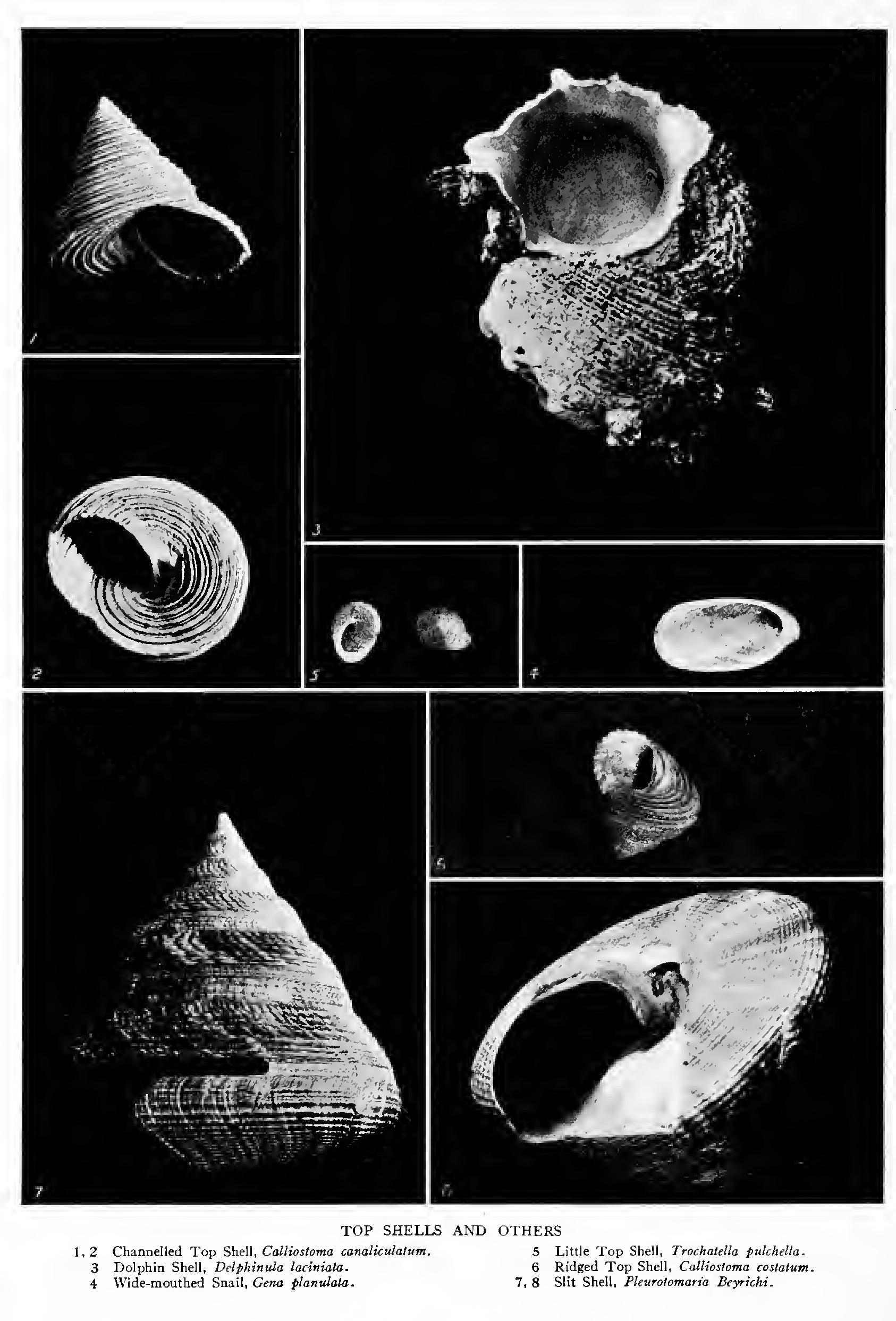
The largest American species is C. canaliculatum, Martyn, an inch and a half high. It is conical; its revolving ribs sharp edged and separated by spiral canals, which, however, are not purple. The ribs are pale yellow or ashy, the depressions brownish.
Habitat.— Pacific coast.
The Blue Top Shell (C. costatum, Martyn) is the abundant species along the northern Pacific coast. It is conical, with a sharp apex, rounded whorls and flattened base. The whorls are ornamented by parallel yellow riblets separated by brown depressions. The aperture is round and beautifully pearly; the columella simple.
This shore-dwelling species has a heavy shell. A dilute acid bath and a scrubbing removes the outer layer and exposes the blue pearl that forms the shell substance. The living mollusks crawl on rock surfaces exposed by the tide, but remain in the dark if possible. Length, I inch.
Habitat.—California northward.
C. gemmulatum, Cpr.,
is wound with strings of granules, each whorl bearing two principal rows, and many small ones. The gray surface is streaked with dark brown from the apex downward. Height, inch.
Habitat.— Southern California.
Several recently named species have been discovered by collectors dredging in deep water off the California coast. All are easily recognisable as top shells by their characteristic form.
The Pearly Top Shell (C.occidentale, Migh. and Ads.) of the Maine coast is strongly ribbed, with a row of white dots ornament ing the pearly surface of the upper half of each whorl. It is but half an inch long, and is only obtained by dredging in gravel off shore.
The Top Shell of Florida and the Carolina coast is C. euglyp tum, A. Ads., a regular pyramid, inch high, with a solid 217 The Top Shells and Dolphin Shells columella. The surface is white overlaid with brown and purplish spots; the ribs set with rows of small white enameled beads. It occurs as far north as Cape Hatteras, and follows the coast to Texas and Vera Cruz.
Many other species occur on our Atlantic coast, but they are either rare or are deep sea forms, not often collected.
C. granulatus,
Born., of European seas is a thin, delicate species, with exceedingly sharp peak, inflated base, and whorls closely sculptured by thread-like riblets; those next to the sutures are .set with fine beading, which gives the surface a granularappearance. It is also shiny, with pinkish ground freckled with brownish yellow. The pearly substance is easily exposed by rubbing off the outer layer with a rag dipped in dilute acid. An inch or more in altitude, it is the largest granular species to be found in Europe.
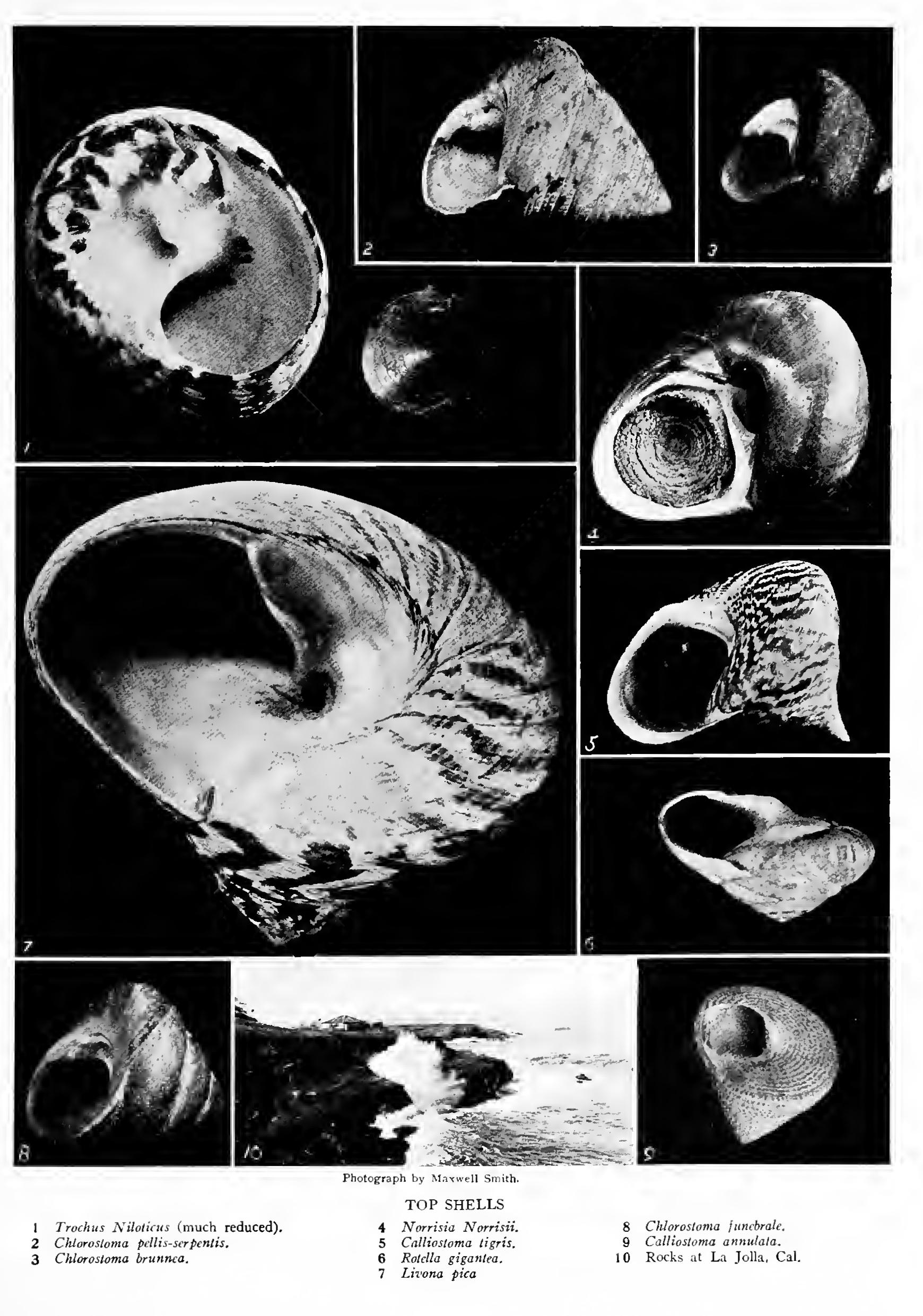
The Tiger Top Shell (C. tigris, Martyn) is two inches in altitude, and banded with tawny colour on the paler and fine granular whorls. It has .a depressed spire with an abruptly sharp point, and flares at base into an unusually large body whorl. The bright colouring and striking pattern of the shell will keep it always a cabinet favourite. New Zealand, Australia.
Genus MARGARITA, Leach Shell very small, thin, depressed, globose, with smooth or cross-striated whorls; aperture circular.
The Wavy Top Shell (M. undulata, Sby.) is a tiny mollusk, scarcely I inch high. 1 t exists in quantities along the New England coast where it is appreciated as an edible mollusk by the codfish and its relatives. It is abundant in their stomachs at various seasons. At times of very low tide the collector may look for this species among the rocks of sheltered coves. The flattened dome is made of four rounded reddish whorls. The columella has a deep, wide umbilicus; the body whorl has many folds along its outer edge.
M. cinerea,
Couth., is a tiny dull greenish shell with fine lines on the lower edge of the square-shouldered whorls and strong ridges on the upper edge. Very fine and close-set oblique lines cross the ridges throughout. It is found from Cape Cod north ward in shallow water.
218 The Top Shells and Dolphin Shells M. helicina, with thinner, more bulging shell, is found on northern coast, feeding on the green Laminaria leaves. Its shell is very small, •about inch in two dimensions, distinguished by its yellowish or olivaceous colour and iridescent, metallic lustre.
Habitat.— Maine, Alaska and northern Europe.