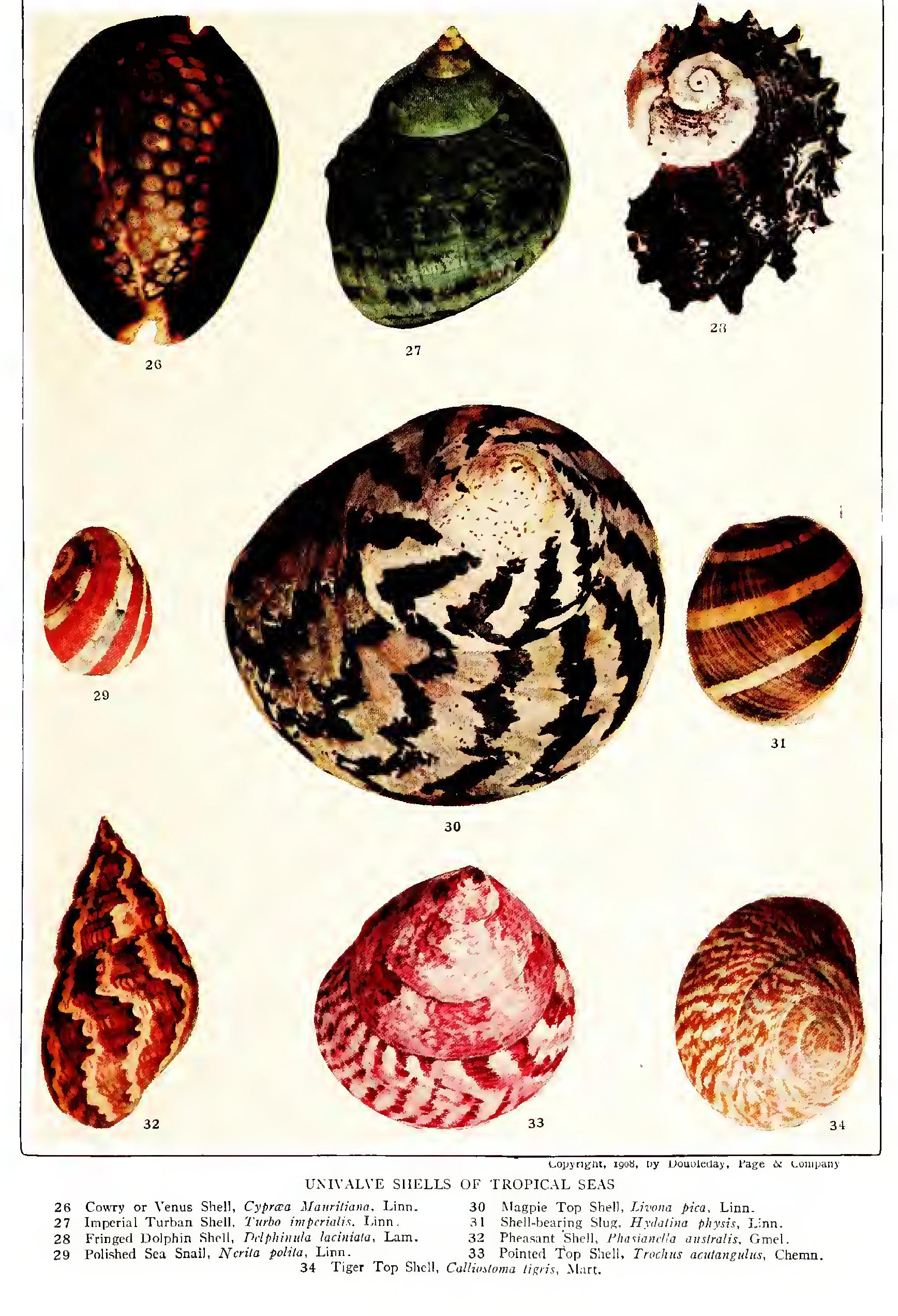
The Turban Shells and Star Shells - Family Turbinidae
210 The Turban Shells and Star Shells T. fluctuosa, Wood, of the west coast, is about two inches high and perhaps a trifle wider. Outside of the pearly shell is a thin coloured layer, brown and white in a bright tesselated pat tern, moulded over the sculpturing which consists of fine spiral and radiating ridges and rows of faint nodules on the shoulders of the whorls. The operculum is deeply cut, as described above.
Habitat.— California.
Genus POMAULAX, Gray Shell large, conic, solid, imperforate; periphery keeled; base flat ; operculum obovate.
The Wavy Pomaulax (P. undosum, Wood) is one of the large shells of the California coast. An altitude of five inches and diameter of six inches is not unusal, though the average is lower. A horny epidermis made of fine overlapping lamina covers the shell to its aperture. It is moulded over a series of nodules that form a ridge like a twisted cord at the outer edge of each whorl. The face of the whorl is further decorated with regular rows of fine knobs and folds. The shell has a thick pearly lining. The shelly layer is pale tinged with brown under the epidermis. The columella has a pearly crescentic groove. Cleaned with acids these pearly top shells are sold at good prices to tourists.
P. inequale,
Martyn,is similar to the last species but smaller, with close, uniform oblique folds crossing all its whorls, and the "twisted cord" at the periphery of each less prominent. The surface is brick red when alive. The base is deeply cut between close spiral ridges. Aperture smooth, lined with white; columel lar edge curved, pearly, ending in a tooth below. This species is 2 inches high and 21 inches in diameter.
Habitat.— Vancouver Island southward.
Genus ASTRALIUM, Link Shell conical, flattened above and below; young individuals depressed, keeled and spiny at periphery; operculum oval, spiral.
The Star Shell (A. longispina, Lam.) of the West Indies, has a flattened cone, and triangular, hollow spines all around its thin outer edge, and following the coils toward the apex. The flat base is sculptured by thin laminar, radiating from the deep umbilicus. The whorls above have beside the large projecting sutural spines a thick sprinkling of recurved hollow tubercles.
The Turban Shells and Star Shells The colour is dirty white, texture calcareous, aperture pearly lined; the operculum is smooth, white, rounded, with a depres sion in one side. Height, I inch; diameter, 2 inches.
Var. spinulosum, Lam., is found on the Florida coasts. It has a higher cone than the typical longi spina, has no umbilicus, and its spines, tubercles and the basal lamina are much reduced in size. The average specimen is 1 inches in altitude, and 2 inches across the base, but the ratio of height to diameter is variable. The specimens examined are decorated with brownish streaks and speckles.
A. latispina,
Phil., is a high cone, armed with triangular spines of small size along the outer margins of the whorls, and short, oblique ridges between. The dull white surface is streaked with brown and yellow. The base has spiral ridges crossed by fine striae. This species is II- inches high and 2 inches in diameter.
H abitat. —Gulf of Mexico to Rio de Janeiro.
Sub-genus LITHOPOMA A section of Astralium containing very solid, turban-shaped shells, with the whorls radiately folded or plaited, and the peri phery rounded or keeled.
The Stone Apple (A. tuber, Linn.) is a heavy turban-shaped shell, distinguished by the regular diagonal plaiting of ridges and valleys that alternately follow down its whorls. The colour follows the plan of sculpture; the valleys are dark, the elevations light. Brown and pale green overlie the dirty white ground colour. The base is paler and has finer markings. A little rubbing exposes the pearly interior substance.
A character that keeps this species in the genus Astralium is the presence of spinous processes around the periphery of young shells; these ultimately wear off. Elsewhere. in the genus Turbo, such processes become more prominent as growth proceeds.
This West Indian shell occurs on East Florida beaches. It attains an altitude of two inches and an equal diameter.
A. Americanum,
Gmel., is of the same stony group, but with a still higher cone. The diameter of 1 to I inches is generally a trifle less than the altitude. The whorls are keeled on the outer edges; oblique folds cross them, and end in a row of nodules on the keels.
Habitat.— Florida Keys and throughout the West Indies.
212