Linn 2 Genus Carpinus
2. GENUS CARPINUS, LINN.
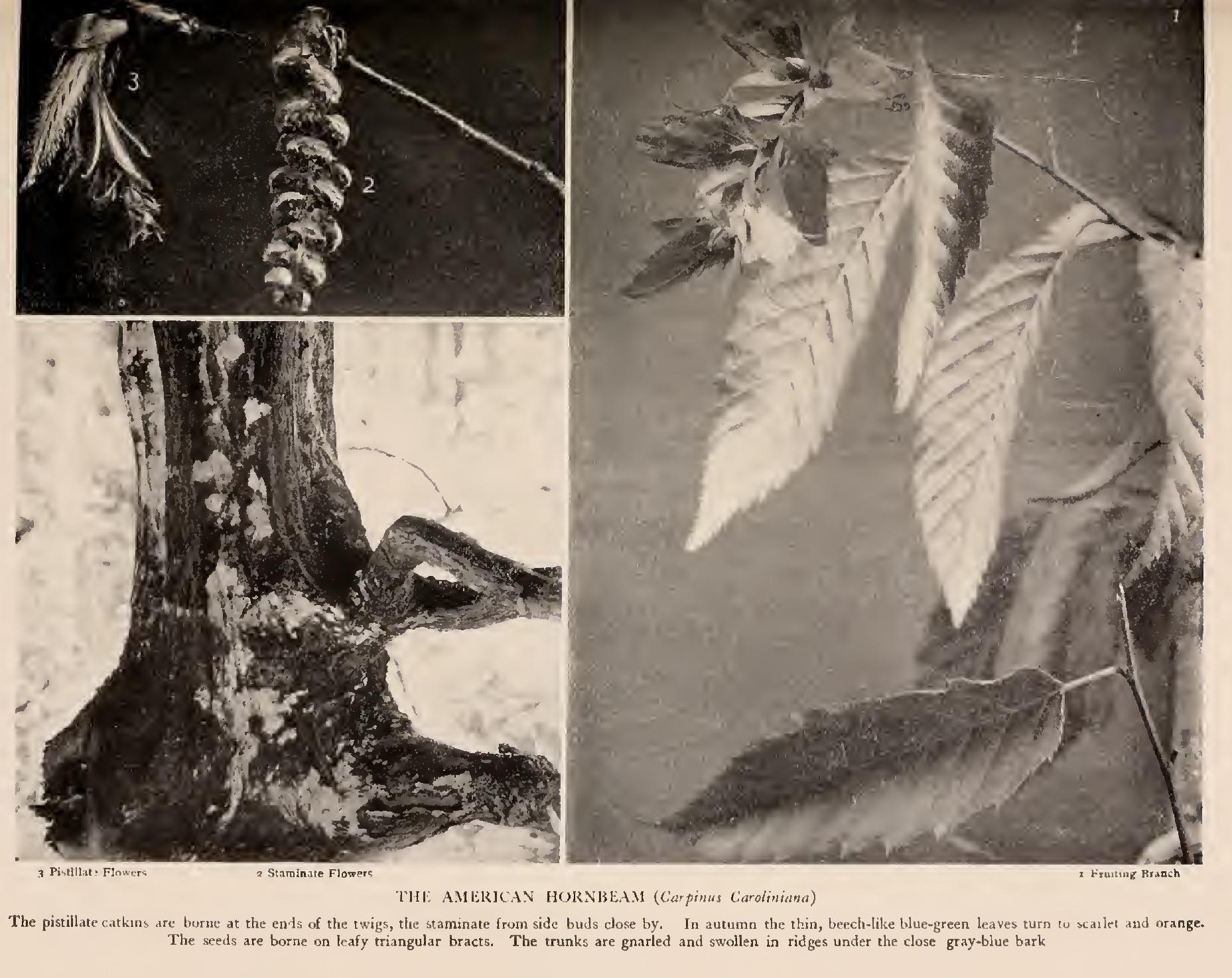
American Hornbeam, Blue Beech (Carpinus Carolini ana, Walt.)—Small, shapeless tree with irregular limbs, often pendulous, and slender, wiry twigs. Bark furrowed at base of trunk on old trees; smooth, bluish grey above, swollen as by veins underneath the bark; twigs brown. Wood light brown, heavy, hard, strong, fine, hard to work. Buds all lateral, ovate, small, brown. Leaves ovate-oblong, long pointed, irregularly doubly serrate, often unequal at base, dull green, pale beneath, orange or scarlet in autumn; hairy petiole and veins. Flowers moncecious, with leaves, in April; staminate catkins, I+ inches long, pendulous, lateral; pistillate flowers in racemes, terminal, loose flowered, with forked red stigmas under green scales. Fruit racemed, hard nutlets in pairs, each supported by a large, leaf-like, 3-lobed bract. Preferred habitat, swampy rich soil near streams, in shade of taller trees. Distribution, Georgian Bay (southern Canada) to Florida; west to Minnesota and Texas; also in Mexico and Central America. Uses: Curious and inter esting tree for planting along watercourses, but rarely seen in landscape gardening. Wood used for tool handles, levers and ox yokes.
The American hornbeam has no "hop" in its name because its fruit has none. Each little seed in the terminal cluster has a mate on the other side of the stem, and all summer they have grown close together, back to back, generally crowding for more room. Each seed sits in the prow of a little boat, shaped like a red maple leaf, but hollowed like a scallop . shell. The wind finally loosens the hold of each, and for a time seed and boat hang by a thread. This breaks at last, and the little nut sails off at the will of the wind, to grow, if it falls in wet ground.
This hornbeam resembles Ostrya in many particulars—its leaves, its flowers, its delicate wiry twigs, its foliage, and the hard ness of its wood. It grows, too, in the shadows of other trees. The bark it is that sets the trees apart. This tree has bark like a young beech, a thin, smooth, blue-grey rind, that has strange flutings or vein-like swellings coursing up the trunk and out on the larger limbs. They remind one of the veins of a blacksmith's sinewy arm, or an athlete's. A trunk a foot in diameter at the base generally shows a few furrows, and some minor roughness near the ground, but above, the smoothness is unbroken.
The hornbeam grows often in thickets, sometimes as scattered, single trees, in marshy ground and along streams. It is a pretty tree, with blue-green leaves that turn to orange and scarlet in the autumn. It is coming into notice as an ornamental tree, now that people are learning that the best way to make a park is to do less levelling and filling, and plant in the lower ground trees and plants that choose such situations naturally.
The anguish of working in this wood was experienced by the early colonists, who appreciated its value. "The New England Prospect" says: "The Home bound tree is a tough kind of wood that requires so much paines in riving as is almost incredible, being the best for to make bolles and dishes, not being subject to cracke or leake." Heads of beetles, stocks, mill cogs, yoke timbers, levers—for such uses it is ideal wood.
The European Hornbeam (Carpinus Betulus, Linn.) ranges from Scandinavia and England to the Caucasus, and is a beautiful tree of no small note. The "hornbeams" of ancient ox yokes wore indefinitely, becoming as hard and smooth as horn. The trees grow in cold, forbidding situations, where most trees fail, and so serve as windbreaks and as covers of barren clay soil. The wood makes excellent fuel and charcoal, beside its special uses to the turner. In the old days of formal gardens, the horn beam was popular, for it suffered itself to be clipped with as much patience as the linden, the beech or the yew. It was a famous hedge tree. The Germans made fences by planting rows of the saplings leaning so that each two plants formed a cross. The bark was scraped at the point of intersection, and then the two were bound together with straw, until they grew fast to each other. Careful pruning made of this in a short time a beautiful and impenetrable wall. Miles of this fencing were seen in Evelyn's day. The Germans also planted the trees near the gates of the great cities, training their branches to cover arbours "for con venience of the people to sit and solace in." Travellers in Europe will find the hornbeam still much used as in earlier centuries.
China, Japan and India have native hornbeams; there are nine or ten species in all. The race is old—the rocks show fossils of extinct species that once inhabited western America.