Scop I Genus Ostrya
I. GENUS OSTRYA, SCOP.
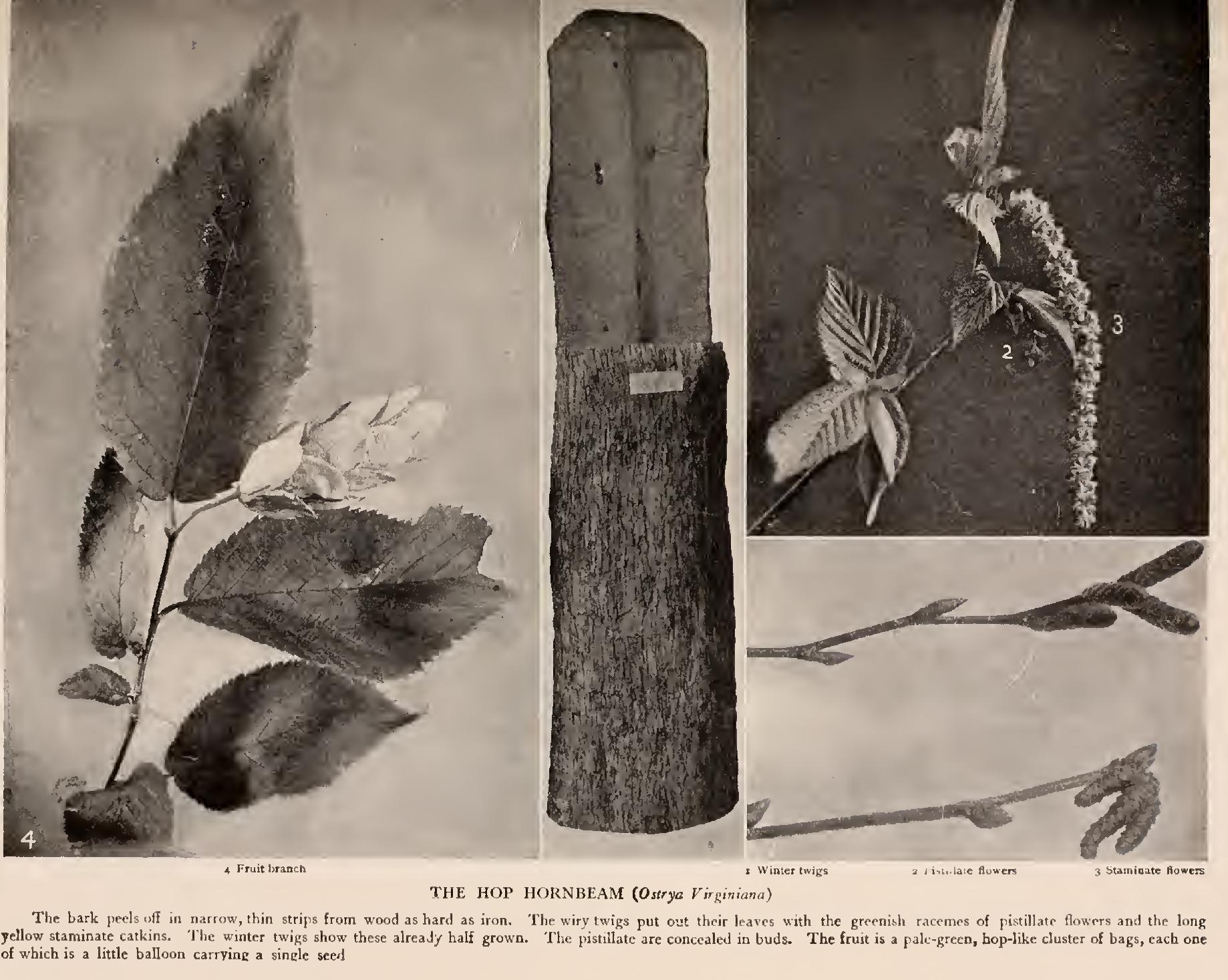
Hop Hornbeam, Ironwood (Ostrya Virginian, WiIld.)— Small, slender tree, with round head of stiff, wiry branches. Bark greyish brown, furrowed into narrow, scaly ridges, which break into small, oblong plates. Wood reddish brown, heavy, cross grained, tough, strong and hard to work. Buds lateral, ovate, acute, small, brown. Leaves ovate, acuminate, sharply and doubly serrate, 3 to 5 inches, thin, tough, dull yellow-green above, paler beneath; yellow in autumn; petioles sh Dm hairy. Flowers with leaves, April and May, moncecious; staminate in catkins formed previous season; pistillate erect, loose catkins, each flower surrounded by three united bracts. Fruit a hop-like cluster of inflated bags, formed of bracts, each containing a hard little seed. Preferred habitat, shady forest ground. Distribution, Nova Scotia to Black Hills; south to Florida and Texas. Uses: Wood used for mallets, levers and tool handles. Desirable for orna mental planting, but rarely used.
The hop hornbeam looks like a relative of the birches. Its leaves convey this impression, and slender limbs in winter bear green catkins that cluster in threes on the ends of twigs and wait for spring, just as the birch catkins do.
The bark of this hornbeam is thin and scales off in narrow strips whose surfaces are covered with squarish scales. The pale colour and the stripping of the bark reminds us of the shell bark—its shaggy strips reduced to a small scale. Among the branches the bark is smooth and close, and the twigs look like fine wires, springing out at right angles from the stem.
In spring the staminate catkins swing out, even as the birch flowers do, but the pistillate clusters have to be looked for. The red, forked tongues thrust out for pollen may be seen at the ends of leafy side shoots. Here the midsummer shows a hop like cluster of little pale green sacs, each with a shining seed inside.
The hop hornbeam is of a retiring disposition, preferring to hide in the .shadows of taller trees. But there is nothing dark or funereal about it. The leaves, bright and green, are held out in level platforms where they can get the sunbeams that trickle down to them. Then comes summer, and the pale green "hops"
make the tree a centre that seems to shed light into dark places. The little hop tree, Pielea frifoliata, is shining in its corner, and at a short distance the two trees might be confused. Each one is a blessed sight on a hot day, for pale green against dark green is always a cool colour scheme.
In the late autumn, after the leaves turn yellow and fall, the hops still hang, grudgingly giving up one little seed balloon after another to the insistent wind. There is likely to be a long sail for each one, and perhaps more than one, for until the bag is punctured and the seed covered, the wind gives it no rest.
The wood of the hop hornbeam is vexatious stuff for the turner, and whoever else tries tool upon it. But once it takes shape it lasts indefinitely. Sled stakes, levers, rake teeth, tool handles, wedges, do not soon need replacing if made of this material. It is equally satisfactory when used for fence posts.
The parks about Boston have beautiful specimens of the hop hornbeam, showing that its merits as an ornamental tree are being recognised by the best judges. The next step will be its increasing popularity for private grounds.
The Western Ironwood (0. Knowlioni), which was dis covered in Arizona but a few years ago, is smaller in every way than the Eastern species, but every trait proclaims it a hop hornbeam. The leaves, catkins and hops are short and blunt pointed. The protective pubescence which belongs to desert plants is on the young shoots and the leaves and fruits of this tree. Its limbs are often gnarled, but it forms a rounded sym metrical top, and is sometimes 3o feet high.
The tree is probably one of the rarest in the country, for as far as known it has not been found except in one locality, where it has formed a considerable grove. How this species has been cut off from its near relative in the East is a problem worthy of investigation.